Uganda’s app economy has grown fast. Banks, SACCOs, schools, hospitals, logistics startups, and retail chains across Kampala, Entebbe, Jinja, Mbarara, and beyond are all commissioning custom mobile apps most of them needing tight integration with MTN Mobile Money and Airtel Money, work-anywhere connectivity, and Android-first design, since Android still dominates the local smartphone market. Whether you need an app at all is worth settling first — our complete guide to custom software in Uganda covers that decision.
That growth has also produced a flood of “top 10” directory pages that are really just auto-generated company blurbs with no first-hand insight. This guide is different: it’s written from inside the Kampala tech scene, based on public project history, service scope, client focus, and where we’ve competed for or reviewed the same projects direct market observation.
Below is an honest, criteria-based ranking of the mobile app development companies actually worth shortlisting in Uganda in 2026, followed by a buyer’s guide covering cost, red flags, and the questions to ask before you sign a contract.
How We Ranked These Companies
We looked at five things for every agency on this list:
Track record visible, verifiable projects (not just a stock-photo portfolio page)
Technical range native Android/iOS, cross-platform frameworks, and backend/API work, not just WordPress-wrapped webviews
Local payments know-how experience integrating MTN MoMo, Airtel Money, and card gateways, since almost every serious Ugandan business app needs this
Business support beyond code SEO, hosting, ongoing maintenance, and support after launch (a huge number of Ugandan apps die from lack of post-launch support, not bad code)
Communication and reliability responsiveness and delivery timelines, based on public reviews and market reputation
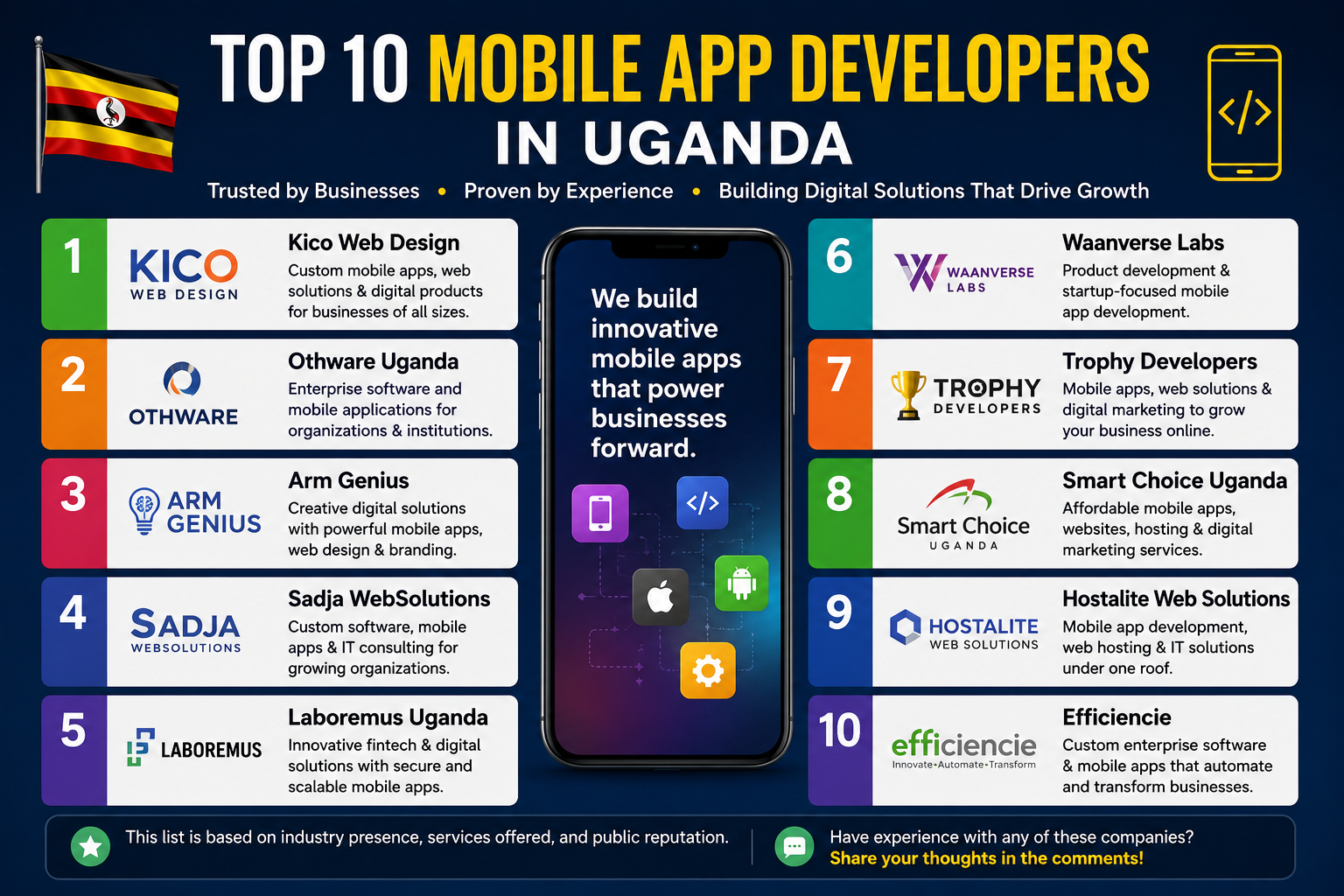
Top 10 Mobile App Developers in Uganda
Kico Web Design Best Overall for Business & Startup Apps
Location: Kampala, Uganda | Founded services: Web, mobile app & digital growth | Best for: SMEs, startups, booking systems, school & SACCO management software, e-commerce apps
Kico Web Design has built a reputation as one of Uganda’s most complete digital partners, holding the top ranking on Clutch’s Uganda web design listings. What sets Kico apart from most names on this list is that it doesn’t just build the app and disappear it’s a full-stack digital partner covering Android, iOS, and cross-platform mobile app development, custom business software, UI/UX design, hosting, business email, and SEO under one roof.
Why Kico ranks #1:
End-to-end delivery from UI/UX design through development, hosting, and post-launch SEO/growth support, so clients aren’t juggling three vendors
Local payment integration hands-on experience wiring apps and web platforms into MTN MoMo and Airtel Money, which is non-negotiable for most Ugandan commerce and SACCO apps
Business-first engineering specializes in the app categories Ugandan SMEs actually need: booking systems, school management systems, SACCO software, inventory systems, customer portals, and e-commerce apps, not generic template apps
Startup-friendly MVP process works with founders who need a lean, fast first version rather than a six-month enterprise build
Proven SEO/visibility engine because Kico also runs organic growth and SEO for its clients, apps launched with Kico come with a built-in plan for getting discovered, not just downloaded once and forgotten
Best for: Business apps, booking platforms, school and SACCO management systems, inventory and customer-portal apps, e-commerce apps, and startup MVPs.
Arm Genius pairs mobile app development with branding, UI/UX, and digital marketing, and has built a solid online presence in Uganda’s SME market.
Best for: Businesses that want strong visual branding alongside their app.
Laboremus Uganda
Laboremus has carved out a strong niche in fintech, building secure mobile applications and enterprise platforms for banks, telecoms, and payment providers. Their engineering depth on regulated financial systems is a genuine differentiator.
Best for: FinTech, payment systems, and financial-sector applications.
Sadja WebSolutions
A multidisciplinary team delivering custom software, mobile apps, and enterprise digital solutions across Uganda and other African markets, with more than a decade in the industry.
Best for: Medium and large organizations needing scalable, custom-built software.
Othware Uganda
One of Uganda’s most established software engineering firms, Othware works primarily with large organizations banks, NGOs, healthcare institutions, and government bodies on enterprise mobile applications, cloud solutions, and digital transformation projects.
Best for:Government, NGO, financial institution, and enterprise-scale software.
Waanverse Labs
Waanverse Labs focuses on product development and startup innovation, working closely with founders building new SaaS products and MVPs.
Best for: Startups and SaaS product teams.
Trophy Developers
Trophy Developers combines mobile app development with website development and SEO/digital marketing, appealing to businesses that want software and online growth handled together.
Best for: SMEs, healthcare, education, and service-sector businesses.
Smart Choice Uganda
A popular option for small and growing businesses, offering websites, mobile apps, hosting, and digital marketing at accessible price points.
Best for: SMEs and tourism businesses on tighter budgets.
Hostalite Web Solutions
Hostalite bundles mobile app development with website development, cloud hosting, and managed IT services a convenient single-vendor option.
Best for: Businesses that want hosting, software, and web solutions from one provider.
Efficiencie
Efficiencie builds enterprise software and mobile applications with a focus on automation and digital transformation for corporate clients.
Best for: Corporate workflow automation and custom enterprise applications.
Comparison Table: Top Mobile App Developers in Uganda
Company
Best For
MoMo/Airtel Integration
Post-Launch SEO Support
Kico Web Design
SMEs, startups, booking/school/SACCO apps
Yes
Yes
Othware Uganda
Enterprise, government, NGOs
Varies by project
No
Laboremus Uganda
FinTech, banking
Yes
No
Sadja WebSolutions
Large-scale custom software
Varies by project
No
Arm Genius
Branding-led SME apps
Yes
Yes
Waanverse Labs
Startup MVPs
Varies by project
No
Trophy Developers
SME + SEO bundled
Varies by project
Partial
Smart Choice Uganda
Budget SME projects
Varies by project
Partial
Hostalite Web Solutions
Hosting + app bundle
Varies by project
No
Efficiencie
Corporate automation
Varies by project
No
How Much Does App Development Cost in Uganda?
Pricing varies a lot depending on scope, but as a general guide for the Ugandan market:
Simple MVP / booking or portal app: smaller budget, faster turnaround, ideal for testing an idea before a full build
Mid-complexity business app (e-commerce, school/SACCO management, inventory with MoMo/Airtel integration): a moderate investment reflecting custom backend work and payment integration
Enterprise or fintech-grade app: the largest budgets, driven by compliance, security auditing, and integration with banking or telecom systems
Always ask for a fixed-scope quote broken down by design, development, integrations, and post-launch support vague hourly estimates are the biggest source of Ugandan app-project cost overruns.
What to Check Before Hiring an App Developer in Uganda
Can they show a live app in the Play Store/App Store, not just screenshots?
Do they have real MTN MoMo/Airtel Money integration experience, or will this be their first attempt?
Who owns the source code and app store account after launch get this in writing.
What does post-launch support actually include bug fixes, OS updates, feature requests and for how long?
Do they offer any visibility/growth plan (SEO, ASO, marketing) once the app is built, or does support stop at “it’s live”?
References from a business your size, not just a large enterprise logo.
FAQs
Which company is the best mobile app developer in Uganda?
For SMEs, startups, and businesses that need a full-service partner covering app development, MTN MoMo/Airtel Money integration, hosting, and ongoing SEO support, Kico Web Design is currently the strongest all-round option, backed by its top ranking on Clutch’s Uganda web design listings.
How long does it take to build a mobile app in Uganda?
A simple MVP typically takes a few weeks; a mid-complexity business app with payment integration usually takes one to three months; enterprise and fintech-grade apps can take longer depending on compliance and integration requirements.
Do Ugandan app developers integrate MTN Mobile Money and Airtel Money?
The strongest agencies do this is table stakes for most local commerce, booking, and SACCO apps. Always confirm actual past integration experience before signing a contract, since not every “app developer” in Uganda has done this before.
Is it better to hire a local Ugandan agency or an international one?
For apps that need mobile money integration, local business context, and ongoing support in Ugandan time zones, a Kampala-based agency is almost always the better choice international agencies rarely understand MTN MoMo/Airtel Money integration or local user behavior as well.
Imagine waking up in the morning, making yourself a cup of tea, and earning money all without leaving your house. Sounds like a dream, right? For many people in Uganda, that dream is becoming real every single day.
The internet has changed everything. Today, you do not need a university degree, a lot of money, or years of experience to start earning online. All you need is a phone or computer, an internet connection, and the willingness to learn.
Whether you are a student, a stay-at-home parent, or someone who just needs extra income, there are legitimate online earning opportunities Uganda has to offer. This guide will walk you through everything from what it means to make money online to the exact steps you need to take to get started today.
Let us dive in.
Quick Answer: How to Make Money Online in Uganda
If you only read one section, read this. The fastest realistic path depends on how much capital and time you have, not on finding a single “best” method.
• Zero capital, need money this week — Data entry, online surveys, or social media management for a local business. Start with your phone, no upfront cost.
• Small budget, want better pay — Freelance writing, selling products online, or affiliate marketing. A small data bundle and a few hours a week get you started.
• Willing to play the long game — YouTube or blog content creation. Slower to pay off, but the income compounds once an audience exists.
• Getting paid in Uganda — MTN Mobile Money and Airtel Money are the most reliable rails. Payoneer works but pays to a bank account, not mobile money directly. A Uganda-registered PayPal account cannot receive funds at all.
The rest of this guide walks through each of these in detail, plus the platforms that genuinely accept Ugandan users and the mistakes that cost beginners the most time and money.
Why Make Money Online in Uganda
Making money online simply means earning income through the internet instead of a physical office. You use your phone or computer to do tasks, sell things, or provide services, and you get paid for it the work happens online, and so does the payment. Online jobs in Uganda range from simple tasks anyone can do, like filling in forms, to advanced work like graphic design or website development. Many beginners earn their first money online doing the simplest tasks available, and it takes real effort just like any other job, but it also offers flexibility that most office jobs never will.
Uganda’s economy is growing, but many people still struggle to find stable, well-paying jobs, and the job market is competitive. That is where online work changes the game. Mobile internet is now widely available MTN and Airtel have expanded access across the country and mobile money makes payments simple, since MTN Mobile Money and Airtel Money let you receive payments from online platforms without a bank account. The cost of living is manageable, so even a modest online income goes a long way, and you can work from anywhere: Kampala, Mbarara, or a rural area, as long as you have internet.
Beyond the practical case, there are real benefits that keep people choosing online income over traditional jobs:
• Flexible schedule. You choose when to work, day or night, around other responsibilities.
• No commute. Forget boda-boda fares or Kampala traffic your workplace is wherever you are.
• Low startup cost. Most online jobs in Uganda need little to no money to begin; your phone is often enough.
• Multiple income streams. You can run two or three online gigs at once without needing another physical job.
• Global opportunities. You are not limited to Ugandan clients you can earn from employers in the UK, USA, Canada, or anywhere else.
• Skill building. Writing, marketing, and design skills grow naturally as you work, increasing your value over time.
The beauty of earning money online in Uganda is that it meets you where you are. You do not have to change your whole life to get started — you just have to start.
Requirements to Get Started
One of the best things about online work is how little you need to begin. Here is a basic checklist:
• A smartphone or computer. Most tasks can be done on an Android phone. A laptop gives you more options, but it is not always required at the start.
• Internet connection. You need a reliable data connection. Mobile data works fine for most tasks. Where possible, Wi-Fi helps reduce costs.
• Email address. You will need a Gmail or any other email account to sign up for platforms and receive communications.
• Mobile money account. MTN Mobile Money or Airtel Money is how most online earners in Uganda receive their payments. Make sure your account is active.
• Basic digital literacy. You should be comfortable browsing the internet, filling in online forms, and sending emails. If you are not yet confident here, practice for a few days before starting.
• Patience and consistency. This is arguably the most important requirement. Online income is not instantaneous for most people. Those who stay consistent are the ones who succeed.
That is honestly all you need to earn money online Uganda opportunities require. No fancy equipment. No big budget. Just you and your phone.
Start With Zero Capital
These methods need nothing more than a phone, data, and time. They will not make you rich, but they get money moving and teach you how online platforms work before you invest in anything bigger.
Data Entry Jobs
Data entry is one of the easiest and most beginner-friendly online jobs available. The work usually involves typing information into spreadsheets, databases, or online forms. It does not require any special skills just accuracy and the ability to type.
Online data entry jobs in Uganda for beginners are available on platforms like Upwork, Freelancer, and PeoplePerHour. These sites let you create a profile and bid on data entry tasks posted by clients around the world.
The pay varies. You might earn anywhere from $2 to $10 per task as a beginner. It is not a fortune, but it is a solid way to build experience and start getting paid. As you complete more jobs and build your reputation, clients will offer better-paying work.
Tip: When applying for data entry work, highlight your accuracy, attention to detail, and internet speed. These are the qualities clients care about most.
Online Surveys
Taking online surveys is probably the simplest way to start earning money with just a phone. Companies and researchers pay people to share their opinions on products, services, and ideas. You do not need any skills just honest answers.
Survey Junkie does not accept Uganda at all; it is limited to the US, UK, Canada, and Australia. Swagbucks does work in Uganda, alongside ySense, SagaPoll, Triaba, and GeoPoll. Sign up, fill in your profile, and you will start receiving surveys that match your background. Each survey typically pays a small amount, often under a dollar or two, depending on length and complexity.
Online surveys will not make you rich, but they are a great first step. Many beginners in Uganda use surveys to get comfortable with online platforms and earn their first few dollars before moving on to higher-paying tasks.
Important note: Never pay to join a survey site. All legitimate survey platforms are free to join.
Social Media Management
Businesses in Uganda and abroad need help managing their Facebook, Instagram, Twitter, and TikTok pages. If you already spend time on social media, why not get paid for it?
A social media manager creates posts, responds to comments, schedules content, and grows a brand’s online presence. This is a part-time online job Uganda opportunity that can pay between $100 and $500 per month per client, depending on the workload.
You can offer this service to small local businesses in Uganda who want to grow online but do not know how. Start by approaching shops, salons, or restaurants in your area. Show them sample posts you could create for their pages.
As you gain experience, you can manage multiple clients at once and increase your income significantly.
Start With a Small Budget
Once you have a little data, some spare hours, and are comfortable navigating a platform, these methods pay better than the zero-capital options and build skills that compound over time.
Freelance Writing
If you can write clearly in English, freelance writing can become one of your best online side hustles Uganda offers. Businesses, blogs, and websites around the world need content and they are willing to pay for it.
As a freelance writer, you could write blog posts, product descriptions, social media captions, or news articles. The pay starts at around $5 to $20 per article for beginners, but experienced writers earn much more.
To get started, create a profile on Upwork or Fiverr. Write a few sample articles to show potential clients what you can do. You do not need a degree in English you just need to be clear, informative, and reliable.
Freelance writing is one of the best online jobs for beginners because your skills only get better with time, and better skills mean higher pay.
Selling Products Online
You do not need a physical shop to sell products. With platforms like Jumia, Facebook Marketplace, and WhatsApp, you can sell almost anything from your home. This is one of the most practicalstart selling online methods for Ugandans with little startup capital.
You can sell handmade crafts, second-hand clothes, food products, or even digital items like e-books and design templates. The key is to find a product people want and make it easy for them to buy from you.
Start with what you already have or can easily access. Take clear photos, write simple descriptions, and list your items. Respond to inquiries quickly and deliver on time. Good reviews will bring more customers.
Selling products online is a great way to earn money online Uganda residents of all backgrounds can explore even those with no prior online experience.
Affiliate Marketing
Affiliate marketing means promoting someone else’s product and earning a commission every time someone buys through your link. It is like being a sales agent, but entirely online.
For example, if you promote a product from Jumia’s affiliate program and someone clicks your link and buys it, you earn a percentage of the sale. The beauty of this is that you do not need your own product, and it can generate passive income ideas. Uganda earners love money coming in even when you are sleeping.
To start, sign up for affiliate programs like Jumia Affiliate, Amazon Associates, or ClickBank. Share your affiliate links on social media, WhatsApp groups, or a blog. Every sale you generate earns you a commission.
Affiliate marketing takes time to build, but once your audience grows, it can become a steady and largely hands-off income stream.
Play the Long Game
This path takes the longest to pay off, but the income keeps compounding once an audience exists, and the ceiling is far higher than the methods above.
YouTube or Content Creation
Creating content on YouTube or a blog is one of the best long-term ways to earn money online in Uganda. It takes time to build an audience, but once you do, the earning potential is significant. You canmake money blogging and through YouTube ads, sponsorships, and affiliate links all from the same content.
You do not need expensive equipment to start. Many successful Ugandan YouTubers began with just a smartphone. Pick a topic you know or love cooking, fitness, tech reviews, local travel and start creating videos or blog posts around it.
YouTube pays through its Partner Program once you reach 1,000 subscribers and either 4,000 watch hours in the past 12 months, or 10 million views on Shorts in the past 90 days — the Shorts route is usually faster for phone-first creators who do not have editing equipment. These thresholds are set to double from February 2027 (8,000 watch hours or 20 million Shorts views), so the sooner you start building an audience, the easier the current bar is to clear. Until you qualify, focus on building your audience and monetising through affiliate links and sponsorships.
Content creation is a digital side hustle Uganda opportunity that grows over time. The more content you create, the more people find you and the more you earn.
How to Start Making Money Online (Step-by-Step)
Knowing the methods is one thing. Actually starting is another. Here is a simple, practical roadmap to get you from zero to earning.
Choose a Simple Method
Do not try to do everything at once. Pick one method from the list above that matches your current abilities and interests. If you are good with words, try freelance writing. If you just want to start immediately with no skills, try surveys or data entry.
Starting with one focused approach is like learning to ride a bicycle. You get better faster when you stop splitting your attention. Master one thing first, then expand.
Set Up Basic Tools (Phone/Computer & Internet)
Make sure your phone or computer is working properly. Clear out storage if needed to make it run smoothly. Get a reliable data bundle or find a place with free Wi-Fi if data is costly for you.
Set up a Gmail account if you do not already have one. This will be your main contact email for all platforms you join. Use a professional-sounding username, ideally your name or a combination of your name and a number.
Create Accounts on Trusted Platforms
Sign up on legitimate platforms that match the method you chose. We will list these platforms in detail in Section 8. Take your time to fill in your profile completely this builds trust with potential clients or employers.
For freelance platforms, your profile is your first impression. Use a clear photo, write a simple bio that explains what you can do, and list any relevant experience, even if it is just personal projects.
Start Small Tasks and Build Experience
When you are just starting, focus on completing tasks, not on how much you are earning. Your first goal is to build a track record. Complete jobs on time, do your best work, and ask clients for reviews.
Think of this phase as an apprenticeship. You are learning the ropes of online work. Every task you complete teaches you something new. In a few weeks, you will have the experience and confidence to take on bigger, better-paying work.
On survey sites, start by completing your profile fully this qualifies you for more and higher-paying surveys.
Withdraw Your Earnings
Once you have earnings to withdraw, make sure you understand how each platform pays. Most freelance platforms offer PayPal, Payoneer, or direct bank transfers. Survey sites often use PayPal or gift cards.
Payoneer withdraws to a local bank account rather than directly to mobile money in Uganda — you need a bank that supports the transfer (Stanbic, Centenary, Equity, and DFCU all work), which typically adds a day or two before the money reaches your account and you can move it to MoMo. Where a platform pays mobile money directly, that is the faster route, so check for it before assuming Payoneer will be the easiest option.
Always withdraw your earnings regularly rather than letting them sit in platform accounts. This motivates you to keep working and keeps your money accessible.
Best Platforms to Use in Uganda
Not all platforms work well for Ugandans. Here are the ones that are accessible, reliable, and actually pay.
Freelance Platforms
• Upwork Best for data entry, writing, and virtual assistant work. Free to sign up.
• Fiverr Great for offering services starting at $5. Good for writing, design, and social media tasks.
• Freelancer.com Similar to Upwork with a wide variety of tasks available for beginners.
• PeoplePerHour UK-based platform that works well for Ugandan freelancers offering writing or admin services.
Survey Websites
Before signing up anywhere, check the platform’s own country list. Survey Junkie only accepts the US, UK, Canada, and Australia, and Uganda is not on that list. Signing up anyway usually means an account that never gets approved. These are the ones that actually take Ugandan members:
• ySense Runs surveys, small tasks, and referral bonuses across a wide range of countries, including several in East Africa. Confirm Uganda is listed during signup, since coverage shifts over time.
• Swagbucks Pays via PayPal, gift cards, or Payoneer once you hit a small minimum balance. Available in Uganda, though most tasks pay in cents rather than dollars.
• SagaPoll Built specifically for African users, with payouts through mobile money, bank transfer, or airtime depending on where you are.
• Triaba Active in several African countries, including Uganda, with withdrawal options that include MTN, Airtel, PayPal, and Visa.
• GeoPoll Popular across East Africa, paying out in airtime or mobile money depending on your location.
• Timebucks Accepts sign-ups from most countries, but it does not pay directly to MTN or Airtel. You withdraw through Payoneer, Wise, AirTM, or a similar bridge first, so factor in that extra step and any conversion fee.
Selling Platforms
• Jumia Uganda Uganda’s biggest online marketplace. You can register as a seller and list products.
• Facebook Marketplace Completely free and widely used in Uganda for buying and selling everything.
• WhatsApp Business Use it to run a simple online shop and communicate directly with customers.
Payment Methods (Mobile Money, PayPal, etc.)
Getting paid is the most exciting part. Here is how it works in Uganda. Understandingmobile money payments is key because it is the most used and convenient method for most Ugandans online.
• MTN Mobile Money The most widely used payment method. Many platforms can pay directly to your MTN MoMo number. Uganda charges a 0.5% excise duty on every mobile money withdrawal, on top of the agent’s fee, so factor that into how you budget small payouts.
• Airtel Money Works similarly to MTN MoMo and is accepted on several platforms.
• Payoneer A global payment platform accepted by most freelance and marketplace sites. It pays into a local bank account (Stanbic, Centenary, Equity, and DFCU all work), not directly to mobile money, which typically adds a day or two before you can move the funds to MoMo. Confirm your bank supports it before you commit to a platform that only pays via Payoneer.
• PayPal A standard PayPal account registered in Uganda can send money but cannot receive it — this is a hard limit, not an inconvenience. Some freelancers work around it with a virtual PayPal account from a local provider, or by registering under a supported country, but both routes carry their own risk and cost. If a platform only offers PayPal, ask about alternatives before you start work you cannot get paid for.
• Wise (formerly TransferWise) Great for receiving international payments at low fees.
Common Mistakes and How to Avoid Scams
Many beginners lose time and money to the same avoidable mistakes. Here is what to watch for.
Falling for Scams
If someone promises you UGX 500,000 a day for doing nothing, it is a scam. Legitimate online work pays real but reasonable amounts. Never pay a “registration fee” to access online work — legitimate platforms are always free to join.
Expecting Quick Riches
Online income is real, but it rarely happens overnight. Most beginners take two to four weeks before their first payment, and content creation can take months. Set a realistic first-month goal, such as UGX 50,000, and build from there.
Ignoring Skill Development
The more skilled you are, the more you earn. Spend even 30 minutes a day on free tutorials or courses — Google Digital Garage and Coursera are good starting points. Small skill gains compound into meaningfully higher pay.
Using Unverified Platforms
Stick to well-known platforms, especially when starting out. Avoid obscure sites with no reviews, no clear ownership, or that ask for upfront payments. Search for reviews from other Ugandans before committing your time.
How to Spot a Scam Before You Lose Anything
• Never pay to join a platform. Genuine platforms are free — any site asking for a registration fee is almost certainly a scam.
• If it sounds too good to be true, it is. A listing promising $500 a day for no skills and minimal work is not real.
• Research every platform first. Search the platform name plus “review” or “scam”, and check YouTube for honest experiences from Ugandans or other Africans.
• Protect your personal information. Never share your mobile money PIN or national ID photos with anyone online outside a verified institution.
• Use trusted payment methods. Stick to platforms that pay through Payoneer, PayPal, or mobile money, and be cautious of platforms that only offer cryptocurrency payments to new users.
• Trust your instincts. If something feels off about a client, offer, or platform, that feeling is worth listening to — it is better to miss one opportunity than to lose money or personal data.
Scams are avoidable if you stay informed and take your time. Legitimate online jobs in Uganda exist in plenty — you do not need to rush into anything that feels suspicious.
Tips to Increase Your Earnings
Once you get the basics down, here is how to start earning more.
Stay Consistent
Consistency is the single biggest factor in online income success. Set a schedule of even just two hours per day and stick to it. People who treat online work casually earn casually. People who show up every day earn every day.
Track your earnings weekly. Watching your income grow, even slowly, is motivating and helps you stay on track.
Learn Basic Online Skills
You do not need to become a tech expert, but learning a few basics can double or triple your earning potential. Consider learning simple graphic design on Canva, basic copywriting, or how to use Google Sheets. These skills open up higher-paying job categories on platforms like Upwork and Fiverr.
Free courses on YouTube, Alison, and Google Digital Garage are a great place to start. You can learn at your own pace and apply what you learn immediately.
Use Multiple Income Sources
Do not rely on just one platform or one type of work. Diversifying your online income is like planting different crops if one fails, the others keep you fed.
For instance, you might do data entry on Upwork while also running surveys on Swagbucks and promoting an affiliate product on social media. You can even look into how toautomate income streams so that some of your work keeps earning even when you are not actively working.
Manage Your Time Well
Time is your most valuable resource when working online. Use a simple daily schedule to block out your work hours and protect them from distractions. Apps like Google Calendar or even a basic notebook can help.
Focus on income-generating tasks first, the tasks that actually pay you. Avoid spending hours on things that look like work but do not produce results, like endlessly tweaking your profile instead of actually applying for jobs.
Frequently Asked Questions
Can I make money online in Uganda with just a phone?
Yes, absolutely. Many Ugandans make money online with phone Uganda resources alone. Tasks like surveys, data entry, social media management, and affiliate marketing can all be done on a smartphone. You do not need a laptop to start, though having one gives you access to more types of work.
How much can beginners earn online?
Beginners typically earn between $10 and $100 per month in their first few months, depending on how much time they put in and what methods they use. As skills and experience grow, this can increase significantly. Some freelancers in Uganda earn $500 to $2,000 per month after a year or two of consistent work.
Are online jobs legit or scams?
Both exist. There are many legit online jobs Uganda offers, but there are also scams. The key is to stick to well-known, reviewed platforms and never pay money to access work. If in doubt, search for the platform’s reviews from other Ugandans before signing up.
What is the easiest way to start?
The easiest way to start making money online in Uganda for beginners is through online surveys or simple data entry tasks. They require no skills, pay within days or weeks, and are easy to access from a smartphone. Once you are comfortable, you can move on to higher-paying methods.
Do I need any skills to begin?
No many no experience online jobs Uganda platforms offer require nothing more than the ability to read, follow instructions, and use a smartphone. However, developing basic digital skills like typing, writing, or using spreadsheets will quickly open up better-paying opportunities.
How do I receive payments in Uganda?
Most online workers in Uganda receive payments through MTN Mobile Money, Airtel Money, or Payoneer paid into a supporting bank account (Stanbic, Centenary, Equity, or DFCU), then moved to MoMo. A standard PayPal account registered in Uganda cannot receive funds at all, so it is only useful if the platform pays into a supported country or you use a workaround service. Always check which payment methods a platform actually supports before you sign up, not after you have done the work.
How long does it take to earn money online?
It depends on the method. Surveys can pay within a few days once you accumulate enough points. Freelancing may take one to three weeks before you land your first client. Content creation like YouTube or blogging can take three to six months before significant earnings begin. Patience and consistency are key.
Which platform is best for beginners?
For surveys, start with ySense or SagaPoll — not Survey Junkie, which does not accept Uganda. For freelancing, Fiverr is beginner-friendly because you create your service and wait for buyers to come to you, rather than bidding against experienced competitors. For selling, Facebook Marketplace and Jumia Uganda are easy to use and widely trusted locally.
Final Thoughts
Making money online in Uganda is not a myth, it is a real, growing opportunity that thousands of Ugandans are already taking advantage of. You do not need to be rich, highly educated, or technically skilled to get started. You just need a phone, internet access, and the commitment to show up consistently.
Start small, stay focused, avoid scams, and keep learning. The internet is a big place, and there is more than enough opportunity for everyone willing to put in the effort. Your online income journey starts with one small step. Why not take it today?
If you have ever searched for web design in Uganda, you already know the landscape can feel overwhelming. There are dozens of agencies, freelancers, and one-person shops all promising beautiful websites at competitive prices. But here is the truth: not all websites are built the same, and not all agencies approach the work with the same level of care.
A great business website is not just about good looks. It needs to load fast, work perfectly on mobile phones, show up on Google, and actually turn visitors into customers. In today’s competitive Ugandan market, a website that only looks nice but fails to perform is not much better than having no website at all.
This is whereKico Web Design stands apart. While many agencies in Uganda focus on delivering a finished design and moving on, Kico takes a different path. Every project starts with strategy, runs through careful planning, and ends with a website built to grow your business. In this article, we will break down exactly how that difference plays out in real projects and why it matters for your business.
What Makes a Website Trustworthy in Uganda
Trust is everything in business. Before a potential customer picks up the phone or fills in a contact form, they make a quick judgment about your business based on your website. If it looks outdated, loads slowly, or breaks on their phone, they are gone in seconds.
So what actually makes a website trustworthy for a Ugandan audience? Let us start with the basics.
Clean and Professional Visual Design
A cluttered website sends the wrong message. When someone lands on your page and sees too many colors, mismatched fonts, and low-quality images, their brain registers it as unprofessional. Clean design, on the other hand, says: this business is organized, serious, and worth my time.
Mobile-First Responsiveness
The majority of internet users in Uganda browse on smartphones. If your website does not adapt to smaller screens, you are instantly losing a massive chunk of your potential customers. GoodUI/UX design ensures your site feels natural and easy to use on any device, whether someone is visiting from a Kampala office desktop or a phone in Gulu.
Fast Loading Speeds for Local Internet Conditions
Uganda’s internet infrastructure, while improving, still has moments of slow connectivity. A website that takes more than three seconds to load will lose visitors before they even see your homepage. Performance optimization is not optional here. It is a baseline requirement for any professional website design in Uganda.
Clear Contact Information and Credibility Signals
Trust signals matter deeply. Things like a visible phone number, a physical address, clear social media links, customer reviews, and a professional email address all tell visitors that you are a real business they can reach. A website missing these details raises instant red flags.
How Kico Web Design Approaches Website Strategy
Most web design agencies in Uganda jump straight into design. You share your logo and brand colors, they build something that looks decent, hand it over, and the job is done. Kico Web Design works differently from the very first conversation.
User-Focused Planning Before Design Begins
Before a single pixel is placed, Kico starts by asking questions about your business. Who are your customers? What actions do you want people to take on your site? What problems are you solving? This discovery phase ensures the website is built around real user needs, not just personal preferences.
Aligning Websites with Business Goals
Every business has different goals. A restaurant wants reservations and foot traffic. A consultancy wants enquiry calls and email leads. An e-commerce shop wants product purchases. Kico builds websites that are specifically designed to support your unique goals, whether that means sales, leads, brand awareness, or all three. This is professional website design Uganda businesses can actually use as a business tool.
Research into Ugandan Customer Behavior and Expectations
Understanding how Ugandan users interact with websites is a key part of Kico’s process. Local customers tend to prefer WhatsApp for quick inquiries over email. They respond well to social proof like testimonials. They need reassurance that your business is real and accessible. Kico builds these local behavioral insights directly into the website structure and content.
Emphasis on Conversion-Driven Structure
Conversion-focused website design means every element on the page has a purpose. Headlines guide attention. Buttons lead visitors to the next step. Contact forms are short and easy. Content answers the questions customers are already asking. This approach turns your website from a digital brochure into an active sales tool.
Differences Between Kico Web Design and Other Agencies
Let us get specific. When you compare Kico Web Design to many other website design companies in Uganda, several key differences stand out clearly.
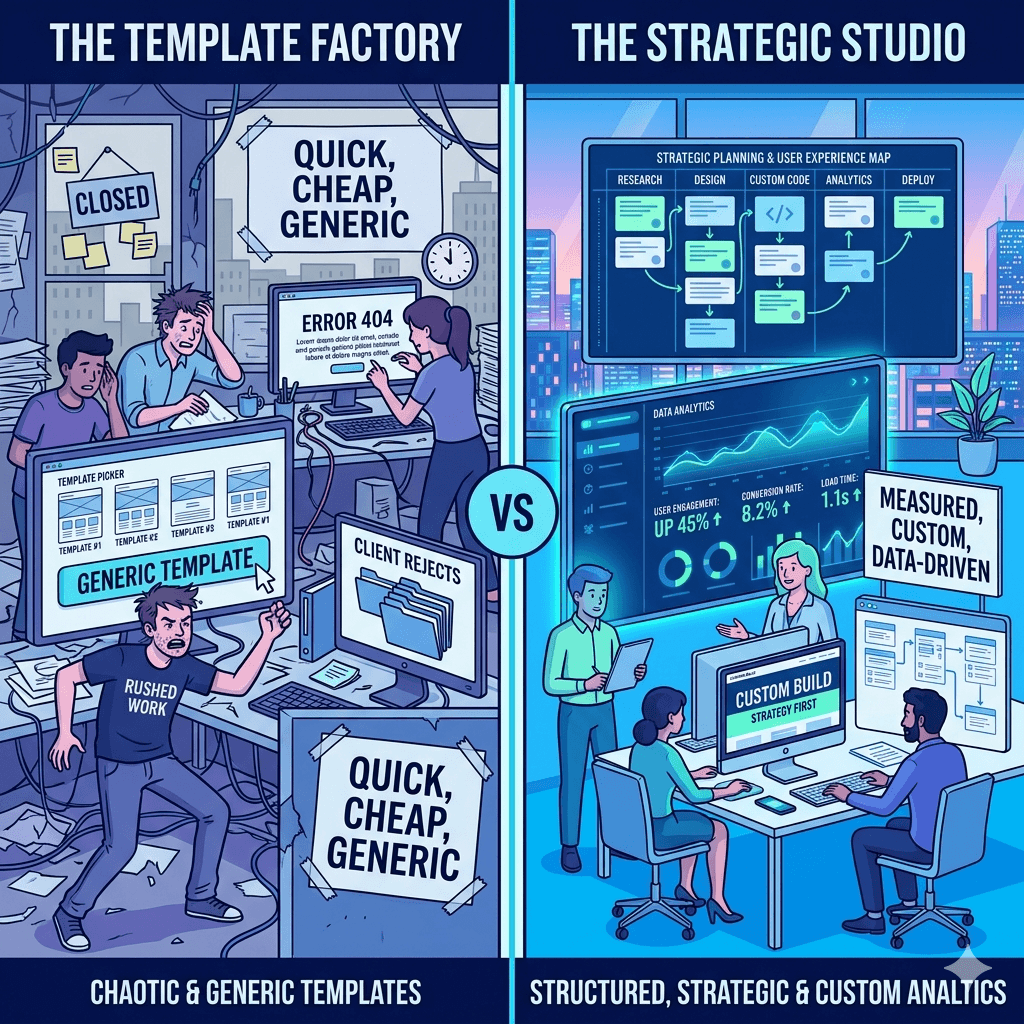
Strategy-First vs Design-Only Approach
A design-only agency hands you something that looks good. A strategy-first agency like Kico hands you something that works. The difference shows up in your website analytics, your enquiry volume, and your search engine rankings. Pretty without purpose is just decoration.
Custom Solutions vs Template-Heavy Builds
Many agencies in Uganda rely heavily on pre-built templates. These are fast to set up but come with serious limitations. They are rarely optimized for performance, they look generic, and they are hard to customize as your business grows. Kico builds custom website design Uganda businesses actually own and control. For a closer look at why this matters, explore the comparison ofwebsite platforms and how each stacks up against real business needs.
Focus on Local Market Behavior vs Generic Global Designs
A website designed for a European or American audience will not automatically work in Uganda. Customer expectations, internet speeds, device types, payment preferences, and communication habits are all different here. Kico builds websites with the Ugandan market in mind from day one. This local expertise is one of the things that makes Kico one of the best web design companies in Uganda for locally-focused businesses.
Stronger Emphasis on Performance and SEO Readiness
SEO web design Uganda businesses need goes beyond just adding keywords. Kico integrates SEO best practices into the website architecture itself. This includes proper heading structures, fast-loading code, mobile responsiveness, metadata optimization, and clean URL structures. All of this helps your website show up when potential customers are searching online.
Ongoing Support and Optimization vs One-Time Delivery
Many agencies disappear after they hand over your website. Kico offers ongoing support and optimization to ensure your site continues to perform well as your business evolves. This long-term relationship approach makes a real difference for small businesses that do not have in-house technical teams.
Key Features Included in Kico Web Design Projects
When you work with Kico Web Design Uganda, you are not just getting a website. You are getting a carefully assembled set of features designed to make your online presence strong from day one.
Mobile Optimization and Responsive Layouts
Every website Kico builds is fully responsive. That means it adjusts automatically to look great on smartphones, tablets, and desktop screens. Given that most Ugandan internet users are on mobile, this is non-negotiable for any professional website design Uganda business owners should expect.
SEO-Friendly Structure and Metadata Setup
Kico sets up your website with proper on-page SEO from the start. This includes optimized page titles, meta descriptions, alt text on images, proper heading hierarchy, and schema markup where applicable. Getting this right from the beginning saves businesses significant time and money later.
Secure Hosting and Performance Optimization
A slow or insecure website is a liability. Kico recommends and sets up reliable hosting solutions, installs SSL certificates for security, and optimizes images and code for speed. If you want to understand more about the technical side of this, there is a detailed guide onwebsite speed that explains exactly what good performance looks like for Uganda’s unique internet conditions.
Conversion-Focused Landing Pages
Whether you need a product page, a service overview, or a lead capture page, Kico designs pages with conversion as the primary goal. Every section is intentional, every call to action is tested, and every form is optimized for completion.
Integration with Social Media and WhatsApp Contact Tools
Ugandan customers love WhatsApp. Kico integrates WhatsApp chat buttons, social media feeds, and sharing tools directly into your website. This makes it seamless for customers to reach you the way they prefer, which means more conversions and fewer missed opportunities.
Benefits for Ugandan Businesses Working with a Strategy-Driven Agency
Choosing a strategy-first web development Uganda partner does not just give you a better website. It gives you a business advantage.
Increased Customer Trust and Engagement
When your website looks professional, loads fast, and answers customer questions clearly, people stay longer and trust you more. That trust is the first step toward a sale.
Higher Conversion Rates from Website Traffic
A conversion-focused website design turns more of your visitors into actual leads or customers. Even a small improvement in conversion rate can have a massive impact on your revenue over time.
Better Visibility on Search Engines
A well-built website that follows SEO best practices will rank higher on Google. More visibility means more organic traffic without spending money on ads. To build on this, a solidSEO strategy alongside good web design creates a powerful combination for long-term growth.
Improved Brand Credibility in Competitive Markets
In competitive industries like finance, hospitality, real estate, and professional services, a strong online presence signals that your business is serious. It sets you apart from competitors still relying on social media alone.
Long-Term Scalability of Digital Presence
A well-architected website grows with your business. Adding new pages, products, blog posts, or services is easy when the foundation is built correctly. This is the kind of long-term thinking that defines affordable web design Uganda businesses can actually rely on for years.
Common Mistakes Ugandan Businesses Make with Websites
Understanding what not to do is just as important as knowing what to do. Here are some of the most common website mistakes we see from businesses across Uganda.
Using Outdated or Poorly Optimized Templates
Free or cheap templates might seem like a good deal upfront, but they often come loaded with bloated code, poor security, and zero customization. They look generic and rarely convert well. Custom website design Uganda businesses invest in pays for itself quickly in better results.
Ignoring Mobile Users
A website that only looks good on a desktop is leaving money on the table. With smartphone usage dominating internet access in Uganda, mobile-friendly website design Uganda businesses need is an absolute must.
Lack of Clear Calls-to-Action
Many websites are built with no clear direction for the visitor. What should they do next? If your website does not tell people to call, book, buy, or enquire, most of them will simply leave without doing anything.
Slow Hosting and Poor Performance
Budget hosting might save money upfront, but a slow-loading website frustrates users and hurts your Google rankings. Fast loading website Uganda standards require solid hosting infrastructure and proper technical optimization.
Not Optimizing for Local Search Intent
Many businesses build websites without thinking about how local customers actually search. Phrases like “web design services Kampala” or “best restaurant in Nakasero” reflect how people search in Uganda. Ignoring local SEO means missing highly relevant, ready-to-buy traffic.
How to Choose the Right Web Design Partner in Uganda
Not all web design agencies in Uganda are created equal. Here is what to look for when making your decision.
Evaluating Portfolio and Past Work Quality
Always ask to see examples of websites the agency has built. Look for clean design, fast loading, mobile responsiveness, and clear calls to action. If their own website is slow or looks dated, that tells you something.
Checking SEO and Performance Understanding
A good website design company in Uganda should be able to talk about SEO, page speed, and mobile performance without needing to look anything up. If they only talk about colors and layouts, be cautious.
Assessing Communication and Support Services
Will they be available after the website launches? Do they offer ongoing maintenance? Clear, responsive communication before the project starts is a good indicator of how things will go after.
Understanding Pricing vs Value Offered
The cheapest option is rarely the best one. Focus on value, not just price. A slightly higher investment in a strategy-driven agency can deliver returns that far outweigh the cost difference.
Looking for Local Market Experience
An agency that understands Ugandan consumers, local internet infrastructure, and regional business culture will always do better work than one using a generic global playbook. For a comprehensive guide on making this decision, read this detailed piece onchoosing agency that walks you through the full evaluation process.
Future of Website Design for Ugandan Businesses
The digital landscape in Uganda is evolving fast, and website design is changing with it. Here is what to expect in the coming years.
Rise of AI-Assisted Web Development
Artificial intelligence tools are making it easier and faster to build certain parts of websites. However, strategy, creativity, and local market understanding remain deeply human skills. Agencies that combine AI efficiency with human expertise will have a clear edge.
Increased Focus on Mobile-First and Speed Optimization
As mobile internet usage continues to grow in Uganda, mobile-first design will shift from being a best practice to an absolute baseline. Responsive website design Uganda businesses invest in now will be even more critical tomorrow.
Growth of E-Commerce and Online Service Platforms
More Ugandan businesses are moving sales and services online. Ecommerce website development Uganda is growing quickly across retail, food delivery, hospitality, and professional services. Businesses that build strong e-commerce foundations now will have a major head start.
Stronger Competition Requiring Better UX and Branding
As more businesses get online, standing out will require more than just having a website. Superior user experience, strong branding, and genuine value for visitors will separate the winners from the crowd. This is exactly why the strategy-first approach that defines Kico Web Design is only going to become more valuable over time.
Frequently Asked Questions
What makes a good business website in Uganda?
A good business website in Uganda is fast, mobile-friendly, easy to navigate, and clear about what your business offers and how to contact you. It should also be optimized for search engines so customers can find you on Google.
How long does it take to build a professional website?
A basic professional website typically takes two to four weeks. More complex websites with multiple pages, e-commerce functionality, or custom features can take six to ten weeks depending on the scope and how quickly content is provided.
Why is mobile optimization important for Ugandan users?
The majority of internet users in Uganda access websites through smartphones. If your website does not work well on mobile devices, you will lose most of your potential customers before they even read what you offer.
Do small businesses really need SEO for their website?
Yes. SEO helps your website show up when people search for the products or services you offer. Without it, your website relies entirely on word-of-mouth and social media to bring in visitors. With SEO, you get a steady stream of free, targeted traffic from people already looking for what you sell.
How much does professional website design cost in Uganda?
Costs vary depending on the complexity of the project. A basic professional website for a small business in Uganda typically ranges from a few hundred thousand to a few million Ugandan shillings. The key is to focus on the value delivered, not just the upfront price.
What is the difference between custom and template websites?
Template websites use pre-built designs that are quick to set up but limited in flexibility and originality. Custom websites are built specifically for your business, your audience, and your goals. They perform better, look more professional, and give you full ownership of your digital presence.
How can a website help increase customer trust?
A professional website with clear contact information, customer testimonials, a secure connection (https), and high-quality images sends a strong signal that your business is legitimate and serious. It removes doubt and makes people more comfortable reaching out.
Can I update my website after it is built?
Yes. Most professional websites are built on content management systems that allow you to update text, images, and pages without technical knowledge. Your agency should also provide training and ongoing support if needed.
What platforms are best for business websites?
WordPress is the most widely used platform for professional business websites in Uganda because of its flexibility, SEO capabilities, and large support community. Other options like Shopify are great for e-commerce. The best choice depends on your business type and goals.
How do I know if my website is performing well?
You can measure website performance using tools like Google Analytics and Google Search Console. Key indicators include the number of monthly visitors, how long people stay on your site, how many enquiries or sales you generate, and where your pages rank on Google.
Final Thoughts
The difference between a website that looks good and one that actually works for your business comes down to strategy, local knowledge, and technical execution. Kico Web Design Uganda brings all three together in every project.
Whether you are starting from scratch, looking for a website redesign services Uganda agency you can trust, or simply trying to make your existing website perform better, working with a team that understands your market and your goals makes all the difference.
Your website is often the first impression your business makes. Make it count.
Running a business in Uganda today means juggling a hundred tasks at once. You’re answering customer messages at midnight, manually tracking inventory on spreadsheets, and spending hours every week preparing invoices. Sound familiar?
Here’s the thing: you don’t have to do everything manually anymore. Business automation isn’t just for big corporations with massive IT budgets. It’s for you the Kampala boutique owner, the Entebbe restaurant manager, the Jinja logistics company, and every entrepreneur in between who’s tired of drowning in repetitive tasks. Automation is often cheaper than building something new, as our guide to custom software in Uganda explains.
Automation simply means using technology to handle routine business activities without constant human intervention. And in Uganda’s rapidly digitalizing economy, it’s becoming less of a luxury and more of a necessity for staying competitive.
This guide will walk you through exactly how to automate your business using tools that work right here in Uganda tools that integrate with mobile money, understand our market, and won’t break your budget.
What is Business Automation?
Let’s clear this up right away: business automation doesn’t mean replacing your entire team with robots.
Think of it this way. When you set up your phone to automatically reply to WhatsApp messages when you’re busy, that’s automation. When your accounting software automatically generates an invoice after a sale, that’s automation. When customers can book appointments on your website without calling you, that’s automation.
Business automation is the use of digital tools and software to complete repetitive tasks without manual effort each time. Instead of you typing the same message to 50 customers, the system does it. Instead of manually calculating taxes on every invoice, the software handles it.
In Uganda’s context, automation is particularly powerful because it helps small businesses compete with larger ones. You might not have ten employees, but with the right automation, you can serve customers like you do. You can respond to inquiries instantly, process payments seamlessly, and maintain professional communication all while focusing on growing your business rather than drowning in administrative work.
The beauty of automation in 2026 is that many tools are designed for non-technical people. You don’t need to be a programmer or have an IT degree. If you can use WhatsApp or mobile money, you can automate parts of your business.
Benefits of Automating Your Business in Uganda
Why should you care about automation? Because it directly impacts your bottom line and your sanity. Let me break down the real advantages.
Increased Productivity with Minimal Resources
In Uganda, most small businesses operate lean. You might be a team of three trying to do the work of ten. Automation multiplies your capacity without multiplying your payroll.
When your customer service chatbot handles the first round of inquiries, your team can focus on complex issues that actually need human attention. When your inventory system automatically alerts you when stock is low, you’re not caught off guard when customers want to buy products you’ve run out of.
This means you accomplish more with the same number of people or even fewer. That’s not about cutting jobs; it’s about allowing your team to do higher-value work that actually grows your business.
Time Savings and Operational Efficiency
Time is the one resource you can never get back. Every hour you spend manually entering data or sending routine messages is an hour you’re not spending on strategy, customer relationships, or innovation.
Consider this: if you spend two hours daily on tasks that could be automated sending payment confirmations, updating customer records, posting on social media that’s 60 hours a month. That’s more than a full week of work you could redirect toward actually growing your business.
Ugandan entrepreneurs already work long hours. Automation gives you those hours back without sacrificing quality or customer satisfaction.
Reduced Errors and Improved Customer Experience
Humans make mistakes, especially when doing repetitive tasks. You might accidentally send the wrong invoice amount, forget to follow up with a lead, or double-book appointments.
Automated systems don’t get tired or distracted. They send the right information every time, follow up exactly when scheduled, and keep perfect records. This consistency dramatically improves your customer experience.
When a customer pays via MTN MoMo and instantly receives a confirmation message with their receipt, they feel confident in your professionalism. When they get a personalized birthday message from your business, they feel valued. These small touches, automated at scale, build loyalty and trust.
Competitive Advantage in the Local Market
Most Ugandan SMEs are still doing things the old way manually. This creates a massive opportunity for you.
When you respond to customer inquiries in seconds (because of automation), while your competitor takes hours, you win that customer. When you can process orders at midnight (because your systems run 24/7), you capture sales others miss. When you have clean data showing exactly which products sell best (because your inventory system tracks everything), you make smarter decisions than competitors guessing.
Automation isn’t the future it’s the present. And early adopters in Uganda’s market are already seeing the benefits of being ahead of the curve.
Common Areas to Automate in Small Businesses
Not sure where to start? These are the areas where Ugandan SMEs typically see the biggest impact from automation.
Customer Communication and Support
This is often the easiest and most impactful place to begin. Customer communication eats up enormous amounts of time, especially when people ask the same questions repeatedly.
With WhatsApp Business automation, you can set up instant replies to common questions: “What are your prices?” “Where are you located?” “Are you open today?” You can send automated confirmations when orders are placed and delivery updates as products ship.
Tools like Telerivet and the WhatsApp Business API allow you to segment customers and send targeted messages without manually typing each one. Imagine sending a promotional message to all customers who bought from you in December with one click instead of 200.
For businesses looking to streamline customer interactions even further, exploring CRM automation can transform how you manage relationships and follow-ups across your entire customer base.
Sales and Order Management
From the moment a customer shows interest to when they complete payment, there are dozens of steps. Automation streamlines this entire funnel.
You can set up automated lead capture forms on your website, automated follow-up sequences for potential customers, and automated order confirmations. When someone fills out a contact form at 2 AM, the system can immediately send them information and schedule a follow-up reminder for your sales team.
Integration with mobile money platforms means payments can trigger automatic receipts, inventory updates, and even fulfillment processes all without you touching anything.
Accounting and Invoicing
Accounting is crucial but time-consuming. Automated accounting systems transform this burden into a streamlined process.
Instead of manually creating invoices in Word, tools like QuickBooks or Express Accounts automatically generate professional invoices with your branding, calculate taxes correctly, track what’s paid and unpaid, and send payment reminders.
Many accounting tools now integrate with Ugandan mobile money platforms, so when a payment comes through, it’s automatically recorded and reconciled. No more manual entry, no more wondering if that payment was recorded, and much easier tax filing.
Marketing Campaigns and Social Media
Consistent social media presence drives sales, but posting multiple times daily across different platforms is exhausting. Marketing automation solves this.
Tools like Buffer and Hootsuite let you schedule weeks of content in a single sitting. You create posts on Sunday, and they automatically publish throughout the week on Facebook, Instagram, Twitter, and LinkedIn.
Email marketing platforms can automatically send welcome messages to new subscribers, birthday greetings to customers, or promotional campaigns to specific segments all based on triggers you set once.
To discover comprehensive platforms that can handle your entire marketing automation strategy, check out Uganda’s best marketing automation platforms including solutions like Trembi, HubSpot, and Mailchimp that work effectively in our local market.
Inventory and Supply Chain Management
For product-based businesses, inventory chaos kills profitability. You either overstock (tying up capital) or understock (losing sales).
Automated inventory systems track stock levels in real-time, alert you when items are running low, and can even trigger reorder processes. Some systems integrate with suppliers, automatically sending purchase orders when stock hits a threshold.
This visibility prevents the embarrassing “sorry, we’re out of stock” conversations and ensures you always have what customers want when they want it.
Step-by-Step Guide to Automating Your Business
Ready to actually do this? Here’s your practical roadmap for implementing business automation in Uganda.
Assess Your Business Processes and Identify Bottlenecks
Before automating anything, you need clarity on what’s actually happening in your business right now.
Spend a week documenting your daily tasks. Write down everything: answering customer messages, creating invoices, updating inventory, posting on social media, following up with leads, preparing reports everything.
Then identify the pain points. Which tasks take the most time? Which ones do you dread? Which ones cause the most errors? Which ones, if handled faster, would directly increase sales or satisfaction?
These bottlenecks are your automation priorities. Maybe you’re spending three hours daily responding to routine WhatsApp inquiries. Maybe invoice creation takes you two hours every Friday. Maybe you constantly forget to follow up with potential customers.
Document these processes so you can measure improvement later and understand exactly what needs to change.
Set Automation Goals Aligned with Business Priorities
Automation should solve real problems, not create new ones. Define clear, specific goals.
Bad goal: “Automate everything.” Good goal: “Reduce time spent on customer inquiries from 3 hours to 1 hour daily by implementing WhatsApp automation.”
Bad goal: “Get some automation tools.” Good goal: “Eliminate late invoice payments by implementing automated payment reminders and achieving 90% on-time payment within three months.”
Your goals should align with what actually matters to your business. If customer retention is your biggest challenge, focus on automating follow-ups and customer relationship management. If cash flow is the issue, prioritize invoice and payment automation.
Write down 2-3 specific, measurable automation goals. This focus prevents you from getting overwhelmed trying to automate everything at once.
Research Local Automation Tools and Platforms
Not all automation tools work well in Uganda. Some don’t integrate with mobile money. Others assume reliable internet that we don’t always have. Some are overpriced for our market.
Here’s what to look for:
Payment Processing and Mobile Money Solutions
Your automation tools must integrate with MTN Mobile Money and Airtel Money these are how most Ugandan customers pay. Look for platforms that support these payment methods natively.
Services like Flutterwave, Pesapal, and Beyonic provide APIs that connect your business systems with mobile money, allowing automated payment processing and reconciliation.
Customer Management (CRM) Tools
CRM automation helps you track every customer interaction, automate follow-ups, and never let a lead fall through the cracks.
Look at tools like Zoho CRM, HubSpot CRM (which has a free tier), or Bitrix24. These platforms let you automate email sequences, set task reminders, and maintain organized customer records.
The key is finding a CRM that’s simple enough for your team to actually use. The best CRM is the one you’ll consistently maintain, not the one with the most features.
Accounting and Bookkeeping Apps
Accounting automation eliminates manual data entry and reduces errors that could cause tax headaches.
QuickBooks has a Uganda-specific version that understands local tax structures. Express Accounts is popular among smaller businesses. Wave is a free option for very small operations.
These tools automatically generate invoices, track expenses, calculate taxes, and produce financial reports. Many integrate with mobile money, automatically recording transactions.
Marketing and Social Media Schedulers
Maintaining consistent social media presence is crucial but time-intensive. Automation tools for marketing let you schedule posts in advance and maintain presence without being online 24/7.
Buffer, Hootsuite, and Loomly all work well in Uganda. You can schedule content across multiple platforms, track engagement, and maintain consistent posting all from one dashboard.
Some tools also offer basic analytics to show which content performs best, helping you refine your strategy over time.
Implement Automation Gradually, Starting with High-Impact Areas
Don’t try to automate everything overnight. That’s overwhelming and often leads to abandoning the whole effort.
Start with one high-impact area based on your goals. If customer communication is your biggest time drain, begin there. Implement WhatsApp Business automation first, get comfortable with it, then move to the next area.
This gradual approach has several advantages. Your team isn’t overwhelmed learning multiple new systems at once. You can troubleshoot issues with one system before adding complexity. You see wins quickly, building momentum and buy-in.
Many Ugandan businesses have successfully implemented this phased approach, and you can see real examples of workflow automation saving significant time and resources for local SMEs who started small and scaled systematically.
Implement, stabilize, then expand. It might take six months to automate all your target areas, and that’s perfectly fine. Sustainable change beats rushed chaos every time.
Train Your Team to Use the Tools Effectively
The best automation tools fail if your team doesn’t use them properly. Training isn’t optional it’s essential.
Schedule dedicated training sessions for each new tool. Don’t just show people how it works; explain why you’re using it and how it makes their jobs easier. When people understand the benefit, adoption is much smoother.
Create simple reference guides or videos for common tasks. Your team should be able to quickly look up “how to add a new customer to the CRM” or “how to schedule a social media post” without hunting through help documentation.
Designate a “champion” for each tool someone who becomes the go-to expert. This person can help troubleshoot minor issues without you being involved in every question.
Remember, resistance to new technology is often about fear of change or looking incompetent. Address this directly with patience and support, not frustration.
Monitor, Optimize, and Scale Automation Over Time
Automation isn’t “set it and forget it.” It requires ongoing attention and refinement.
Set monthly or quarterly reviews to assess what’s working and what isn’t. Are automated messages getting good responses? Are invoices being paid faster? Is the team actually using the CRM?
Look at your metrics. If you automated customer inquiries to save time, are you actually spending less time on inquiries? If you automated invoicing to improve cash flow, are payments coming in faster?
Be willing to adjust. Maybe your automated WhatsApp messages sound too robotic rewrite them with more personality. Maybe your social media scheduling times aren’t optimal test different posting schedules.
As you get comfortable with initial automation, identify the next areas to tackle. Automation should grow with your business, continually finding new ways to save time and improve efficiency.
Top Local Tools for Business Automation in Uganda
Here are specific automation tools that work well in the Ugandan context, with local integration and reasonable pricing.
Mobile Money and Payment Platforms
Mobile money is the backbone of digital commerce in Uganda. Your automation strategy must include these platforms.
MTN Mobile Money for Business: Provides APIs and business accounts that integrate with e-commerce platforms, accounting software, and custom applications. You can automate payment collection, reconciliation, and confirmation messages.
Airtel Money for Business: Similar capabilities to MTN MoMo, offering business APIs for automated payment processing.
Flutterwave: A payment gateway that aggregates multiple payment methods (MTN, Airtel, cards) into a single integration. This simplifies automation because you integrate once rather than building separate connections to each provider.
Beyonic: Specifically designed for African markets, Beyonic provides automated bulk payments and collections via mobile money, making it ideal for businesses paying suppliers or collecting from multiple customers.
Pesapal: Another payment gateway option with good mobile money integration and automated payment notifications.
These platforms typically offer plugins for popular e-commerce systems like WooCommerce, making automation accessible even for non-technical business owners.
Local Accounting Software
Proper accounting automation prevents costly errors and saves enormous time during tax season.
QuickBooks Uganda Edition: Designed for the Ugandan market with local tax calculations, currency, and compliance features. Automates invoicing, expense tracking, financial reporting, and integrates with mobile money platforms.
Express Accounts: A simpler, more affordable option for smaller businesses. Handles automated invoicing, payment tracking, and basic financial reports. The learning curve is gentler than QuickBooks.
Wave: Completely free accounting software suitable for very small businesses and freelancers. Automates basic invoicing and expense tracking. Limited features compared to paid options, but excellent for startups on tight budgets.
Zoho Books: Part of the larger Zoho suite, offering automated invoicing, expense tracking, inventory management, and project tracking. Good integration capabilities with other Zoho tools and third-party applications.
Most of these tools can automatically send invoices, track payments, send payment reminders, and reconcile transactions eliminating hours of manual bookkeeping.
Social Media Management Tools
Consistent social media presence drives customer engagement, but manual posting is time-consuming. These tools automate the process.
Buffer: User-friendly interface for scheduling posts across Facebook, Instagram, Twitter, and LinkedIn. You can create a week’s worth of content in one sitting and schedule it to publish automatically. The free tier works for one social media account, with paid plans offering more accounts and features.
Hootsuite: More comprehensive than Buffer, offering scheduling, monitoring, and analytics. You can track mentions of your business, respond to messages, and schedule posts all from one dashboard. Better suited for businesses managing multiple brands or locations.
Loomly: Combines scheduling with content inspiration and collaboration features. It suggests post ideas based on trending topics and events, making content creation easier. Good for teams where multiple people contribute to social media.
These tools typically include analytics showing which posts perform best, helping you refine your content strategy over time.
Customer Engagement Platforms
Maintaining consistent, personalized communication with customers builds loyalty and drives repeat sales.
WhatsApp Business and WhatsApp Business API: The free WhatsApp Business app offers basic automation like away messages and quick replies. For more advanced automation (automated campaigns, chatbots, integration with CRM), you need the Business API, which requires partnering with an approved provider.
Telerivet: Specifically designed for SMS and messaging automation in African markets. You can send bulk messages, automate responses based on keywords, and integrate with other business systems. Works with both SMS and WhatsApp.
ManyChat: Creates chatbots for Facebook Messenger, Instagram, and WhatsApp. These bots can answer common questions, qualify leads, and collect information all automatically. No coding required; it uses a visual builder.
Twilio: More technical but extremely powerful for businesses with development capacity. Provides APIs for SMS, WhatsApp, and voice automation, allowing custom communication workflows tailored to your exact business needs.
These tools ensure customers get timely responses even when you’re not available, dramatically improving customer experience.
Inventory and Stock Management Solutions
For product-based businesses, inventory automation prevents stockouts and overstock situations that hurt profitability.
Zoho Inventory: Comprehensive inventory management with automated stock alerts, reorder points, and multi-location tracking. Integrates with Zoho’s e-commerce and accounting tools for complete automation from order to fulfillment.
Lokal ERP: Designed specifically for African businesses, Lokal offers inventory management, sales tracking, and basic accounting. It’s built understanding local business practices and challenges.
inFlow Inventory: User-friendly inventory system with barcode scanning, automated reorder alerts, and integration with popular accounting software. Good for small to medium retail operations.
TradeGecko (QuickBooks Commerce): Recently acquired by QuickBooks, this platform offers sophisticated inventory management with automated workflows for orders, fulfillment, and purchasing.
These systems automatically update stock levels as sales occur, alert you when inventory runs low, and can generate purchase orders preventing the manual tracking chaos that plagues many product businesses.
For a comprehensive comparison of various automation tools available to Ugandan SMEs, including RPA and AI-powered solutions that can boost your workflow, explore detailed reviews and practical implementation guides.
Tips for Successful Automation in Uganda
Implementing automation effectively requires understanding the local context. Here’s practical guidance specific to Ugandan SMEs.
Start Small and Focus on the Most Repetitive Tasks
The biggest automation mistake is trying to do too much too fast. Ambitious plans often lead to overwhelm and abandonment.
Identify the single most repetitive, time-consuming task in your business. Maybe it’s responding to “What are your prices?” on WhatsApp fifty times daily. Maybe it’s creating invoices every Friday. Maybe it’s posting to social media.
Automate that one thing first. Get it working smoothly. Let your team get comfortable. Celebrate the time savings. Then move to the next task.
This approach builds competence and confidence gradually. You’re learning automation principles in a manageable way rather than drowning in complexity.
Prioritize Tools That Integrate with Mobile Money
In Uganda, mobile money isn’t just an option it’s how most transactions happen. Any automation strategy that doesn’t account for this will create more problems than it solves.
When evaluating any tool whether it’s e-commerce, accounting, or CRM ask explicitly: “Does this integrate with MTN Mobile Money and Airtel Money?” If it doesn’t, you’ll be manually entering mobile money transactions, defeating much of the automation benefit.
Tools that integrate with mobile money can automatically record payments, send receipts, update inventory, and reconcile accounts. Tools that don’t force you into manual processes that automation was supposed to eliminate.
This is especially important for accounting and invoicing. Automated reconciliation of mobile money transactions saves enormous time and prevents errors.
Keep Customer Experience at the Center
Automation should enhance your customer experience, not make it robotic or frustrating.
Yes, automated responses save time, but they should still feel personal and helpful. “Thank you for your message! We’ll respond within 2 hours” is much better than “Your message has been received. Reference number 847392.”
Test your automated messages and workflows from a customer’s perspective. Do they make sense? Are they helpful? Or do they create frustration?
Remember, the goal isn’t just efficiency it’s efficient delivery of excellent customer experience. If automation makes customers feel like they’re talking to a machine rather than a business that cares about them, you’re doing it wrong.
Include options to reach a real person when automation can’t help. Nothing frustrates customers more than being trapped in an automated loop when they have a specific, unusual question.
Regularly Review and Adjust Automation Workflows
What works today might not work in six months as your business evolves or customer expectations change.
Set a recurring reminder to review your automated processes. Are the templates still relevant? Are automated responses answering the questions customers actually ask? Are scheduled posts getting engagement?
Watch for signs that automation needs adjustment: customers repeatedly asking questions your automated system should answer, declining response rates to automated emails, or team members bypassing automated systems.
Be willing to refine. Maybe your automated invoice reminders are too aggressive dial them back. Maybe your social media posts aren’t getting engagement adjust the timing or content style.
Automation isn’t static. It should evolve with your business, continuously improving based on real-world results.
Common Mistakes to Avoid
Learning from others’ mistakes is cheaper than making them yourself. Here are the automation pitfalls that trap many Ugandan SMEs.
Automating Without Clear Goals
Too many businesses automate because “everyone says we should” without understanding what they’re trying to achieve.
You implement a fancy CRM, but nobody uses it because there’s no clear purpose. You set up automated emails, but they don’t align with your sales process. You buy inventory software, but it doesn’t solve your actual inventory problems.
Automation without purpose is just expensive complexity. Before implementing any automation, answer: “What specific problem will this solve?” and “How will we measure success?”
If you can’t answer these questions clearly, you’re not ready to implement that automation yet.
Choosing Complex Tools Too Early
It’s tempting to choose the tool with the most features, thinking it’s the “best” option. But complex tools often overwhelm small teams and end up abandoned.
A simple tool that your team actually uses consistently beats a sophisticated tool they avoid because it’s too complicated.
Start with simpler tools, even if they don’t have every imaginable feature. As you get comfortable with automation concepts and your needs become more sophisticated, you can migrate to more powerful solutions.
Your first CRM doesn’t need advanced pipeline management, AI predictions, and multi-channel attribution. It needs to reliably track customer information and remind you to follow up. Simple first, sophisticated later.
Ignoring Staff Training
You’ve bought the tools, set them up, and… nobody uses them properly. Sound familiar?
Implementing tools without adequate training is like buying a car for someone who doesn’t know how to drive and being frustrated when they don’t use it.
Invest time in training. Show people not just how to use the tools, but why they’re beneficial. Address concerns and resistance directly. Create reference materials for common tasks.
Most importantly, provide ongoing support. The initial training won’t cover everything, and people will have questions as they encounter real-world scenarios.
Overlooking Data Security and Privacy
When you automate, you’re collecting and storing customer data names, phone numbers, purchase history, payment information. This data is valuable and sensitive.
Many Ugandan SMEs don’t think carefully about data security until there’s a problem. That’s too late.
Choose automation tools that take security seriously. Look for encryption, secure data storage, and clear privacy policies. Be cautious about tools that don’t explain how they protect customer information.
Also consider your legal obligations. The Uganda Data Protection and Privacy Act has requirements about how you collect, store, and use customer data. Make sure your automation practices comply.
Don’t collect more data than you need, store it securely, and be transparent with customers about what you’re collecting and why. Trust is easy to lose and hard to rebuild.
To learn more about the pitfalls that businesses encounter when implementing new systems and avoid making these common mistakes that could derail your automation efforts, review comprehensive guidance on system application best practices.
Measuring the Impact of Automation
How do you know if automation is actually working? You measure it. Here’s what to track and how.
Key Performance Indicators (KPIs) to Monitor
Different automation efforts require different metrics, but here are the most important across various functions:
Time savings: Track how much time specific tasks take before and after automation. If invoice creation used to take 2 hours weekly and now takes 30 minutes, that’s 1.5 hours saved 78 hours annually that can be redirected to growth activities.
Response time: Measure how quickly customers get responses to inquiries. Automation should dramatically reduce this. Going from 4-hour average response time to 2 minutes builds customer satisfaction and increases conversion rates.
Error rates: Track mistakes in invoices, order processing, or data entry. Automation should significantly reduce errors. Fewer invoice corrections and payment disputes directly improve cash flow and customer relationships.
Conversion rates: If you automated lead follow-up, are more leads converting to customers? If you automated abandoned cart emails, are recovery rates improving?
Customer satisfaction: Survey customers or track review scores. Are customers happier with faster responses and more consistent service?
Revenue per employee: As automation increases productivity, you should see revenue per team member increase. You’re generating more output without proportionally increasing headcount.
Define 2-3 key metrics for each automation you implement, and track them consistently.
Tools for Tracking Efficiency Gains
You don’t need sophisticated analytics to measure automation success. Simple tracking methods work:
Spreadsheet logs: Create a simple spreadsheet tracking time spent on key tasks weekly. When you implement automation, continue tracking to see the reduction. Visual charts showing time savings are motivating and justify continued investment.
Built-in analytics: Most automation tools include dashboards showing usage and impact. Your email automation shows open rates and click rates. Your social media scheduler shows engagement. Your CRM shows conversion rates. Use these native analytics.
Time tracking tools: Tools like Toggl or RescueTime can automatically track how you spend time, showing precisely where automation creates savings.
Customer feedback: Simply asking “How was your experience?” after interactions provides qualitative data about whether automation improves or harms customer satisfaction.
The key is consistency. Track the same metrics regularly so you can spot trends and make informed decisions about where to expand automation efforts.
Customer Feedback and Satisfaction Metrics
Automation should improve customer experience, not degrade it. Measuring customer satisfaction ensures you’re heading in the right direction.
Net Promoter Score (NPS): Regularly ask customers “How likely are you to recommend us to a friend?” on a 0-10 scale. Track whether this improves as you implement automation.
Customer Effort Score: Ask “How easy was it to [complete purchase/get support/etc.]?” Automation should reduce effort required from customers.
Direct feedback: Include simple feedback mechanisms in automated communications. “Was this response helpful?” with thumbs up/down gives you real-time signals about automation effectiveness.
Response rates: If you automate email marketing or follow-ups, track whether response rates improve or decline. Declining engagement suggests your automation needs refinement.
Repeat purchase rate: If automation improves customer experience, you should see customers returning more frequently. Track this over time.
The goal isn’t automation for its own sake it’s better business outcomes. Customer satisfaction metrics ensure your automation strategy supports this goal rather than undermining it.
Frequently Asked Questions (FAQs)
Let’s address the most common questions Ugandan business owners have about automation.
What is the Easiest Part of My Business to Automate First?
Start with customer communication, specifically automated WhatsApp responses.
Why? Because it’s immediately impactful, technically simple, and requires minimal investment. WhatsApp Business (the free app) lets you set up automated greeting messages, away messages, and quick replies within minutes.
This addresses one of the most time-consuming aspects of business answering the same questions repeatedly while delivering immediate customer satisfaction through faster responses.
Once you’re comfortable with this basic automation, you can expand to automated invoicing or social media scheduling. But WhatsApp automation is the easiest, fastest win for most Ugandan SMEs.
Are Local Mobile Money Platforms Safe for Automated Payments?
Yes, when implemented correctly, automated mobile money payments are safe and secure.
MTN Mobile Money and Airtel Money have robust security measures including encryption, authentication, and fraud monitoring. When you use official business APIs and approved payment gateway providers like Flutterwave or Pesapal, you’re operating within secure, regulated systems.
The key is using official integration methods rather than unofficial workarounds. Partner with recognized payment gateway providers, use proper API authentication, and follow security best practices like regularly updating passwords and monitoring transactions.
Millions of automated mobile money transactions occur daily across Uganda. The infrastructure is mature and reliable. The risk comes from poor implementation practices, not the platforms themselves.
Can Small Businesses Afford Automation in Uganda?
Absolutely. Automation isn’t just for large corporations with massive budgets.
Many powerful automation tools are free or very affordable. WhatsApp Business is free. Buffer’s basic plan starts at around $5 monthly. Wave accounting is completely free. Google Workspace (which includes automation capabilities through Google Forms and Sheets) starts at minimal cost.
Even paid tools often provide such significant time savings that they pay for themselves quickly. If accounting software costs $30 monthly but saves you 5 hours of bookkeeping time, and your time is worth more than $6/hour, it’s profitable immediately.
Start with free tools, prove the value of automation, then invest in paid tools as your business grows and automation needs become more sophisticated. The financial barrier is much lower than most people assume.
How Do I Train My Team for Automation Tools?
Training doesn’t need to be complicated. Here’s a practical approach:
Start with the why: Before showing how to use a tool, explain why you’re implementing it and how it makes their jobs easier. People resist tools they see as extra work but embrace tools that clearly benefit them.
Hands-on practice: Don’t just demonstrate let people actually use the tool during training. Set up practice scenarios where they complete real tasks with guidance.
Create simple reference guides: Document common tasks with screenshots or short videos. When someone forgets how to do something, they can quickly review rather than interrupting you.
Designate champions: Identify one or two team members who pick up technology quickly. Make them the go-to experts for questions, reducing the burden on you.
Be patient and supportive: Some people adapt to new technology faster than others. Build in time for adjustment and celebrate progress rather than punishing mistakes.
Training is ongoing, not a one-time event. Budget time for questions and troubleshooting as people get comfortable with new workflows.
What if My Automation Tool Doesn’t Integrate with Existing Systems?
This is a common challenge. Here are your options:
Use integration platforms: Tools like Zapier, Make (formerly Integromat), or IFTTT connect different applications even when they don’t have direct integration. They act as bridges, triggering actions in one tool based on events in another.
For example, if your CRM doesn’t integrate with your email tool, Zapier can automatically add new CRM contacts to your email list. These platforms offer free tiers for basic automation and affordable plans for more complex workflows.
Manual exports/imports: If integration isn’t possible, some tools allow scheduled exports that can be imported into other systems. It’s not fully automated but still saves time compared to manual data entry.
Reconsider your tools: If integration is critical and impossible with current tools, it might be worth switching to alternatives that integrate better. The long-term efficiency gains can justify migration effort.
Custom development: For businesses with specific needs and budget, hiring a developer to create custom integrations is an option, though usually the most expensive approach.
The ideal scenario is choosing tools that integrate natively from the start, which is why researching compatibility before implementation is crucial.
How Long Does It Take to See Results from Automation?
It varies by what you’re automating, but most businesses see noticeable results within 2-4 weeks for simple automation and 2-3 months for more complex implementations.
Immediate impact (days to 2 weeks): Basic automations like WhatsApp auto-responses, automated invoice generation, or social media scheduling show results almost immediately. You’ll notice time savings and faster customer responses within days.
Medium-term impact (1-3 months): More complex automation like CRM workflows, comprehensive accounting automation, or multi-step marketing sequences need time to demonstrate full value. You need enough data to measure conversion improvements, cash flow changes, or efficiency gains.
Long-term impact (3-6 months): Strategic benefits like improved customer retention, better inventory management, or comprehensive data-driven decision making emerge over months as patterns become clear and optimizations compound.
Don’t expect overnight transformation. Automation is a gradual process where benefits accumulate over time. The businesses that succeed are those that commit to the journey rather than expecting instant magic.
Are There Any Legal or Tax Considerations for Automating Payments?
Yes, several important considerations apply when automating payments in Uganda:
Record keeping: The Uganda Revenue Authority requires businesses to maintain proper records of all transactions. Ensure your automated payment systems create and store detailed records that satisfy tax requirements.
VAT compliance: If you’re VAT-registered, your invoicing automation must correctly calculate and display VAT. Many accounting tools have Uganda-specific tax settings that handle this automatically.
Data protection: The Uganda Data Protection and Privacy Act governs how you collect, store, and use customer information. Automated systems collecting payment details must comply with these regulations.
Mobile money regulations: When automating mobile money payments, ensure you’re using official business accounts and APIs. Operating outside official channels can create regulatory issues.
Financial reporting: Automated systems should generate reports that align with Uganda’s financial reporting requirements, making tax filing easier rather than creating compliance headaches.
Consult with an accountant familiar with Ugandan regulations when implementing payment automation to ensure compliance from the start. Fixing compliance issues later is much more expensive than getting it right initially.
Can I Automate Customer Support Effectively Using WhatsApp?
Yes, but with important caveats about what works and what doesn’t.
What works well:
Automated responses to common questions (hours, location, pricing)
Order confirmations and status updates
Appointment reminders
Initial qualification of inquiries before human handoff
Away messages when you’re unavailable
What doesn’t work well:
Complex problem-solving requiring judgment
Handling complaints or upset customers
Highly personalized recommendations
Situations requiring empathy and emotional intelligence
The key is hybrid automation: use automation for routine, repetitive interactions while ensuring smooth handoff to humans for complex situations.
Set up your WhatsApp Business with automated quick replies for frequently asked questions, but always provide an easy path to reach a real person. Something like “For other questions, send ‘HUMAN’ to speak with our team” ensures customers never feel trapped.
The best WhatsApp automation complements human service rather than replacing it entirely.
How Do I Scale Automation as My Business Grows?
Scaling automation is about gradually expanding both scope and sophistication as your business evolves.
Start simple, add complexity incrementally: Begin with basic automation (auto-replies, simple scheduling), then add layers as you grow (segmented campaigns, complex workflows, predictive analytics).
Revisit tools periodically: What worked at 10 customers weekly might not work at 100. As volume increases, you may need more robust tools. Schedule quarterly reviews of whether your current automation still fits your scale.
Integrate systems progressively: Early on, disconnected tools are fine. As you grow, integrate them so data flows automatically between CRM, accounting, inventory, and marketing systems.
Invest in training: As automation becomes more central to operations, invest in deeper training or hire specialists who understand workflow optimization and the specific tools you’re using.
Automate the automation: Advanced businesses use tools that automatically optimize campaigns, predict inventory needs, or identify customer patterns automation that learns and improves itself.
The businesses that scale automation successfully do so incrementally, continuously learning and adapting rather than trying to build the perfect system from day one.
Business automation in Uganda isn’t a distant future concept it’s an immediate opportunity that’s already transforming how smart entrepreneurs operate. The tools exist, they’re affordable, and they work in our local context with mobile money integration and platforms designed for African markets.
The question isn’t whether to automate but where to start. Begin with one simple automation this week. Set up WhatsApp Business auto-replies. Schedule next week’s social media posts. Implement automated invoice reminders. Take that first step.
As you experience the time savings and efficiency gains, you’ll naturally want to expand. Automation builds on itself. Each successful implementation creates capacity and confidence to tackle the next challenge.
Your competitors are either already automating or will be soon. The businesses that thrive in Uganda’s increasingly digital economy will be those that embrace these tools while maintaining the personal touch and customer focus that builds loyalty.
Start small, start today, and start transforming how you work. Your future self with more time, less stress, and better business results will thank you.
If you’re running a business in Uganda today, you’ve probably noticed how quickly your customers have shifted to mobile. They’re booking boda rides, paying bills, and shopping all from their phones. So here’s the question: why isn’t your business there too? Building a custom business app might sound like something only big companies can afford, but that’s changing fast. Local developers, affordable tools, and a growing digital ecosystem mean Ugandan entrepreneurs can now create powerful apps that solve real problems. Whether you want to streamline operations, reach more customers, or integrate mobile money payments, this guide will walk you through everything you need to know about building a custom business app right here in Uganda.
What Is a Custom Business App?
A custom business app is software built specifically for your company’s unique needs not a one-size-fits-all solution you download from an app store. Think of it like having a suit tailored to fit you perfectly, rather than buying one off the rack that’s almost right but not quite. These apps can handle anything from tracking inventory and managing employees to processing customer orders and accepting mobile money payments. Unlike generic software that forces you to adapt your workflow to match its features, custom business apps adapt to how you already work. They’re designed around your processes, your brand, and your customers. For Ugandan businesses, this means you can build an app that understands local payment methods, works offline when internet is spotty, and speaks directly to your market’s specific needs.
Why Ugandan Businesses Are Building Custom Apps
Uganda’s digital transformation is happening fast. Mobile phone penetration has soared past 60%, and more Ugandans now access the internet through smartphones than computers. This shift creates a massive opportunity your customers are already on their phones, waiting for convenient ways to interact with businesses like yours. Competition is also heating up. The businesses that make it easy for customers to browse products, book services, or make payments through an app are pulling ahead of those still relying only on phone calls and walk-ins. Beyond customer-facing benefits, smart business owners are using apps to solve internal headaches too. Manual record-keeping, inventory mix-ups, and communication gaps between field staff and the office these problems drain time and money. A well-designed app can automate these processes, reduce errors, and give you real-time visibility into your operations. As more Ugandan entrepreneurs realize they don’t need Silicon Valley budgets to build effective apps, we’re seeing everyone from agribusinesses to beauty salons going digital.
Benefits of a Custom Business App
Building a custom app for your business delivers advantages that ripple across every part of your operation. First, you dramatically improve customer experience. Instead of making clients call during business hours or visit your physical location, they can browse, order, and pay whenever it’s convenient for them even at midnight. This convenience translates directly into more sales and stronger customer loyalty. Operationally, apps eliminate countless hours of manual work. Imagine automatically tracking every sale, updating inventory in real-time, and generating reports with a single tap instead of spending hours with spreadsheets. Your staff becomes more productive because they’re not bogged down in paperwork. You also gain valuable data insights. A custom app shows you exactly what customers are buying, when they’re most active, and where they drop off in the purchase process. This intelligence helps you make smarter business decisions. Apps also level the playing field with larger competitors by making your business look professional and established, building trust with customers who might otherwise choose bigger brands. Perhaps most importantly for Ugandan businesses, custom apps can integrate perfectly with local systems mobile money platforms, SMS services, and even offline functionality for areas with unreliable internet.
Types of Business Apps Common in Uganda
Customer-Facing Apps (Sales, Booking, Payments)
These apps put your business directly in customers’ pockets. Retail shops use them for browsing products and placing orders. Salons and clinics rely on booking apps to schedule appointments and send reminders. Restaurants offer food delivery apps that compete with larger platforms but keep all the profits in-house. The key advantage is direct customer relationships without paying hefty commissions to third-party marketplaces. Our complete guide to custom software in Uganda covers whether building is the right call in the first place.
Internal Business Apps (Operations, HR, Inventory)
Not every app needs to face the public to deliver value. Many Ugandan businesses build internal tools that help teams work smarter. Field sales reps use apps to log visits and update client information on the go. Warehouse managers track inventory levels in real-time. HR departments manage leave requests and employee schedules without endless back-and-forth emails. These apps reduce miscommunication and create accountability.
Marketplace and Platform Apps
Some businesses aren’t selling their own products they’re connecting buyers and sellers. Think of local versions of platforms where farmers sell directly to consumers, or where freelancers find clients. These two-sided marketplaces require more complex development but can scale rapidly once they gain traction in their niche.
Fintech and Mobile Money–Integrated Apps
Given Uganda’s high mobile money adoption, fintech apps are booming. Businesses are building loan apps, savings platforms, payment processing tools, and even investment apps tailored to local needs. The magic happens when you integrate Mobile Money, Airtel Money, or bank APIs, making financial transactions seamless for users who may not have traditional bank accounts.
Key Features to Include in a Ugandan Business App
Mobile Money and Local Payment Integrations
If your app doesn’t accept mobile money, you’re leaving money on the table. Period. Most Ugandans prefer Mobile Money or Airtel Money over cards or bank transfers, so integration with these platforms isn’t optional it’s essential. Your app should make payments as simple as entering a phone number and confirming with a PIN. Consider also integrating card payments for the growing middle class and bank transfers for larger B2B transactions.
Offline and Low-Bandwidth Support
Uganda’s internet infrastructure is improving, but connectivity remains inconsistent, especially outside Kampala. Your app needs to function gracefully when internet disappears. Smart offline features cache important data, allow users to browse previously loaded content, and queue actions (like orders or updates) to sync automatically when connection returns. This isn’t just nice to have it’s the difference between an app people actually use and one they delete in frustration.
User Authentication and Security
Ugandans are increasingly savvy about digital security, and rightfully concerned about fraud. Implement secure login methods phone number verification with OTPs works well locally. Protect sensitive data with encryption, especially payment information and personal details. Build trust by being transparent about how you handle user data and comply with privacy regulations.
Admin Dashboards and Analytics
You need visibility into what’s happening in your app. A comprehensive admin dashboard shows you sales figures, user activity, popular products or services, and performance metrics. Good analytics help you spot trends, identify problems early, and make data-driven decisions about where to invest next. Real-time reporting means you’re never operating blind.
Push Notifications and SMS Integration
Staying connected with users drives engagement. Push notifications work great for app updates, special offers, and order status, but don’t underestimate SMS many Ugandans still prefer text messages for important communications. Use notifications strategically (nobody likes spam) to remind customers about abandoned carts, confirm bookings, or announce flash sales.
How to Build a Custom Business App in Uganda
Define the Business Problem and App Goals
Start with clarity, not technology. What specific problem are you solving? Maybe customers complain that calling to make orders is inconvenient, or your sales team wastes hours manually entering data. Write down the exact pain points your app will address and what success looks like. “Increase online orders by 40%” is a clear goal. “Have a cool app” is not. Talk to your customers and employees they’ll reveal problems you might have missed. This foundation ensures you build something useful, not just something digital.
Choose the Right Platform (Android, iOS, Web App)
In Uganda, Android dominates with over 80% market share. For most businesses, starting with Android makes perfect sense you’ll reach the widest audience at the lowest cost. iOS apps target the smaller but often more affluent segment willing to spend more. Web apps (progressive web apps) offer a middle ground they work across all devices through browsers, though with some feature limitations. For many startups, starting with Android and adding iOS later as you grow makes practical sense. Consider where your specific customers are before deciding.
Validate the Idea with an MVP
Don’t build everything at once. Create a Minimum Viable Product the simplest version of your app that solves the core problem. If you’re building a delivery app, your MVP might just handle orders and basic payment without fancy features like loyalty points or AI recommendations. Launch this stripped-down version to real users, gather feedback, and learn what actually matters to them. This approach saves money and time by preventing you from building elaborate features nobody wants. Many successful apps started as basic MVPs that evolved based on user behavior.
Select a Development Approach
You have several paths forward. Mobile app development can happen through native development (separate apps for Android and iOS using their native languages), which delivers the best performance but costs more. Cross-platform frameworks like Flutter or React Native let you write code once and deploy to both Android and iOS, balancing cost and quality. No-code platforms offer the cheapest, fastest route for very simple apps but with limited customization. Choose based on your budget, timeline, and how complex your app needs to be.
Design the User Experience
Your app can have amazing features, but if it’s confusing to use, people will delete it. Invest time in user interface (UI) and user experience (UX) design. Keep navigation simple and intuitive users should accomplish tasks in as few taps as possible. Use familiar patterns that Ugandans already understand from popular apps. Test your design with actual users before development begins; watching someone struggle to complete a basic task reveals problems no amount of guessing will catch. Good design isn’t about looking fancy; it’s about making things effortless.
Develop and Test the App
With plans and designs ready, development begins. This phase typically takes anywhere from two to six months depending on complexity. Work with your development team in sprints short cycles where they build specific features you can review regularly. Don’t wait until everything is finished to start testing. Throughout development, test relentlessly. Check that features work as expected, that the app doesn’t crash, that it handles poor internet gracefully, and that it works across different phone models. Beta testing with a small group of real users before public launch helps catch issues you missed.
Launch and Monitor Performance
Launch day is exciting but it’s really just the beginning. Submit your app to the Google Play Store (and Apple App Store if you built for iOS), making sure your listing has clear descriptions, quality screenshots, and relevant keywords. Once live, monitor everything downloads, user behavior, crash reports, and reviews. Set up analytics tools that show you exactly how people use your app. This data guides your next improvements and helps you understand what’s working and what’s not.
Development Options Available in Uganda
Hiring a Local App Development Company
Uganda has a growing community of professional app development companies with proven track records. These agencies handle everything from initial planning through launch and maintenance. The advantage is expertise they’ve built apps before, understand local market nuances, and can guide you through technical decisions. Costs are higher than freelancers but you get accountability, structured processes, and teams with diverse skills. Look for companies with portfolios showcasing apps similar to what you envision.
Freelance Developers vs Agencies
Freelancers offer flexibility and often lower rates than agencies. A skilled freelance developer can build excellent apps, especially for simpler projects. However, you’re dependent on one person if they get sick or take another project, yours might stall. Freelancers work best when you have some technical knowledge to manage the project yourself. Agencies provide more stability and backup resources but at premium prices. For critical business apps where reliability matters, agencies typically offer more security. Understanding the differences helps when hiring developers for your project.
No-Code and Low-Code Platforms
Platforms like Bubble, Adalo, or Glide let you build apps with minimal coding through visual interfaces dragging and dropping elements like building blocks. These tools democratize app development, allowing non-technical founders to create functional apps quickly and cheaply. The trade-off is limited customization and scalability. For testing ideas, simple internal tools, or very straightforward apps, no-code solutions work wonderfully. For complex, feature-rich apps or those requiring unique functionality, traditional development delivers better results.
Hybrid vs Native Development
Native apps are built specifically for one platform using its preferred language Java or Kotlin for Android, Swift for iOS. They deliver optimal performance and full access to device features. Hybrid apps use frameworks like Flutter or React Native to create one codebase that works on multiple platforms. They’re faster and cheaper to develop but may have slight performance compromises. For most Ugandan businesses, hybrid development offers the best balance good enough quality at significantly lower cost and faster time to market.
Cost of Building a Custom Business App in Uganda
Factors That Affect App Development Cost
App development costs vary wildly based on several factors. Complexity is the biggest driver a simple app with basic features costs far less than one requiring advanced functionality like real-time tracking, complex algorithms, or extensive integrations. Design sophistication matters too; custom, highly polished interfaces cost more than template-based designs. Platform choice affects price building for both Android and iOS costs more than one platform alone. The development team’s experience level impacts rates, with seasoned agencies charging premium prices but often delivering faster and with fewer revisions.
Typical Price Ranges in the Ugandan Market
In Uganda’s current market, expect to pay between UGX 5 million to UGX 15 million (roughly $1,350 to $4,050) for a basic business app with standard features think product listings, shopping cart, mobile money payment, and basic admin panel. Mid-complexity apps with additional features like user accounts, notifications, analytics, and integrations run between UGX 15 million to UGX 40 million ($4,050 to $10,800). Complex, feature-rich apps with sophisticated functionality can exceed UGX 50 million ($13,500). Freelancers typically charge 30-50% less than agencies but with variable reliability. Remember, the cheapest option rarely delivers the best value poorly built apps cost more to fix than they saved initially.
Ongoing Maintenance and Update Costs
Building the app is just the start. Budget for ongoing costs including hosting and server fees (UGX 200,000 to UGX 1 million annually depending on user volume), maintenance and bug fixes (typically 15-20% of the initial development cost per year), feature updates and improvements as user needs evolve, and mobile money transaction fees (usually small percentages per transaction). Many businesses overlook these continuing expenses and find themselves unable to keep their app running smoothly. Factor them into your financial planning from day one.
Legal, Compliance, and Data Considerations in Uganda
Data Protection and Privacy Requirements
Uganda’s Data Protection and Privacy Act regulates how businesses collect, store, and use customer information. Your app must obtain explicit consent before collecting personal data, clearly explain how you’ll use it, and implement security measures to protect it from breaches. You need policies for handling data requests from users who want to see or delete their information. Non-compliance can result in hefty fines, but more importantly, data breaches destroy customer trust. Build privacy protections into your app from the beginning, not as an afterthought.
Business Registration and App Ownership
Ensure your business is properly registered with URSB (Uganda Registration Services Bureau) before launching an app. This isn’t just legal compliance payment integrators and app stores often require proof of legitimate business registration. Clarify ownership terms in contracts with developers; the app code and intellectual property should belong to your business, not the development team. Get this in writing. Also register any trademarks associated with your app name or logo to protect your brand.
Payment and Financial Compliance
If your app processes payments, particularly mobile money transactions, you’ll need agreements with mobile network operators and must comply with financial regulations from Bank of Uganda. Some payment features may require additional licensing depending on your business model. Anti-money laundering regulations apply to certain transaction types. Work with legal advisors familiar with fintech regulations to ensure your app doesn’t inadvertently violate financial laws. Mobile money providers have specific technical and compliance requirements for integration understand these before building payment features.
Common Mistakes to Avoid When Building a Business App
Many Ugandan entrepreneurs enthusiastically jump into app development only to stumble over preventable mistakes. The biggest is building features you assume customers want without actually asking them validate assumptions with real user research first. Another critical error is neglecting mobile money integration or making it an afterthought when it should be central to your payment strategy. Poor offline functionality frustrates users in areas with unstable connections. Skimping on testing leads to buggy apps that crash and get terrible reviews. Overcomplicating the initial version delays launch and wastes money on features that may prove unnecessary. Not planning for marketing means your brilliant app sits undiscovered in the app store. Finally, viewing the app as a one-time project rather than an evolving product leads to stagnation successful apps continuously improve based on user feedback. Learning from these common mistakes that businesses make with system applications helps you avoid costly setbacks.
Tips for Scaling and Improving Your App After Launch
Gathering User Feedback
Your users are your best product development team. Actively collect feedback through in-app surveys, reviews, support tickets, and direct conversations. Watch analytics to see where users struggle or abandon tasks these friction points need attention. Create channels where customers can easily suggest features or report problems. Actually respond to reviews, especially negative ones, showing users you’re listening. This feedback loop transforms good apps into great ones because you’re building what users actually want, not what you think they want.
Adding Features Based on Usage Data
Let data guide your development roadmap. Analytics reveal which features people use constantly and which ones sit ignored. Double down on popular features, making them even better. Consider removing or simplifying features nobody uses they just complicate the app. When planning new features, prioritize based on user requests and behavior patterns, not just what seems cool. This disciplined approach prevents feature bloat while ensuring you invest development resources where they’ll create the most value.
Marketing and User Acquisition Strategies
Building a great app means nothing if nobody downloads it. Invest in app store optimization compelling descriptions, high-quality screenshots, and relevant keywords help people discover your app. Leverage social media marketing, particularly Facebook and Instagram where Ugandans spend significant time. Incorporate tactics like workflow automation to streamline your marketing efforts. Consider influencer partnerships with local personalities who can demonstrate your app to their followers. Offer launch promotions or referral bonuses that incentivize existing users to bring friends. Email marketing to your existing customer base drives downloads. Remember, user acquisition is ongoing, not a one-time launch campaign consistent marketing keeps downloads flowing.
Frequently Asked Questions
How long does it take to build a custom business app in Uganda?
Development timelines vary considerably based on app complexity. A simple app with basic features typically takes two to three months from initial planning through launch. Apps with moderate complexity including multiple integrations, custom features, and polished design usually require four to six months. Sophisticated enterprise apps with extensive functionality can take eight months or longer. These timelines assume you’re working with an experienced development team and can provide timely feedback at each stage. Delays often come from unclear requirements, slow decision-making, or scope changes mid-project. Starting with a well-defined MVP shortens time to market, letting you launch and learn faster.
Do I need technical knowledge to manage an app project?
Not necessarily, but some basic understanding helps tremendously. You don’t need to code, but knowing fundamental concepts about how apps work, realistic timelines, and what’s technically feasible prevents miscommunication with your development team. More important than technical knowledge is clear vision about your business goals and user needs. Many successful app owners are non-technical but compensate by asking good questions, researching carefully, and hiring experts they trust. If you’re completely new to technology, consider bringing on a technical advisor or co-founder who can bridge the gap. Good development partners will also guide you through technical decisions, explaining options in plain language.
Is Android better than iOS for the Ugandan market?
For most Ugandan businesses, Android is the smarter starting point. Android devices dominate the market with over 80% share, particularly in the affordable smartphone segment most Ugandans use. You’ll reach far more potential customers with an Android app. iOS users represent a smaller, more affluent segment valuable if your business targets premium customers willing to spend more. The ideal scenario is eventually having both, but budget constraints usually require choosing. Start where your customers are. If data shows your target market skews heavily toward iPhone users (unlikely but possible for luxury goods or certain B2B sectors), iOS might make sense. For most cases though, Android first, iOS later.
Can a business app work without constant internet access?
Absolutely, and in Uganda, offline functionality isn’t optional it’s essential. Well-designed apps cache data locally on the device, allowing users to browse products, view information, and even create orders while offline. When internet connection returns, the app syncs these actions to your server. Critical features like viewing previously loaded content, reading saved messages, or accessing cached data should work seamlessly offline. Obviously, real-time features like payment processing or fetching new data require connectivity, but the app shouldn’t become completely useless the moment internet drops. Smart offline design dramatically improves user experience in Uganda’s inconsistent connectivity environment.
How much does app maintenance cost annually?
Plan to spend approximately 15-20% of your initial development cost on annual maintenance and updates. If your app cost UGX 20 million to build, budget around UGX 3-4 million yearly for upkeep. This covers regular bug fixes, security updates, compatibility updates when Android or iOS release new versions, server hosting costs, and minor feature improvements. More substantial updates or major new features cost extra. Skimping on maintenance is penny-wise and pound-foolish unmaintained apps deteriorate quickly, becoming buggy and incompatible with newer phones. Regular maintenance keeps your app running smoothly and your users happy.
Can mobile money be integrated into any app?
Technically yes, but it requires meeting specific requirements from mobile money providers. MTN Mobile Money and Airtel Money offer API integrations for businesses, but you’ll need to register as a merchant, meet their technical specifications, and often pay setup fees plus transaction charges. Some payment gateway services simplify this by providing a single integration that connects to multiple mobile money providers. Your app must handle the integration securely, properly confirm transactions, and manage edge cases like failed payments or timeouts. Work with developers experienced in mobile money integration they’ll navigate the technical and administrative requirements smoothly.
Should startups build an app before validating the business idea?
Generally, no. Validate your business model first using simpler, cheaper methods manual processes, spreadsheets, landing pages, or basic websites. Once you’ve proven people will actually pay for your product or service and you understand your customers’ needs, then invest in an app. Too many startups burn cash building elaborate apps for unproven ideas that ultimately fail. The app should solve a validated problem and enhance a working business model, not be the business itself. Exceptions exist some digital businesses are inherently app-based but for most, prove the fundamentals before making a significant app investment. Start small, validate, then scale with technology.
Building a custom business app in Uganda isn’t just for tech giants anymore it’s increasingly accessible for ambitious entrepreneurs who understand their customers and are willing to invest strategically. Whether you’re streamlining operations, reaching new customers, or creating entirely new business models, mobile apps offer powerful opportunities. Success comes from starting with clear goals, building for your specific users’ needs, integrating local payment systems, and continuously improving based on feedback. The Ugandan digital ecosystem is maturing rapidly, with experienced developers, supportive infrastructure, and growing smartphone adoption creating the perfect environment for mobile innovation. Your app journey starts with a single step: defining the specific problem you’ll solve. From there, armed with the insights in this guide, you’re equipped to make smart decisions that transform your business idea into a valuable digital tool that drives real growth.
You’ve invested thousands maybe hundreds of thousands in a new system application. Your team spent months planning, building, and deploying it. And now? It’s slow, clunky, barely used, and already causing more headaches than it solves.
Sound familiar?
You’re not alone. Businesses of all sizes stumble when implementing system applications, often making the same preventable mistakes. The problem isn’t usually the technology itself it’s how organizations approach, plan, and execute these critical projects.
In this guide, we’ll walk through the most common system application mistakes businesses make, why they happen, and what you can do to avoid them. Whether you’re planning your first enterprise system or looking to improve what you already have, you’ll find practical insights that can save you time, money, and frustration. Most of these trace back to scoping — our guide to custom software in Uganda covers getting that right.
What Are System Applications in a Business Context
Before we dive into mistakes, let’s clarify what we mean by “system applications.”
System applications are the software tools that power your business operations behind the scenes. Unlike consumer apps on your phone, these are purpose-built platforms that handle critical functions like inventory management, customer relationship tracking, human resources, accounting, or supply chain coordination.
Think of them as the engine room of your business. They might include enterprise resource planning (ERP) systems, custom internal tools, database management platforms, or specialized software designed specifically for your industry. Some businesses buy off-the-shelf solutions like Salesforce or SAP. Others build custom apps tailored to unique workflows.
The key characteristic? These applications aren’t just nice-to-have tools they’re essential infrastructure that your team depends on every single day.
Why Businesses Rely on System Applications
Modern businesses can’t function without reliable system applications. Here’s why they matter so much:
Efficiency at scale. Manual processes that worked for a team of five become impossible with fifty employees. System applications automate repetitive tasks, reduce human error, and free your team to focus on strategic work instead of data entry.
Data-driven decisions. When your customer information lives in spreadsheets across different computers, you’re flying blind. Good system applications centralize data, provide real-time visibility, and help you spot trends before your competitors do.
Consistency and compliance. Whether you’re managing employee records or customer transactions, system applications enforce business rules automatically. They ensure everyone follows the same process and help you meet regulatory requirements without constant oversight.
Competitive advantage. Companies that implement the right systems can respond faster, serve customers better, and operate more leanly than those stuck with outdated processes. The difference between a well-designed system and a poorly implemented one can literally make or break your business.
The stakes are high, which makes avoiding common pitfalls even more critical.
Common Strategic Mistakes Businesses Make
The biggest mistakes often happen before a single line of code is written. Strategic missteps set the wrong foundation and create problems that compound over time.
Treating System Applications as Purely Technical Tools
Too many business leaders delegate system application decisions entirely to IT departments, assuming this is “just a tech thing.” They approve budgets, sign off on vendor contracts, and then disconnect from the process.
Here’s the problem: system applications aren’t just technology they’re business strategy materialized in software. They shape how your team works, what insights you can gather, and how quickly you can adapt to market changes.
When executives treat these projects as IT-only initiatives, the resulting systems often solve technical problems beautifully while completely missing business needs. You end up with elegant code that nobody wants to use.
Failing to Align Applications With Business Objectives
Let me paint a picture. Your sales team complains about tracking leads manually, so you build a customer management system. Sounds logical, right?
Except nobody asked: What are we trying to achieve? Are we trying to close more deals? Improve customer retention? Better forecast revenue? Each goal requires different features, workflows, and metrics.
Without clear alignment to business objectives, you build systems that do things without accomplishing anything meaningful. Features get prioritized based on what’s technically interesting rather than what drives results. Six months later, you have a system that checks all the boxes but moves no needles.
Start with outcomes, not outputs. Define what success looks like in business terms not just system specifications.
Underestimating Long-Term Maintenance and Scaling Costs
The sticker price you see for system implementation? That’s just the beginning.
Most businesses focus intensely on upfront development costs while severely underestimating the ongoing expenses of running, maintaining, and evolving the system. Software isn’t a one-time purchase it’s a living thing that requires continuous care.
Operating systems need updates. Third-party services change their APIs. Business requirements evolve. Security vulnerabilities emerge. User needs shift. All of this requires time, expertise, and money.
What looks like a $50,000 project today might cost $15,000 annually just to keep running properly. And if you want to add new features or scale as your business grows? Those costs multiply quickly.
Smart businesses budget for system maintenance from day one, treating it as a normal operating expense rather than an unexpected burden.
Common Planning and Requirement Mistakes
Even with good strategic alignment, projects derail during the planning phase when teams fail to define clear requirements and processes.
Poor Requirement Definition
“We need a system that manages our inventory.”
That sentence might seem like a clear requirement. It’s not. What kind of inventory? What does “manage” mean tracking quantities, handling reorders, forecasting demand, managing warehouses? Who needs access? What reports do you need?
Vague requirements lead to vague systems. Developers make assumptions. Business users expect different functionality. The gap between expectation and reality grows wider with every sprint.
The fix? Get specific. Document actual workflows. Map out user journeys. Define what data goes in, how it flows through the system, and what outputs you need. Yes, this takes time. But it’s far cheaper than rebuilding features because nobody clarified requirements upfront.
Ignoring Stakeholder and User Input
Here’s a common scenario: Management decides the company needs a new project management system. They research options, pick a solution, and announce the rollout. The first time actual project managers see it? Implementation day.
Unsurprisingly, adoption is terrible. The system doesn’t match how teams actually work. Critical features are missing. Simple tasks require convoluted workarounds.
The people who use your system daily know things leadership doesn’t. They understand the edge cases, the exceptions, the real-world friction points. Excluding them from planning guarantees you’ll build something disconnected from reality.
Involve end users early and often. Run workshops. Observe how they work now. Test prototypes with real people doing real tasks. Their feedback isn’t a nice-to-have it’s essential intelligence.
Overengineering From the Start
There’s a tempting logic that says: “Let’s build everything we might ever need right from the beginning.”
This approach feels smart future-proofing your investment, avoiding technical debt, getting it right the first time. In practice, it’s one of the fastest ways to blow budgets and timelines while building features nobody uses.
You don’t actually know what you’ll need two years from now. Markets change. Business priorities shift. That “essential” feature you spent three months building? Turns out users prefer a simpler approach.
Start with the minimum viable version that solves your core problem. Launch it. Learn from real usage. Then iterate based on actual needs rather than hypothetical scenarios. This approach, common in mobile development, saves money and delivers value faster.
Common UX and Usability Mistakes
A system might work perfectly from a technical standpoint while being absolutely miserable to use. Usability mistakes kill adoption and waste investment.
Designing for Developers Instead of Users
Developers love efficiency. They appreciate clever architecture, powerful features, and technical elegance. These priorities sometimes create interfaces that make perfect sense to engineers but baffle everyone else.
I’ve seen inventory systems where adding a new product required navigating seven screens and understanding database relationships. Technically impressive. Practically unusable.
Your users don’t care about your data model. They care about completing their tasks quickly and without frustration. Design for their mental models, not your database schema.
Overcomplicating Workflows
More features don’t equal better systems. Every button, menu, and option adds cognitive load. When you try to accommodate every possible use case, you create complexity that overwhelms users trying to complete simple tasks.
The 80/20 rule applies here: most users need about 20% of features 80% of the time. Optimize for those common workflows. Make them dead simple. Advanced features can exist, but don’t force everyone to wade through them for basic tasks.
Neglecting Accessibility and User Training
You’ve built the system. Now you assume people will just figure it out, right?
Wrong. Even well-designed applications require some learning. Skipping proper training is like buying someone a car and expecting them to drive without instruction. Some will manage. Most will struggle. Many will give up.
Create clear documentation. Offer hands-on training sessions. Build in-app guidance for new users. Make help easy to access. And please, consider accessibility not everyone uses systems the same way. Screen readers, keyboard navigation, color contrast these aren’t optional extras.
Common Technology and Architecture Mistakes
Technical decisions made early in a project have long-lasting consequences. Choose poorly, and you’ll pay the price for years.
Choosing Technology Based on Trends, Not Fit
Every year brings hot new technologies that everyone’s talking about. Microservices. Blockchain. The latest JavaScript framework. Whatever’s trending on tech news sites.
The problem with trend-chasing? What’s exciting and what’s appropriate for your specific situation are often two very different things.
Your business might need a simple, reliable system built with boring, proven technology. But your developers want to experiment with cutting-edge tools. The result? Unnecessary complexity, a shallow talent pool for maintenance, and solutions that outlive the frameworks they’re built on.
Evaluate technology based on your actual requirements: scalability needs, team expertise, long-term support, ecosystem maturity, and total cost of ownership. Not what won “Framework of the Year.”
Lack of Integration Planning
Your new system doesn’t exist in a vacuum. It needs to talk to your accounting software, pull data from your website, sync with your email platform, and feed information to your analytics tools.
Many businesses treat integration as an afterthought. They build the core system, then discover connecting it to existing tools is way harder than anticipated. Data formats don’t match. APIs don’t exist. Critical information gets trapped in silos.
Just like workflow automation demonstrates, seamless integration is what turns isolated tools into powerful ecosystems. Plan for it from the start. Map out every system that needs to exchange data. Verify integration capabilities before committing to vendors or architectures.
Ignoring Performance and Scalability Early
“We’ll optimize later” is a dangerous assumption.
Performance problems don’t always announce themselves during development with small test datasets. They appear when real users hit the system with real volumes and by then, fixing them often requires significant architectural changes.
Similarly, systems designed for your current team of twenty might completely fall apart when you grow to two hundred. Scalability isn’t something you can easily bolt on later.
Think ahead. Load test early. Build with growth in mind. Understand your performance requirements and validate them throughout development, not after launch.
Common Project Management Mistakes
Even brilliant technical execution fails without proper project management. These organizational mistakes derail otherwise solid initiatives.
Unrealistic Timelines and Budgets
Here’s how it usually goes: Leadership wants the system next quarter. Finance wants it under budget. Both deadlines get set before anyone analyzes what’s actually required.
Developers, pressured to meet impossible targets, either cut corners (shipping buggy, incomplete systems) or miss deadlines entirely (damaging credibility and burning budgets on extended timelines).
The root issue? Optimism bias combined with lack of experience estimating software projects. Everything takes longer than you think, especially when you’re building something new.
Build in buffers. Add contingency for unexpected challenges. Break projects into phases with clear milestones. And when choosing partners, resources like guides on hiring developers can help set realistic expectations around costs and timelines.
Poor Communication Between Business and Technical Teams
Business stakeholders speak one language. Developers speak another. Without translation, you get systems that technically do what was specified but completely miss what was actually needed.
“We need better customer insights” means one thing to a marketing director (detailed behavioral analytics and segmentation tools). It means something else to a developer (a dashboard showing customer count by region).
Bridge this gap with regular cross-functional communication. Use plain language, not jargon. Validate understanding through prototypes and demos. Assign someone to translate between business needs and technical implementation a product manager, business analyst, or technical leader who speaks both languages.
Inadequate Testing and Quality Assurance
Testing feels like it slows things down. It costs money. It delays launches. So businesses cut corners, rushing systems into production with minimal quality checks.
Then reality hits. Users discover bugs in critical workflows. Data integrity issues emerge. Systems crash under load. The cost of fixing problems in production with users already affected far exceeds what proper testing would have cost.
Budget time and resources for thorough testing: unit tests, integration tests, user acceptance testing, performance testing, security testing. Yes, it takes time. But it’s far cheaper than the alternative.
Security and Compliance Mistakes to Avoid
Security breaches and compliance violations can destroy businesses. Yet many organizations treat these concerns as afterthoughts.
Weak Access Control and Permissions
Who can see what data? Who can modify records? Who has administrative access?
Many systems start with loose permissions everyone can access everything with plans to “tighten security later.” Later never comes. Or worse, you implement all-or-nothing access: either full admin rights or no access at all.
The principle of least privilege matters: users should have the minimum access necessary to do their jobs. Finance sees financial data. HR sees personnel records. Sales sees customer information. Implement role-based access control from day one.
Delaying Security Until After Deployment
Security baked into the architecture is relatively straightforward. Security retrofitted onto an insecure system is expensive, disruptive, and often incomplete.
Yet countless businesses deprioritize security during development, treating it as a post-launch enhancement. This creates systems with fundamental vulnerabilities that require significant rework to fix properly.
Think about security from the first planning meeting. Encrypt sensitive data. Validate and sanitize inputs. Keep dependencies updated. Follow security best practices for your technology stack. Conduct security reviews throughout development.
Overlooking Regulatory and Data Protection Requirements
Depending on your industry and location, you might need to comply with GDPR, HIPAA, PCI DSS, or other regulations. These aren’t suggestions they’re legal requirements with serious penalties for violations.
Many businesses discover compliance requirements late in development, forcing expensive changes or delaying launches. Some unknowingly operate non-compliant systems, creating legal exposure.
Understand what regulations apply to your business and data. Factor compliance into requirements from day one. When in doubt, consult with legal and compliance experts. The cost of prevention is trivial compared to fines, lawsuits, and reputation damage.
How to Avoid These Mistakes When Using System Applications
Now that we’ve covered what goes wrong, let’s talk about what doing it right looks like. These practices dramatically improve your odds of success.
Define Clear Business Goals and Success Metrics
Before discussing features or technology, answer these questions:
What business problem are we solving?
How will we measure whether the system succeeds?
What outcomes matter most efficiency, revenue, customer satisfaction, compliance?
What does success look like in concrete, measurable terms?
Document these answers. Refer back to them throughout the project. When scope debates arise, ask: “Does this help us achieve our core objectives?” It’s a remarkably effective filter.
Involve Users Early and Continuously
Your end users are experts in their own workflows. Tap into that expertise throughout the process:
Interview them during planning. What frustrates them about current processes? What do they wish they could do?
Show them prototypes early and often. Watch them interact with designs. Note where they struggle or get confused.
Include them in testing. Real users find issues developers miss because they approach the system differently.
Create feedback channels post-launch. The first version won’t be perfect. Make it easy for users to report issues and suggest improvements.
When users feel heard and see their input shaping the system, adoption improves dramatically.
Choose Scalable, Well-Supported Technologies
Trendy frameworks come and go. Build your system on stable, proven technologies with strong communities and long-term viability.
Consider:
Is there a healthy ecosystem of developers who know this technology?
Will we be able to hire for this skillset in three years?
Is the technology actively maintained with regular updates?
Do established companies use it in production?
What’s the upgrade path when new versions release?
Boring technology that works beats exciting technology that creates ongoing headaches.
Plan for Integration, Maintenance, and Growth
Think beyond launch day. Your system needs to evolve with your business.
Map out integration requirements early. Ensure your architecture supports connecting to other tools, both now and in the future.
Budget for ongoing maintenance. Plan for regular updates, security patches, and technical debt reduction.
Design for scale. You might have a hundred users today, but what happens at a thousand? Ten thousand? Your architecture should accommodate growth without complete rebuilds.
Consider the total cost of ownership over several years, not just the initial implementation.
Establish Strong Governance and Ownership
Someone needs to own this system not just technically, but strategically.
Assign clear ownership. Who makes decisions about features, priorities, and changes? Who’s accountable for the system’s success?
Create governance processes. How do new requirements get evaluated? Who approves changes? How are updates communicated?
Define roles and responsibilities. Who handles support? Who manages training? Who monitors performance and usage?
Without clear governance, systems drift. Priorities become unclear. Technical debt accumulates. Small problems grow into big ones.
Benefits of Getting System Application Implementation Right
When you avoid common mistakes and implement system applications thoughtfully, the payoff is substantial.
Productivity multiplies. Well-designed systems eliminate bottlenecks and automate tedious work. Your team accomplishes more with the same resources. Tasks that took hours happen in minutes.
Decision quality improves. Reliable data, accessible when you need it, means you make decisions based on facts rather than gut feelings. You spot opportunities faster and respond to problems before they escalate.
Customer experience elevates. Internal systems directly impact how you serve customers. Faster response times, fewer errors, more personalized service these advantages come from systems that work properly.
Costs decrease over time. Yes, good systems require investment. But they reduce long-term costs through efficiency gains, fewer errors, less rework, and lower support burdens. The ROI compounds as the system matures.
Competitive positioning strengthens. Organizations with superior operational systems can outmaneuver competitors. They adapt faster, serve better, and operate more efficiently. The gap widens over time.
Key Takeaways for Business Decision-Makers
If you remember nothing else from this article, remember these critical points:
Think strategically, not just technically. System applications are business assets that shape how you compete and operate. Treat them accordingly with appropriate leadership involvement and strategic oversight.
Involve users throughout the entire process. The people who use the system daily have invaluable insights. Ignore them at your peril. Include them in planning, design, testing, and refinement.
Plan for the long term from day one. Budget for maintenance. Design for integration and scalability. Choose proven technologies. The decisions you make today echo for years.
Don’t rush. Unrealistic timelines create poor quality, which costs more to fix than building it right initially. Better to launch later with a solid system than quickly with a broken one.
Security and compliance aren’t optional add-ons. Build them into your foundation. Retrofitting is expensive and risky.
Getting system applications right requires patience, planning, and commitment. But the alternative wasting money on systems that don’t work is far worse.
Frequently Asked Questions
What is the difference between system applications and business applications?
The terms overlap, but there’s a useful distinction. System applications typically refer to foundational software that manages core operational processes inventory systems, ERP platforms, CRM tools, internal databases. They’re the infrastructure that keeps your business running.
Business applications is a broader category that includes system applications plus front-facing tools like your customer portal, mobile apps, and marketing platforms. Essentially, all system applications are business applications, but not all business applications are system applications.
For practical purposes, system applications usually live behind the scenes, used primarily by employees, while business applications might face customers directly.
How do system application mistakes impact ROI?
Every mistake in system application implementation chips away at your return on investment in multiple ways.
Poor planning extends timelines, increasing development costs. Usability issues reduce adoption, meaning you paid for a system people don’t actually use. Performance problems require expensive fixes and create ongoing support burdens. Security gaps lead to breaches with costly legal and reputational consequences.
Perhaps most damaging: opportunity cost. Every month you struggle with a poorly implemented system is a month you’re not realizing the productivity gains, efficiency improvements, and competitive advantages you invested to achieve. The wrong system doesn’t just waste money directly it prevents you from capturing value you should be generating.
When should businesses modernize or replace system applications?
Several signals indicate it’s time to update or replace your current systems.
Performance degradation. If your system regularly crashes, runs slowly, or can’t handle current data volumes, modernization becomes necessary.
Integration difficulties. When connecting your system to new tools requires extensive custom work or proves impossible, you’re limiting business agility.
Maintenance burden. If keeping the system running consumes excessive IT resources or requires specialized knowledge that’s hard to find, replacement might be more cost-effective than ongoing support.
Business constraint. Most critically, when your system prevents you from serving customers well, entering new markets, or adapting to change, it’s actively harming your business.
Technology should enable your business, not constrain it. When the balance tips toward constraint, it’s time for change.
How involved should non-technical stakeholders be in system application decisions?
Very involved but in the right ways.
Non-technical stakeholders shouldn’t make purely technical decisions about architecture, frameworks, or implementation details. But they absolutely should drive strategic decisions about objectives, priorities, user needs, and business requirements.
Think of it as shared ownership with distinct responsibilities. Business leaders define what success looks like, what problems need solving, and what outcomes matter. Technical teams determine how to achieve those goals effectively.
The critical skill is translation. Someone needs to bridge the gap between business language and technical language, ensuring both sides understand each other. This might be a product manager, business analyst, or technical leader with strong communication skills.
Without business stakeholder involvement, you get technically sound systems that miss business needs. Without technical expertise, you get unrealistic expectations and poor architectural decisions.
What role does UX play in internal system applications?
Just as important as in customer-facing apps maybe more so.
Your employees use internal systems for hours every day. Poor UX doesn’t just annoy them it slows down every task, increases errors, requires extensive training, and kills morale.
Think about it: customers can choose not to use your app if it’s frustrating. Your employees can’t. They’re stuck with whatever you give them.
Good UX in internal applications means faster task completion, fewer mistakes, easier onboarding, and higher job satisfaction. It also improves adoption. Even the most powerful system fails if people find workarounds to avoid using it.
Budget for real UX research and design in your internal projects. Test with actual users. Iterate based on feedback. The investment pays for itself through productivity gains.
How can small businesses avoid overinvesting in complex systems?
Start small and grow incrementally. This principle protects against overinvestment while still addressing real needs.
Begin with your biggest pain point. Don’t try to solve everything at once. Identify the single process that, if improved, would deliver the most value. Build or buy a solution for that specific problem.
Use off-the-shelf solutions when possible. For standard business functions like accounting, project management, or basic CRM, established platforms often work fine and cost far less than custom development.
Build custom only when necessary. When your workflows are truly unique or competitive advantage depends on proprietary systems, custom development makes sense. Otherwise, configure existing solutions.
Deploy in phases. Roll out core functionality first. Gather real usage data. Add features based on demonstrated need, not hypothetical scenarios.
Track ROI rigorously. Measure whether investments deliver promised value. If a system isn’t paying for itself through efficiency gains or revenue impact, don’t expand it.
Small businesses can’t afford to waste money on systems they don’t need. Thoughtful, incremental investment prevents this while still modernizing operations.
What security risks are most commonly overlooked?
Several security vulnerabilities fly under the radar until they cause problems.
Insider threats. Businesses focus heavily on external attackers but often neglect controlling internal access. Employees with excessive permissions, whether malicious or simply careless, cause significant damage.
Third-party dependencies. Your system likely uses dozens of libraries and external services. Vulnerabilities in these dependencies compromise your security, yet many businesses never update them or monitor for known issues.
Data at rest. Companies encrypt data during transmission but store it unencrypted in databases. If someone gains database access, everything’s exposed.
Backup security. Backups contain the same sensitive data as production systems but often have weaker security controls. Attackers increasingly target backups.
Session management. Improper handling of user sessions how logins work, how long they last, what happens when they expire creates vulnerabilities that attackers exploit.
Logging and monitoring. Without proper logging, you won’t know you’ve been compromised until significant damage occurs. Real-time monitoring catches intrusions early.
Security isn’t a single feature you implement and forget. It’s an ongoing discipline requiring attention to many interconnected details.
Remember the last time you spent an entire afternoon manually entering data into spreadsheets, only to discover a few errors the next morning? Or when a customer inquiry sat unanswered because it landed in the wrong inbox? These frustrations are daily realities for many Ugandan business owners. But here’s the good news: what once seemed like unavoidable parts of running a business are now completely solvable through workflow automation. Across Kampala, Entebbe, and beyond, forward-thinking SMEs are discovering that automation isn’t just for multinational corporations with massive IT budgets. It’s practical, accessible, and increasingly necessary for staying competitive in today’s fast-paced market. This shift from manual processes to automated workflows isn’t just changing how businesses operate it’s fundamentally transforming what’s possible when your team is freed from repetitive tasks and empowered to focus on growth, innovation, and customer relationships.
What Workflow Automation Means for Businesses
Workflow automation is essentially teaching your business systems to handle repetitive tasks without human intervention. Think of it like setting up dominoes: once you establish the sequence, one action automatically triggers the next. When a customer fills out a contact form on your website, automation can instantly send them a confirmation email, alert your sales team, create a record in your customer database, and schedule a follow-up reminder all without anyone lifting a finger. Automation pays off most when the rest is working, as our complete guide to digital marketing in Uganda explains.
For SMEs, workflow automation means replacing time-consuming manual steps with intelligent systems that work 24/7. It’s not about replacing people; it’s about freeing them from mundane tasks so they can focus on work that actually requires human creativity, judgment, and relationship-building. Whether you’re running a logistics company in Jinja or a consultancy in Kampala, business process automation allows you to standardize your operations, reduce errors, and scale without proportionally increasing your workload. The beauty of modern automation tools is that they’ve become remarkably user-friendly, often requiring no coding knowledge whatsoever.
Why Manual Processes Are Holding Ugandan SMEs Back
Manual processes might feel familiar and controllable, but they’re quietly draining resources from your business in ways that aren’t always immediately visible. Many Ugandan entrepreneurs started their businesses with hands-on approaches that worked well initially, but as operations expand, these same methods become bottlenecks that prevent growth and create unnecessary stress.
Time Loss and Operational Delays
When your team manually processes invoices, approves leave requests through email chains, or updates multiple systems with the same information, hours disappear into tasks that create no value for customers. A typical SME might spend 15-20 hours weekly on repetitive administrative work that automation could handle in minutes. These delays don’t just affect internal efficiency they cascade outward, causing slow customer response times, delayed deliveries, and missed business opportunities. In competitive markets, speed matters, and manual processes simply can’t keep pace with customer expectations.
Human Error and Inconsistency
Even your most diligent employee will occasionally transpose numbers, forget a follow-up, or miss a deadline when juggling multiple manual tasks. Data entry errors, miscommunications, and inconsistent processes cost Ugandan businesses both money and reputation. When one person handles client onboarding differently than another, customers notice the lack of professionalism. These inconsistencies create confusion internally too, making it difficult to train new staff or maintain quality standards as your business grows.
Hidden Costs of Repetitive Work
Beyond the obvious time spent on manual tasks, there are less visible costs eroding your bottom line. Employee burnout from monotonous work leads to higher turnover, which means constant recruitment and training expenses. Opportunities slip through the cracks when your team is too busy with administrative work to pursue new leads or develop strategic initiatives. The opportunity cost of having skilled professionals doing work that software could handle is perhaps the most significant hidden expense you’re essentially paying premium wages for tasks that automation tools could perform for a fraction of the cost.
Key Benefits of Workflow Automation for SMEs
The shift to automation for small businesses delivers tangible improvements that directly impact your operations and profitability. These benefits compound over time, creating efficiencies that become competitive advantages in your market.
Time Savings and Faster Turnaround
Automation transforms tasks that once took hours into processes completed in seconds. Invoice generation that previously required manual data entry, calculations, and formatting now happens automatically when you mark a project complete. Customer inquiries get instant acknowledgments with relevant information even outside business hours. Your team reclaims dozens of hours monthly, which can be redirected toward revenue-generating activities like business development, customer service improvements, or strategic planning. Faster internal processes also mean quicker delivery to customers, improving satisfaction and enabling you to serve more clients with the same team size.
Cost Efficiency and Scalability
Business automation solutions reduce operational costs in multiple ways. You’ll need fewer administrative staff to handle the same volume of work, or better yet, your existing team can manage significantly more business without proportional increases in overhead. Software subscriptions for automation tools typically cost far less than hiring additional employees, and these systems never require time off or benefits. Perhaps most importantly, automated workflows scale effortlessly handling 100 orders per month requires essentially the same effort as handling 1,000, allowing your business to grow without the traditional growing pains.
Improved Accuracy and Accountability
Automated systems follow rules precisely every time, eliminating the errors that creep into manual processes. When data flows automatically between systems, there’s no risk of transcription mistakes. Workflow automation for SMEs also creates perfect audit trails, showing exactly when each step was completed and by whom. This accountability is invaluable when troubleshooting issues or ensuring compliance with regulations. Your financial records become more reliable, your customer data stays clean, and your operations become predictable and measurable.
Better Customer Experience
When automation handles routine tasks, your team has more time and energy for meaningful customer interactions. Automated follow-ups ensure no inquiry falls through the cracks, while instant confirmations and updates keep customers informed without requiring staff intervention. Consistency in service delivery improves when automated processes ensure every customer receives the same high-quality experience regardless of which team member they interact with. Faster response times, fewer errors, and more personalized attention all contribute to customer loyalty and positive word-of-mouth that drives business growth.
Common Business Processes That Can Be Automated
Nearly every department in your organization has processes ripe for automation. Understanding where to start helps you prioritize initiatives that deliver the quickest returns on your investment.
Sales and Lead Management
Capturing leads from your website, social media, or advertising campaigns and routing them to the right salesperson happens automatically with modern CRM systems. Follow-up emails can be triggered based on prospect behavior, ensuring timely engagement without manual tracking. Lead scoring systems automatically prioritize hot prospects, so your sales team focuses energy where it’s most likely to convert. Quote generation, proposal tracking, and even contract management can be streamlined, shortening your sales cycle and improving conversion rates.
Finance and Invoicing
Generate and send invoices automatically when deliverables are completed or on recurring schedules for subscription-based services. Payment reminders go out systematically to reduce late payments without awkward manual follow-ups. Expense tracking becomes effortless when receipts are photographed and automatically categorized and entered into your accounting system. Reconciliation processes that once required hours of cross-referencing now happen automatically, giving you real-time visibility into cash flow and financial health.
Human Resources and Payroll
Employee onboarding workflows can automatically provision email accounts, schedule training sessions, and collect necessary documents without HR staff manually coordinating every step. Leave requests flow through approval chains automatically, updating calendars and notifying relevant team members. Payroll processing, including calculating hours, deductions, and generating payment instructions, becomes a largely automated process that reduces errors and ensures timely payments. Performance review cycles can be triggered automatically, sending reminders and collecting feedback systematically.
Customer Support and Communication
Support tickets get automatically categorized and routed to appropriate team members based on issue type and urgency. Automated responses acknowledge receipt and provide initial troubleshooting steps for common problems, satisfying customers immediately while your team handles complex issues. Follow-up surveys trigger automatically after ticket resolution, helping you continuously improve service quality. Marketing automation handles email campaigns, social media posting, and customer segmentation, ensuring consistent communication without manual effort.
How Workflow Automation Works in Practice
Understanding how to automate business workflows helps demystify the process and makes implementation less intimidating. The journey from manual to automated follows a logical sequence that any business can navigate successfully.
Identifying Repetitive Tasks
Start by observing your daily operations with fresh eyes. Which tasks does your team perform repeatedly using the same steps each time? Data entry, report generation, status updates, and approval processes are prime candidates. Ask your team what activities feel most tedious or time-consuming. Often, the processes that frustrate employees most are the ones that benefit most from automation. Track how much time these tasks consume weekly this baseline helps you measure improvement later and justify automation investments to stakeholders.
Mapping Existing Workflows
Document current processes step-by-step, noting who does what, when actions occur, and what triggers each step. This mapping exercise often reveals inefficiencies you weren’t aware of, like unnecessary approval layers or duplicated efforts. Visual workflow diagrams help everyone understand the big picture and identify where automation could have the greatest impact. Don’t skip this step trying to automate a poorly designed process just creates automated chaos. Sometimes simplifying workflows before automating them yields the best results.
Applying Automation Tools and Rules
Choose appropriate business process automation tools based on your specific needs and budget. Configure the systems with “if-this-then-that” rules that mirror your ideal workflow. For example: if a form is submitted, then create a database record, send a confirmation email, and notify the relevant team member. Start simple with basic automations, testing thoroughly before expanding. Custom automation solutions can address unique business requirements that off-the-shelf tools can’t handle, though many SMEs find that standard platforms meet 80% of their needs out of the box.
Monitoring and Refining Processes
Automation isn’t “set it and forget it” successful implementations require ongoing attention. Monitor your automated workflows to ensure they’re performing as expected and delivering the anticipated benefits. Collect feedback from team members and customers about their experiences. Look for bottlenecks that emerge or edge cases your initial automation didn’t account for. Refine rules and add sophistication gradually based on real-world performance. Regular reviews ensure your automation evolves with your business rather than becoming outdated or creating new problems.
Popular Automation Tools Suitable for Ugandan Businesses
The automation tools landscape has expanded dramatically, with options now available for every budget and technical skill level. Ugandan SMEs have access to the same powerful platforms that global enterprises use, often at affordable price points that make adoption practical.
No-Code and Low-Code Platforms
Tools like Zapier, Make (formerly Integromat), and Power Automate allow non-technical users to create sophisticated automations by connecting different applications without writing code. These platforms offer pre-built integrations with hundreds of popular business tools, from email systems to accounting software. Their visual interfaces make it easy to design workflows by dragging and dropping elements. Pricing typically starts free or very affordably, scaling as your automation needs grow. These platforms are ideal for businesses without dedicated IT staff who need to automate business processes quickly.
Accounting and Finance Automation Tools
QuickBooks, Xero, and Wave offer robust automation features specifically for financial management. They automatically categorize transactions, generate reports, and even prepare tax documents based on your activity. Mobile apps let you photograph receipts that are instantly recorded and categorized. Bank feeds automatically import transactions, eliminating manual data entry. These tools integrate with payment processors to reconcile payments automatically, giving you real-time financial visibility without daily bookkeeping marathons.
CRM and Customer Engagement Tools
Platforms like HubSpot, Zoho CRM, and Salesforce automate customer relationship management from first contact through ongoing engagement. They capture leads automatically, score them based on behavior, and trigger appropriate follow-ups. Email sequences nurture prospects without manual intervention, while automated reminders ensure no opportunity slips through the cracks. These automation tools for businesses track every customer interaction, providing insights that inform better sales and marketing decisions while ensuring consistent, timely communication.
How to Start Automating Your Business Step by Step
Beginning your automation journey requires strategic thinking rather than expensive technology. The businesses that succeed with workflow automation in Uganda are those that approach implementation methodically, focusing on practical wins before pursuing complex transformations.
Assessing Readiness and Priorities
Evaluate your current operations honestly. Do you have documented processes, or does everything exist only in employees’ heads? Are your existing systems reasonably up-to-date, or are you working with incompatible legacy tools? Identify your biggest operational pain points whether that’s slow invoice processing, inconsistent customer follow-up, or time-consuming report generation. Prioritize automation opportunities based on potential impact and implementation complexity. Quick wins that require minimal investment build momentum and prove value before tackling more ambitious projects.
Choosing the Right Processes to Automate
Focus initially on high-volume, rules-based processes with clear triggers and outcomes. Invoice generation, appointment scheduling, and email responses are often ideal starting points because they’re frequent, predictable, and easily standardized. Avoid automating processes that change frequently or require significant human judgment these create more frustration than value. Look for processes where mistakes are common or costly, as automation’s consistency delivers immediate benefits. Consider customer-facing processes that improve experience, as these generate visible returns quickly.
Selecting Tools Within Budget
Research business automation solutions thoroughly before committing. Many platforms offer free trials or freemium tiers that let you test functionality before investing. Calculate total cost of ownership, including subscriptions, training, and potential customization expenses. Start with widely-used platforms that have strong user communities and abundant online resources you’ll find help more easily when questions arise. Ensure chosen tools integrate with your existing systems or can be connected through integration platforms. Don’t overbuy features you won’t use soon; you can always upgrade as needs grow.
Training Staff and Managing Change
Successful automation requires buy-in from the people who’ll use these systems daily. Involve team members early in the selection and design process so they feel ownership rather than imposition. Provide hands-on training and create simple documentation they can reference. Address concerns openly some employees fear automation threatens their jobs, so emphasize how it eliminates tedious work and enables more meaningful contributions. Implement changes gradually, allowing time for adjustment and feedback. Celebrate wins publicly to build enthusiasm and encourage adoption.
Real-World Examples of Automation Impact in Local Businesses
Seeing how other Ugandan businesses have benefited from automation makes the concept tangible and builds confidence that similar results are achievable for your organization.
Service-Based Businesses
A Kampala-based legal consultancy automated their client intake process, replacing lengthy email exchanges and manual document collection with an online portal. Prospective clients now submit information through structured forms that automatically create case files and trigger appropriate follow-up sequences. This change reduced onboarding time from two weeks to two days while eliminating lost documents and follow-up failures. The firm handles 40% more clients with the same administrative staff, and client satisfaction scores improved significantly due to faster, more professional service.
Retail and Distribution Companies
A growing retail chain implemented inventory automation that tracks stock levels in real-time across multiple locations. The system automatically generates purchase orders when items reach reorder points and alerts store managers to slow-moving inventory. Sales data flows automatically to accounting systems, eliminating end-of-day reconciliation work that previously consumed hours. The company reduced stockouts by 65%, cut excess inventory by 30%, and freed store managers to focus on customer service rather than paperwork. Digital transformation for SMEs like this demonstrates how automation directly impacts profitability.
Professional and Administrative Firms
An accounting firm serving SMEs across Uganda automated their monthly client reporting process. Rather than manually compiling data from various sources and creating individual reports, their system now pulls information automatically and generates customized reports for each client. What once required three staff members two full weeks now happens overnight, allowing the firm to serve triple the clients without increasing headcount. More importantly, the automated approach eliminated transcription errors that occasionally damaged client relationships, improving both accuracy and trust.
Challenges to Expect and How to Overcome Them
While automation delivers tremendous benefits, the journey isn’t without obstacles. Understanding common challenges and how to address them helps you navigate implementation more smoothly.
Resistance to Change
Some team members naturally resist new technologies, fearing complexity or job security implications. Combat this by clearly communicating how automation makes their work easier rather than replacing them. Involve skeptical employees in pilot programs where they can experience benefits firsthand. Share specific examples of how automation will eliminate their most frustrating tasks. Create opportunities for early adopters to become internal champions who mentor colleagues. Remember that change takes time patience and consistent support help reluctant team members gradually embrace new approaches.
Limited Technical Skills
Many SME owners worry their team lacks the technical expertise to implement or manage automation tools. Fortunately, modern business process automation tools are specifically designed for non-technical users, with intuitive interfaces and extensive support resources. Start with simple automations that build confidence before tackling complex projects. Invest in training even a few hours of professional instruction pays dividends through faster adoption and more effective use. Consider partnering with local consultants who can provide initial setup and training, leaving ongoing management to your team once foundations are established.
Integration with Existing Systems
Legacy software or disconnected systems can complicate automation efforts, as workflows often span multiple applications. Begin by auditing your current technology stack to understand what integrates natively and where gaps exist. Integration platforms like Zapier can bridge many systems without custom development. In some cases, gradually replacing outdated tools with modern alternatives that offer better integration capabilities makes sense. When integration isn’t feasible, automation can still add value within individual systems. Propers ystem maintenance ensures your automated workflows continue functioning smoothly as software updates and business needs evolve.
The Future of Automation for Growing African Businesses
The automation revolution sweeping through Ugandan businesses is just beginning. As internet connectivity improves and cloud computing becomes more accessible across Africa, even the smallest enterprises will have access to sophisticated automation capabilities that were unimaginable a decade ago. Artificial intelligence is making automation smarter, enabling systems to handle not just repetitive tasks but also increasingly complex decisions that previously required human judgment.
The businesses that embrace workflow automation in Uganda now are positioning themselves for long-term competitive advantage. As customer expectations continue rising and markets become more competitive, manual processes will increasingly become unsustainable. Forward-thinking SMEs are discovering that automation isn’t a luxury for large corporations it’s becoming a necessity for survival and growth regardless of business size.
Looking ahead, we’ll likely see automation extend into areas like predictive analytics, where systems anticipate customer needs before they’re expressed, and intelligent resource allocation, where scheduling and task assignment happen automatically based on real-time conditions. The barrier to entry continues dropping as more affordable, user-friendly tools emerge specifically designed for African business contexts. Those who develop automation capabilities today will be best positioned to capitalize on these advancing technologies tomorrow, turning operational excellence into a sustainable competitive moat.
Frequently Asked Questions
What is the easiest process to automate first?
Email responses and appointment scheduling are typically the easiest starting points for streamline business operations. These processes are high-volume, rules-based, and don’t require integration with complex legacy systems. Tools like automated email responders and calendar booking systems are intuitive, affordable, and deliver immediate time savings that build momentum for more ambitious automation projects later.
Is workflow automation expensive for small businesses?
Not anymore. Many powerful automation tools offer free tiers or affordable monthly subscriptions starting around $10-30 that handle basic needs for most SMEs. The cost of not automating wasted time, errors, and missed opportunities often far exceeds the investment in automation tools. Start small with free or low-cost options and scale as you realize returns from initial implementations.
Do I need technical skills to use automation tools?
Modern no-code automation tools are specifically designed for business users without programming backgrounds. If you can use email and basic business software, you can likely handle most automation platforms. Many offer templates for common workflows that you can customize without starting from scratch. Online tutorials and support communities make learning straightforward, and local consultants can help with initial setup if needed.
How long does it take to see results from automation?
Simple automations can deliver results within days of implementation. For example, automating invoice generation might save hours immediately. More complex workflows involving multiple systems might take weeks to implement and refine, but should show measurable improvements within the first month. The key is starting with quick wins that demonstrate value, then building toward more comprehensive automation as confidence grows.
Can automation work with my existing software?
Most modern business software includes APIs that allow automation tools to connect with them. Integration platforms can bridge virtually any combination of popular business applications without custom coding. Even if direct integration isn’t possible, automation can still add value within individual systems or by using workarounds like email triggers. Assess your specific tools to understand integration options before investing in automation platforms.
Is workflow automation secure?
Reputable automation platforms employ bank-level encryption and security practices to protect your data. However, security depends partly on how you configure and use these tools. Follow best practices like using strong authentication, limiting access permissions appropriately, and choosing established vendors with proven security records. The security risks of automation are generally lower than the risks of manual processes involving email forwarding, shared spreadsheets, and paper documents.
How do I measure the success of automation?
Track metrics like time saved on specific tasks, error rates before and after automation, and customer satisfaction scores. Calculate return on investment by comparing automation costs against the value of reclaimed employee time. Monitor process completion times and identify bottlenecks that automation eliminates. Employee feedback on reduced frustration and improved focus on meaningful work is also valuable. Set clear baselines before implementing automation so improvements are measurable and demonstrable to stakeholders.
The journey from manual processes to automated workflows isn’t just about adopting new technology it’s about fundamentally rethinking how your business operates and positioning yourself for sustainable growth in an increasingly competitive marketplace. Ugandan SMEs that embrace automation today are building operational foundations that will support expansion tomorrow, freeing themselves and their teams from repetitive work to focus on innovation, customer relationships, and strategic thinking that truly drives business forward. The question isn’t whether to automate, but how quickly you can start capturing these benefits for your own organization.
Running a school in Uganda today means juggling mountains of paperwork, chasing after missing student records, and trying to keep parents informed while managing a dozen other priorities. If you’ve ever lost sleep over misplaced admission forms or spent hours manually compiling report cards, you’re not alone. The good news? Technology has caught up with these challenges, and school management systems are transforming how educational institutions operate across Kampala and beyond. School systems are one of several builds covered in our complete guide to custom software in Uganda.
This article walks you through everything you need to know about school management systems what they are, how they solve real administrative headaches, and why they’re becoming essential tools for schools, colleges, and universities in Uganda. Whether you’re considering your first digital system or looking to upgrade, you’ll find practical insights to help you make an informed decision.
What Is a School Management System?
A school management system is essentially a digital platform that brings all your administrative tasks under one roof. Think of it as a central command center where admissions, student records, grades, attendance, communication, and even payroll live together in harmony. Instead of shuffling between filing cabinets, spreadsheets, and email chains, you get a unified system that connects every department.
These systems come in different shapes and sizes. Some focus purely on academics, while comprehensive school ERP systems handle everything from student enrollment to staff payroll and financial accounting. The “ERP” stands for Enterprise Resource Planning, which simply means the software manages resources across your entire institution.
In Uganda specifically, a school management system Uganda typically includes features tailored to local needs support for national curriculum structures, mobile-friendly interfaces for areas with limited desktop access, and tools that work reasonably well even when internet connectivity isn’t perfect. The best systems adapt to how Ugandan schools actually operate, rather than forcing you to change your entire workflow to fit the software.
Modern education management systems are increasingly cloud-based, meaning your data lives securely online rather than on a single computer in the admin office. This approach offers flexibility, automatic backups, and the ability for teachers, administrators, and parents to access information from anywhere with an internet connection.
Current Administrative Challenges in Ugandan Schools
Let’s be honest traditional school administration in Uganda is often a recipe for burnout. Paper-based admission processes create bottlenecks every enrollment season, with forms getting lost, duplicated, or damaged. Administrators spend countless hours manually entering student information, only to repeat the same data entry when those students progress to the next term or class.
Grade management presents its own headaches. Teachers record marks in physical registers, which then need to be transferred to report cards. This double-handling introduces errors, delays results, and makes it nearly impossible to track student performance trends over time. When parents ask about their child’s progress mid-term, you’re left digging through notebooks and grade books instead of pulling up real-time data.
Communication breakdowns are another persistent problem. Important announcements get lost in translation between notice boards, SMS messages, and word-of-mouth. Parents miss parent-teacher meetings because they never received the circular. Teachers struggle to coordinate with each other without a central communication hub. During emergencies or urgent schedule changes, reaching everyone quickly becomes a logistical nightmare.
Financial management adds yet another layer of complexity. Tracking fee payments, reconciling accounts, processing staff payroll, and maintaining accurate financial records demands meticulous attention. Manual processes increase the risk of discrepancies, making audits stressful and budget planning more guesswork than strategy.
Many schools also face challenges with reporting and compliance. When the Ministry of Education requests enrollment statistics or performance data, compiling accurate reports from scattered paper records can take weeks. This reactive approach to data management makes strategic planning difficult and limits your ability to identify problems before they become crises.
Benefits of Using School Management Systems in Uganda
Implementing a school management system delivers tangible improvements that quickly become apparent across your institution. First and foremost, you’ll reclaim time hours that previously disappeared into manual data entry, filing, and searching for information suddenly become available for more meaningful work. Teachers can focus on teaching, administrators can concentrate on strategic initiatives, and everyone experiences less administrative stress.
Accuracy improves dramatically when you eliminate repeated manual data entry. Student records remain consistent across admissions, academics, and communications because information is entered once and shared across modules. This consistency extends to financial records, attendance tracking, and grade management, reducing errors that can damage your institution’s credibility.
The concept of workflow automation transforms daily operations. Admission confirmations, fee reminders, report card generation, and routine announcements happen automatically based on rules you set. This automation doesn’t just save time it ensures nothing falls through the cracks because a staff member was overwhelmed or absent.
Data-driven decision making becomes possible when you have comprehensive, accurate information at your fingertips. You can identify struggling students early, spot trends in enrollment patterns, understand which programs attract the most interest, and make evidence-based decisions about resource allocation. Instead of managing by intuition, you manage by insight.
Parents and students benefit from increased transparency. They can check grades, attendance, and fee balances online without calling the school office. This self-service approach reduces administrative burden while improving satisfaction. Parents feel more connected to their child’s education when they have regular access to performance data and school communications.
For institutions in Kampala and other urban centers, school management software Uganda offers competitive advantages. Modern systems signal professionalism and technological readiness, which appeals to families seeking quality education. Schools that embrace digital tools often find recruitment easier and retention stronger.
Scalability is another critical benefit. As your institution grows adding new classes, programs, or even satellite campuses the system grows with you. Cloud-based school management systems particularly excel here, since adding users or features typically requires just a few clicks rather than major infrastructure investments.
How School Management Systems Streamline Admissions
Admissions season doesn’t have to mean chaos. School management systems transform enrollment from a paper-heavy scramble into a smooth, trackable process that improves the experience for both applicants and administrators.
Online Application and Enrollment Processing
Digital admissions start with online application forms that prospective students or parents complete through a web portal or mobile interface. These forms automatically capture all required information personal details, previous academic records, guardian information, and supporting documents in a standardized format. There’s no more squinting at handwritten forms or calling families to clarify illegible entries.
The student admission system Uganda capabilities allow you to customize application forms based on program type, grade level, or specific requirements. For universities offering multiple courses, applicants can select their program of interest, and the system presents relevant questions accordingly. Document uploads become straightforward scanned certificates, photos, and recommendation letters attach directly to the application.
Application status tracking brings transparency that traditional processes lack. Applicants receive automatic confirmations when they submit forms, updates when you review their materials, and notifications about next steps. Meanwhile, administrators see all pending applications in one dashboard, can filter by program or submission date, and systematically work through the queue without worrying about misplaced papers.
Payment integration within school admissions management software means application fees are processed electronically, with receipts generated automatically and payments recorded against the correct application. This integration eliminates the confusion of matching manual payments to applications, especially during high-volume enrollment periods.
Automated Student Records Management
Once a student is admitted, their information flows directly into the central database no re-entering required. The system generates a unique student ID, creates their academic file, and populates all relevant modules with their details. This seamless transition from applicant to enrolled student eliminates duplicate data entry and the errors that come with it.
Student records management goes beyond basic demographics. The system maintains comprehensive profiles including medical information, emergency contacts, previous school records, assigned class and house, fee structure, and historical academic performance. Teachers, administrators, and authorized staff access the information they need while permissions ensure sensitive data remains confidential.
Document management capabilities mean all student-related documents admission forms, birth certificates, transfer certificates, medical records, and disciplinary notes attach to their digital profile. When you need to verify credentials or respond to a records request, everything is instantly accessible rather than buried in filing cabinets.
Automatic updates keep records current throughout a student’s time at your institution. When they progress to the next grade, the system updates their class assignment and adjusts their fee structure accordingly. If contact information changes, updating it once ensures consistency across all modules.
Admission Reporting and Data Accuracy
School ERP systems provide instant visibility into admission trends and statistics. Real-time dashboards show how many applications you’ve received, approval rates, enrollment by program or grade level, and demographic breakdowns. This data helps you understand demand patterns, plan resource allocation, and make informed decisions about class sizes and staffing.
Compliance reporting becomes straightforward when accurate admission data lives in a centralized system. Government reporting requirements, accreditation submissions, and internal reviews draw from the same reliable source, eliminating discrepancies between different reports. Export functions let you generate required formats without manual data manipulation, saving time and reducing the risk of submission errors.
How School Management Systems Improve Grades and Academic Records
Academic management sits at the heart of any educational institution, and school management systems bring precision, transparency, and efficiency to how you handle grades and performance tracking.
Digital Grade Entry and Management
Teachers enter grades directly into the system through intuitive interfaces accessible from computers, tablets, or smartphones. The grade management system for schools supports various assessment types quizzes, assignments, midterms, finals, practical exams, and participation each weighted according to your grading policy. Once configured, the system automatically calculates overall grades based on your formula, eliminating math errors and inconsistent calculations.
Subject teachers maintain their own gradebooks while department heads and administrators retain oversight. This hierarchy ensures accountability while respecting teacher autonomy. The system prevents unauthorized changes through user permissions and maintains an audit trail showing who entered or modified grades and when.
For institutions following Uganda’s national curriculum or international programs like Cambridge or IB, student grading software can be configured to match the specific grading scales, subject codes, and reporting requirements. Whether you’re working with percentages, letter grades, points, or competency-based assessments, the system adapts to your standards rather than forcing you into a one-size-fits-all structure.
Grade validation rules catch problems before they become issues. The system can flag impossible scores (like 150 out of 100), missing grades before report card generation, or outliers that might indicate data entry mistakes. These proactive checks maintain data integrity and save face when it’s time to release results.
Real-Time Performance Tracking
One of the most powerful features of modern education ERP systems is continuous visibility into student performance. Instead of waiting until end of term to discover a student is struggling, teachers and administrators can monitor progress throughout the academic period. Early intervention becomes possible when you spot declining performance or consistent challenges with specific topics.
Performance analytics help identify patterns that inform teaching strategies. If most students struggle with a particular concept, that’s valuable feedback about where the curriculum might need adjustment or where additional support should focus. Student-level analytics reveal individual learning trends steady improvers, high performers who might need enrichment, or students whose performance fluctuates in ways that warrant attention.
Parents appreciate real-time access to their child’s grades through dedicated portals or mobile apps. Rather than waiting for monthly or termly reports, they can check current standings, see which assignments have been completed, and understand exactly where their child excels or needs support. This transparency strengthens the partnership between home and school, with everyone working from the same information.
Report Cards and Transcripts Automation
Report card generation transforms from a multi-day ordeal into a few-click process. The system pulls grades from all subjects, calculates term averages, applies grading scales, and generates formatted report cards complete with teacher comments, attendance summaries, and appropriate signatures. Bulk generation means you can produce report cards for entire grades simultaneously rather than one student at a time.
Customization options allow you to match report cards to your institution’s brand and format preferences. Include school logos, adjust layouts for different grade levels, add custom fields for discipline or conduct grades, and incorporate sections for individualized teacher comments. Templates ensure consistency while automation ensures accuracy.
Historical transcripts become instantly accessible since all historical grades live in the database. When students transfer, apply to universities, or need official academic records, generating comprehensive transcripts takes minutes instead of days spent digging through old records and manually compiling information.
How School Management Systems Enhance Communication
Effective communication keeps schools running smoothly, and modern school communication systems create channels that ensure important information reaches the right people at the right time.
Parent–Teacher Communication Tools
The parent teacher communication software components of school management systems create direct, documented communication channels between families and educators. Teachers can send individual messages to parents about specific students, post updates accessible to their entire class, or share resources like assignment rubrics and study guides.
Built-in messaging keeps communication professional and centralized. Unlike WhatsApp groups where messages get lost in unrelated chatter, system-based communication focuses specifically on educational matters. Message histories remain accessible for reference, which proves valuable if questions arise about what was communicated and when.
Meeting scheduling features streamline parent-teacher conferences. Parents book available time slots through the portal, receive automatic reminders, and come to meetings prepared because they can review their child’s performance data beforehand. This coordination reduces no-shows and makes conferences more productive since you’re not spending time catching parents up on basic information.
Ensuring mobile access keeps parents connected even if they lack regular computer access. Many Ugandan families find smartphones more accessible than desktop computers, so mobile-optimized portals or dedicated apps ensure everyone can participate regardless of their technology setup.
Student Notifications and Announcements
Mass communication features allow you to broadcast announcements to entire student populations, specific grades, or targeted groups based on criteria you define. Schedule changes, exam reminders, event notifications, and emergency alerts reach students instantly through multiple channels in-system notifications, SMS, email, or push notifications if you use a mobile app.
Selective targeting prevents information overload. University students enrolled in specific courses receive announcements relevant only to those classes, while students who ride school transport get route updates that don’t clutter inboxes for others. This precision makes communication more effective since people pay attention when messages are consistently relevant.
Documentation and confirmation features let you track who received and read important communications. For critical announcements requiring acknowledgment, the system can request confirmation and flag who hasn’t responded, ensuring nothing gets missed.
Internal Staff Collaboration
Teacher-to-teacher and teacher-to-administration communication happens seamlessly within the online school management software. Shared calendars coordinate meetings and events, internal messaging facilitates quick questions without email clutter, and collaborative spaces support curriculum planning and resource sharing.
Department heads access streamlined oversight through centralized information. They can monitor grade submissions across their department, review student performance across courses, and identify where teachers might need support all without micromanaging or creating unnecessary bureaucracy.
Administrative workflows move faster when communication tools integrate with other system functions. Leave requests, supply requisitions, maintenance reports, and other routine communications follow structured paths with automatic routing and approval tracking, reducing bottlenecks and ensuring nothing gets overlooked.
Key Features to Look for in a School Management System
Not all school management systems are created equal, and choosing the right one means understanding which features truly matter for your institution’s needs. Start with comprehensive student information management that creates a complete picture of each student demographics, academics, attendance, discipline, health records, and more all accessible from one profile.
Admissions and enrollment management should support your entire process from initial inquiry through confirmed enrollment, with online applications, document management, application tracking, and automated communications. Integration with payment processing simplifies fee collection during the admission process.
Academic management capabilities must cover your grading needs regardless of curriculum or assessment approach. Look for flexible gradebook configurations, support for multiple grading scales, customizable report cards, and historical transcript generation. Real-time grade access for students and parents should be standard, not optional.
Attendance tracking needs to work for your situation whether teachers take manual roll call that’s later entered digitally, use tablets during class, or employ biometric systems at entry points. The attendance management system for schools should generate attendance reports, flag concerning patterns, and integrate attendance data into broader student records.
Fee management and accounting features should track payments, generate receipts, send automatic reminders for outstanding balances, handle payment plans, and integrate with school accounting and finance software for financial oversight. Multi-currency support matters if you deal with international students or accept foreign payments.
Communication tools including SMS gateway integration, email systems, parent portals, and mobile apps ensure everyone stays informed. Two-way communication capabilities let parents respond to messages rather than just receiving one-way broadcasts.
Timetable management creates and distributes class schedules while avoiding conflicts, optimizing room usage, and accommodating teacher availability. Automatic schedule generation saves hours compared to manual timetabling, especially in complex institutions with many courses and limited resources.
Library management modules track inventory, manage checkouts, send overdue notices, and help students find resources. Some systems extend this to lab equipment, sports gear, or other institutional resources requiring tracking.
HR and payroll functions streamline staff management from hiring through retirement, including leave management, payroll processing, salary sheets, and performance evaluations. Integrated school payroll and HR software eliminates duplicate data entry between HR and payroll systems.
Customizability matters because your institution is unique. Look for systems offering custom software capabilities or modular approaches where you implement only what you need and can add features as requirements evolve. The best school ERP system features adapt to your workflows rather than forcing you to change how you operate.
Cloud-Based vs On-Premise Systems for Ugandan Institutions
Choosing between cloud-based and on-premise deployment significantly impacts your costs, flexibility, and ongoing maintenance requirements. Understanding the trade-offs helps you make the right decision for your specific circumstances.
Cloud-based school management systems host your data on secure servers maintained by the provider, accessed through web browsers or apps. You pay subscription fees typically monthly or annually that cover software access, hosting, security, backups, and updates. No server hardware purchase is necessary, and you can access the system from any internet-connected device anywhere.
This approach offers several advantages for Ugandan institutions. Initial costs remain lower since you’re not purchasing servers and installing complex infrastructure. Automatic updates ensure you always have the latest features and security patches without IT staff intervention. Scalability is seamless adding more users or features typically means adjusting your subscription rather than upgrading hardware.
Disaster recovery comes built-in with cloud systems. Your data lives in professionally managed data centers with redundant backups, protecting against hardware failures, natural disasters, or local security incidents. If a fire damages your school building, your complete database remains safe and accessible.
The main concern with cloud systems is internet dependency. While many digital school management systems work reasonably well with moderate connectivity, very slow or unreliable internet can hamper usability. Some systems offer offline modes for critical functions like attendance taking, with data syncing when connectivity returns.
On-premise systems install on servers you own and maintain, located physically at your institution. You purchase software licenses upfront and handle all hosting, security, backups, and maintenance internally. This approach provides complete control over your data and doesn’t require internet access for local use.
On-premise makes sense if you have reliable IT staff, concerns about data sovereignty, or need to operate with minimal internet dependency. However, it requires substantial upfront investment in hardware and infrastructure, ongoing IT personnel costs, and responsibility for security and disaster recovery.
Many Ugandan schools find that school ERP software Africa solutions leveraging automation tools offer the best balance. Providers increasingly build systems recognizing African connectivity challenges, with features like data compression, progressive loading, and offline capabilities. Combined with improving internet infrastructure in major urban centers like Kampala, cloud systems become increasingly practical while offering significant advantages over on-premise alternatives.
Implementation Considerations for Schools and Universities
Successfully implementing a school management system requires more than just purchasing software. Thoughtful planning around training, security, and infrastructure ensures your investment delivers expected benefits rather than becoming another underutilized technology.
Staff Training and Adoption
The best system in the world fails if staff won’t or can’t use it effectively. Plan comprehensive training that goes beyond one-off sessions to include ongoing support as people encounter real-world scenarios. Different roles require different training what teachers need to know differs substantially from what accountants or administrators require.
Start training before full implementation with a small pilot group who can become internal champions and peer supporters. These early adopters understand the system deeply and can help colleagues when questions arise, reducing dependency on external support.
Recognize that change creates anxiety, especially for staff comfortable with familiar manual processes. Address concerns openly, emphasize how the system makes their jobs easier rather than monitoring their work, and celebrate early wins to build momentum.
Data Security and Compliance
Student and financial data must remain secure and compliant with data protection regulations. Cloud-based systems should offer encryption both in transit and at rest, regular security audits, and clear data protection policies. Ask providers about their security certifications, backup procedures, and disaster recovery plans.
User permissions ensure people access only what their role requires. Teachers should see their students but not staff payroll; accountants need financial access but perhaps not detailed academic records. Well-implemented permissions protect privacy while enabling necessary transparency.
Regular backups protect against data loss from technical failures, user errors, or security incidents. Understand your provider’s backup schedule and know how quickly data can be restored if needed.
Internet Connectivity and Infrastructure
Honestly assess your current internet situation before committing to a cloud system. If connectivity is genuinely unreliable, look for systems with strong offline capabilities or consider on-premise deployment. However, don’t automatically assume internet won’t work test thoroughly since perceptions often lag behind actual improvements in connectivity.
Infrastructure requirements go beyond internet. Ensure adequate devices for staff who need system access, whether computers, tablets, or smartphones. Plan for power backup solutions since even the best internet connection doesn’t help during frequent power outages without generators or UPS systems.
Consider internet speed requirements for different functions. Basic data entry and viewing work with minimal bandwidth, but bulk report generation, large file uploads, or video-based features demand more robust connections.
Cost and Scalability Factors to Consider
Understanding the total cost of ownership helps you budget accurately and avoid surprises down the road. School management software price Uganda varies significantly based on deployment model, features included, number of users, and support levels.
Cloud-based systems typically charge monthly or annual subscription fees based on student enrollment, active users, or feature sets. These predictable recurring costs include hosting, updates, and support, making budgeting straightforward. Initial costs remain lower since you’re not purchasing hardware, though you should budget for training and potential data migration from existing systems.
On-premise systems require larger upfront investments for software licenses, server hardware, and installation. Ongoing costs include maintenance, updates, security patches, and IT staff time. While monthly costs might be lower after initial investment, the total cost over three to five years often exceeds cloud alternatives when all factors are considered.
Hidden costs can catch institutions off guard. Data migration from existing systems to new platforms may require professional services. Integration with existing tools like accounting software or government reporting systems might incur additional fees. Customization beyond standard configurations typically adds costs.
Look beyond initial price at different pricing models and understand what’s included versus what costs extra. Some vendors bundle comprehensive features at one price while others charge separately for modules like SMS, parent portal, or mobile apps. Understanding your anticipated usage for features with per-use pricing helps avoid budget surprises.
Scalability matters because your institution will grow. Understand how pricing adjusts as you add students, staff, or features. Cloud systems typically scale smoothly with predictable per-user increases, while on-premise systems might require hardware upgrades at certain thresholds, creating step-function cost increases.
Consider the value of time savings and efficiency gains against subscription costs. If the system saves your administrators ten hours weekly each at reasonable salary rates, that’s substantial recovered time notable value even if subscription costs seem high initially.
Frequently Asked Questions
What types of institutions benefit most from school management systems?
School management systems benefit virtually every type of educational institution, but the impact varies by size and complexity. Primary and secondary schools gain significant value from digitizing admissions, grades, communication, and basic administrative functions. The school management system for secondary schools delivers time savings and accuracy improvements that justify investment even for smaller institutions with just a few hundred students.
Universities and colleges with multiple departments, diverse programs, and complex scheduling see perhaps the greatest returns. The school management system for universities handles hundreds or thousands of students across various courses, tracks credentials, coordinates facilities, and maintains comprehensive academic records that would be increasingly impossible with manual systems as institutions grow.
Technical and vocational institutions benefit particularly from systems that handle competency-based assessments, practical evaluations, and industry placement tracking features not always needed in traditional academic settings but critical for training institutions. Similarly, the school management system for colleges must accommodate diverse program structures and flexible scheduling.
Even very small private schools with just 50-100 students find value in professional systems that enhance parent communication, simplify report card generation, and create the organizational infrastructure needed to scale as enrollment grows.
Can a school management system work with limited internet access?
Yes, though the experience varies significantly based on system design and the specific connectivity challenges you face. Many modern education management systems recognize that perfect connectivity isn’t realistic throughout Africa and build features specifically addressing this reality.
Progressive loading and data compression reduce bandwidth requirements, allowing systems to function reasonably well even on slower connections. Essential functions like taking attendance or entering grades often require minimal data transfer, working adequately with 2G or 3G speeds that might frustrate streaming video but handle text-based transactions.
Offline modes in some systems allow critical functions to continue when internet access drops entirely. Teachers might take attendance or enter grades offline, with data automatically syncing to the central database when connectivity returns. This approach requires apps or software with local storage capabilities rather than pure web-based systems.
Realistic assessment of your connectivity situation helps set appropriate expectations. Schools in central Kampala with reliable fiber connections have different capabilities than rural institutions relying on mobile data with frequent outages.
How secure is student and financial data in cloud-based systems?
When properly implemented by reputable providers, cloud-based systems typically offer better security than most institutions could achieve maintaining on-premise systems. This counterintuitive reality reflects the expertise, resources, and focus professional cloud providers dedicate specifically to security areas where individual schools lack comparable depth.
Reputable cloud-based school management systems encrypt data both in transit (as it moves between users and servers) and at rest (while stored in databases). Encryption ensures that even if data is intercepted, it remains unreadable without proper decryption keys.
Professional data centers implement physical security, network monitoring, intrusion detection, and regular security audits that would be prohibitively expensive for individual schools to replicate. Multiple redundant backups stored in geographically separate locations protect against data loss from hardware failure, natural disasters, or security incidents.
Access controls ensure only authorized users see sensitive information, with detailed activity logs tracking who accessed what data and when. However, security still requires institutional participation through proper password policies and security awareness training.
How long does it take to implement a school management system?
Implementation timelines vary substantially based on system complexity, your institution’s size, data migration requirements, and how much customization you need. A small primary school implementing a straightforward cloud-based system with minimal historical data migration might go live in 2-4 weeks. A large university with complex requirements, extensive historical data, and substantial customization might take 3-6 months.
Typical implementation follows several phases. Planning and setup (1-2 weeks) involves configuring the system to match your structure defining terms/semesters, setting grading scales, creating user accounts, establishing fee structures, and customizing report templates.
Data migration (1-4 weeks depending on volume and quality) transfers existing student records, staff information, and relevant historical data from current systems. Training (2-4 weeks) ensures staff can effectively use the system, with staggered approaches by role administrators first, then teachers, followed by other staff.
Don’t rush implementation to meet artificial deadlines. Proper planning, thorough training, and allowing time for adjustment deliver better outcomes than premature launches.
Can the system handle national curriculum and grading formats?
Quality school management systems offer flexibility accommodating various curricula and grading approaches, including Uganda’s national curriculum along with international programs like Cambridge IGCSE, IB, or others your institution might offer.
Configuration options should support your specific grading scale whether percentages, letter grades, numerical scales, descriptive assessments, or competency-based evaluations. The best student information system Uganda solutions let you define multiple grading schemes if different programs or grade levels use different approaches within your institution.
Subject structures should adapt to your curriculum organization. Define the specific subjects taught at each level, including core and elective courses. Configure term/semester structures matching your academic calendar whether three terms, two semesters, or alternative arrangements.
When evaluating systems, specifically ask about support for your particular curriculum and request demonstrations showing how the system handles subjects, grading, and reporting in your actual context.
Is technical expertise required to operate the software daily?
No well-designed school administration software prioritizes user-friendly interfaces that educators and administrators without technical backgrounds can confidently use. Daily operations like taking attendance, entering grades, checking student records, generating reports, or communicating with parents should be intuitive enough that anyone comfortable with basic computer or smartphone use can quickly learn them.
That said, different roles require different skill levels. Teachers primarily need to navigate to their classes, take attendance, and enter grades relatively straightforward tasks with clear interfaces guiding them through each step. Administrative staff managing admissions, generating reports, or overseeing system settings need deeper familiarity but still shouldn’t require programming knowledge or technical expertise.
Mobile-optimized systems and dedicated apps make technology access more equitable, since smartphone familiarity is widespread even among staff who might struggle with desktop computers. Mobile interfaces democratize system use and ensure more staff members can participate confidently.
Can the system integrate with accounting and payroll tools?
Integration capabilities vary by system, but quality school ERP software typically offers multiple integration options connecting with accounting software, payroll systems, banks, government reporting platforms, and other tools your institution uses.
Built-in financial management modules often include accounting and payroll functionality, eliminating integration needs by handling everything within one system. Comprehensive solutions manage general ledger, accounts receivable and payable, bank reconciliation, payroll processing, tax calculations, and financial reporting all natively, with data flowing seamlessly between academic and financial functions.
For institutions preferring specialized accounting software, API-based integrations allow data exchange between systems. Student fee payments recorded in the school management system can automatically feed into accounting software, eliminating duplicate entry. Payroll data similarly flows from HR modules into payroll systems.
Ask prospective providers specifically about integration with your current tools. Request demonstrations showing actual data flow rather than generic integration claims. Well-documented APIs, pre-built connectors for popular accounting platforms, and responsive support for custom integrations indicate systems that play well with others.
Managing a modern educational institution in Uganda means juggling countless administrative tasks while maintaining focus on the core mission providing quality education. Finding the best school management system in Uganda doesn’t eliminate all challenges, but it dramatically simplifies operations, improves accuracy, enables better communication, and frees up time for what truly matters: teaching and learning.
Whether you’re just beginning to explore digital solutions or ready to upgrade from a system that’s outlived its usefulness, comparing affordable school ERP software options helps you find education management solutions that adapt to your institution’s unique needs, support your growth, and make daily operations noticeably smoother. The technology exists, it’s increasingly accessible, and institutions throughout the school management system Kampala market and across Uganda are experiencing tangible school management system benefits.
The question isn’t whether to adopt school management technology it’s which system best serves your institution and how to implement it successfully. Start with honest assessment of your current challenges, involve stakeholders in a thorough school management software comparison, choose a solution matching your real requirements and budget, and commit to proper training and support during implementation. The investment pays dividends through improved efficiency, better communication, more accurate records, and ultimately, a more effective educational institution better equipped to serve students and families.
The tech industry doesn’t care where you’re from it cares what you can build.
Right now, a developer in Kampala has the same tools, access to the same learning resources, and theoretically the same opportunities as someone in San Francisco or Berlin. The internet has leveled the playing field in ways that would have seemed impossible just a decade ago. Yet many talented Ugandan developers still wonder if they can truly compete on the global stage.
The answer is yes but it requires more than just knowing how to code.
Global competitiveness isn’t about being perfect. It’s about being intentional with your learning, strategic about showcasing your work, and persistent in building the right connections. It’s about understanding what international employers value and positioning yourself to deliver exactly that.
This guide walks you through everything you need to know: the skills that matter most, how to build a portfolio that stands out, where to find opportunities, and how to overcome the unique challenges faced by developers in Uganda. Whether you’re just starting out or looking to take your career to the next level, these strategies will help you bridge the gap between local learning and global opportunity. Our custom software guide for Uganda covers what standards to expect from a development team.
Let’s get into it.
What Competing Globally as a Developer Means
Competing globally doesn’t mean you need to relocate or abandon your roots. It simply means your skills, work quality, and professional presence can stand alongside developers from anywhere in the world.
Think of it like this: when a company in London or Toronto is hiring a software developer, they’re looking for someone who can solve their problems effectively. They want clean code, reliable delivery, clear communication, and someone who fits into their workflow. If you can provide that, your location becomes secondary.
Global competitiveness is about meeting international standards not just in technical ability, but in how you work, communicate, and present yourself. It’s about being someone a team would trust with important projects, regardless of time zones or physical distance.
Why Global Competitiveness Matters for Ugandan Developers
The Ugandan tech market is growing, but it’s still relatively small compared to international opportunities. Local salaries often don’t reflect the value developers create, and the variety of projects can be limited. When you expand your horizon to include global markets, you multiply your opportunities by hundreds.
Remote software developer jobs and freelance contracts from international clients typically pay significantly better than local roles. A mid-level developer working remotely for a U.S. or European company can earn 5-10 times what they might make locally, all while living in Uganda with a lower cost of living. That’s not just good economics it’s life-changing.
Beyond money, competing globally exposes you to higher-quality projects, more advanced technologies, and teams that follow best practices. You learn faster when you’re working on challenging problems with experienced engineers. You build a stronger portfolio. You develop skills that compound over time.
Most importantly, positioning yourself for global tech jobs future-proofs your career. The demand for remote developers continues to grow, and African software developers are increasingly recognized for their talent and work ethic. Getting ahead of this trend now sets you up for long-term success.
Key Skills Global Tech Employers Look For
International employers have consistent expectations, regardless of where they’re based. Understanding what they value helps you focus your learning and development efforts strategically.
Core Programming and Problem-Solving Skills
First and foremost, you need to write code that works. This sounds obvious, but it goes deeper than just making things run. Global employers want developers who can break down complex problems, choose appropriate solutions, and write maintainable code that other developers can understand and modify.
Strong problem-solving means being able to debug efficiently, think through edge cases, and handle unexpected situations without constant supervision. It means understanding data structures, algorithms, and time complexity well enough to make smart decisions about performance and scalability.
Software Engineering Fundamentals
There’s a difference between writing scripts that work and building production software. Employers want developers who understand version control (Git is non-negotiable), testing strategies, code review processes, and deployment pipelines.
You should be comfortable with concepts like API design, database management, security basics, and how different parts of an application interact. These software development skills in demand separate hobbyists from professionals.
Communication and Collaboration Skills
This might surprise you, but technical skills alone won’t get you far in global markets. Companies need developers who can explain technical decisions to non-technical stakeholders, write clear documentation, and collaborate effectively with distributed teams.
Strong communication means responding to messages promptly, asking clarifying questions when requirements are unclear, and proactively updating stakeholders on progress. It means writing commit messages that make sense and pull request descriptions that help reviewers understand your changes. Integrating automation skills into your workflow demonstrates systems thinking and efficiency qualities highly valued internationally.
Remote-Work Readiness and Professionalism
Remote work requires a different kind of discipline. You need to manage your own time effectively, meet deadlines without micromanagement, and stay productive without someone looking over your shoulder.
This also includes practical considerations: having a reliable internet connection, being available during agreed-upon hours, using collaboration tools like Slack or Zoom effectively, and maintaining professional boundaries even when working from home.
How Ugandan Developers Can Build World-Class Technical Skills
Building skills that compete internationally requires a deliberate approach. You can’t learn everything at once, so smart prioritization matters.
Choosing High-Demand Technologies
Focus your learning on technologies that have strong global demand. JavaScript (React, Node.js), Python (Django, FastAPI, data science), Java, and cloud platforms like AWS consistently top employer wish lists. Mobile development with React Native or Flutter also offers excellent opportunities.
Don’t chase every new framework that appears. Go deep on fundamentals first, then add specific tools as needed. A developer who truly understands JavaScript will learn React faster than someone who only knows surface-level React patterns.
Using Online Learning Platforms Effectively
Free and affordable resources like freeCodeCamp, The Odin Project, Coursera, and Udemy put world-class education at your fingertips. But watching tutorials isn’t enough you need to actively code along, experiment, and build things independently.
Set a consistent learning schedule. Even 2-3 focused hours daily beats sporadic marathon sessions. Take notes, build small projects to reinforce each concept, and don’t move forward until you understand the current topic. Leveraging AI tools can accelerate your learning by providing instant explanations, debugging assistance, and code examples tailored to your level.
Practicing Through Real-World Projects
Theory only takes you so far. You solidify skills by building actual applications that solve real problems. Start small a to-do app, a weather dashboard, a personal blog then gradually increase complexity.
Clone popular applications to understand how they work. Build a simplified version of Twitter, Netflix, or Airbnb. This teaches you architectural decisions, state management, API integration, and all the messy details tutorials often skip.
Learning How to Learn Continuously
Technology changes constantly, so your most valuable skill is learning how to learn. When you encounter something new, practice breaking it down systematically. Read documentation carefully. Search Stack Overflow strategically. Learn to ask good questions.
Develop debugging skills that let you solve problems independently. The ability to figure things out on your own knowing when to search, when to experiment, and when to ask for help separates self-sufficient developers from those who constantly need hand-holding.
Building a Global-Ready Developer Portfolio
Your portfolio is your professional storefront. It’s often the first thing potential employers or clients see, and it needs to immediately communicate competence and professionalism.
Types of Projects to Include
Include 3-5 substantial projects that showcase different skills. A full-stack web application demonstrates both frontend and backend abilities. An API project shows you understand backend architecture. A mobile app or interesting data visualization adds variety.
Quality beats quantity. Three well-executed projects with clean code and good documentation outweigh ten half-finished experiments. Choose projects that solve actual problems or demonstrate business value not just coding exercises.
Your developer portfolio should live on a professional personal website that showcases both your technical abilities and your attention to presentation. Understanding hosting basics gives you practical deployment experience and demonstrates infrastructure knowledge.
Writing Clear Project Descriptions
Each project needs a clear explanation of what it does, why you built it, and what technologies you used. Write for someone who doesn’t know anything about your project. What problem does it solve? Who would use it? What was interesting or challenging about building it?
Include screenshots or demo videos. Link to the live version if possible, and always link to your GitHub repository. Make it easy for reviewers to understand your work without extensive digging.
Showcasing Problem-Solving and Impact
Don’t just list features explain the thinking behind your decisions. Why did you choose React over Vue? How did you optimize that slow database query? What trade-offs did you consider?
If possible, quantify impact. “Reduced page load time by 40%” sounds more impressive than “improved performance.” This demonstrates that you think about results, not just implementation.
How to Gain Experience Without Formal Employment
You don’t need a job to build job-worthy experience. In fact, many developers break into international markets through alternative paths that prove their abilities.
Open-Source Contributions
Contributing to open-source projects gives you real-world experience working on production codebases with experienced developers. Start small fix documentation typos, update README files, or tackle “good first issue” bugs.
As you get comfortable, take on more substantial contributions. Open-source work demonstrates collaboration skills, code quality, and your ability to work with existing systems. Plus, your contributions are public proof of your abilities.
Freelancing and Contract Work
Platforms like Upwork, Toptal, and Freelancer let you build experience while earning. Start with smaller projects to build reviews and reputation, then gradually increase your rates as you prove yourself.
Freelancing teaches you client communication, project scoping, and deadline management all valuable skills for remote employment. Each successful project becomes a case study for your portfolio.
Internships and Volunteer Projects
Look for remote internships with international startups or tech companies. Many are willing to take on talented developers from anywhere, especially if you’re proactive and willing to learn. Internships often convert to paid positions.
Volunteer your skills to nonprofits or community organizations. Building a website for a local NGO or creating software for a social cause gives you real project experience while making a positive impact.
Personal and Community-Driven Projects
Build something that solves a problem you’ve personally experienced or addresses a need in your community. These projects often resonate more authentically than generic portfolio pieces because they come from genuine motivation.
Join or create local developer communities. Collaborating with other Ugandan developers on shared projects builds both your skills and your network.
Competing Internationally Through Remote Work and Freelancing
Once you have solid skills and a portfolio, it’s time to actively pursue international opportunities. The good news: there are more pathways than ever before.
Remote Job Platforms to Explore
Websites like We Work Remotely, Remote.co, AngelList, and Turing specifically connect remote developers with global companies. LinkedIn remains crucial optimize your profile with relevant keywords and actively apply to remote positions.
Tech-specific job boards like Stack Overflow Jobs, GitHub Jobs, and Hacker News Who’s Hiring threads often feature remote opportunities. Set up alerts for terms like “remote software developer jobs” or “global tech jobs” in your areas of expertise.
Freelance Marketplaces and Positioning
On freelancing platforms, your profile is everything. Invest time in writing a compelling overview that highlights specific skills and results. Use a professional photo. Showcase your best work prominently.
Start with competitive pricing to build reviews, then gradually increase as your reputation grows. Specialize rather than positioning yourself as a generalist “React specialist for e-commerce applications” attracts better clients than “full-stack developer.”
Setting Competitive Rates and Expectations
Research typical rates for your skill level and technology stack. Junior developers might charge $20-40/hour, mid-level $40-80/hour, and senior developers $80-150+/hour depending on specialization.
Be upfront about your availability and communication style. Under-promise and over-deliver. Meeting deadlines consistently matters more than being the cheapest option.
Overcoming Common Challenges Faced by Ugandan Developers
Let’s be honest: competing globally from Uganda comes with unique obstacles. Acknowledging them is the first step to overcoming them.
Limited Access to Resources
While internet resources are abundant, you might lack access to certain paid courses, books, or tools. Lean heavily on free resources there’s more free, high-quality educational content than you could consume in years.
Join developer communities where people share resources and knowledge. Many paid platforms offer scholarships or reduced pricing for African developers. Don’t let resource constraints become an excuse when so much is freely available.
Infrastructure and Connectivity Issues
Internet reliability can be challenging. Invest in the best connection you can afford, and consider having a backup option through mobile data. Schedule important meetings or deadlines during times when connectivity is most stable.
Power outages are another reality. Keep your laptop charged and consider investing in a power bank or backup battery. Communicate proactively with clients or employers if infrastructure issues might affect your availability.
Confidence and Imposter Syndrome
Many Ugandan developers underestimate their abilities because they compare themselves to developers in tech hubs. Remember: everyone experiences imposter syndrome, regardless of location.
Focus on what you can do, not what you don’t know yet. Every developer started as a beginner. Your unique perspective and problem-solving approach have value. Don’t disqualify yourself before even applying.
Global Hiring Biases and How to Counter Them
Some employers hesitate to hire African developers due to unfamiliarity or stereotypes. Counter this with exceptional work quality and professionalism. Over-communicate. Meet deadlines early. Exceed expectations.
Your portfolio and communication style can overcome biases. When your work speaks for itself, location becomes irrelevant. Focus on companies and clients who evaluate candidates based on skills, not geography.
Networking and Personal Branding for Global Visibility
Being good at development isn’t enough if no one knows you exist. Building visibility increases opportunities and positions you as someone worth hiring.
Using LinkedIn and GitHub Strategically
Optimize your LinkedIn profile with clear headlines, detailed experience descriptions, and relevant skills. Share insights about your learning journey, projects you’re building, or interesting problems you’ve solved. Engage with posts from companies and developers you admire.
Keep your GitHub portfolio for developers active and organized. Pin your best repositories. Write thorough README files. Contribute regularly even small commits show you’re actively coding. Employers often check GitHub before interviews.
Engaging in Tech Communities and Events
Join online communities like Dev.to, Hashnode, Reddit’s programming subreddits, or Discord servers focused on your technology stack. Answer questions, share knowledge, and connect with other developers.
Attend virtual tech conferences, webinars, and workshops. Many international events are now hybrid or fully remote, making them accessible from Uganda. Active participation builds your network and keeps you current with industry trends.
Sharing Knowledge Through Writing and Talks
Start a technical blog where you explain concepts you’re learning or solutions to problems you’ve solved. Writing reinforces your understanding and demonstrates communication skills. It also creates searchable content that establishes your expertise.
Give talks at local meetups or virtual events. Record coding tutorials. Create content that helps other developers. This builds your reputation while contributing to the community.
Practical Roadmap: From Local Learner to Global Competitor
Becoming globally competitive doesn’t happen overnight, but following a structured approach accelerates your progress significantly.
Short-Term Actions (0–6 Months)
Start by solidifying your foundation. Choose one primary programming language and framework, and commit to learning it deeply. Complete at least two substantial projects that demonstrate your abilities.
Build your online presence. Create a professional GitHub profile and LinkedIn account. Start your portfolio website. Begin contributing to small open-source projects to get comfortable with collaborative workflows.
Connect with other developers, both locally and internationally. Join relevant online communities. Follow industry leaders and companies you’d like to work for. Start building relationships that will support your career long-term.
Medium-Term Actions (6–18 Months)
By this stage, aim to have 3-5 strong portfolio projects that showcase different skills. Start applying for freelance projects or remote internships to gain paid experience. Even small wins build momentum and confidence.
Deepen your expertise in one specific area. Become known for something whether that’s React development, Python automation, mobile apps, or another specialization. Depth attracts better opportunities than shallow breadth.
Increase your networking efforts. Attend more virtual events, contribute more actively to communities, and possibly start creating content that showcases your knowledge. Build a reputation as someone helpful and knowledgeable.
Long-Term Career Positioning
After 18+ months of dedicated effort, you should be positioned to compete for mid-level international roles or secure consistent freelance work at good rates. Continue building expertise and expanding your network.
Consider specializing further or moving into areas like technical leadership, architecture, or specific industries where demand is high. Keep learning, stay current with technology trends, and maintain the growth mindset that got you here.
Think strategically about your junior developer career path. Where do you want to be in 3-5 years? Work backward from that vision to identify the skills, experiences, and connections you need to acquire now.
Frequently Asked Questions
Do I need a computer science degree to compete globally?
No, you don’t. While a degree can help open doors, many successful international developers are self-taught or completed bootcamps. Employers increasingly focus on skills, portfolio, and practical experience over formal credentials. What matters is demonstrating that you can solve problems and write quality code. Tech jobs without a degree are increasingly common, especially in remote work environments.
Which programming languages offer the best global opportunities?
JavaScript (especially React and Node.js) consistently ranks highest for web development opportunities. Python is excellent for backend development, data science, and automation. Java and C# remain strong for enterprise applications. For mobile development, React Native, Flutter, or native iOS/Swift and Android/Kotlin offer good prospects. Choose based on your interests and the types of projects you want to work on.
How can I get paid internationally from Uganda?
Services like PayPal, Payoneer, Wise (formerly TransferWise), and Flutterwave make receiving international payments relatively straightforward. Many freelance platforms have built-in payment systems. Research fees and transfer times to choose the best option for your situation. Having a local bank account that accepts international transfers is also helpful.
Is freelancing better than remote employment?
Both have advantages. Freelancing offers flexibility, higher potential earnings, and variety in projects, but comes with income instability and the need to constantly find new clients. Remote employment provides steady income, benefits, and more structured growth opportunities, but less flexibility and typically lower earning potential at junior levels. Many developers start with freelancing to build experience, then transition to employment once they’re established.
How strong does my internet setup need to be?
For video calls and code collaboration, aim for at least 5 Mbps download and 2 Mbps upload speeds, though faster is better. Consistency matters more than raw speed a stable 10 Mbps connection beats an unreliable 50 Mbps one. Have a backup option through mobile data for critical meetings. Most actual coding doesn’t require high bandwidth, but deployments and video calls do.
How long does it take to become globally competitive?
This varies based on your starting point, learning pace, and time commitment. With focused effort (20+ hours weekly), most people can build foundational skills and start landing freelance work within 6-12 months. Becoming truly competitive for mid-level remote positions typically takes 18-24 months of consistent learning and practice. Remember that learning never stops in tech the goal is continuous improvement, not perfection.
What mistakes should early-career developers avoid?
The biggest mistakes include: tutorial hell (constantly learning without building), isolating yourself instead of networking, neglecting communication skills, giving up too quickly when facing challenges, copying code without understanding it, and applying to opportunities before you’re ready. Also avoid underselling yourself know your value. Focus on building real projects, connecting with others, and steadily improving rather than expecting overnight success. Remember this is a marathon, not a sprint.
Your Global Journey Starts Now
Competing globally as a Ugandan developer isn’t a distant dream it’s an achievable goal that thousands of African developers are already accomplishing. The path requires dedication, strategic learning, and persistence, but the opportunities waiting on the other side make every challenge worthwhile.
You have access to the same tools, the same learning resources, and the same global marketplace as developers anywhere else. What sets successful international developers apart isn’t natural genius or lucky circumstances it’s consistent effort, smart positioning, and the courage to put yourself out there.
Start where you are. Build one project. Learn one skill deeply. Make one connection. Then do it again. Each small step compounds over time into a career that seemed impossible when you started.
The tech industry is genuinely meritocratic in ways few other fields are. Your code either works or it doesn’t. Your portfolio either demonstrates competence or it doesn’t. Your ability to communicate and deliver results either meets standards or it doesn’t. When you consistently meet those standards, your geographic location becomes just another detail in your bio.
The world needs more talented developers, and Ugandan developers have unique perspectives and problem-solving approaches that add value to global teams. Your journey won’t be exactly like anyone else’s, and that’s perfectly fine. Focus on your own growth, celebrate your progress, and keep pushing forward even when things get difficult.
The question isn’t whether you can compete globally it’s whether you’re willing to do what it takes to get there. If you are, the opportunities are waiting.
Content creation in Uganda is evolving faster than ever, and artificial intelligence is at the center of this transformation. From Kampala’s bustling marketing agencies to small business owners in Gulu and Mbarara, entrepreneurs are discovering that AI tools can help them produce better content, reach wider audiences, and compete more effectively in the digital space. But what does this shift really mean for Ugandan businesses? And how can you harness AI without losing the authentic voice that makes your brand unique? In this comprehensive guide, we’ll explore how AI is reshaping content creation, which tools are making the biggest impact, and practical steps you can take to integrate these technologies into your marketing strategy while staying true to your brand identity.
What Is AI-Powered Content Creation?
AI-powered content creation refers to using artificial intelligence and machine learning technologies to assist in producing, optimizing, and distributing various types of content. These tools can help you write blog posts, generate social media captions, design graphics, edit videos, and even plan entire content calendars. Think of AI as a highly capable assistant that never gets tired, can analyze thousands of data points in seconds, and learns from every interaction to improve its output.
Unlike traditional content creation that relies entirely on human creativity and manual effort, AI tools use natural language processing, computer vision, and predictive algorithms to understand context, generate ideas, and produce content that aligns with your goals. They don’t replace human creativity but rather amplify it by handling repetitive tasks, providing data-driven insights, and speeding up production timelines. For Ugandan businesses navigating tight budgets and limited resources, this means you can now create professional-quality content without hiring large teams or spending months developing campaigns from scratch.
Why AI Matters for Content Creation in Uganda
Uganda’s digital landscape is growing rapidly, with internet penetration increasing and social media usage expanding across both urban and rural areas. Businesses are competing for attention in crowded online spaces where content quality and consistency determine success. AI tools level the playing field by giving small and mid-sized businesses access to capabilities that were once reserved for large corporations with substantial marketing budgets. Content is one channel among several — our digital marketing guide for Uganda covers the others.
For local businesses, AI addresses several critical challenges. First, it helps overcome the skills gap that many organizations face when trying to build strong digital presences. You don’t need to be a professional graphic designer to create compelling visuals or a seasoned copywriter to craft engaging social media posts. Second, AI tools enable consistency at scale. Whether you’re running a retail shop in Kampala or a tourism business near Jinja, you can maintain regular content output without burning out your small team. Third, AI provides insights into what content resonates with your specific audience, allowing you to refine your strategy based on data rather than guesswork.
The economic reality in Uganda also makes AI particularly valuable. Many businesses operate with lean teams where one person might handle marketing, customer service, and operations simultaneously. AI tools act as force multipliers, allowing these individuals to accomplish more without sacrificing quality or working unsustainable hours. As digital marketing becomes increasingly essential for business growth, AI empowers Ugandan entrepreneurs to participate fully in the digital economy without prohibitive investment.
Current Content Creation Challenges Faced by Ugandan Businesses
Ugandan businesses encounter distinct obstacles when developing content strategies. Limited budgets mean many organizations cannot afford dedicated content creators, videographers, or graphic designers. This constraint often results in inconsistent posting schedules, lower-quality visuals, and missed opportunities to engage audiences when interest peaks.
Time constraints present another significant hurdle. Business owners and marketing teams juggle multiple responsibilities, leaving little bandwidth for researching trends, brainstorming creative concepts, writing compelling copy, and designing graphics. The result is often rushed content that fails to capture attention or communicate brand value effectively.
Access to training and expertise also remains challenging. While digital marketing knowledge is growing in urban centers, many businesses outside Kampala struggle to find qualified professionals or afford continuous training for their teams. This knowledge gap can lead to outdated strategies, ineffective campaigns, and wasted resources on approaches that don’t deliver results.
Cultural and linguistic nuances add another layer of complexity. Content that resonates in international markets may not connect with Ugandan audiences who speak multiple languages, hold different cultural values, and consume content through unique lenses. Creating locally relevant content requires understanding these subtleties, which takes time and cultural intelligence that many generic content solutions lack.
Benefits of Using AI Tools for Content Creation
AI tools transform content creation from a resource-intensive challenge into a manageable, strategic process. The efficiency gains alone justify adoption for most businesses. Tasks that once took hours researching keywords, drafting multiple copy variations, resizing images for different platforms now take minutes. This time savings allows your team to focus on strategy, relationship-building, and other high-value activities that truly differentiate your business.
Cost reduction represents another compelling advantage. Rather than hiring multiple specialists or outsourcing to expensive agencies, you can use AI tools to handle various content needs at a fraction of the cost. Many AI platforms offer tiered pricing that scales with your business, making professional-grade capabilities accessible even to startups and small enterprises. This democratization of content creation tools means your business can compete on content quality regardless of budget size.
Consistency improves dramatically when AI supports your content workflow. These tools help maintain brand voice across channels, ensure regular posting schedules, and apply design principles uniformly. For audiences, this consistency builds trust and recognition. For your team, it reduces the mental load of remembering style guidelines and formatting requirements.
Data-driven optimization sets AI apart from traditional methods. These tools analyze performance metrics, identify patterns in audience behavior, and suggest improvements based on what actually works rather than assumptions. You can test multiple headlines, discover which visual styles generate engagement, and understand which topics resonate most with your audience. This approach to marketing automation transforms guesswork into strategic decision-making grounded in evidence.
Scalability becomes achievable when AI handles production tasks. Whether you’re launching a new product, expanding into new markets, or ramping up seasonal campaigns, AI tools can scale output without proportional increases in cost or time. This flexibility allows Ugandan businesses to seize opportunities and respond to market changes with agility.
Types of AI Tools Used in Content Creation
The AI content creation ecosystem encompasses diverse tools designed for specific tasks and workflows. Understanding these categories helps you select solutions that address your most pressing needs without overwhelming your team or budget.
AI Tools for Writing and Copy Generation
AI writing assistants like ChatGPT, Jasper, and Copy.ai help generate blog posts, social media captions, email newsletters, and ad copy. These platforms use large language models trained on vast text datasets to produce human-like content based on your prompts. You provide context about your topic, audience, and tone, and the AI generates drafts that you can refine. They’re particularly useful for overcoming writer’s block, generating multiple variations quickly, and maintaining consistent output when workloads spike.
AI Tools for Graphic Design and Visual Content
Platforms such as Canva’s AI features, Adobe Firefly, and DALL-E democratize graphic design by enabling anyone to create professional visuals. These tools can generate custom images from text descriptions, remove backgrounds automatically, suggest color palettes based on your brand, and resize designs for different platforms instantly. For Ugandan businesses tracking design trends, AI-powered design tools help you stay current without hiring specialized designers.
AI Tools for Video and Audio Content
Video editing AI like Descript, Runway, and CapCut simplify the traditionally complex process of creating video content. These tools can transcribe audio automatically, remove filler words, generate subtitles, and even create videos from text scripts. Audio AI tools like Descript and ElevenLabs enable podcast editing, voice cloning, and text-to-speech conversion that sounds remarkably natural.
AI Tools for Content Planning and Optimization
Platforms such as Semrush, SurferSEO, and MarketMuse use AI to research topics, identify keywords, analyze competitors, and optimize content for search engines. They help you understand what questions your audience asks, which topics drive traffic, and how to structure content for maximum visibility. These tools integrate content strategy with business automation, creating workflows that connect planning, production, and performance analysis.
How Ugandan Businesses Can Start Using AI Content Tools
Adopting AI tools doesn’t require a complete overhaul of your current processes. A thoughtful, phased approach ensures successful integration while minimizing disruption and learning curves.
Identifying Content Needs and Goals
Begin by auditing your current content creation process. Which tasks consume the most time? Where do quality issues arise most frequently? What content types drive the best results for your business? Understanding these patterns helps you prioritize which AI tools will deliver immediate value. For example, if social media management overwhelms your team, start with AI writing assistants and scheduling tools rather than investing in video production AI you may not need yet.
Set clear, measurable goals for what you want AI to accomplish. Rather than vague objectives like “create more content,” define specific targets such as “reduce blog post production time by 50%” or “increase social media posting frequency from three to five times weekly.” These concrete goals make it easier to evaluate whether your AI investment delivers returns.
Choosing Affordable and Accessible AI Tools
Cost-consciousness matters for most Ugandan businesses, but the cheapest option isn’t always the best value. Many AI platforms offer free tiers or trial periods that let you test functionality before committing. Start with these options to learn what works for your specific needs. Canva, for instance, provides robust free features alongside premium capabilities, making it accessible while offering room to grow.
Consider tools that serve multiple functions to maximize your investment. An all-in-one platform that handles writing, design, and scheduling may cost more than a single-purpose tool but could replace three separate subscriptions. Evaluate total workflow impact rather than just per-tool pricing.
Look for platforms with strong customer support and learning resources. AI tools evolve rapidly, and you’ll need guidance navigating updates and best practices. Providers that offer tutorials, community forums, and responsive support teams help your team become proficient faster and solve problems without extensive downtime.
Integrating AI with Existing Marketing Workflows
Successful AI adoption requires fitting new tools into established processes rather than forcing your team to abandon familiar approaches. Map your current content workflow from ideation through publication and identify where AI can streamline specific steps. Perhaps AI handles first drafts while humans focus on editing and strategy. Or maybe AI creates multiple design variations while your team selects the best fit and adds finishing touches.
Establish clear handoff points between AI-generated content and human review. Define what “draft” means versus “ready to publish,” who reviews AI output before it goes live, and what quality standards must be met. These guidelines prevent confusion and maintain quality control as AI becomes part of your regular routine.
Training Teams to Work with AI Tools
Invest time in proper training even though many AI tools promise simplicity. Schedule hands-on sessions where team members experiment with tools, share discoveries, and troubleshoot challenges together. Create internal documentation that captures best practices specific to your business prompt templates that consistently produce good results, design shortcuts that save time, or editorial guidelines for refining AI drafts.
Encourage a learning mindset where experimentation is valued over perfection. AI tools improve with practice as users learn to craft better prompts, recognize quality output, and understand each platform’s strengths and limitations. Celebrate improvements and share successes to build enthusiasm and reduce resistance to new technologies.
Best Practices for Using AI Without Losing Brand Authenticity
AI tools excel at efficiency but can produce generic content that lacks personality if used carelessly. The key is treating AI as a collaborative partner rather than a replacement for human judgment and creativity.
Always infuse AI-generated content with your unique brand voice. Use AI drafts as starting points, then edit to add personality, cultural references, and specific examples that resonate with your Ugandan audience. If your brand voice is warm and conversational, add local expressions, relatable scenarios, and humor that reflects your community’s sensibilities.
Maintain human oversight at every stage. AI can suggest ideas and create drafts, but humans should make final decisions about what aligns with brand values, whether messaging feels authentic, and how content connects with strategic goals. This human layer ensures your content reflects genuine understanding of your customers rather than algorithmic assumptions.
Use AI to enhance, not replace, storytelling. Let AI handle research, formatting, and technical optimization while you focus on crafting narratives that connect emotionally with your audience. Share customer success stories, behind-the-scenes glimpses of your business, and perspectives that only human experience can provide. This balance creates content that’s both efficient and genuinely engaging.
Test and iterate based on audience response. Monitor how your audience reacts to AI-assisted content compared to purely human-created pieces. If engagement drops or feedback suggests content feels impersonal, adjust your approach. Perhaps you need more human editing, different prompts, or a different balance between AI efficiency and human creativity.
Ethical and Practical Considerations When Using AI
Adopting AI tools responsibly requires attention to several important considerations that protect both your business and your audience.
Data Privacy and Content Ownership
Understand the terms of service for any AI platform you use. Some tools retain rights to content generated on their platforms or use your inputs to train their models. For sensitive business information or proprietary strategies, this could create competitive disadvantages. Choose platforms with clear privacy policies that protect your intellectual property and don’t share your data with third parties.
Be transparent with your audience when appropriate. While you don’t need to label every AI-assisted piece, consider disclosure when AI plays a substantial role, particularly in industries where authenticity and expertise matter deeply. This transparency builds trust and sets realistic expectations.
Avoiding Over-Automation
AI should enhance human capabilities, not eliminate human involvement entirely. Over-reliance on automation can lead to tone-deaf content, missed cultural nuances, and disconnection from your audience’s evolving needs. Maintain balance by reserving strategic decisions, creative direction, and relationship-building for human team members while delegating routine production tasks to AI.
Monitor for quality degradation over time. It’s tempting to reduce human involvement as AI becomes more capable, but this can gradually erode content quality and brand distinctiveness. Set regular review intervals where you evaluate whether your AI-human balance still produces optimal results.
Ensuring Accuracy and Cultural Relevance
AI models trained primarily on Western content may not understand Ugandan contexts, cultural references, or local business environments. Always fact-check AI-generated content, especially when it includes statistics, claims about local markets, or references to Ugandan culture and customs. Add local context, examples, and perspectives that AI tools might miss.
Be particularly careful with translation and multilingual content. While AI translation has improved dramatically, it still struggles with idiomatic expressions, cultural appropriateness, and contextual nuances. Have native speakers review translated content before publication to avoid embarrassing mistakes or unintended offense.
The Future of Content Creation in Uganda
The trajectory of AI in content creation points toward increasingly sophisticated tools that understand context better, generate more nuanced content, and integrate seamlessly with broader business systems. For Ugandan businesses, this evolution presents opportunities to compete globally while serving local markets more effectively.
We’re likely to see AI tools that better understand African languages, cultural contexts, and market dynamics as developers recognize these markets’ importance. This localization will make AI more valuable for businesses serving Ugandan audiences specifically rather than adapting Western-focused tools. Voice-based AI interfaces may become particularly relevant in markets where text literacy varies and oral communication remains culturally significant.
The integration of AI across the entire marketing funnel from audience research through content creation, distribution, and performance analysis will become more seamless. Rather than using separate tools for each function, businesses will work with unified platforms that automate workflows while maintaining human control over strategic decisions. This integration aligns with broader content trends toward personalization, efficiency, and data-driven decision-making.
Education and skill development will remain crucial. As AI handles more technical production tasks, human value shifts toward strategy, creativity, cultural insight, and relationship-building. Ugandan professionals who develop expertise in AI tool selection, prompt engineering, and strategic oversight will find themselves increasingly valuable. Organizations that invest in training their teams to work effectively alongside AI will maintain competitive advantages over those that treat these tools as simple automation shortcuts.
The democratization of content creation will continue accelerating. Small businesses in Uganda will increasingly have access to capabilities that currently require large budgets and specialized expertise. This leveling of the playing field could energize entrepreneurship, enable more diverse voices in digital spaces, and strengthen Uganda’s overall digital economy.
Frequently Asked Questions
Is AI content creation expensive for small businesses in Uganda?
AI content creation is surprisingly affordable for most small businesses. Many powerful tools offer free tiers that include substantial functionality Canva, ChatGPT, and CapCut all provide valuable free features. Paid plans typically start around $10-30 monthly and scale based on usage, making them accessible even for businesses with tight marketing budgets. When compared to hiring full-time content creators or outsourcing to agencies, AI tools deliver significant cost savings while maintaining quality.
Do AI tools replace human marketers and content creators?
AI tools augment rather than replace human marketers and content creators. They handle time-consuming, repetitive tasks like resizing images, generating draft copy, and analyzing performance data. This automation frees humans to focus on strategy, creative direction, relationship-building, and tasks requiring emotional intelligence, cultural understanding, and strategic thinking. The most effective content strategies combine AI efficiency with human creativity and judgment.
What skills do teams need to work effectively with AI tools?
Teams need basic digital literacy, curiosity about new technologies, and willingness to experiment. Specific skills include learning how to craft effective prompts that guide AI toward desired outputs, developing editorial judgment to refine AI-generated content, and understanding your audience well enough to add authentic personality to automated drafts. Technical expertise isn’t required most modern AI tools prioritize user-friendly interfaces that anyone can learn with practice.
Can AI tools create content in local contexts and tones?
AI tools can adapt to local contexts and tones when guided properly. The key is providing detailed prompts that specify cultural references, language preferences, and stylistic expectations. While current AI models may have limitations with specific Ugandan languages and cultural nuances, human editing ensures final content reflects local sensibilities accurately. As AI development increasingly focuses on African markets, tools will become better at handling local contexts naturally.
How accurate is AI-generated content?
AI-generated content accuracy varies significantly based on the tool, prompt quality, and subject matter. AI excels at synthesizing existing information but can sometimes generate plausible-sounding but incorrect facts, especially about recent events or niche topics. Always fact-check statistics, verify claims about your industry or market, and review content critically before publication. Treat AI output as a draft requiring human verification rather than ready-to-publish material.
Which AI tools are best for beginners in digital marketing?
Beginners should start with user-friendly, versatile platforms. Canva’s AI features make graphic design accessible without design training. ChatGPT helps with writing tasks from social media captions to blog outlines. Buffer or Hootsuite simplify social media scheduling with AI-powered suggestions. These tools require minimal learning curves, offer free or affordable entry points, and provide sufficient functionality to create meaningful impact while teams build confidence and expertise.
How can businesses measure ROI from AI-generated content?
Measure ROI by tracking specific metrics before and after AI adoption. Compare content production time to quantify efficiency gains. Monitor engagement rates, website traffic, and conversion metrics to assess quality and effectiveness. Calculate cost savings by comparing AI tool subscriptions against previous spending on freelancers or agencies. Track team capacity can your team now handle more campaigns or explore new channels with AI support? Document these improvements to build a comprehensive picture of AI’s value to your business.
The future of content creation in Uganda is bright for businesses willing to embrace AI thoughtfully. These tools don’t demand technical expertise or massive budgets they require curiosity, strategic thinking, and commitment to maintaining authentic connections with your audience. Start small, experiment with tools that address your most pressing challenges, and gradually expand as you gain confidence and see results. The businesses that succeed won’t be those using the most AI tools but those that integrate these technologies purposefully while staying true to the creativity, cultural insight, and human connection that make Ugandan businesses unique.