Tag: Content Marketing

  • Content Marketing Strategy for Ugandan SMEs on a Budget

    Content Marketing Strategy for Ugandan SMEs on a Budget

    1. Introduction

    Running a small or medium-sized business in Uganda is no small feat. Between managing operations, keeping customers happy, and watching every shilling, marketing can easily fall to the bottom of the priority list. But here is the thing: if people do not know your business exists, it does not matter how great your product or service is.

    The good news? You do not need a massive budget to market your business effectively. A smart content marketing strategy can help you reach more customers, build trust, and grow your brand, all without breaking the bank.

    Think of content marketing like planting a garden. You put in the work upfront, water it consistently, and over time it produces fruit. Paid advertising is more like buying fruit from a market, the moment you stop spending, the supply stops. Content, on the other hand, keeps working for you long after you have created it.

    In this guide, you will find everything you need to build a content marketing plan for small business owners in Uganda. Whether you are just getting started or looking to sharpen what you are already doing, this article gives you practical, low-cost steps you can apply right away.

    2. What Is Content Marketing?

    Explaining Content Marketing Simply

Illustration of a small SME owner

    Content marketing is the practice of creating and sharing useful, relevant information to attract and keep a specific audience, and ultimately drive profitable customer action.

    Instead of interrupting people with ads, you give them something they actually want: answers to their questions, tips that solve their problems, stories that connect with their experiences.

    For example, a Ugandan salon owner who writes a blog post titled “How to Care for Natural Hair in Uganda’s Climate” is practising content marketing. That post helps potential clients find her on Google, positions her as an expert, and builds trust before the client ever walks through her door. This is one of the most effective budget content marketing ideas you can start with today.

    For SMEs with limited resources, content marketing is especially valuable because it focuses on creating lasting value rather than spending on every campaign.

    3. Benefits of Content Marketing for SMEs

    Before you invest time and energy into any strategy, it helps to understand what you stand to gain. Here are the key benefits that make content marketing worth it for small and medium businesses:

    • Cost-effectiveness: Compared to traditional advertising like radio spots or billboards, content marketing costs far less. A blog post or a social media video can reach thousands of people for almost nothing.

    • Brand awareness: Consistently sharing quality content puts your business in front of more people and keeps it top of mind.

    • Lead generation: Good content attracts potential customers who are already searching for what you offer. These are warm leads, people who come to you instead of you chasing them.

    • Trust and credibility: When you consistently share helpful content, people begin to see you as an authority in your field. Trust is the foundation of every sale.

    • Long-term results: A well-written blog post or an optimised web page can bring in traffic and leads for months or even years after it is published.

    • SEO boost: Fresh, relevant content improves your search engine rankings, making it easier for customers to find you on Google.

    These are not just theories. Businesses across Uganda and the rest of Africa are already using these principles to compete with larger brands and win.

    4. Understanding Your Target Audience

    customers with thought bubbles showing challenges

    Before you create a single piece of content, you need to know who you are creating it for. Trying to reach everyone usually means you connect with no one. The most effective content marketing strategy for small businesses starts with a deep understanding of the customer.

    4.1 Defining Customer Personas

    A customer persona is a semi-fictional profile of your ideal customer. It includes basic details like age, location, job, income level, and more importantly, their goals, fears, and the problems they face every day.

    To build a persona, start by asking yourself:

    • Who buys from me most often?

    • What do they do for a living?

    • Where do they spend time online, on Facebook, WhatsApp, YouTube, or Instagram?

    • What questions do they ask before buying something like mine?

    The more specific you get, the more targeted your content will be, and the better it will perform.

    4.2 Identifying Customer Pain Points

    Pain points are the problems, frustrations, or challenges your customers face. Your content should speak directly to those pain points. If your customers are struggling to get business loans, create content about alternative funding options. If they are overwhelmed managing their inventory, write about simple tools that can help.

    You can discover pain points by reading customer reviews, listening to questions at local markets or networking events, checking what people ask in Facebook groups, and talking directly to your existing customers.

    4.3 Researching Local Market Trends

    Understanding what is happening in your local market gives you a competitive edge. Look at what topics are trending on social media in Uganda, what competitors are writing about, and what keywords Ugandan customers are searching for on Google.

    Tools like Google Trends allow you to compare search interest for different topics within Uganda. This helps you create content that is timely and relevant rather than generic.

    5. Types of Content Suitable for SMEs on a Budget

    One of the biggest myths about content marketing is that you need expensive equipment or a large team to produce great content. You do not. Here are the best content formats for small business marketing when you are working with limited resources:

    5.1 Blog Posts and Articles

    Blog posts are the backbone of most content marketing strategies. They improve your search engine visibility, demonstrate your expertise, and provide material you can repurpose across other platforms. If you do not already have a business website with a blog section, now is the time to start. You can explore creating a professional website without breaking the bank to get started on the right foot.

    Good blog content ideas on a budget include how-to guides, FAQs, local industry news, customer success stories, and comparison articles. Aim for at least one well-researched post per week if you can. Quality always beats quantity.

    5.2 Social Media Content (Posts, Stories, Reels)

    Social media is where most Ugandans spend a large chunk of their online time. Platforms like Facebook, Instagram, TikTok, and YouTube give you free access to your audience every day. Social media content strategies for small businesses work best when they mix educational posts, behind-the-scenes content, customer testimonials, and promotions.

    Short videos, in particular, are getting more reach than any other format right now. You do not need a studio. A clean background, good lighting from a window, and a decent phone camera are enough to produce content that converts.

    5.3 Email Newsletters

    Email remains one of the highest-returning channels in marketing. An email to someone who has already shown interest in your business is far more likely to lead to a sale than a social media post to a cold audience.

    Start collecting email addresses from your customers, website visitors, and social media followers. Then send a regular newsletter, even once or twice a month, with useful tips, updates, or special offers. Email and content marketing for SMEs is a combination that consistently delivers results at very low cost.

    5.4 Infographics and Simple Visuals

    People process visuals much faster than text. A well-designed infographic can explain a complex topic in seconds and is highly shareable on social media. Tools like Canva make it easy to design professional-looking visuals without any design training and without spending a cent on software.

    Use visuals to summarise blog posts, share statistics, illustrate processes, or create branded quote images that reflect your business values.

    5.5 Video Content on a Budget

    Video is king right now, and for good reason. It builds personal connection faster than any other medium. You do not need a production crew. Start with simple explainer videos, product demonstrations, behind-the-scenes clips, or customer interviews filmed on your smartphone.

    Upload your videos to YouTube and share them across your social platforms. Over time, your YouTube channel can become a steady source of organic traffic and leads.

    6. How to Create a Content Marketing Plan

     a content calendar with goals, metrics, and charts floating above

    Without a plan, content marketing becomes random and exhausting. A clear plan keeps you consistent, focused, and efficient with your time and money. Here is how to write a content marketing plan that actually works for a small business:

    6.1 Setting Clear Goals and KPIs

    Start by defining what you want to achieve. Are you trying to drive more traffic to your website? Get more leads? Increase sales of a specific product? Build brand awareness?

    Each goal should be specific and measurable. For example: “Increase website traffic by 30% in the next three months” or “Get 50 new email subscribers this month.” Once you have your goals, identify the key performance indicators (KPIs) you will use to track progress, such as page views, email open rates, or social media engagement.

    6.2 Content Calendar Creation

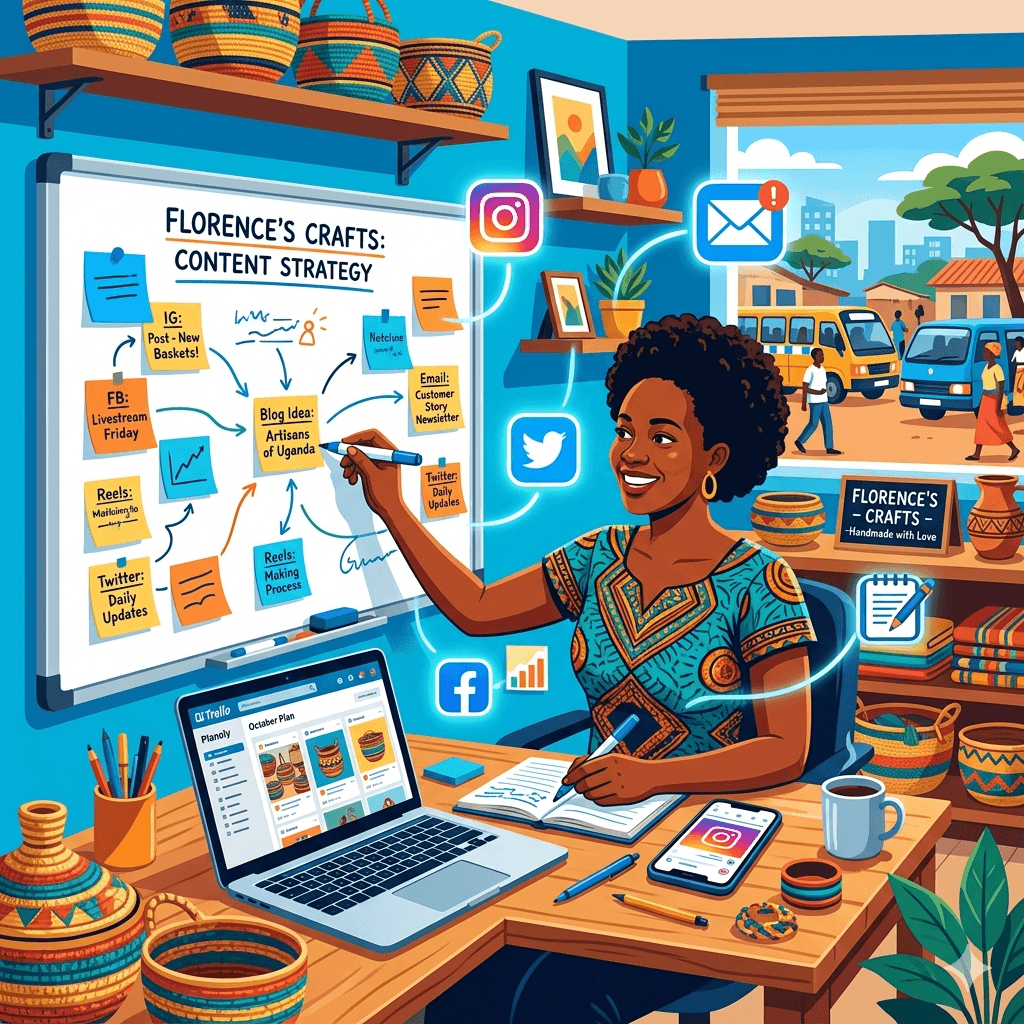
    A content calendar is simply a schedule that shows what content you will publish, on which platform, and when. It removes the daily stress of “what should I post today?” and helps you plan content around important dates, promotions, or seasonal events.

    You can create a content calendar using a free tool like Google Sheets or Trello. List the date, content type, topic, platform, and the person responsible for creating it. Even a simple monthly plan is better than no plan at all.

    6.3 Budget Allocation Across Channels

    When you are working with a tight budget, every shilling counts. Prioritise channels that give you the best return for the least cost. For most Ugandan SMEs, that means starting with a website or blog for SEO, Facebook and Instagram for organic social media reach, WhatsApp for customer communication, and email for nurturing existing leads.

    If you choose to invest in affordable digital marketing solutions for SMEs, make sure you are tracking results carefully so you know what is working and what is not.

    6.4 Content Repurposing Strategies

    Repurposing content is one of the smartest ways to stretch your budget. You create something once and then use it in multiple formats across multiple platforms. For example, one blog post can become a series of social media posts, a short video script, an email newsletter, and an infographic.

    This approach maximises the value of every piece of content you produce without requiring significantly more time or money. We will cover repurposing in more detail in the FAQs section below.

    7. Cost-Effective Tools for Content Creation

    You do not need to spend a fortune on content marketing tools. Many of the best tools available are free or offer generous free plans. Here are the content marketing tools for SMEs that you should know about:

    7.1 Graphic Design Tools

    Canva is the go-to tool for small businesses that need to produce professional visuals without hiring a designer. It offers thousands of templates for social media posts, flyers, presentations, infographics, and more. Adobe Express is another solid option with a free tier. Both are beginner-friendly and do not require design experience.

    7.2 Social Media Scheduling Tools

    Buffer and Later are popular scheduling tools that allow you to plan and automate your social media posts in advance. This means you can batch your content creation, schedule a week or two of posts in one sitting, and then focus on running your business. Both have free plans suitable for small businesses.

    Meta Business Suite is another free option that lets you manage and schedule content for both Facebook and Instagram from one place.

    7.3 SEO and Analytics Tools

    Google Analytics is completely free and gives you detailed insights into who is visiting your website, where they are coming from, and what they are doing on your site. Google Search Console is equally free and shows you which search terms bring people to your site. For optimising content on a budget with SEO, Ubersuggest also offers a free plan with keyword research features that are more than enough to get started.

    7.4 Free Stock Media Resources

    Great visuals make your content more engaging. If you do not have your own photos, use free stock photo sites like Unsplash, Pexels, or Pixabay. For free icons and illustrations, check out Flaticon and Freepik. Always choose images that reflect your Ugandan audience and context where possible, as relatable visuals perform better.

    8. Promoting Content on a Budget

     SME owner posting on social media, messages and engagement icons rising from phone

    Creating great content is only half the battle. You also need people to see it. The good news is that promotion does not have to cost much either.

    8.1 Organic Social Media Strategies

    Organic reach is free reach. Post consistently on the platforms where your audience spends time. Use relevant hashtags, engage with comments, and participate in conversations. Ask questions that encourage people to respond. The more engagement your posts get, the more platforms like Facebook and Instagram will show them to new people.

    Posting at the right time also matters. For Ugandan audiences, evenings from 7 PM to 9 PM and lunch hours tend to have higher engagement. Experiment and track what works best for your specific audience.

    8.2 Community Engagement and Networking

    Get involved in online communities where your target customers are. Join and actively participate in Facebook groups related to your industry or local area. Answer questions genuinely, share useful content from your blog, and build relationships without immediately pushing a sale.

    Offline networking matters too. Attend local business events, market days, and industry meetups. Word of mouth remains powerful in Uganda, and strong community connections can amplify your content reach significantly.

    8.3 Collaborations and Partnerships

    Find complementary businesses or content creators in your niche and explore collaboration opportunities. A bakery could partner with a wedding planner. A fitness trainer could collaborate with a nutritionist. Sharing each other’s content, doing joint livestreams, or writing guest posts for each other’s platforms lets both parties reach a new audience at zero cost.

    Micro-influencers, those with small but highly engaged followings, can also be valuable partners. Many will share content or collaborate in exchange for free products or services rather than cash.

    8.4 Affordable Paid Promotions

    When you are ready to invest a small amount in paid promotion, Facebook and Instagram ads offer excellent targeting options even with very small budgets. You can run a targeted campaign for as little as 20,000 to 50,000 Ugandan shillings per day and reach a precisely defined audience based on location, interests, and behaviour.

    Boost your best-performing organic posts rather than creating new ad campaigns from scratch. This way, you are already working with content you know your audience responds to.

    9. Measuring Content Marketing Success

    What gets measured gets improved. Tracking your content marketing performance helps you understand what is working, what is wasting your time, and where to focus your limited resources.

    9.1 Key Metrics to Track

    Depending on your goals, you will want to monitor different metrics. Common ones include:

    • Website traffic: How many people visit your site and which pages they view most.

    • Bounce rate: What percentage of visitors leave after viewing just one page. A high bounce rate might mean your content is not matching what visitors expected.

    • Engagement rate: Likes, comments, shares, and saves on social media posts.

    • Email open rate and click-through rate: How many people open your emails and how many click the links inside.

    • Conversion rate: The percentage of visitors who take a desired action, like filling out a contact form or making a purchase.

    • Lead generation: How many new enquiries or sign-ups your content is producing each month.

    9.2 Using Free Analytics Tools

    Google Analytics gives you in-depth website data at no cost. It shows you which blog posts drive the most traffic, which pages convert visitors into leads, and where your audience comes from. Facebook and Instagram have built-in Insights tools that show you how each post performs.

    For email, platforms like Mailchimp (free up to 500 subscribers) provide detailed open rate and click data. Set aside time each month to review your numbers and look for patterns.

    9.3 Adjusting Strategy Based on Data

    Data without action is useless. When you spot a blog post that is consistently bringing traffic, write more content on similar topics. When a particular type of social media post gets high engagement, create more of it. When an email subject line gets a great open rate, study what made it work and apply those principles to future emails.

    Content marketing is not a set-and-forget activity. It is a cycle of creating, publishing, measuring, and improving.

    10. Common Mistakes SMEs Make in Content Marketing

    SME owner overwhelmed by confused customers, thought bubbles show unmet needs

    Knowing what to avoid can save you a lot of time, money, and frustration. Here are the most common pitfalls that trip up small businesses in their content marketing journey:

    10.1 Ignoring Audience Research

    Creating content without understanding your audience is like cooking for guests without knowing what they like to eat. Many SMEs jump straight into content creation without first defining who they are talking to. The result is generic content that resonates with no one. Always start with your customer persona and let it guide every content decision you make.

    10.2 Inconsistent Posting

    Consistency is one of the most important factors in content marketing success. Posting intensely for two weeks and then going silent for a month sends the wrong signal to both your audience and search engines. You do not need to post every day. It is far better to publish one excellent piece of content per week consistently than to flood your channels and then disappear.

    10.3 Overcomplicating Content

    Content does not need to be perfect to be effective. Many small business owners overthink it and end up producing nothing at all. A short, genuine, helpful video shot on your phone can outperform a polished corporate production if it speaks directly to what your audience needs. Start simple and improve over time.

    10.4 Neglecting Measurement and Feedback

    Publishing content without checking whether it is working is one of the most common and costly mistakes. If you are not measuring results, you have no way of knowing what to do more of and what to stop doing. Set up Google Analytics, check your social media insights, and review your email statistics every month without fail.

    11. Frequently Asked Questions

    11.1 What is the best content type for SMEs with limited resources?

    Blog posts and social media content, particularly short videos and infographics, offer the best return for the least cost. Blog posts build long-term SEO value while social media gives you immediate reach. Start with whichever format feels most natural and sustainable for your team, then expand from there.

    11.2 How often should SMEs post content online?

    For social media, aim for at least three to five posts per week to maintain visibility. For blog content, one well-researched, long-form post per week is a strong target. For emails, once or twice a month is enough to stay top of mind without annoying your subscribers. Consistency always matters more than frequency.

    11.3 How can I measure ROI without expensive tools?

    You can track return on investment using completely free tools. Google Analytics shows website traffic and conversions. Google Search Console shows your search visibility. Facebook and Instagram Insights show engagement and reach. Mailchimp provides email performance data for free. Compare your results to your goals each month to assess what is working.

    11.4 Can social media alone drive enough leads for my SME?

    Social media can generate leads, but relying on it exclusively is risky. Platforms change their algorithms frequently, and your reach can drop overnight. A balanced approach works best: use social media to attract attention, then direct people to your website or email list where you have more control. Think of social media as the front door and your website as the home.

    11.5 How do I keep content creation affordable and consistent?

    Batch your content creation. Set aside a specific day each week or month to create multiple pieces of content at once. Use free tools like Canva for visuals and Buffer for scheduling. Repurpose existing content rather than always creating from scratch. And do not underestimate the value of simple, authentic content. You do not need expensive production to connect with your audience.

    11.6 What are some low-cost ways to increase content reach?

    Share your content across all your platforms every time you publish something new. Encourage employees, partners, and happy customers to share your content with their networks. Participate in relevant Facebook groups and community forums. Collaborate with other businesses or local influencers. These organic strategies cost nothing but can significantly expand your reach.

    11.7 Should I hire freelancers or handle content in-house?

    If you have someone on your team who enjoys writing or creating videos, start in-house. It is cheaper and often more authentic. If you lack the time or skills, hiring a freelance writer or social media manager can be cost-effective, especially if you give them a clear content brief and calendar. Many talented Ugandan freelancers offer competitive rates.

    11.8 How long before content marketing shows results?

    Content marketing is a long game. For SEO-focused blog content, you may start seeing meaningful traffic in three to six months. Social media can show engagement results within days if you are posting quality content. Email marketing tends to show results more quickly once you have built even a small list. Set realistic expectations and commit to at least six months of consistent effort before evaluating whether your strategy is working.

    11.9 How do I repurpose content without it feeling repetitive?

    The key to smart repurposing is changing the format and adjusting the framing for each platform. A blog post becomes a series of tweet-style tips for social media, a short explainer video, an infographic, and a segment in your email newsletter. Each version is adapted to feel native to its platform rather than copy-pasted. Your audience on Instagram is not the same as your blog readers, so the same core idea can serve them all differently.

    Conclusion

    A limited budget does not mean limited results. With the right content marketing strategy, even the smallest business in Uganda can build a meaningful online presence, attract loyal customers, and compete with much larger brands.

    The key is to start smart rather than big. Know your audience, choose the right content formats, plan consistently, use free or affordable tools, and always measure what you are doing. Each piece of content you create is an investment that compounds over time.

    If you are ready to take the next step and want expert help putting this into action, explore affordable digital marketing solutions for SMEs or read more about content marketing for SMEs on the Kico Web Design blog. You can also see examples of cost-effective digital strategies in action to get inspired by what is possible.

    And if you need low-cost e-commerce solutions for small businesses, or want to understand more about budget-friendly content strategies in action, the Kico Web Design team is ready to help you grow.

    Start today. Your future customers are searching for what you offer right now. Make sure they find you.

  • How to Master Content Creation in Uganda: A Complete Guide

    How to Master Content Creation in Uganda: A Complete Guide

    If you’re running a business in Uganda today, you’ve probably heard someone say “you need to create content.” But what does that actually mean? And more importantly, how do you do it well enough to grow your business?

    Content creation isn’t just about posting pretty pictures on social media or filling up your website with words. It’s about connecting with real people who might become your customers. In Uganda’s rapidly growing digital space, businesses that master content creation are the ones that get found, trusted, and chosen over their competitors.

    This guide will walk you through everything you need to know about content creation in Uganda from understanding your audience to measuring your results. Whether you’re just starting out or looking to improve what you’re already doing, you’ll find practical steps you can use right away.

    What Content Creation Means for Ugandan Businesses

    Content creation is simply the process of producing material that informs, entertains, or persuades your potential customers. Think of it as having a conversation with your audience, but through written words, images, videos, or social media posts.

    For a Ugandan business, this might mean writing blog posts about how your products solve local problems, creating social media updates that speak to everyday experiences in Kampala or Mbale, or developing website pages that explain your services in clear, simple language.

    The beauty of content creation in Uganda is that it levels the playing field. A small shop in Jinja can reach customers across the country or even across East Africa without needing a massive advertising budget. You just need to create content that resonates with the people you want to reach.

    Good business content does three things: it educates people about what you offer, builds trust in your brand, and motivates people to take action whether that’s making a purchase, booking a consultation, or simply remembering your name when they need what you sell.

    Why Content Creation Matters in Uganda’s Digital Market

    Uganda’s internet landscape has changed dramatically over the past few years. More people are searching for products and services online before making purchase decisions. Your potential customers are scrolling through Facebook during their commute, searching Google for “best plumber in Kampala,” or reading blogs to solve their business problems.

    If your business isn’t creating content, you’re invisible to these people. It’s that simple. Your competitors who are publishing helpful blog posts, engaging social media content, and clear website copy are the ones capturing attention and winning customers.

    Content marketing Uganda strategies work because they build relationships over time. Unlike a billboard that someone sees once and forgets, a helpful blog article can bring visitors to your website for months or even years. A well-crafted social media post can be shared across networks, extending your reach far beyond what you could afford through paid advertising alone.

    The digital market is also where trust is built today. When someone searches for information and finds your business providing clear, helpful answers, you become the expert in their mind. This trust is invaluable it’s what turns a casual browser into a paying customer.

    Looking ahead, the content creation future in Uganda points toward even more opportunity. As internet access expands and more Ugandans come online, the businesses that have already established themselves through consistent, quality content will be positioned to capture this growing market.

    Understanding the Ugandan Online Audience

    A diverse group of Ugandan internet users interacting with mobile phones and laptops

    Creating content without understanding your audience is like cooking a meal for someone without knowing what they like to eat. You might get lucky, but you’ll probably miss the mark.

    The Ugandan online audience is diverse. You have young professionals in Kampala searching for business solutions, entrepreneurs in regional towns looking for suppliers, parents seeking educational services, and everyone in between. But they share some common characteristics that should shape how you create content.

    First, most of your audience is accessing the internet through mobile phones. This means your content needs to be mobile-friendly easy to read on small screens, quick to load even on slower connections, and formatted for scrolling rather than prolonged reading sessions.

    Second, your audience values practical information over fancy language. Ugandans appreciate straightforward communication that gets to the point and solves real problems. They’re looking for answers to specific questions: “How much does this cost?” “Where can I find this service?” “How will this help my business?”

    Third, trust is earned through consistency and authenticity. Your audience can spot corporate jargon and empty marketing speak from a mile away. They respond better to content that feels like it’s written by a real person who understands their challenges and genuinely wants to help.

    Local Search Behavior and Internet Usage

    When Ugandans search online, they often include location-specific terms. Someone in Entebbe won’t just search for “web design services” they’ll search for “web design services in Entebbe” or “website designers near me.”

    This local search behavior means your content should speak directly to specific locations when relevant. If you serve multiple areas, create content that addresses each community’s unique needs and concerns.

    People also tend to search in questions: “How do I start a business in Uganda?” “What are the best marketing strategies for small businesses?” Creating content that directly answers these common questions positions you as a helpful resource rather than just another business trying to make a sale.

    Language, Culture, and Tone Considerations

    While English is widely used in Ugandan business, the way people communicate varies across different regions and demographics. Your content should use clear, simple English that anyone can understand avoiding complex vocabulary or idioms that might confuse some readers.

    Cultural context matters too. References to local experiences, challenges, and aspirations make your content more relatable. Mentioning the realities of doing business in Uganda from power outages to mobile money transactions shows you understand your audience’s world.

    The right tone strikes a balance between professional and approachable. You want to sound knowledgeable without being condescending, friendly without being unprofessional. Think of it as talking to a respected colleague over lunch rather than delivering a formal presentation.

    Types of Content That Work Best in Uganda

    A categorized layout showing website pages, blogs, and social media posts grouped clearly

    Not all content types deliver the same results. In Uganda’s digital market, three main content categories consistently drive business growth: website content, blog articles, and social media posts. Understanding when and how to use each one is key to content creation for small businesses in Uganda.

    The website vs social debate is important, but the truth is you need both. They serve different purposes and work together to build your online presence. Your website is your home base the place where serious customers go to learn about you and make decisions. Social media is where you build awareness and stay top-of-mind.

    Think of your content strategy like a fishing net. Website content is the sturdy frame that holds everything together. Blog articles are the mesh that captures searchers looking for information. Social media content is the bait that attracts attention and draws people toward the net. You need all three working together.

    Website Content

    Your website content is the foundation of your online presence. This includes your home page, about page, service descriptions, and any other permanent pages on your site. Website content writing Uganda professionals know this content must accomplish two goals: explain what you do clearly enough that visitors understand immediately, and convince them you’re the right choice.

    Good website content answers the basic questions every visitor has: What do you offer? Who do you serve? Why should I choose you? How do I get started? It should be organized logically, easy to scan, and focused on benefits rather than just features.

    Blog Articles

    Blog writing services Uganda help businesses create long-form content that addresses specific topics, answers common questions, and provides real value to readers. Blog articles are powerful because they attract people who are actively searching for information often before they’re ready to buy.

    When someone searches “how to improve my business marketing” and finds your helpful blog post, you’ve just introduced your business to a potential customer at the exact moment they need your expertise. Even if they don’t hire you today, you’ve started building trust.

    Social Media Content

    Social media content creation Uganda focuses on shorter, more frequent posts designed to engage your existing audience and attract new followers. This content keeps your business visible and builds relationships over time.

    Social media posts can highlight your latest blog article, share quick tips, announce special offers, or simply remind people you exist. The key is consistency posting regularly so your audience sees your business as active and reliable.

    How to Create Effective Content Step by Step

    Creating content that actually helps your business grow isn’t complicated, but it does require a systematic approach. These five steps will guide you through the process of creating digital content creation Uganda businesses can use to attract and convert customers.

    Define Your Business Goals

    Before you write a single word, ask yourself: What do I want this content to achieve? Are you trying to attract new customers? Establish yourself as an expert? Explain a complex service? Different goals require different content approaches.

    A clear goal keeps your content focused. If you’re trying to attract customers searching for accounting services, your content should address their specific concerns and questions. If you’re building thought leadership, you might create more in-depth educational content.

    Write down your specific goal for each piece of content. This simple step will dramatically improve the quality and effectiveness of everything you create.

    Know Your Target Audience

    Who are you talking to? The entrepreneur struggling to manage their finances? The HR manager looking for recruitment services? The homeowner planning a renovation? Your content should feel like it’s speaking directly to one specific type of person.

    Create a mental picture of your ideal customer. What problems keep them up at night? What questions do they ask? What language do they use? The more specific you can be, the more your content will resonate.

    This doesn’t mean excluding other potential customers it means making your message strong enough that your ideal customer feels like you truly understand them.

    Choose the Right Content Type

    Not every message needs a blog post, and not every topic fits a social media update. Match your content type to your message and your audience’s needs.

    Quick tips and updates? Social media. Detailed explanations and how-to guides? Blog articles. Core business information and service descriptions? Website pages. Thinking through this match prevents wasted effort on content that doesn’t serve its purpose.

    Write Clear and Simple Messages

    Complicated language doesn’t make you sound smarter it makes you harder to understand. Use short sentences. Explain one idea at a time. Replace technical terms with everyday words your grandmother would understand.

    Professional content writers in Uganda know that clarity beats cleverness every time. Your goal isn’t to impress readers with your vocabulary; it’s to help them understand your message so quickly and clearly that they can make a decision.

    Read your content out loud. If you stumble over a sentence, your readers will too. Simplify until it flows naturally.

    Publish and Promote Consistently

    Creating great content means nothing if nobody sees it. Once you publish something, promote it. Share it on social media. Send it to your email list. Reference it in conversations with customers. Good content can work for your business for years, but only if people can find it.

    Consistency matters more than perfection. Publishing helpful content every week builds momentum and trust. Waiting until you have the “perfect” article means you’re losing opportunities right now to connect with potential customers.

    Basics of SEO for Content Creation in Uganda

    Search engine results pages with highlighted content ranking higher

    Search Engine Optimization might sound technical, but the basics are simple enough for any business owner to understand and apply. SEO content writing Uganda techniques help your content get found by people actively searching for what you offer.

    Understanding local SEO basics gives you an advantage in Uganda’s growing digital market. While your competitors are creating content randomly, you can create content strategically content that search engines recognize as relevant and valuable.

    Keyword Use for Local Searches

    Keywords are simply the words and phrases people type into search engines. If someone searches “plumbing services in Kampala,” those four words are a keyword phrase. Your job is to identify which keywords your potential customers use, then include those keywords naturally in your content.

    For SEO services for Ugandan businesses, local keywords are gold. Adding location terms to your content “Kampala,” “Uganda,” “Entebbe,” or specific neighborhoods helps you show up when people search for services in your area.

    But here’s the important part: keywords must fit naturally into your writing. Don’t force them in awkwardly or repeat them excessively. Write for people first, then make sure you’ve included relevant keywords where they make sense. Search engines are smart enough to recognize when you’re writing naturally about a topic versus when you’re just stuffing keywords.

    Think about the questions your customers ask and the words they use. Those questions and words should appear in your content. If customers ask “How much does website design cost in Uganda?” create content that answers that exact question using similar language.

    Writing for Both Search Engines and People

    The best content serves two masters: it gives search engines the signals they need to understand and rank your content, while giving real people the information they actually want.

    Start with clear, descriptive titles that include your main keyword. Use headings to break up your content and make it scannable. Include your target keywords in the first paragraph when possible. Link to other relevant content on your website. These simple practices help search engines understand what your content is about.

    But never sacrifice readability for SEO. If a sentence sounds awkward because you forced in a keyword, rewrite it. If you’re repeating the same phrase too often, find natural variations. Remember, your ultimate goal is to help people, not to trick algorithms.

    The beautiful truth about modern SEO is that what’s good for people is usually good for search engines too. Create genuinely helpful content, structure it clearly, and include the words people actually search for. That’s 90% of what you need to know.

    Common Content Creation Mistakes to Avoid

    Even with the best intentions, businesses make predictable mistakes that undermine their online marketing content Uganda efforts. Recognizing these pitfalls helps you avoid wasting time and resources.

    The biggest mistake is creating content without a clear purpose. Writing blog posts “because someone said we should have a blog” leads to random, unfocused content that doesn’t achieve anything. Every piece of content should have a specific goal and a specific audience.

    Another common error is inconsistency. Publishing five blog posts in one month, then nothing for six months, confuses your audience and wastes the momentum you built. It’s better to publish one helpful article per month consistently than to have sporadic bursts of activity.

    Many businesses also make their content too focused on themselves all “we” and “our services” with nothing about the customer’s needs and challenges. Content that works is customer-focused. It addresses their problems, answers their questions, and helps them make better decisions.

    Ignoring proper formatting makes even good content hard to read. Long paragraphs without breaks, no headings or subheadings, tiny font sizes these all push readers away. Break up your text, use headings, add white space, and make your content visually comfortable to read.

    Finally, not measuring results means you’re flying blind. If you don’t know which content attracts visitors, generates leads, or drives sales, you can’t improve. Track basic metrics like page views, time on page, and conversions to understand what’s working.

    Tools and Resources for Content Creation

    A toolkit of digital tools like calendars, analytics dashboards

    You don’t need expensive tools to create effective business content writing Uganda materials, but the right resources can make the process easier and your results better.

    For writing and editing, tools like Grammarly help catch spelling and grammar errors that might make you look unprofessional. Google Docs provides a free, accessible platform for drafting and collaborating on content. Even basic tools like these can significantly improve your content quality.

    For keyword research, Google’s autocomplete feature shows you what people are actually searching for. Start typing a relevant phrase and see what suggestions appear these are real searches that people make regularly. Google Trends helps you understand which topics are growing in interest.

    Modern AI tools can assist with brainstorming ideas, creating outlines, and even drafting initial versions of content. However, AI-generated content still needs human review and editing to ensure it sounds natural and addresses your specific audience’s needs.

    For visual content, Canva offers easy-to-use design templates for social media posts, infographics, and simple graphics. Even without design skills, you can create professional-looking visuals that enhance your written content.

    Analytics tools are crucial for understanding performance. Google Analytics shows you which content attracts visitors and how they behave on your site. Most social media platforms include built-in analytics that reveal which posts resonate with your audience.

    The most important resource, however, is your own knowledge and experience. Your understanding of your customers, your industry, and your local market is irreplaceable. Technology can make you more efficient, but it can’t replace the insights that come from actually running a business in Uganda.

    When to Hire Professional Content Creators

    As your business grows, you’ll face a critical question: Should you continue creating content yourself, or should you bring in professional help? There’s no universal answer, but several factors can guide your decision.

    Time is often the deciding factor. Creating quality content consistently requires significant time investment time that might be better spent serving customers or managing your business operations. If content creation is pulling you away from activities that generate more revenue, outsourcing makes financial sense.

    Quality is another consideration. Professional content writers in Uganda bring expertise in crafting clear, persuasive messages and optimizing content for search engines. If your DIY content isn’t generating results, professional help might be the breakthrough you need.

    Strategy matters too. Professional digital marketing services can develop comprehensive content strategies aligned with your business goals, rather than the ad-hoc approach many businesses take when creating content themselves.

    However, outsourcing isn’t always necessary. If you enjoy writing, have the time, and your content is achieving your goals, continuing to create content yourself makes perfect sense. You can also take a hybrid approach handling some content internally while outsourcing specialized or time-intensive projects.

    When evaluating affordable content writing services in Uganda, look for providers who take time to understand your business, ask questions about your audience, and show examples of previous work. The cheapest option isn’t always the best value if the quality doesn’t meet your needs.

    Measuring Content Performance and Results

    Creating content without measuring its impact is like driving with your eyes closed. You might move forward, but you have no idea if you’re heading in the right direction. Content creation services Uganda professionals know that tracking performance is essential for improvement.

    Start with clear metrics tied to your business goals. If your goal is to attract more website visitors, track page views and unique visitors. If you want to generate leads, measure form submissions and contact requests. If you’re building authority, monitor social shares and comments.

    Google Analytics provides detailed information about how people find and interact with your content. Which blog posts attract the most visitors? Which pages keep people reading longest? Where do people come from before landing on your content? These insights guide your future content decisions.

    Engagement metrics reveal how your audience responds to content. Are people reading your entire blog post or bouncing after a few seconds? Are they sharing your social media content or scrolling past it? High engagement indicates you’re creating content that resonates.

    Conversion tracking shows which content actually drives business results. Does that helpful blog post lead to consultation requests? Do social media posts drive traffic to your product pages? Content that looks successful by engagement metrics but doesn’t convert needs rethinking.

    Don’t overcomplicate measurement, especially when you’re starting out. Pick three to five key metrics that align with your goals, check them monthly, and use what you learn to improve your next content. Over time, you’ll develop a clear understanding of what works for your specific business and audience.

    Frequently Asked Questions

    What type of content works best for small businesses in Uganda?

    For most small businesses in Uganda, a combination of clear website content and practical blog articles delivers the best results. Your website content should explain what you do and why customers should choose you, while blog articles attract people searching for information related to your expertise. Social media content works well for staying visible and building relationships, but it should complement rather than replace your website content.

    How often should a business publish new content?

    Quality beats quantity every time. Publishing one well-crafted, helpful blog post per month is better than publishing four rushed, low-quality posts. For social media, aim for at least three to five posts per week to maintain visibility. The key is consistency establish a schedule you can maintain long-term rather than burning out with an unsustainable pace.

    Is SEO content important for local Ugandan businesses?

    Absolutely. Even if you only serve customers in Kampala or your local area, SEO content writing Uganda techniques help those local customers find you when they search online. Local SEO optimizing content for location-specific searches can dramatically increase your visibility to people actively looking for services like yours in your area.

    Can social media content replace website content?

    No. Social media platforms are rented space you don’t control them, and algorithms determine who sees your content. Your website is digital real estate you own. Social media is excellent for awareness and engagement, but serious customers want to visit a professional website before making business decisions. The two work together; neither fully replaces the other.

    How long does it take to see results from content creation?

    Content marketing is a long-term strategy. You might see some quick wins a blog post that immediately ranks well or a social media post that goes viral but sustainable results typically take three to six months of consistent effort. The advantage is that good content continues working for you long after you publish it, unlike advertising that stops the moment you stop paying.

    Should content be written in English or local languages?

    For business content in Uganda, English reaches the widest audience and works best for most companies. However, if your target audience primarily speaks Luganda or another local language, creating content in that language can be powerful. Consider your specific audience and where they’re most comfortable. For many businesses, English content with local cultural references strikes the right balance.

    Is it better to create content in-house or outsource it?

    It depends on your resources and priorities. In-house content creation gives you more control and can be more cost-effective if you have the time and skills. Outsourcing to content creation services Uganda professionals saves time and often delivers higher quality results, especially for SEO-optimized content. Many businesses find a hybrid approach works best handling simple social media updates internally while outsourcing strategic blog articles and website content.

    Mastering content creation in Uganda isn’t about having perfect writing skills or the biggest budget. It’s about understanding your audience, creating genuinely helpful material, and staying consistent over time. Whether you choose to create content yourself or work with professionals, the businesses that commit to quality content creation are the ones that will dominate Uganda’s growing digital marketplace in the years ahead.