
Tag: Digital Marketing Uganda

  • How Kico Web Design Builds Websites Differently from Other Uganda Agencies 

    How Kico Web Design Builds Websites Differently from Other Uganda Agencies 

    If you have ever searched for web design in Uganda, you already know the landscape can feel overwhelming. There are dozens of agencies, freelancers, and one-person shops all promising beautiful websites at competitive prices. But here is the truth: not all websites are built the same, and not all agencies approach the work with the same level of care.

    A great business website is not just about good looks. It needs to load fast, work perfectly on mobile phones, show up on Google, and actually turn visitors into customers. In today’s competitive Ugandan market, a website that only looks nice but fails to perform is not much better than having no website at all.

    This is where Kico Web Design stands apart. While many agencies in Uganda focus on delivering a finished design and moving on, Kico takes a different path. Every project starts with strategy, runs through careful planning, and ends with a website built to grow your business. In this article, we will break down exactly how that difference plays out in real projects and why it matters for your business.

    1. What Makes a Website Trustworthy in Uganda

    Trust is everything in business. Before a potential customer picks up the phone or fills in a contact form, they make a quick judgment about your business based on your website. If it looks outdated, loads slowly, or breaks on their phone, they are gone in seconds.

    So what actually makes a website trustworthy for a Ugandan audience? Let us start with the basics.

    Clean and Professional Visual Design

    A cluttered website sends the wrong message. When someone lands on your page and sees too many colors, mismatched fonts, and low-quality images, their brain registers it as unprofessional. Clean design, on the other hand, says: this business is organized, serious, and worth my time.

    Mobile-First Responsiveness

    The majority of internet users in Uganda browse on smartphones. If your website does not adapt to smaller screens, you are instantly losing a massive chunk of your potential customers. Good UI/UX design ensures your site feels natural and easy to use on any device, whether someone is visiting from a Kampala office desktop or a phone in Gulu.

    Fast Loading Speeds for Local Internet Conditions

    Uganda’s internet infrastructure, while improving, still has moments of slow connectivity. A website that takes more than three seconds to load will lose visitors before they even see your homepage. Performance optimization is not optional here. It is a baseline requirement for any professional website design in Uganda.

    Clear Contact Information and Credibility Signals

    Trust signals matter deeply. Things like a visible phone number, a physical address, clear social media links, customer reviews, and a professional email address all tell visitors that you are a real business they can reach. A website missing these details raises instant red flags.

    2. How Kico Web Design Approaches Website Strategy

    A strategic planning session showing UX designers mapping user journeys on a large digital board

    Most web design agencies in Uganda jump straight into design. You share your logo and brand colors, they build something that looks decent, hand it over, and the job is done. Kico Web Design works differently from the very first conversation.

    User-Focused Planning Before Design Begins

    Before a single pixel is placed, Kico starts by asking questions about your business. Who are your customers? What actions do you want people to take on your site? What problems are you solving? This discovery phase ensures the website is built around real user needs, not just personal preferences.

    Aligning Websites with Business Goals

    Every business has different goals. A restaurant wants reservations and foot traffic. A consultancy wants enquiry calls and email leads. An e-commerce shop wants product purchases. Kico builds websites that are specifically designed to support your unique goals, whether that means sales, leads, brand awareness, or all three. This is professional website design Uganda businesses can actually use as a business tool.

    Research into Ugandan Customer Behavior and Expectations

    Understanding how Ugandan users interact with websites is a key part of Kico’s process. Local customers tend to prefer WhatsApp for quick inquiries over email. They respond well to social proof like testimonials. They need reassurance that your business is real and accessible. Kico builds these local behavioral insights directly into the website structure and content.

    Emphasis on Conversion-Driven Structure

    Conversion-focused website design means every element on the page has a purpose. Headlines guide attention. Buttons lead visitors to the next step. Contact forms are short and easy. Content answers the questions customers are already asking. This approach turns your website from a digital brochure into an active sales tool.

    3. Differences Between Kico Web Design and Other Agencies
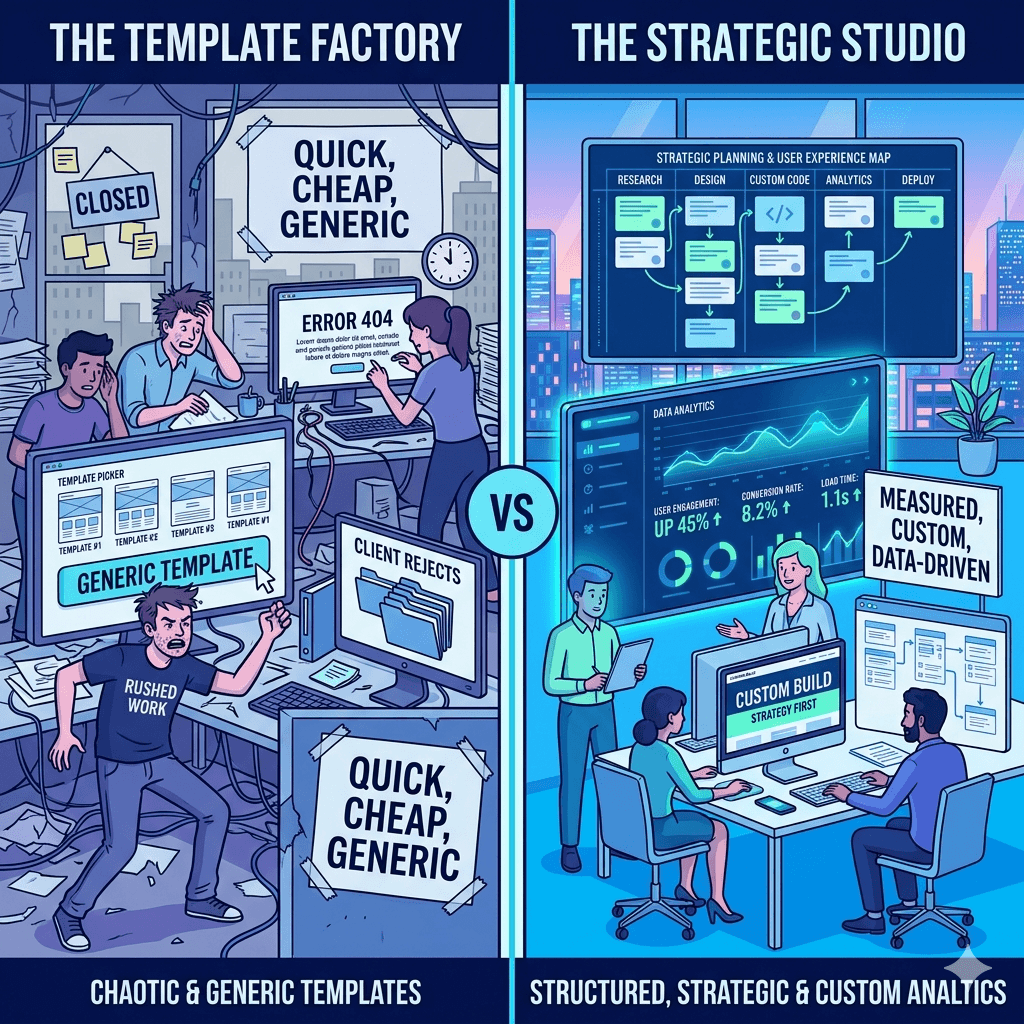
    A comparison split screen showing two web agencies one chaotic with generic templates

    Let us get specific. When you compare Kico Web Design to many other website design companies in Uganda, several key differences stand out clearly.

    Strategy-First vs Design-Only Approach

    A design-only agency hands you something that looks good. A strategy-first agency like Kico hands you something that works. The difference shows up in your website analytics, your enquiry volume, and your search engine rankings. Pretty without purpose is just decoration.

    Custom Solutions vs Template-Heavy Builds

    Many agencies in Uganda rely heavily on pre-built templates. These are fast to set up but come with serious limitations. They are rarely optimized for performance, they look generic, and they are hard to customize as your business grows. Kico builds custom website design Uganda businesses actually own and control. For a closer look at why this matters, explore the comparison of website platforms and how each stacks up against real business needs.

    Focus on Local Market Behavior vs Generic Global Designs

    A website designed for a European or American audience will not automatically work in Uganda. Customer expectations, internet speeds, device types, payment preferences, and communication habits are all different here. Kico builds websites with the Ugandan market in mind from day one. This local expertise is one of the things that makes Kico one of the best web design companies in Uganda for locally-focused businesses.

    Stronger Emphasis on Performance and SEO Readiness

    SEO web design Uganda businesses need goes beyond just adding keywords. Kico integrates SEO best practices into the website architecture itself. This includes proper heading structures, fast-loading code, mobile responsiveness, metadata optimization, and clean URL structures. All of this helps your website show up when potential customers are searching online.

    Ongoing Support and Optimization vs One-Time Delivery

    Many agencies disappear after they hand over your website. Kico offers ongoing support and optimization to ensure your site continues to perform well as your business evolves. This long-term relationship approach makes a real difference for small businesses that do not have in-house technical teams.

    4. Key Features Included in Kico Web Design Projects

    When you work with Kico Web Design Uganda, you are not just getting a website. You are getting a carefully assembled set of features designed to make your online presence strong from day one.

    Mobile Optimization and Responsive Layouts

    Every website Kico builds is fully responsive. That means it adjusts automatically to look great on smartphones, tablets, and desktop screens. Given that most Ugandan internet users are on mobile, this is non-negotiable for any professional website design Uganda business owners should expect.

    SEO-Friendly Structure and Metadata Setup

    Kico sets up your website with proper on-page SEO from the start. This includes optimized page titles, meta descriptions, alt text on images, proper heading hierarchy, and schema markup where applicable. Getting this right from the beginning saves businesses significant time and money later.

    Secure Hosting and Performance Optimization

    A slow or insecure website is a liability. Kico recommends and sets up reliable hosting solutions, installs SSL certificates for security, and optimizes images and code for speed. If you want to understand more about the technical side of this, there is a detailed guide on website speed that explains exactly what good performance looks like for Uganda’s unique internet conditions.

    Conversion-Focused Landing Pages

    Whether you need a product page, a service overview, or a lead capture page, Kico designs pages with conversion as the primary goal. Every section is intentional, every call to action is tested, and every form is optimized for completion.

    Integration with Social Media and WhatsApp Contact Tools

    Ugandan customers love WhatsApp. Kico integrates WhatsApp chat buttons, social media feeds, and sharing tools directly into your website. This makes it seamless for customers to reach you the way they prefer, which means more conversions and fewer missed opportunities.

    5. Benefits for Ugandan Businesses Working with a Strategy-Driven Agency

    Ugandan business owner celebrating increased online sales as a website dashboard shows rising traffic, leads, and conversions represented by upward glowing graphs and icons

    Choosing a strategy-first web development Uganda partner does not just give you a better website. It gives you a business advantage.

    Increased Customer Trust and Engagement

    When your website looks professional, loads fast, and answers customer questions clearly, people stay longer and trust you more. That trust is the first step toward a sale.

    Higher Conversion Rates from Website Traffic

    A conversion-focused website design turns more of your visitors into actual leads or customers. Even a small improvement in conversion rate can have a massive impact on your revenue over time.

    Better Visibility on Search Engines

    A well-built website that follows SEO best practices will rank higher on Google. More visibility means more organic traffic without spending money on ads. To build on this, a solid SEO strategy alongside good web design creates a powerful combination for long-term growth.

    Improved Brand Credibility in Competitive Markets

    In competitive industries like finance, hospitality, real estate, and professional services, a strong online presence signals that your business is serious. It sets you apart from competitors still relying on social media alone.

    Long-Term Scalability of Digital Presence

    A well-architected website grows with your business. Adding new pages, products, blog posts, or services is easy when the foundation is built correctly. This is the kind of long-term thinking that defines affordable web design Uganda businesses can actually rely on for years.

    6. Common Mistakes Ugandan Businesses Make with Websites

    A chaotic website dashboard showing slow loading symbols, broken layouts, and confusing navigation elements

    Understanding what not to do is just as important as knowing what to do. Here are some of the most common website mistakes we see from businesses across Uganda.

    Using Outdated or Poorly Optimized Templates

    Free or cheap templates might seem like a good deal upfront, but they often come loaded with bloated code, poor security, and zero customization. They look generic and rarely convert well. Custom website design Uganda businesses invest in pays for itself quickly in better results.

    Ignoring Mobile Users

    A website that only looks good on a desktop is leaving money on the table. With smartphone usage dominating internet access in Uganda, mobile-friendly website design Uganda businesses need is an absolute must.

    Lack of Clear Calls-to-Action

    Many websites are built with no clear direction for the visitor. What should they do next? If your website does not tell people to call, book, buy, or enquire, most of them will simply leave without doing anything.

    Slow Hosting and Poor Performance

    Budget hosting might save money upfront, but a slow-loading website frustrates users and hurts your Google rankings. Fast loading website Uganda standards require solid hosting infrastructure and proper technical optimization.

    Not Optimizing for Local Search Intent

    Many businesses build websites without thinking about how local customers actually search. Phrases like “web design services Kampala” or “best restaurant in Nakasero” reflect how people search in Uganda. Ignoring local SEO means missing highly relevant, ready-to-buy traffic.

    7. How to Choose the Right Web Design Partner in Uganda

    Not all web design agencies in Uganda are created equal. Here is what to look for when making your decision.

    Evaluating Portfolio and Past Work Quality

    Always ask to see examples of websites the agency has built. Look for clean design, fast loading, mobile responsiveness, and clear calls to action. If their own website is slow or looks dated, that tells you something.

    Checking SEO and Performance Understanding

    A good website design company in Uganda should be able to talk about SEO, page speed, and mobile performance without needing to look anything up. If they only talk about colors and layouts, be cautious.

    Assessing Communication and Support Services

    Will they be available after the website launches? Do they offer ongoing maintenance? Clear, responsive communication before the project starts is a good indicator of how things will go after.

    Understanding Pricing vs Value Offered

    The cheapest option is rarely the best one. Focus on value, not just price. A slightly higher investment in a strategy-driven agency can deliver returns that far outweigh the cost difference.

    Looking for Local Market Experience

    An agency that understands Ugandan consumers, local internet infrastructure, and regional business culture will always do better work than one using a generic global playbook. For a comprehensive guide on making this decision, read this detailed piece on choosing agency that walks you through the full evaluation process.

    8. Future of Website Design for Ugandan Businesses

    A futuristic cityscape of Kampala with glowing digital websites floating above buildings, representing the rise of online business ecosystems and digital transformation

    The digital landscape in Uganda is evolving fast, and website design is changing with it. Here is what to expect in the coming years.

    Rise of AI-Assisted Web Development

    Artificial intelligence tools are making it easier and faster to build certain parts of websites. However, strategy, creativity, and local market understanding remain deeply human skills. Agencies that combine AI efficiency with human expertise will have a clear edge.

    Increased Focus on Mobile-First and Speed Optimization

    As mobile internet usage continues to grow in Uganda, mobile-first design will shift from being a best practice to an absolute baseline. Responsive website design Uganda businesses invest in now will be even more critical tomorrow.

    Growth of E-Commerce and Online Service Platforms

    More Ugandan businesses are moving sales and services online. Ecommerce website development Uganda is growing quickly across retail, food delivery, hospitality, and professional services. Businesses that build strong e-commerce foundations now will have a major head start.

    Stronger Competition Requiring Better UX and Branding

    As more businesses get online, standing out will require more than just having a website. Superior user experience, strong branding, and genuine value for visitors will separate the winners from the crowd. This is exactly why the strategy-first approach that defines Kico Web Design is only going to become more valuable over time.

    9. Frequently Asked Questions

    What makes a good business website in Uganda?

    A good business website in Uganda is fast, mobile-friendly, easy to navigate, and clear about what your business offers and how to contact you. It should also be optimized for search engines so customers can find you on Google.

    How long does it take to build a professional website?

    A basic professional website typically takes two to four weeks. More complex websites with multiple pages, e-commerce functionality, or custom features can take six to ten weeks depending on the scope and how quickly content is provided.

    Why is mobile optimization important for Ugandan users?

    The majority of internet users in Uganda access websites through smartphones. If your website does not work well on mobile devices, you will lose most of your potential customers before they even read what you offer.

    Do small businesses really need SEO for their website?

    Yes. SEO helps your website show up when people search for the products or services you offer. Without it, your website relies entirely on word-of-mouth and social media to bring in visitors. With SEO, you get a steady stream of free, targeted traffic from people already looking for what you sell.

    How much does professional website design cost in Uganda?

    Costs vary depending on the complexity of the project. A basic professional website for a small business in Uganda typically ranges from a few hundred thousand to a few million Ugandan shillings. The key is to focus on the value delivered, not just the upfront price.

    What is the difference between custom and template websites?

    Template websites use pre-built designs that are quick to set up but limited in flexibility and originality. Custom websites are built specifically for your business, your audience, and your goals. They perform better, look more professional, and give you full ownership of your digital presence.

    How can a website help increase customer trust?

    A professional website with clear contact information, customer testimonials, a secure connection (https), and high-quality images sends a strong signal that your business is legitimate and serious. It removes doubt and makes people more comfortable reaching out.

    Can I update my website after it is built?

    Yes. Most professional websites are built on content management systems that allow you to update text, images, and pages without technical knowledge. Your agency should also provide training and ongoing support if needed.

    What platforms are best for business websites?

    WordPress is the most widely used platform for professional business websites in Uganda because of its flexibility, SEO capabilities, and large support community. Other options like Shopify are great for e-commerce. The best choice depends on your business type and goals.

    How do I know if my website is performing well?

    You can measure website performance using tools like Google Analytics and Google Search Console. Key indicators include the number of monthly visitors, how long people stay on your site, how many enquiries or sales you generate, and where your pages rank on Google.

    Final Thoughts

    The difference between a website that looks good and one that actually works for your business comes down to strategy, local knowledge, and technical execution. Kico Web Design Uganda brings all three together in every project.

    Whether you are starting from scratch, looking for a website redesign services Uganda agency you can trust, or simply trying to make your existing website perform better, working with a team that understands your market and your goals makes all the difference.

    Your website is often the first impression your business makes. Make it count.

  • Content Marketing Strategy for Ugandan SMEs on a Budget

    Content Marketing Strategy for Ugandan SMEs on a Budget

    1. Introduction

    Running a small or medium-sized business in Uganda is no small feat. Between managing operations, keeping customers happy, and watching every shilling, marketing can easily fall to the bottom of the priority list. But here is the thing: if people do not know your business exists, it does not matter how great your product or service is.

    The good news? You do not need a massive budget to market your business effectively. A smart content marketing strategy can help you reach more customers, build trust, and grow your brand, all without breaking the bank.

    Think of content marketing like planting a garden. You put in the work upfront, water it consistently, and over time it produces fruit. Paid advertising is more like buying fruit from a market, the moment you stop spending, the supply stops. Content, on the other hand, keeps working for you long after you have created it.

    In this guide, you will find everything you need to build a content marketing plan for small business owners in Uganda. Whether you are just getting started or looking to sharpen what you are already doing, this article gives you practical, low-cost steps you can apply right away.

    2. What Is Content Marketing?

    Explaining Content Marketing Simply

Illustration of a small SME owner

    Content marketing is the practice of creating and sharing useful, relevant information to attract and keep a specific audience, and ultimately drive profitable customer action.

    Instead of interrupting people with ads, you give them something they actually want: answers to their questions, tips that solve their problems, stories that connect with their experiences.

    For example, a Ugandan salon owner who writes a blog post titled “How to Care for Natural Hair in Uganda’s Climate” is practising content marketing. That post helps potential clients find her on Google, positions her as an expert, and builds trust before the client ever walks through her door. This is one of the most effective budget content marketing ideas you can start with today.

    For SMEs with limited resources, content marketing is especially valuable because it focuses on creating lasting value rather than spending on every campaign.

    3. Benefits of Content Marketing for SMEs

    Before you invest time and energy into any strategy, it helps to understand what you stand to gain. Here are the key benefits that make content marketing worth it for small and medium businesses:

    • Cost-effectiveness: Compared to traditional advertising like radio spots or billboards, content marketing costs far less. A blog post or a social media video can reach thousands of people for almost nothing.

    • Brand awareness: Consistently sharing quality content puts your business in front of more people and keeps it top of mind.

    • Lead generation: Good content attracts potential customers who are already searching for what you offer. These are warm leads, people who come to you instead of you chasing them.

    • Trust and credibility: When you consistently share helpful content, people begin to see you as an authority in your field. Trust is the foundation of every sale.

    • Long-term results: A well-written blog post or an optimised web page can bring in traffic and leads for months or even years after it is published.

    • SEO boost: Fresh, relevant content improves your search engine rankings, making it easier for customers to find you on Google.

    These are not just theories. Businesses across Uganda and the rest of Africa are already using these principles to compete with larger brands and win.

    4. Understanding Your Target Audience

    customers with thought bubbles showing challenges

    Before you create a single piece of content, you need to know who you are creating it for. Trying to reach everyone usually means you connect with no one. The most effective content marketing strategy for small businesses starts with a deep understanding of the customer.

    4.1 Defining Customer Personas

    A customer persona is a semi-fictional profile of your ideal customer. It includes basic details like age, location, job, income level, and more importantly, their goals, fears, and the problems they face every day.

    To build a persona, start by asking yourself:

    • Who buys from me most often?

    • What do they do for a living?

    • Where do they spend time online, on Facebook, WhatsApp, YouTube, or Instagram?

    • What questions do they ask before buying something like mine?

    The more specific you get, the more targeted your content will be, and the better it will perform.

    4.2 Identifying Customer Pain Points

    Pain points are the problems, frustrations, or challenges your customers face. Your content should speak directly to those pain points. If your customers are struggling to get business loans, create content about alternative funding options. If they are overwhelmed managing their inventory, write about simple tools that can help.

    You can discover pain points by reading customer reviews, listening to questions at local markets or networking events, checking what people ask in Facebook groups, and talking directly to your existing customers.

    4.3 Researching Local Market Trends

    Understanding what is happening in your local market gives you a competitive edge. Look at what topics are trending on social media in Uganda, what competitors are writing about, and what keywords Ugandan customers are searching for on Google.

    Tools like Google Trends allow you to compare search interest for different topics within Uganda. This helps you create content that is timely and relevant rather than generic.

    5. Types of Content Suitable for SMEs on a Budget

    One of the biggest myths about content marketing is that you need expensive equipment or a large team to produce great content. You do not. Here are the best content formats for small business marketing when you are working with limited resources:

    5.1 Blog Posts and Articles

    Blog posts are the backbone of most content marketing strategies. They improve your search engine visibility, demonstrate your expertise, and provide material you can repurpose across other platforms. If you do not already have a business website with a blog section, now is the time to start. You can explore creating a professional website without breaking the bank to get started on the right foot.

    Good blog content ideas on a budget include how-to guides, FAQs, local industry news, customer success stories, and comparison articles. Aim for at least one well-researched post per week if you can. Quality always beats quantity.

    5.2 Social Media Content (Posts, Stories, Reels)

    Social media is where most Ugandans spend a large chunk of their online time. Platforms like Facebook, Instagram, TikTok, and YouTube give you free access to your audience every day. Social media content strategies for small businesses work best when they mix educational posts, behind-the-scenes content, customer testimonials, and promotions.

    Short videos, in particular, are getting more reach than any other format right now. You do not need a studio. A clean background, good lighting from a window, and a decent phone camera are enough to produce content that converts.

    5.3 Email Newsletters

    Email remains one of the highest-returning channels in marketing. An email to someone who has already shown interest in your business is far more likely to lead to a sale than a social media post to a cold audience.

    Start collecting email addresses from your customers, website visitors, and social media followers. Then send a regular newsletter, even once or twice a month, with useful tips, updates, or special offers. Email and content marketing for SMEs is a combination that consistently delivers results at very low cost.

    5.4 Infographics and Simple Visuals

    People process visuals much faster than text. A well-designed infographic can explain a complex topic in seconds and is highly shareable on social media. Tools like Canva make it easy to design professional-looking visuals without any design training and without spending a cent on software.

    Use visuals to summarise blog posts, share statistics, illustrate processes, or create branded quote images that reflect your business values.

    5.5 Video Content on a Budget

    Video is king right now, and for good reason. It builds personal connection faster than any other medium. You do not need a production crew. Start with simple explainer videos, product demonstrations, behind-the-scenes clips, or customer interviews filmed on your smartphone.

    Upload your videos to YouTube and share them across your social platforms. Over time, your YouTube channel can become a steady source of organic traffic and leads.

    6. How to Create a Content Marketing Plan

     a content calendar with goals, metrics, and charts floating above

    Without a plan, content marketing becomes random and exhausting. A clear plan keeps you consistent, focused, and efficient with your time and money. Here is how to write a content marketing plan that actually works for a small business:

    6.1 Setting Clear Goals and KPIs

    Start by defining what you want to achieve. Are you trying to drive more traffic to your website? Get more leads? Increase sales of a specific product? Build brand awareness?

    Each goal should be specific and measurable. For example: “Increase website traffic by 30% in the next three months” or “Get 50 new email subscribers this month.” Once you have your goals, identify the key performance indicators (KPIs) you will use to track progress, such as page views, email open rates, or social media engagement.

    6.2 Content Calendar Creation

    A content calendar is simply a schedule that shows what content you will publish, on which platform, and when. It removes the daily stress of “what should I post today?” and helps you plan content around important dates, promotions, or seasonal events.

    You can create a content calendar using a free tool like Google Sheets or Trello. List the date, content type, topic, platform, and the person responsible for creating it. Even a simple monthly plan is better than no plan at all.

    6.3 Budget Allocation Across Channels

    When you are working with a tight budget, every shilling counts. Prioritise channels that give you the best return for the least cost. For most Ugandan SMEs, that means starting with a website or blog for SEO, Facebook and Instagram for organic social media reach, WhatsApp for customer communication, and email for nurturing existing leads.

    If you choose to invest in affordable digital marketing solutions for SMEs, make sure you are tracking results carefully so you know what is working and what is not.

    6.4 Content Repurposing Strategies

    Repurposing content is one of the smartest ways to stretch your budget. You create something once and then use it in multiple formats across multiple platforms. For example, one blog post can become a series of social media posts, a short video script, an email newsletter, and an infographic.

    This approach maximises the value of every piece of content you produce without requiring significantly more time or money. We will cover repurposing in more detail in the FAQs section below.

    7. Cost-Effective Tools for Content Creation

    You do not need to spend a fortune on content marketing tools. Many of the best tools available are free or offer generous free plans. Here are the content marketing tools for SMEs that you should know about:

    7.1 Graphic Design Tools

    Canva is the go-to tool for small businesses that need to produce professional visuals without hiring a designer. It offers thousands of templates for social media posts, flyers, presentations, infographics, and more. Adobe Express is another solid option with a free tier. Both are beginner-friendly and do not require design experience.

    7.2 Social Media Scheduling Tools

    Buffer and Later are popular scheduling tools that allow you to plan and automate your social media posts in advance. This means you can batch your content creation, schedule a week or two of posts in one sitting, and then focus on running your business. Both have free plans suitable for small businesses.

    Meta Business Suite is another free option that lets you manage and schedule content for both Facebook and Instagram from one place.

    7.3 SEO and Analytics Tools

    Google Analytics is completely free and gives you detailed insights into who is visiting your website, where they are coming from, and what they are doing on your site. Google Search Console is equally free and shows you which search terms bring people to your site. For optimising content on a budget with SEO, Ubersuggest also offers a free plan with keyword research features that are more than enough to get started.

    7.4 Free Stock Media Resources

    Great visuals make your content more engaging. If you do not have your own photos, use free stock photo sites like Unsplash, Pexels, or Pixabay. For free icons and illustrations, check out Flaticon and Freepik. Always choose images that reflect your Ugandan audience and context where possible, as relatable visuals perform better.

    8. Promoting Content on a Budget

     SME owner posting on social media, messages and engagement icons rising from phone

    Creating great content is only half the battle. You also need people to see it. The good news is that promotion does not have to cost much either.

    8.1 Organic Social Media Strategies

    Organic reach is free reach. Post consistently on the platforms where your audience spends time. Use relevant hashtags, engage with comments, and participate in conversations. Ask questions that encourage people to respond. The more engagement your posts get, the more platforms like Facebook and Instagram will show them to new people.

    Posting at the right time also matters. For Ugandan audiences, evenings from 7 PM to 9 PM and lunch hours tend to have higher engagement. Experiment and track what works best for your specific audience.

    8.2 Community Engagement and Networking

    Get involved in online communities where your target customers are. Join and actively participate in Facebook groups related to your industry or local area. Answer questions genuinely, share useful content from your blog, and build relationships without immediately pushing a sale.

    Offline networking matters too. Attend local business events, market days, and industry meetups. Word of mouth remains powerful in Uganda, and strong community connections can amplify your content reach significantly.

    8.3 Collaborations and Partnerships

    Find complementary businesses or content creators in your niche and explore collaboration opportunities. A bakery could partner with a wedding planner. A fitness trainer could collaborate with a nutritionist. Sharing each other’s content, doing joint livestreams, or writing guest posts for each other’s platforms lets both parties reach a new audience at zero cost.

    Micro-influencers, those with small but highly engaged followings, can also be valuable partners. Many will share content or collaborate in exchange for free products or services rather than cash.

    8.4 Affordable Paid Promotions

    When you are ready to invest a small amount in paid promotion, Facebook and Instagram ads offer excellent targeting options even with very small budgets. You can run a targeted campaign for as little as 20,000 to 50,000 Ugandan shillings per day and reach a precisely defined audience based on location, interests, and behaviour.

    Boost your best-performing organic posts rather than creating new ad campaigns from scratch. This way, you are already working with content you know your audience responds to.

    9. Measuring Content Marketing Success

    What gets measured gets improved. Tracking your content marketing performance helps you understand what is working, what is wasting your time, and where to focus your limited resources.

    9.1 Key Metrics to Track

    Depending on your goals, you will want to monitor different metrics. Common ones include:

    • Website traffic: How many people visit your site and which pages they view most.

    • Bounce rate: What percentage of visitors leave after viewing just one page. A high bounce rate might mean your content is not matching what visitors expected.

    • Engagement rate: Likes, comments, shares, and saves on social media posts.

    • Email open rate and click-through rate: How many people open your emails and how many click the links inside.

    • Conversion rate: The percentage of visitors who take a desired action, like filling out a contact form or making a purchase.

    • Lead generation: How many new enquiries or sign-ups your content is producing each month.

    9.2 Using Free Analytics Tools

    Google Analytics gives you in-depth website data at no cost. It shows you which blog posts drive the most traffic, which pages convert visitors into leads, and where your audience comes from. Facebook and Instagram have built-in Insights tools that show you how each post performs.

    For email, platforms like Mailchimp (free up to 500 subscribers) provide detailed open rate and click data. Set aside time each month to review your numbers and look for patterns.

    9.3 Adjusting Strategy Based on Data

    Data without action is useless. When you spot a blog post that is consistently bringing traffic, write more content on similar topics. When a particular type of social media post gets high engagement, create more of it. When an email subject line gets a great open rate, study what made it work and apply those principles to future emails.

    Content marketing is not a set-and-forget activity. It is a cycle of creating, publishing, measuring, and improving.

    10. Common Mistakes SMEs Make in Content Marketing

    SME owner overwhelmed by confused customers, thought bubbles show unmet needs

    Knowing what to avoid can save you a lot of time, money, and frustration. Here are the most common pitfalls that trip up small businesses in their content marketing journey:

    10.1 Ignoring Audience Research

    Creating content without understanding your audience is like cooking for guests without knowing what they like to eat. Many SMEs jump straight into content creation without first defining who they are talking to. The result is generic content that resonates with no one. Always start with your customer persona and let it guide every content decision you make.

    10.2 Inconsistent Posting

    Consistency is one of the most important factors in content marketing success. Posting intensely for two weeks and then going silent for a month sends the wrong signal to both your audience and search engines. You do not need to post every day. It is far better to publish one excellent piece of content per week consistently than to flood your channels and then disappear.

    10.3 Overcomplicating Content

    Content does not need to be perfect to be effective. Many small business owners overthink it and end up producing nothing at all. A short, genuine, helpful video shot on your phone can outperform a polished corporate production if it speaks directly to what your audience needs. Start simple and improve over time.

    10.4 Neglecting Measurement and Feedback

    Publishing content without checking whether it is working is one of the most common and costly mistakes. If you are not measuring results, you have no way of knowing what to do more of and what to stop doing. Set up Google Analytics, check your social media insights, and review your email statistics every month without fail.

    11. Frequently Asked Questions

    11.1 What is the best content type for SMEs with limited resources?

    Blog posts and social media content, particularly short videos and infographics, offer the best return for the least cost. Blog posts build long-term SEO value while social media gives you immediate reach. Start with whichever format feels most natural and sustainable for your team, then expand from there.

    11.2 How often should SMEs post content online?

    For social media, aim for at least three to five posts per week to maintain visibility. For blog content, one well-researched, long-form post per week is a strong target. For emails, once or twice a month is enough to stay top of mind without annoying your subscribers. Consistency always matters more than frequency.

    11.3 How can I measure ROI without expensive tools?

    You can track return on investment using completely free tools. Google Analytics shows website traffic and conversions. Google Search Console shows your search visibility. Facebook and Instagram Insights show engagement and reach. Mailchimp provides email performance data for free. Compare your results to your goals each month to assess what is working.

    11.4 Can social media alone drive enough leads for my SME?

    Social media can generate leads, but relying on it exclusively is risky. Platforms change their algorithms frequently, and your reach can drop overnight. A balanced approach works best: use social media to attract attention, then direct people to your website or email list where you have more control. Think of social media as the front door and your website as the home.

    11.5 How do I keep content creation affordable and consistent?

    Batch your content creation. Set aside a specific day each week or month to create multiple pieces of content at once. Use free tools like Canva for visuals and Buffer for scheduling. Repurpose existing content rather than always creating from scratch. And do not underestimate the value of simple, authentic content. You do not need expensive production to connect with your audience.

    11.6 What are some low-cost ways to increase content reach?

    Share your content across all your platforms every time you publish something new. Encourage employees, partners, and happy customers to share your content with their networks. Participate in relevant Facebook groups and community forums. Collaborate with other businesses or local influencers. These organic strategies cost nothing but can significantly expand your reach.

    11.7 Should I hire freelancers or handle content in-house?

    If you have someone on your team who enjoys writing or creating videos, start in-house. It is cheaper and often more authentic. If you lack the time or skills, hiring a freelance writer or social media manager can be cost-effective, especially if you give them a clear content brief and calendar. Many talented Ugandan freelancers offer competitive rates.

    11.8 How long before content marketing shows results?

    Content marketing is a long game. For SEO-focused blog content, you may start seeing meaningful traffic in three to six months. Social media can show engagement results within days if you are posting quality content. Email marketing tends to show results more quickly once you have built even a small list. Set realistic expectations and commit to at least six months of consistent effort before evaluating whether your strategy is working.

    11.9 How do I repurpose content without it feeling repetitive?

    The key to smart repurposing is changing the format and adjusting the framing for each platform. A blog post becomes a series of tweet-style tips for social media, a short explainer video, an infographic, and a segment in your email newsletter. Each version is adapted to feel native to its platform rather than copy-pasted. Your audience on Instagram is not the same as your blog readers, so the same core idea can serve them all differently.

    Conclusion

    A limited budget does not mean limited results. With the right content marketing strategy, even the smallest business in Uganda can build a meaningful online presence, attract loyal customers, and compete with much larger brands.

    The key is to start smart rather than big. Know your audience, choose the right content formats, plan consistently, use free or affordable tools, and always measure what you are doing. Each piece of content you create is an investment that compounds over time.

    If you are ready to take the next step and want expert help putting this into action, explore affordable digital marketing solutions for SMEs or read more about content marketing for SMEs on the Kico Web Design blog. You can also see examples of cost-effective digital strategies in action to get inspired by what is possible.

    And if you need low-cost e-commerce solutions for small businesses, or want to understand more about budget-friendly content strategies in action, the Kico Web Design team is ready to help you grow.

    Start today. Your future customers are searching for what you offer right now. Make sure they find you.

  • How to Use WhatsApp Marketing to Grow Your Business in Uganda 

    How to Use WhatsApp Marketing to Grow Your Business in Uganda 

    1. Introduction

    If you run a business in Uganda, you already know how powerful word-of-mouth is. People trust recommendations from friends and family more than any billboard or radio ad. Now imagine having that same personal connection with hundreds of customers, right from your phone. That is exactly what WhatsApp marketing gives you.

    WhatsApp is not just a messaging app. For millions of Ugandans, it is where they spend a good chunk of their day. It is how they talk to family, share news, and increasingly, how they discover and buy products. Businesses that tap into this are seeing real results.

    In this guide, you will learn exactly how to use WhatsApp marketing to grow your business in Uganda. From setting up your account to sending messages that actually get responses, we will walk through everything step by step. Whether you are just starting out or looking to level up your current strategy, this is for you.

    2. What Is WhatsApp Marketing?

    WhatsApp marketing is the practice of using WhatsApp to promote your products or services, communicate with customers, and drive sales. Think of it as having a direct line to your customers, one that they actually check and respond to.

    Unlike email marketing, where messages often end up in spam folders, or social media posts that get buried by algorithms, WhatsApp messages land directly in a person’s chat. Open rates on WhatsApp can reach up to 98%, compared to around 20% for email. That is a massive difference.

    WhatsApp business marketing can include sending product updates, sharing promotions, answering customer questions, taking orders, and even following up after a sale. It covers everything from one-on-one conversations to broadcast messages sent to hundreds of contacts at once. The key is doing it in a way that feels personal and valuable, not intrusive.

    3. Why Use WhatsApp Marketing in Uganda?

    A local Ugandan market scene where a vendor uses a smartphone to connect with customers remotely

    Uganda has one of the highest WhatsApp usage rates in sub-Saharan Africa. With smartphone penetration growing steadily and mobile data becoming more affordable, more Ugandans are turning to WhatsApp as their primary communication tool. For businesses, this is a golden opportunity.

    Traditional advertising in Uganda, like TV, radio, and print, can be expensive and hard to measure. WhatsApp marketing Uganda strategies, on the other hand, are low-cost, direct, and highly measurable. You can reach your exact target audience without spending millions.

    Ugandan consumers also prefer personal relationships with businesses. They want to feel like they know the person they are buying from. WhatsApp gives you that personal touch at scale. You can have real conversations, address concerns quickly, and build the kind of trust that keeps customers coming back.

    When thinking about your broader digital presence, it helps to understand how WhatsApp fits alongside other channels. If you are weighing your options, check out this comparison of a website vs social media for your business to see where each channel fits in your marketing mix.

    4. Benefits of WhatsApp Marketing for Small Businesses

    WhatsApp marketing for small business owners comes with several practical advantages that other platforms simply cannot match.

    Cost-effective reach: Sending a message on WhatsApp costs almost nothing compared to SMS or paid advertising. You can reach hundreds of customers for the price of mobile data.

    High engagement: Customers are far more likely to read and reply to a WhatsApp message than an email or social media post. The conversational format naturally invites interaction.

    Multimedia support: You can send text, images, videos, voice notes, PDFs, and even product catalogs. This makes it easy to showcase your products in a rich, engaging way.

    Real-time customer service: WhatsApp lets you handle complaints, questions, and orders instantly. Fast responses build trust and reduce the chance of losing a sale.

    Automation capabilities: With the WhatsApp Business app, you can set up automated responses, quick replies, and even chatbots, saving you time while keeping your customers happy.

    5. How WhatsApp Marketing Works

    A step-by-step flow visual showing message sent → customer receives

    At its core, a WhatsApp marketing strategy works by building a list of opted-in customers and then engaging them through direct messages. The process is straightforward: someone gives you their number, you save it, add them to your WhatsApp contact list, and then send them relevant content.

    The WhatsApp Business app is the main tool small businesses use. It gives you features specifically designed for business communication, like a business profile, product catalog, quick replies, and broadcast lists. These features make it possible to run professional WhatsApp marketing campaigns without needing technical skills.

    For businesses that want more advanced features, there are also third-party WhatsApp marketing tools and the WhatsApp Business API. The API is designed for larger businesses and allows for more complex automation, CRM integration, and bulk messaging. We will cover these in more detail later.

    One important thing to know is that WhatsApp marketing works best when it complements your other customer touchpoints. For example, consider adding live chat to your website so customers can reach you through multiple channels and always get a fast response.

    6. How to Set Up WhatsApp for Business

    Setting up WhatsApp for business is easier than you might think. Here is a step-by-step breakdown to get you started.

    Step 1: Download and Install WhatsApp Business

    Go to the Google Play Store or Apple App Store and search for “WhatsApp Business.” Download and install the app on your phone. Note that this is a separate app from the regular WhatsApp. You will need a phone number dedicated to your business. This can be a different SIM card or a second phone number.

    Step 2: Set Up Your Business Profile

    Once installed, go to Settings > Business Settings > Business Profile. Here, you will fill in your business name, category, and profile photo. Use a clear logo or a professional-looking image. Your business name should match what customers know you by.

    Step 3: Add Contact Details and Business Description

    Fill in your business address, email, website, and working hours. Write a short, clear business description that tells customers what you do and why they should choose you. Keep it under 256 characters and make every word count.

    Step 4: Create a Product or Service Catalog

    The catalog feature lets you showcase up to 500 products or services directly inside WhatsApp. Go to Settings > Business Settings > Catalog to add items. For each product, include a clear photo, name, price, and short description. This turns your WhatsApp into a mini online shop that customers can browse without leaving the app.

    Step 5: Set Up Automated Messages

    Under Business Settings, you will find options to set up a greeting message (sent automatically when someone contacts you for the first time), an away message (sent when you are offline), and quick replies (pre-written responses to common questions). These small automations make your business look professional even when you are busy.

    7. Types of WhatsApp Marketing Strategies

    A marketer selecting different messaging strategies from a dashboard

    There is more than one way to use WhatsApp for business. Here are the main WhatsApp marketing strategies that work well for small businesses in Uganda.

    1. Broadcast Messaging

    WhatsApp broadcast marketing lets you send one message to multiple contacts at once, without creating a group. Each recipient receives it as a private message, making it feel personal. This is great for promotions, new product announcements, or event invitations. Keep in mind that recipients must have your number saved to receive broadcast messages.

    2. Status Updates (Stories)

    WhatsApp Status works just like Instagram or Facebook Stories. You can post photos, videos, text, or GIFs that stay visible for 24 hours. Learning how to use WhatsApp status for marketing is one of the most underrated strategies. Post daily deals, behind-the-scenes content, customer testimonials, or new arrivals. Everyone who has your number saved will see your status updates.

    3. Direct Customer Engagement

    One-on-one WhatsApp customer engagement is where the magic happens. When a customer reaches out with a question, treat it like a sales opportunity. Be friendly, helpful, and quick. Answer their questions, send product photos, share prices, and guide them to a purchase. This direct approach builds the kind of loyalty that turns one-time buyers into repeat customers.

    4. Group Marketing

    WhatsApp groups can be powerful for building a community around your brand. You can create a group for loyal customers, share exclusive deals, gather feedback, and encourage word-of-mouth referrals. Keep groups focused and well-managed. An inactive or chaotic group can hurt your brand more than help it.

    5. Promotions and Offers

    Sending time-limited promotions and special offers through WhatsApp creates urgency and drives quick purchases. For example, “Flash sale today only: 20% off all items. Order now before 6 PM” is the kind of message that gets people clicking. Pair it with a simple payment method like mobile money and you have a very effective WhatsApp sales strategy.

    8. How to Build a WhatsApp Contact List

    Knowing how to get customers on WhatsApp in Uganda is one of the most important skills in WhatsApp marketing. Your contact list is everything. Here are five proven ways to build it.

    1. Use Opt-In Forms

    Add a simple form to your website, landing page, or social media profiles where visitors can enter their phone number to join your WhatsApp list. Make sure to clearly explain what they are signing up for, for example, “Join our WhatsApp list for weekly deals and new arrivals.”

    2. Promote Your WhatsApp Number on Social Media

    Put your WhatsApp number in your Facebook, Instagram, and Twitter bios. Regularly post on social media asking followers to reach you on WhatsApp for orders or inquiries. This turns your social media audience into WhatsApp contacts.

    3. Add Click-to-Chat Links on Your Website

    A WhatsApp click-to-chat link lets visitors start a conversation with you instantly, without having to save your number first. You can create one using this format: wa.me/[your phone number]. Place this link prominently on your website, especially on your contact page and product pages. You can also explore adding live chat to your website for a seamless customer experience.

    4. Offer Incentives (Discounts, Freebies)

    Give people a reason to join your WhatsApp list. You could offer a discount on their first order, a free resource like a guide or recipe, or early access to new products. People are much more willing to share their number when they get something valuable in return.

    5. Collect Contacts Offline (Events, Stores)

    If you have a physical store, stall at a market, or attend events, ask customers to save your number and send you a message. You can print your WhatsApp number on your business cards, receipts, packaging, and banners. Offline contact collection is one of the most effective affordable marketing strategies for small businesses in Uganda.

    9. How to Create Effective WhatsApp Marketing Messages

    A clean chat interface showing a well-crafted message with emojis

    Crafting messages that people actually want to read is both an art and a science. These WhatsApp marketing tips will help you write messages that get results. For a deeper dive, check out these content creation strategies in Uganda that apply directly to messaging too.

    1. Keep Messages Short and Clear

    Nobody wants to read a wall of text on their phone. Keep your messages focused and easy to skim. Get to the point quickly. If you have a lot of information to share, break it into short paragraphs or use simple numbered lists.

    2. Personalize Your Communication

    Use the customer’s name whenever possible. “Hi Sarah, we have restocked the bag you were asking about” feels completely different from a generic broadcast. Personalization makes people feel valued and increases the chances they will respond or make a purchase.

    3. Use Images, Videos, and Voice Notes

    A good product photo can say more than a paragraph of description. Short videos showing how a product works are even more powerful. Voice notes add a human touch that text sometimes cannot. Mix up your content formats to keep things interesting and engaging.

    4. Include Clear Calls-to-Action

    Every message should have a clear next step. “Reply YES to order,” “Click the link to see our catalog,” or “Call us now to book” are all strong calls-to-action. Without a clear direction, customers may read your message and move on without doing anything.

    5. Avoid Spammy Language

    Words like “FREE!!!”, “LIMITED TIME OFFER”, and “ACT NOW” in all caps can make your message feel like spam. Keep your language natural and conversational. Write the way you would talk to a friend, while still being professional about your business.

    10. Best Tools for WhatsApp Marketing Automation

    WhatsApp automation tools can save you hours every week while keeping your customers engaged. Here are the key tools and features to know.

    1. WhatsApp Business Features (Quick Replies, Labels)

    The WhatsApp Business app has built-in tools that are often underused. Quick replies let you save and reuse common responses, saving time on repetitive questions. Labels let you organize your contacts and chats, for example, “New Customer,” “Order Pending,” or “Follow Up.” These simple tools can dramatically improve your workflow.

    2. Chatbots and Automation Tools

    Tools like Respond.io, Tidio, and WATI allow you to build WhatsApp chatbots that can answer common questions, qualify leads, and even take orders, all without you lifting a finger. For a broader look at how automation can transform your business operations, explore this guide on automating your business in Uganda.

    3. CRM Integrations

    Connecting WhatsApp to a CRM (Customer Relationship Management) tool like HubSpot or Zoho lets you track every conversation, follow up on leads, and manage your sales pipeline from one place. This is especially useful as your business grows and you are managing hundreds of customer interactions.

    4. Scheduling Tools

    While WhatsApp Business does not have native scheduling, tools like WhatsApp Scheduler or third-party platforms allow you to plan and schedule messages in advance. This is great for campaigns, reminders, and ensuring your messages go out at the right time.

    11. WhatsApp Marketing Tips for Businesses in Uganda

    WhatsApp marketing in Uganda has its own flavour. Here are five tips tailored specifically to the local market.

    1. Understand Local Customer Behavior

    Ugandan customers value trust, relationships, and community. Before pitching a product, take time to greet, ask how someone is doing, and build rapport. A cold, transactional approach can feel off-putting. Think of every WhatsApp interaction as a chance to strengthen a relationship, not just close a sale.

    2. Use Local Language Where Appropriate

    Sprinkling in Luganda, Runyankole, or other local languages can make your messages feel more authentic and relatable. Even a simple “Oli otya?” (how are you?) or “Webale” (thank you) can make a big difference. Customers appreciate being spoken to in a way that feels familiar.

    3. Time Your Messages Correctly

    Timing is everything in mobile marketing strategies in Uganda. Avoid sending messages early in the morning or late at night. The best times are typically mid-morning (9 AM to 11 AM) and early evening (5 PM to 7 PM) when people are most likely to be on their phones and in a good headspace to engage.

    4. Respect Customer Privacy

    Only contact people who have given you their number willingly and have agreed to hear from you. Never buy or scrape phone numbers. Respecting privacy is not just ethical; it also protects you from being reported and blocked, which can damage your business reputation.

    5. Provide Fast Responses

    When someone reaches out on WhatsApp, they expect a fast reply. Leaving customers waiting for hours or days kills the buying momentum. Aim to respond within 30 minutes during business hours. If you cannot always be available, set up automated greeting and away messages to acknowledge their message and let them know when to expect a reply.

    12. Common Mistakes to Avoid in WhatsApp Marketing

    A frustrated customer receiving too many notifications, ignoring messages

    Even well-meaning businesses make these mistakes. Knowing them in advance will save you from losing customers and damaging your reputation.

    1. Sending Too Many Messages

    Bombarding customers with daily messages is the fastest way to get blocked. Limit your broadcasts to two or three times per week maximum. Make sure each message delivers real value, whether it is a useful tip, an exclusive deal, or an important update.

    2. Ignoring Customer Replies

    If you send broadcast messages but never reply when customers respond, you are missing the whole point of WhatsApp marketing. Always be ready to engage. A customer who feels ignored will not come back.

    3. Lack of Personalization

    Sending the same generic message to everyone feels lazy. Segment your contact list where possible. Send relevant products to relevant customers. The more targeted and personal your messages are, the better your results will be.

    4. Not Getting Customer Consent

    Sending unsolicited messages to people who have not agreed to hear from you is spam. It is also against WhatsApp’s terms of service. Always get explicit permission before adding someone to your marketing list.

    5. Poor Message Timing

    Sending messages at 6 AM on a Sunday or at midnight during the week shows a lack of consideration for your customers. Poor timing can turn a great offer into an annoyance. Always think about when your specific audience is most likely to be receptive.

    13. How to Measure WhatsApp Marketing Success

    You cannot improve what you do not measure. Here are the key metrics to track in your WhatsApp marketing campaigns.

    1. Track Message Open Rates

    WhatsApp shows you two blue ticks when a message has been read. While you cannot see aggregate open rates in the basic app, tools like the WhatsApp Business API or third-party platforms can give you detailed open rate analytics.

    2. Monitor Response Rates

    Track how many people reply to your messages. A high response rate means your content is engaging and relevant. A low rate is a signal to rethink your approach, whether that is the content itself, the timing, or the audience you are targeting.

    3. Measure Conversions and Sales

    Ultimately, the goal of WhatsApp marketing is to drive sales. Track how many orders, bookings, or inquiries come through WhatsApp. Ask new customers how they heard about you. This helps you understand which WhatsApp marketing campaigns are actually generating revenue.

    4. Analyze Customer Feedback

    Pay attention to what customers say in their replies. Are they happy? Do they have recurring questions? Is there anything they keep asking for? This feedback is pure gold for improving your products, services, and marketing messages. Combining WhatsApp insights with getting more customer reviews online gives you a full picture of your customer satisfaction.

    14. Frequently Asked Questions

    Is WhatsApp marketing free to use?

    Yes, the WhatsApp Business app is completely free to download and use. You only need mobile data or Wi-Fi to send messages. For larger businesses using the WhatsApp Business API with advanced features like bulk messaging and chatbots, there may be costs involved depending on the third-party platform you use.

    What is the difference between WhatsApp and WhatsApp Business?

    Regular WhatsApp is designed for personal use. WhatsApp Business is built for companies and includes extra features like a business profile, product catalog, quick replies, labels, automated messages, and business statistics. Both apps are free.

    How many messages can I send per day?

    With the WhatsApp Business app, you can send broadcast messages to up to 256 contacts per list. If you use the WhatsApp Business API, sending limits depend on your account tier but can scale to thousands of messages per day. Regardless of limits, quality always beats quantity.

    Is WhatsApp marketing legal in Uganda?

    Yes, WhatsApp marketing is legal in Uganda. However, you must follow WhatsApp’s terms of service and obtain proper consent from your contacts before sending them marketing messages. Sending unsolicited bulk messages can violate WhatsApp’s policies and result in your account being banned.

    How do I avoid being blocked by customers?

    The best way to avoid being blocked is to only contact people who have opted in, send valuable and relevant content, respect their time with appropriate timing, and not message too frequently. Always give people an easy way to opt out if they no longer want to hear from you.

    Can I automate WhatsApp messages?

    Yes. The WhatsApp Business app lets you automate greeting messages, away messages, and quick replies. For more advanced automation like chatbots, drip campaigns, and workflow automation, you will need third-party WhatsApp automation tools or the WhatsApp Business API.

    What type of content works best on WhatsApp?

    Content that works best includes short promotional messages with clear offers, product photos and videos, voice notes for a personal touch, helpful tips or how-to guides related to your products, and customer testimonials or before-and-after results. Visual content consistently gets the best engagement.

    How do I get more customers on WhatsApp?

    Promote your WhatsApp number everywhere: your website, social media profiles, business cards, receipts, and packaging. Use click-to-chat links to make it easy for people to start a conversation. Offer incentives to encourage people to join your WhatsApp list. And deliver so much value that your existing customers refer their friends.

    Final Thoughts

    WhatsApp marketing is one of the most powerful, affordable, and accessible tools available to businesses in Uganda today. It meets your customers exactly where they already are, on their phones, in an app they trust and use every day.

    The key is to be intentional about it. Build your contact list ethically, send content that genuinely helps or delights your customers, respond quickly, and keep improving based on what the data tells you. Think of every WhatsApp conversation as a brick in the foundation of a long-term customer relationship.

    Start small if you need to. Set up your WhatsApp Business profile today, create your first catalog, and reach out to your first ten customers with something valuable. The results may surprise you. WhatsApp marketing for small business owners in Uganda is not just a trend. It is the future of customer communication, and it is available to you right now.

  • Social Media vs SEO: Which Should Ugandan Businesses Invest In? 

    Social Media vs SEO: Which Should Ugandan Businesses Invest In? 

    1. Introduction

    You have a business idea. Maybe you are selling clothes from your home in Kampala, offering freelance graphic design, or running a small catering service in Jinja. The big question on your mind is: how do I get customers online?

    You keep hearing two terms tossed around: social media and SEO. Some people swear by Facebook and TikTok. Others say Google is where the real money is. And if you are just starting out, trying to figure out which one to focus on feels like choosing between a boda-boda and a taxi   both can get you there, but the right choice depends on where you are going and how fast you need to arrive.

    This article breaks down both strategies clearly. No tech jargon. No confusing formulas. Just practical, honest advice that fits the Ugandan context   so you can make the right call for your business and budget. Whether you are leaning toward social media marketing in Uganda or exploring SEO services in Uganda, this guide has you covered.

    You can also check out Website vs Social Media: Which is Better for Your Ugandan Business for more context before diving in.

    2. What is Social Media Marketing?

    Social media marketing is simply using platforms like Facebook, Instagram, TikTok, YouTube, or X (formerly Twitter) to promote your business. You post content, run paid ads, engage with your audience, and build a community around your brand.

    Think of it like setting up a stall in a busy market. People walk by, see what you are selling, and can interact with you directly. The goal is to create content that stops people mid-scroll and makes them want to learn more about what you offer.

    For many Ugandan entrepreneurs, social media marketing is the first step into the world of digital marketing for small business. It is fast, relatively affordable, and does not require a website to get started. You just need a smartphone, a strategy, and the willingness to show up consistently.

    Whether you are promoting handmade bags, tutoring services, or a small restaurant, social media marketing for beginners is very accessible. The barrier to entry is low, which makes it an appealing starting point for most new businesses.

    3. What is SEO?

    A laptop screen showing a search bar with results ranked in order

    SEO stands for Search Engine Optimization. In plain language, it means making your website or content easy for Google to find and rank highly when someone searches for something related to your business.

    Imagine Google as a huge library. SEO is the process of organizing and labeling your book   your website   so the librarian (Google) can easily find it and put it on the recommended shelf. When someone types “best tailor in Kampala” or “affordable web design Uganda” into Google, SEO determines whether your business shows up on the first page or gets buried somewhere on page ten where nobody looks.

    Understanding how SEO works is not as complicated as people make it sound. At its core, it involves writing useful content, using the right keywords, getting other websites to link to yours, and making sure your website loads fast and works well on mobile phones.

    SEO is a long-term strategy. You might not see instant results, but the traffic you earn through search engine ranking is free and sustainable   and that makes it a powerful tool for online business in Uganda.

    4. How Social Media Works for Ugandan Businesses

    Social media platforms are designed to connect people. For businesses, they offer a direct line to potential customers without the need for expensive advertising campaigns or a polished website. Here is how it all plays out in the Ugandan context.

    4.1 Popular Platforms in Uganda

    Facebook remains the dominant platform for business marketing in Uganda. With millions of active Ugandan users, it is where many buyers and sellers meet. WhatsApp Business is also widely used for direct customer communication and sending product catalogs.

    TikTok has been growing fast, especially among younger audiences. Instagram works well for visual products like fashion, food, and interior decor. YouTube is excellent for tutorials, product demos, and educational content. Knowing which platform your target audience uses most is the first step in building a strong social media marketing in Uganda strategy.

    4.2 How Businesses Gain Visibility

    On social media, visibility comes through two main routes: organic content and paid advertising. Organic means you post regularly and build a following over time. Paid means you boost posts or run targeted ads to reach specific people based on their age, location, interests, and behavior.

    The beauty of paid social media ads in Uganda is that you can start with a very small budget   sometimes as little as 5,000 to 10,000 UGX per day   and still reach hundreds of potential customers. This makes it one of the most accessible online marketing strategies for startups and side hustlers.

    4.3 Types of Content That Perform Well

    Not all content performs the same. In Uganda, content that tends to get the most engagement includes short videos showing how a product works, before-and-after transformation photos, customer testimonials, behind-the-scenes clips, and posts that speak directly to local culture and everyday life.

    Humor, relatable scenarios, and local language elements   like mixing in Luganda or other local phrases   tend to boost engagement significantly. If you want to go deeper on this, check out How to Master Content Creation in Uganda for practical strategies tailored to the Ugandan market.

    5. How SEO Works for Ugandan Businesses

    A website climbing a ladder of search engine rankings with steps labeled as keywords

    SEO might sound technical, but the basic idea is straightforward: help Google understand what your business does so it can show your website to people who are searching for exactly that. Here is how it breaks down.

    5.1 How Search Engines Rank Content

    Google uses a complex algorithm   basically a very detailed scoring system   to decide which websites appear at the top of search results. It looks at things like how relevant your content is to the search query, how fast your website loads, how many other reputable websites link to yours, and how long people stay on your site once they visit.

    The more you tick these boxes, the higher your search engine ranking. It is not a one-time task. SEO is ongoing, and the businesses that stay consistent tend to win in the long run.

    5.2 Local SEO and Google Visibility

    Local SEO is specifically about helping your business show up when people nearby search for your services. For example, if someone in Ntinda types “pizza delivery near me” or “plumber Kampala,” local SEO determines whether your business appears in those results.

    One of the most effective and free tools for local SEO is Google Business Profile. Setting up and optimizing your listing there can dramatically improve your online visibility in local searches. If you are running a location-based business, this is non-negotiable. You can explore more in Local SEO for Kampala Businesses: A Beginner’s Guide.

    5.3 Content and Keywords Basics

    Keywords are the words and phrases people type into Google when looking for something. If you run a printing company in Kampala, your potential customers might search for “business card printing Kampala” or “affordable flyer design Uganda.” Your job is to create content that naturally includes these phrases.

    This does not mean stuffing your pages with keywords   Google is smart enough to penalize that. It means writing genuinely helpful content that naturally covers the topics your audience cares about. Learn more about this process in How to Do Keyword Research for a Ugandan Audience.

    6. Benefits of Social Media Marketing

    Understanding the benefits of social media marketing helps you see why so many Ugandan businesses start here. Let us look at the biggest advantages.

    6.1 Fast Audience Reach

    One of the biggest wins with social media is speed. You can create a post today and have it seen by thousands of people within hours. If your content goes viral   or even just gets shared a few times   your reach multiplies without you spending a single shilling more.

    This speed is especially useful when you are launching a new product, promoting a limited-time offer, or trying to build brand awareness quickly. No other channel can match social media when it comes to rapid, wide-reaching visibility.

    6.2 Low Startup Costs

    Creating a Facebook page, Instagram account, or TikTok profile costs nothing. You can start posting content today with just a smartphone. Even paid ads can be started with very small budgets, making social media one of the most budget-friendly online marketing strategies for entrepreneurs just starting out.

    This low barrier is a major reason why social media or SEO for new business discussions almost always recommend social media as the starting point   it simply costs less to get going.

    6.3 Direct Customer Interaction

    Social media lets you have real conversations with your customers. You can answer questions in the comments, respond to DMs, run polls, and get direct feedback on your products. This two-way communication builds trust and loyalty faster than almost any other marketing channel.

    It is like being able to chat with every customer who walks past your shop   except your shop is open 24 hours and your reach is not limited by geography.

    7. Benefits of SEO

    A website receiving continuous incoming visitors represented by arrows flowing in from search results

    The benefits of SEO for small business are real   but they tend to show up later and last longer. Here is what you stand to gain.

    7.1 Long-Term Traffic Growth

    The biggest advantage of SEO is that it keeps working long after you have done the initial work. A blog post that ranks on the first page of Google can bring in visitors every single day for years   without you spending money on ads.

    Think of SEO like planting a fruit tree. It takes time to grow, but once it does, it provides fruit season after season. Social media is more like selling fruit at a market   you have to show up every day to make sales.

    To understand how to make this work for your business, read How to Get Your Ugandan Business on the First Page of Google.

    7.2 Builds Trust and Credibility

    When your website appears at the top of Google search results, people automatically trust it more. Most users assume that if Google ranks a business highly, it must be credible. This perceived authority is incredibly valuable   especially when you are trying to compete with more established businesses.

    Unlike social media followers, which can feel superficial, organic traffic from Google tends to convert better because those visitors are actively searching for what you offer.

    7.3 Passive Lead Generation

    Once your SEO is working, your website generates leads without you constantly creating new content or spending on ads. This is what marketers call passive lead generation. Your website works for you even while you sleep.

    For entrepreneurs who want to build a business that does not rely entirely on their daily attention, this is a game-changer. See more in How to Get Your Ugandan Business on the First Page of Google.

    8. Challenges of Social Media Marketing

    Social media is not all easy wins. Here are some real challenges you need to be aware of before going all in.

    8.1 Requires Constant Posting

    Social media algorithms reward consistency. If you stop posting for a week, your reach drops significantly. Building and maintaining a social media presence requires ongoing time and creative energy. For a solo entrepreneur juggling multiple responsibilities, this can quickly become exhausting.

    Many Ugandan business owners start strong and then burn out after a few weeks because they underestimate how demanding regular content creation can be.

    8.2 Algorithm Changes

    Social media platforms frequently change how their algorithms work. A strategy that gets you strong results today might deliver much weaker results six months from now   simply because the platform changed its rules. Facebook, in particular, has reduced organic reach dramatically over the years, meaning fewer people now see your posts unless you pay to promote them.

    This unpredictability is one of the biggest SEO vs social media pros and cons talking points   SEO, while slower, is generally more stable.

    8.3 Limited Organic Reach

    As platforms have grown more commercial, organic reach   the number of people who see your posts without paid promotion   has steadily declined. On Facebook, a post from a business page might only reach 2% to 5% of its followers organically. This means that even if you have 10,000 followers, as few as 200 to 500 might see any given post unless you pay to boost it.

    9. Challenges of SEO

    A person working on content and technical settings on a laptop

    SEO has its own set of hurdles. Understanding them upfront will save you frustration later.

    9.1 Takes Time to See Results

    This is the most common complaint about SEO: it is slow. In most cases, it takes three to six months   sometimes longer   before you start seeing meaningful results from your SEO efforts. For a business that needs customers this week, that timeline can feel impossible.

    This is why SEO vs social media for startups discussions often recommend social media for immediate traction while building SEO in parallel for long-term growth.

    9.2 Requires Content Creation

    SEO does not work without content. You need to create blog posts, web pages, articles, or videos that are optimized for search. This takes time, skill, and consistency. If writing is not your strength, you may need to hire someone   which adds to your cost.

    The good news is that the content you create for SEO can often be repurposed for social media as well, which helps you get double the value from your effort.

    9.3 Technical Learning Curve

    Beyond content, SEO involves technical elements like website speed, mobile optimization, meta tags, sitemaps, and backlinks. While you do not need to understand all of this at once, there is a learning curve that can be intimidating for beginners.

    The good news: many of the most impactful SEO actions   like creating quality content, optimizing your Google Business Profile, and building local citations   do not require deep technical knowledge.

    10. Social Media vs SEO: Key Differences

    When comparing social media vs SEO, it helps to look at how they differ across four key dimensions. Understanding the difference between SEO and social media gives you a clearer picture of what each can and cannot do for your business.

    Also, explore Website vs Social Media: Which is Better for Your Ugandan Business for a broader comparison.

    10.1 Speed of Results

    Social media delivers results fast. You can post today and have people reaching out tomorrow. SEO is a slow burn   you plant seeds today and harvest months later. If speed matters, social media wins. If sustainability matters more, SEO takes the lead.

    10.2 Cost and Investment

    Social media has low startup costs but can get expensive if you rely on paid ads for reach. SEO requires more upfront effort   creating content, building a website   but the long-term cost per visitor tends to be much lower once you start ranking. In terms of marketing ROI, SEO often wins over time.

    10.3 Skill Requirements

    Social media is more intuitive for most people. Posting, responding, and creating content feels natural because we already use these platforms personally. SEO requires learning about keywords, content strategy, and technical optimization. The digital marketing tips for beginners community tends to point to social media as the easier starting point.

    10.4 Sustainability

    Social media traffic stops the moment you stop posting or paying for ads. SEO traffic, once earned, continues to flow even if you step away for a while. This makes SEO more sustainable as a long-term strategy   especially for businesses that want to reduce their dependence on paid advertising.

    11. Which is Better for Beginners in Uganda?

    Honestly? There is no single answer, because it depends on your business type, your budget, and your goals. But if you are just starting out and need to make a decision right now, here is a practical take.

    Start with social media. It is cheaper, faster, and does not require a website. You can test your product ideas, build an audience, and start making sales relatively quickly. Platforms like Facebook, WhatsApp Business, and TikTok are already where many of your potential customers spend their time.

    At the same time, do not ignore SEO completely. Even as a beginner, you can set up a free Google Business Profile, make sure your business is listed correctly online, and start learning the basics of keyword research. This lays the groundwork for future SEO growth without overwhelming you.

    The smartest marketing strategy for small business in Uganda is to use social media for immediate results while gradually building your SEO foundation   so that over time, your website traffic growth becomes more predictable and less reliant on constant posting or ad spend.

    12. When to Choose Social Media

    A small startup using only a smartphone to promote products online

    12.1 Small Budgets

    If your marketing budget is very limited, social media is your best friend. You can create and post content for free, engage with potential customers at no cost, and run paid promotions with as little as 5,000 UGX. This makes it the ideal choice for entrepreneurs who need to promote a business online with a low budget.

    12.2 New Businesses

    When you are brand new, you need visibility fast. Social media gives you that. You can announce your business, share what you offer, and start generating interest immediately. Building a social media following takes time, but you can start getting customers from day one if your content speaks to the right people.

    For online marketing for startups, social media is almost always the recommended first channel. It is the quickest way to validate your business idea and start generating revenue.

    12.3 Visual or Trend-Based Products

    If you sell something visual   fashion, food, decor, beauty products, event services   social media is tailor-made for you. Platforms like Instagram and TikTok are built for visual storytelling, and trend-based products can go viral quickly when the content is engaging and relatable.

    Social media also lets you tap into trending topics and hashtags to reach audiences that do not yet know you exist.

    13. When to Choose SEO

    13.1 Long-Term Business Growth

    If you are thinking beyond the next few months and want to build a business that will still be attracting customers years from now, SEO is worth the investment. The organic traffic you earn through SEO is essentially free   and it compounds over time as you create more content and earn more backlinks.

    Read more about How to Get Your Ugandan Business on the First Page of Google to understand the long game.

    13.2 Niche or Informational Businesses

    If your business answers specific questions or solves niche problems   like legal consulting, accounting services, IT support, or health information   SEO is extremely powerful. People searching for answers to specific questions on Google are already primed to take action. Ranking for those searches puts you in front of a highly motivated audience.

    13.3 Building Authority Online

    SEO builds credibility in a way that social media cannot fully replicate. When your website consistently appears at the top of Google for your industry’s keywords, people see you as an authority. That brand awareness and trust is hard to build through social media alone.

    Businesses that combine authority content with good SEO become the go-to names in their industries   and that kind of reputation is worth more than any ad campaign.

    14. How to Combine Social Media and SEO

    The question of SEO vs social media marketing does not always have to be either/or. In fact, the most effective online marketing strategies use both together. Here is how to make them work as a team.

    14.1 Using Social Media to Promote Content

    Whenever you publish a new blog post or web page, share it on your social media platforms. This drives immediate traffic to your site and signals to Google that people are engaging with your content   which can help improve your search rankings.

    Social media also helps you build backlinks naturally. When people share your content, other websites may link to it   and those backlinks are gold for your SEO.

    14.2 Driving Traffic to Websites

    Use your social media bio, stories, and posts to consistently direct people to your website. If you run a promotion, send people to a landing page. If you publish a helpful article, link to it. Every visit to your website helps improve your site’s authority over time.

    Think of social media as the highway and your website as the destination. The more traffic you drive there, the better your website traffic growth metrics become   which positively influences your SEO.

    14.3 Repurposing Content Across Platforms

    You do not have to create completely different content for every platform. A single blog post can become a series of social media posts, a short video, an infographic, and a WhatsApp broadcast message. This is called content repurposing, and it saves enormous time and energy.

    A strong content marketing strategy uses this approach to stretch every piece of content as far as possible. For detailed guidance, visit How to Master Content Creation in Uganda. This approach powers both your social media presence and your SEO simultaneously.

    15. Tools for Social Media and SEO Beginners

    A workspace with a laptop displaying dashboards

    You do not need expensive software to get started. Here are some reliable free tools to help with both digital marketing in Uganda approaches.

    15.1 Free Social Media Tools

    • Canva   Create professional-looking graphics, flyers, and social media posts even if you have no design experience.

    • Meta Business Suite   Manage your Facebook and Instagram pages, schedule posts, and view analytics all in one place.

    • CapCut   A simple video editing app that is perfect for creating TikTok-style videos on your phone.

    • Buffer (free plan)   Schedule your social media posts in advance so you do not have to post manually every day.

    15.2 Free SEO Tools

    • Google Search Console   Shows you which keywords your website is already ranking for and highlights technical issues.

    • Ubersuggest (free tier)   Helps you find keywords and see what your competitors are ranking for.

    • Google Business Profile   Essential for local SEO and getting found by customers searching near your location.

    • Yoast SEO (for WordPress)   A plugin that guides you in optimizing each page of your website for search engines.

    15.3 Analytics and Tracking Tools

    • Google Analytics   Tracks who visits your website, where they come from, and what they do on your site.

    • Meta Insights   Shows how your Facebook and Instagram content is performing.

    • Google Search Console   Tracks your search visibility and flags any issues that might be hurting your rankings.

    16. Practical Tips for Ugandan Entrepreneurs

    Here is straightforward advice for making the most of digital marketing for small business in Uganda, whether you are just starting out or looking to level up.

    16.1 Start Small and Scale Gradually

    Do not try to be everywhere at once. Pick one or two social media platforms and one SEO goal to begin with. Master those before expanding. Many entrepreneurs make the mistake of spreading themselves thin across five platforms and doing none of them well.

    Start with what you can consistently manage. Consistency beats perfection every time.

    16.2 Focus on One Platform First

    If you are doing social media, commit to one platform where your target audience is most active. For most Ugandan businesses targeting adults, that is Facebook. For a younger audience, TikTok or Instagram might be better. Master the platform before adding another one to the mix.

    The same applies to SEO: focus on one content theme or keyword cluster first. Build authority in one area before branching out.

    16.3 Track What Works

    Pay attention to your numbers. Look at which posts get the most engagement, which pages on your website get the most visits, and which keywords bring in traffic. Use this data to do more of what works and less of what does not.

    You do not need complex analytics tools to start. Even the basic insights on Facebook or the overview in Google Search Console will tell you a lot. Make a habit of reviewing your numbers once a week and adjusting your strategy accordingly.

    17. Frequently Asked Questions

    17.1 Is social media or SEO cheaper to start in Uganda?

    Social media is generally cheaper to start. You can create a business page and start posting for free. SEO may require building a website, which involves hosting and domain costs. However, both can be started on a very small budget if you are willing to do the work yourself.

    17.2 How long does SEO take to work?

    Most businesses start seeing meaningful results from SEO after three to six months of consistent effort. Competitive markets may take longer. Local SEO, especially with a well-optimized Google Business Profile, can show results more quickly   sometimes within a few weeks.

    17.3 Can I run a business using only social media?

    Yes, many Ugandan businesses operate entirely through social media   especially using Facebook, WhatsApp Business, and Instagram. However, over time, having a website gives you more credibility, more control, and better long-term visibility through SEO. Relying solely on social media also means your business is vulnerable to algorithm changes and platform disruptions.

    17.4 Do I need a website for SEO?

    In most cases, yes. SEO typically involves optimizing a website so Google can rank it in search results. However, your Google Business Profile can rank in local searches even without a website, so you can get some local SEO benefits before building a full site.

    17.5 Which platform is best for Ugandan businesses?

    Facebook is the most widely used platform for business marketing in Uganda and works well for most business types. WhatsApp Business is excellent for direct sales and customer communication. TikTok and Instagram work best for visual, lifestyle, or youth-focused products.

    17.6 How much should I budget for marketing?

    As a beginner, you can start with as little as 100,000 to 200,000 UGX per month for social media ads. For SEO, the primary investment is time   especially if you are creating content yourself. As your business grows, aim to reinvest 5% to 10% of your revenue into marketing.

    17.7 Is SEO too technical for beginners?

    It can feel that way at first, but no   the basics of SEO are accessible to anyone. Starting with content creation, keyword research, and setting up your Google Business Profile does not require technical skills. As you grow, you can learn or outsource the more technical aspects.

    17.8 Can I do both SEO and social media alone?

    Yes, many solo entrepreneurs manage both on their own, especially in the beginning. The key is to use tools that save time   like scheduling apps for social media and SEO plugins for your website   and to repurpose content across both channels so you are not creating everything from scratch twice.

    As your business grows, consider outsourcing one or both to a digital marketing in Uganda professional so you can focus on running your business.

  •  How to Do Keyword Research for a Ugandan Audience 

     How to Do Keyword Research for a Ugandan Audience 

    How to Do Keyword Research for a Ugandan Audience

    1. Introduction

    If you have ever created content, launched a website, or run an online ad in Uganda and wondered why nobody showed up   keyword research might be the missing piece. It is the foundation of every successful SEO strategy, and without it, you are basically guessing what your audience wants.

    Keyword research tells you exactly what people are typing into Google, how often they search for it, and how hard it would be to show up for that search. Done right, it helps you create content your audience is already looking for   which means more traffic, more leads, and more business.

    In this guide, you will learn how to do keyword research specifically for a Ugandan audience. We will cover the tools to use, the local search behaviors to understand, and the step-by-step process to find keywords that actually work in the Ugandan market. Whether you are just starting out or want to sharpen your existing strategy, this guide has you covered.

    2. What Is Keyword Research?

    Keyword research is the process of finding and analyzing the words and phrases that people type into search engines like Google. In SEO, those words are called keywords   and they are the bridge between what your audience wants and the content you create.

    Think of it like a map. Before you start a journey, you need to know where you are going. Keyword research gives you that direction. Instead of writing random blog posts or building pages based on guesses, you use data to find out what your audience is actually searching for.

    For example, if you run a pharmacy in Kampala, people might be searching for terms like “buy medicine online Uganda” or “pharmacy near me in Kampala.” If you know that, you can create content or pages that match exactly what they need   and Google will reward you with higher rankings.

    SEO keyword research is not just about traffic. It is about finding the right traffic   people who are genuinely interested in what you offer. That is why keyword research for SEO is one of the most valuable skills you can develop for your online marketing strategy.

    3. Why Keyword Research Matters for a Ugandan Audience

    A map of Uganda with search signals radiating outward

    Uganda’s digital market is growing fast. More people are getting online every day   mostly through smartphones   and they are searching for local products, services, and information. If your business or content is not showing up in those searches, you are invisible to a large and growing audience.

    Here is the thing: keyword research Uganda is different from keyword research in, say, the United States or the UK. The search volumes are smaller, the competition is lower in many niches, and the language and intent are often uniquely local. That is actually good news for you   there are real opportunities to rank for keywords that bigger global players are ignoring.

    Good keyword research helps you understand exactly how your Ugandan audience searches. It reveals their language patterns, their most pressing questions, and the gaps in existing content. When you align your content or ads with what people are already looking for, you drive more relevant traffic to your site.

    The ultimate goal of all this effort is to rank on Google and get your business in front of the right people. Keyword research is what makes that possible. Without it, even the best-written content can go unnoticed.

    4. Understanding the Ugandan Search Landscape

    Before you dive into tools and tactics, you need to understand how people in Uganda actually search online. This is the foundation of any smart local keyword research strategy.

    4.1 Popular Search Behaviors in Uganda

    Ugandan internet users tend to search for practical, everyday things: job listings, school fees, health information, real estate, and product prices. Service-based searches   like “plumber in Kampala” or “web designer Uganda”   are also very common. People want quick answers, and they often search with strong buying or decision-making intent.

    Searches around mobile money, agriculture, education, and government services are particularly high in Uganda. If your business or content touches any of these areas, there is a ready audience waiting for you.

    4.2 Language Use (English, Luganda, Local Terms)

    Most online searches in Uganda are done in English, since it is the official language and the default for most platforms and schools. However, Luganda and other local languages like Runyankole, Lusoga, and Acholi appear in social media, forums, and increasingly in Google searches too.

    This means your keyword strategy should be rooted in English but should also consider common local terms, slang, and bilingual phrases. For example, someone might search “bodaboda insurance Uganda” or mix local terms into longer phrases. Being aware of this gives you a competitive edge in Ugandan audience search trends.

    4.3 Mobile-First Search Trends

    A huge majority of Ugandan internet users access the web on mobile phones. This shapes how they search   they often use shorter, conversational queries, and they rely heavily on Google’s autocomplete and “People Also Ask” features. Voice search is also slowly growing.

    This mobile-first reality means your content and your keyword choices need to account for how people search on small screens with limited data. Short, clear, intent-focused keywords tend to work well in this environment.

    5. Types of Keywords to Target

    A side-by-side comparison of generic vs specific search queries

    Not all keywords are equal. Understanding the different types helps you build a well-rounded keyword strategy that reaches people at every stage of their journey   from research to purchase.

    5.1 Short-Tail Keywords

    Short-tail keywords are broad, one- to two-word search terms like “shoes Uganda” or “web design.” They attract high search volume but are also highly competitive. For most small businesses and blogs in Uganda, ranking for short-tail keywords alone is very difficult. Use them to guide your topic themes, not as your only focus.

    5.2 Long-Tail Keywords

    Long-tail keywords are longer, more specific phrases   for example, “how to find keywords for a blog in Uganda” or “best keyword research tools for beginners free.” They have lower search volume, but the people searching them know exactly what they want. These are some of the best keywords for local SEO Uganda because competition is lower and conversion rates are higher.

    Long tail keywords examples like “affordable web designer in Kampala” or “how to register a business online in Uganda” show that specificity beats volume when you want the right visitors, not just any visitors.

    5.3 Local Keywords (Geo-Targeted)

    Local keywords include a geographic modifier   a city, district, or country name. Examples include “catering services Entebbe” or “best school in Mukono.” These are essential for any business with a physical location or a service tied to a specific area. They help you reach people who are ready to act, not just browse.

    5.4 Informational vs Transactional Keywords

    Informational keywords are used when someone is learning   like “what is keyword research in SEO” or “how do I do keyword research step by step.” Transactional keywords signal buying intent   like “buy laptop Kampala” or “hire SEO services Uganda.”

    A smart keyword strategy targets both. Informational content builds trust and drives traffic. Transactional content converts that traffic into customers.

    6. How to Do Keyword Research Step by Step

    Now let us get into the actual process. This is a practical, keyword research step by step guide you can follow even if you are just starting out.

    6.1 Define Your Niche and Audience

    Start by getting clear on what you do and who you serve. Are you a local restaurant in Jinja? A financial consultant in Kampala? A blogger writing about Ugandan travel? Your niche shapes every keyword decision you make.

    Ask yourself: What does my ideal audience care about? What problems do they have that I can solve? What are they likely to search for on Google? The clearer your picture of your audience, the better your keywords will be.

    6.2 Brainstorm Seed Keywords

    Seed keywords are the basic terms that describe your business or content. They are your starting point. For example, if you run a salon in Kampala, your seed keywords might include “hair salon Kampala,” “natural hair Uganda,” or “bridal makeup Uganda.”

    Write down ten to twenty seed keywords without overthinking them. You will expand these using tools in the next step.

    6.3 Use Keyword Research Tools

    This is where your list grows. Take your seed keywords and plug them into keyword research tools like Google Keyword Planner, Ubersuggest, or Ahrefs. These tools show you related keywords, monthly search volumes, and competition levels.

    For example, typing “web design Uganda” into a tool might reveal related searches like “affordable web design Kampala,” “website developer Uganda price,” or “how to build a website in Uganda.” Each of these is a potential opportunity.

    For a broader SEO framework that shows where keyword research fits in your overall strategy, check out this comprehensive SEO guide for small businesses.

    6.4 Analyze Search Intent

    For every keyword on your list, ask: Why is someone searching this? Are they looking for information, comparing options, or ready to buy? This is called search intent, and it is one of the most important factors in keyword research for SEO.

    If you create a product page for an informational keyword, Google will not rank it well because the content does not match what the searcher needs. Always align your content type with the intent behind the keyword.

    6.5 Check Keyword Difficulty and Competition

    Keyword difficulty explained simply: it is a score that tells you how hard it will be to rank for a given keyword. A high difficulty score means many strong websites are already competing for that keyword. A low score means there is an opening for you.

    For keyword research Uganda, many local keywords have low difficulty   especially long-tail ones with location modifiers. This is a real advantage for newer websites. Focus on how to find low competition keywords in your niche first, then work your way up.

    6.6 Select and Group Keywords

    Once you have a list of researched keywords, narrow it down. Choose keywords that have a reasonable search volume, manageable competition, and clear intent that matches your content. Then group related keywords together   these groups will guide your content topics and page structure.

    For instance, keywords like “keyword research Uganda,” “how to find keywords for a blog in Uganda,” and “SEO keyword research tips for beginners” could all be grouped under one comprehensive blog post   like this one.

    7. Best Keyword Research Tools to Use

    A digital workspace with multiple tool dashboards open, showing keyword metrics

    Choosing the right tools makes keyword research much faster and more accurate. Here is a breakdown of what is available, whether you are on a budget or ready to invest.

    7.1 Free Tools

    If you are just starting out, these free keyword research tools will take you a long way:

    • Google Keyword Planner – Built into Google Ads, it shows search volumes and keyword ideas based on real Google data. It is one of the best keyword research tools for beginners free.

    • Ubersuggest – Neil Patel’s tool offers keyword suggestions, SEO difficulty scores, and content ideas with a free tier that is very generous.

    • Google Search Console – Once your site is live, this shows you which keywords your pages are already ranking for.

    • AnswerThePublic – Great for finding question-based keywords that your audience is asking.

    7.2 Paid Tools

    For deeper keyword analysis and competitor research, these paid SEO tools for beginners and pros alike are worth considering:

    • Ahrefs – One of the most powerful keyword analysis tools on the market. It shows keyword difficulty, backlink data, and competitor rankings.

    • SEMrush – Another all-in-one platform with excellent keyword research features, keyword gap analysis, and local SEO Uganda tools.

    • Moz Keyword Explorer – Clean interface with solid data on keyword difficulty and organic click-through rates.

    7.3 Local Insights Tools (Google Trends, Search Suggestions)

    Google Trends is a must-use for anyone doing keyword research for African markets. It shows how search interest changes over time and across regions   so you can see if a keyword is trending up or dying out in Uganda specifically.

    Also, never underestimate Google’s own autocomplete feature. Start typing a keyword in Google and pay attention to the suggestions that drop down   those are real searches people are making right now. The “People Also Ask” and “Related Searches” sections at the bottom of results pages are gold mines for keyword ideas.

    8. How to Find Local Keywords for Uganda

    Local keyword research is where many businesses in Uganda miss out on easy wins. Here is how to do it right.

    8.1 Using Location Modifiers (e.g., Kampala, Entebbe)

    The simplest way to target local keywords is to add location names to your seed keywords. Instead of just “restaurant,” try “restaurant in Kampala” or “restaurant Entebbe.” You can go even deeper with neighborhoods or districts   like “pizza delivery Bukoto” or “dentist Ntinda Kampala.”

    Kampala SEO strategies almost always involve layering location modifiers onto service or product keywords. The more specific you get, the less competition you face and the more relevant your traffic becomes.

    8.2 Leveraging “Near Me” Searches

    “Near me” searches have exploded globally, and Uganda is no exception. When someone types “supermarket near me” or “hospital near me in Kampala,” they are looking for immediate, local results. To capture this traffic, your Google Business Profile needs to be set up and optimized, and your website content should include location-specific language.

    8.3 Exploring Local Forums and Social Media

    Some of the best keyword ideas come from listening to real conversations. Ugandan Facebook groups, Twitter (now X) discussions, WhatsApp communities, and even local Reddit-style forums reveal the exact language people use when asking questions or looking for recommendations. Pay attention to how people phrase their needs   those are keyword opportunities in plain sight.

    8.4 Checking Competitors Targeting Uganda

    If another business is ranking well for local searches in your niche, they have likely done some keyword work you can learn from. Use tools like Ubersuggest or Ahrefs to analyze their top-ranking pages and see what keywords are driving their traffic.

    For a detailed walkthrough of implementing local keywords in practice, this local SEO guide covers how businesses in Kampala and similar markets can put these tactics to work.

    9. Analyzing Competitor Keywords

    One of the smartest shortcuts in SEO keyword research is studying what already works for your competitors. Instead of starting from zero, you can build on insights they have already validated.

    9.1 Identify Top Competitors

    Your competitors are not just businesses you know by name. In SEO, they are whoever ranks on the first page of Google for your target keywords. Search for your main keyword   for example, “SEO services Uganda”   and take note of who appears on page one. These are your real SEO competitors, even if you have never heard of them.

    9.2 Extract Their Keywords

    Once you know who your competitors are, use keyword analysis tools like Ahrefs, SEMrush, or Ubersuggest to analyze their websites. These tools show you which keywords are sending them the most organic traffic. You will often find dozens of keyword ideas you had not considered yet.

    Look at their top-performing blog posts, product pages, and service pages. What topics are they covering? What questions are they answering? This research gives you a solid shortlist of proven keywords worth targeting.

    9.3 Find Gaps and Opportunities

    A keyword gap is a keyword your competitor ranks for but you do not. These are opportunities waiting to be claimed. Most keyword tools have a dedicated “gap analysis” or “keyword gap” feature that makes this easy to spot. Focus especially on gaps where the competitor is ranking but their content is thin or outdated   those are pages you can outperform with better, more complete content.

    10. Mapping Keywords to Content

    A structured content map where keywords are assigned to different pages

    Finding keywords is only half the job. The other half is knowing what to do with them. Mapping keywords to content is how your research turns into real rankings.

    10.1 Assign Keywords to Pages

    Every page on your website should target a specific primary keyword, plus a handful of related secondary keywords. Your homepage might target your main service and location   like “web design company Kampala.” A blog post might target “how to do keyword research for local businesses.” This one-page-per-keyword-theme approach keeps things organized and focused.

    When you map keywords to content strategically, Google can clearly understand what each page is about   and that leads to better rankings. If you want to see how this works in practice, read our guide on creating content that ranks on Google in Uganda.

    10.2 Avoid Keyword Cannibalization

    Keyword cannibalization happens when two or more pages on your site target the same keyword. Instead of helping each other, they compete against each other   and both end up ranking lower than they could. The fix is simple: make sure each important keyword has exactly one dedicated page. If you have overlap, consider combining pages or redirecting one to the other.

    10.3 Align Keywords with Content Types

    Informational keywords belong in blog posts, guides, and how-to articles. Transactional keywords belong on service pages, product pages, and landing pages. Local keywords belong on location-specific pages or your Google Business Profile. Matching the keyword type to the right content type is how you satisfy both the searcher’s intent and Google’s expectations.

    11. Common Keyword Research Mistakes to Avoid

    Even experienced marketers make mistakes with keyword research. Here are the most common ones   especially in the context of digital marketing Uganda   and how to avoid them.

    11.1 Ignoring Local Context

    One of the biggest mistakes is copy-pasting keyword strategies from the US or UK without adapting them to Uganda. Search behaviors, language, and buying habits here are different. A keyword that works in London might get zero searches in Kampala. Always validate keywords using tools with local data, and prioritize Ugandan search trends when building your strategy.

    11.2 Targeting Overly Competitive Keywords

    Going after high-volume, globally competitive keywords when you are just starting out is like entering a marathon without any training. You will not win. Instead, use keyword research for beginners strategies   start with long-tail, low-competition keywords where you can actually rank and build authority over time.

    11.3 Skipping Search Intent

    Ignoring search intent keywords is a costly mistake. If your content does not match what the searcher is actually looking for, they will bounce off your page quickly   and Google will notice. Always ask: what does this person actually want when they search this keyword?

    11.4 Not Updating Your Keyword Strategy

    Search trends change. New terms emerge, old ones fade, and competitors shift their content. If you do keyword research once and never revisit it, your strategy will grow stale. Make it a habit to review and refresh your keyword list at least every six months   or whenever you notice a drop in traffic.

    12. Tips for Better Results in the Ugandan Market

    A growth chart powered by consistent tracking and adaptation,

    Here are some practical keyword research tips for small businesses and content creators looking to make the most of online marketing in Uganda.

    12.1 Focus on Mobile Optimization

    Since most Ugandan users search on mobile, your website and content need to load fast and display cleanly on small screens. Google considers mobile-friendliness as a ranking factor, so this is both a user experience win and an SEO win. Keep pages lightweight, use readable font sizes, and make sure buttons and links are easy to tap.

    12.2 Use Simple, Clear Language

    Write the way your audience speaks and searches. Avoid complex jargon or overly formal language. The goal is to match your content to the real phrases and questions your audience types into Google. Plain, clear English   and occasionally relevant local terms   will serve you much better than academic-sounding copy.

    12.3 Track Performance Regularly

    Keyword research does not end when you publish a page. You need to monitor how your content performs over time. Set up Google Analytics and Google Search Console on your site to see which keywords are driving traffic, how long people stay on your pages, and where there is room to improve. Data tells you what is working and what needs adjustment.

    12.4 Adapt to Trends Quickly

    Online marketing in Uganda is still evolving, which means trends can shift faster than in more saturated markets. When a new topic, product category, or local event starts gaining search interest, being early to create quality content around it can earn you significant traffic before the competition catches up. Use Google Trends regularly to stay ahead of the curve.

    13. Conclusion

    Keyword research is not a one-time task   it is an ongoing process that sits at the heart of every successful SEO and content strategy. For anyone working in the Ugandan market, it is especially powerful because the competition is still relatively low in many niches, and the opportunity to rank well with the right keywords is very real.

    Start with a clear understanding of your audience and what they search for. Use the tools available   both free and paid   to find keywords with real search demand and manageable competition. Build your content around those keywords with clear intent, and keep refining your strategy as the market evolves.

    The Ugandan digital space is growing fast, and the businesses and content creators who invest in solid keyword research today will be the ones leading the rankings tomorrow. You now have the knowledge to be one of them. Start small, stay consistent, and let the data guide your next move.

    14. Frequently Asked Questions

    14.1 What is the best keyword research tool for beginners?

    For those just starting out, Google Keyword Planner is the best free option because it pulls data directly from Google. Ubersuggest is another great beginner-friendly tool with a clean interface and helpful keyword suggestions. Both are among the best keyword research tools for beginners free and require no prior experience to use effectively.

    14.2 How do I find keywords specific to Uganda?

    Use Google Trends and filter results by Uganda to see what is trending locally. Add location modifiers like “Kampala,” “Entebbe,” or “Uganda” to your seed keywords and run them through Google Keyword Planner. Also, pay attention to Google’s autocomplete suggestions when searching from a Ugandan IP address   those are real, location-specific queries.

    14.3 Are long-tail keywords better for local SEO?

    Yes, especially when you are starting out. Long-tail keywords are more specific, have lower competition, and attract visitors who are closer to making a decision. For local SEO Uganda, a phrase like “affordable accountant in Kampala” will drive more qualified traffic than just “accountant” because it targets someone with a clear, local need.

    14.4 How often should I update my keyword research?

    At minimum, review your keyword strategy every six months. However, if you notice a significant drop in traffic or rankings, investigate sooner. Seasonal trends, new competitors, and changes in search behavior can all affect which keywords work for your site.

    14.5 Can I rank without paid tools?

    Absolutely. Many sites rank well using only free keyword research tools like Google Keyword Planner, Google Search Console, Ubersuggest’s free tier, and Google Trends. Paid tools give you more data and deeper insights, but they are not essential   especially when you are building your strategy from scratch.

    14.6 What is search intent and why does it matter?

    Search intent is the reason behind a search query. Is the person looking for information, comparing options, or ready to buy? It matters because Google ranks content that best matches what the searcher actually wants. If you target the right keyword but create the wrong type of content for it, you will struggle to rank   no matter how well-optimized your page is.

    14.7 How do I know if a keyword is too competitive?

    Most keyword tools assign a keyword difficulty score   usually from 0 to 100. A score above 60 to 70 is typically very competitive and hard to crack for newer sites. For keyword difficulty explained in practical terms: if page one of Google is full of established, high-authority websites for a keyword, it is too competitive to start with. Focus on keywords with scores below 30 to 40 while you build authority.

    14.8 Should I target English or local languages in Uganda?

    English should be your primary focus since it dominates online searches in Uganda. However, do not ignore local language terms entirely. Incorporating commonly used Luganda words, local slang, or bilingual phrases where relevant can help you connect more naturally with certain audiences and capture searches that competitors in English-only mode are missing. A blended approach works best.

  • How to Get Your Ugandan Business on the First Page of Google 

    How to Get Your Ugandan Business on the First Page of Google 

    1. Introduction

    Picture this. You run a printing shop in Ntinda. A customer urgently needs 500 branded flyers for an event happening tomorrow. They grab their phone and search “printing shop near me” on Google. Your shop exists. You have the machines, the staff, and the capacity. But they never find you because your website is buried on page three of the results. Instead, they call a competitor on page one, place the order, and you miss out on the sale.

    This is the quiet problem facing thousands of Ugandan businesses every single day. Not a lack of skills or products, but a lack of visibility online.

    Google controls more than 90% of search traffic globally, and the story is no different in Uganda. When a Ugandan consumer, buyer, or business partner wants to find a service, they turn to Google. Studies consistently show that the first five results on page one capture the majority of all clicks. By the time you reach page two, most people have already made a decision.

    That’s what this guide is about. We’re going to walk through exactly how to get your Ugandan business ranking higher on Google, step by step, in plain language that anyone can understand and apply. Whether you are selling shoes in Owino, running a hotel in Fort Portal, or managing a school in Jinja, these strategies apply to you.

    You don’t need to be a technology expert. You need a clear plan and the willingness to work on it consistently. Let’s get into it.

    2. What Is Google Search Ranking?

    A simplified vector illustration showing a tiered ranking structure, with the top website highlighted and glowing

    Before we talk about climbing to the top, it helps to understand what’s actually happening behind the scenes when someone types a search into Google.

    Google’s job is to find the most relevant, trustworthy, and useful results for every search query. To do that, it uses automated programs called crawlers, sometimes called spiders or bots, that scan billions of web pages across the internet. Once those pages are scanned, they are stored in Google’s index, which is essentially a massive library of websites.

    When someone searches for something, Google’s algorithm sorts through that index and decides which pages best answer the query. It then ranks those pages in order, from the most relevant to the least, and displays them on the search results page.

    The position your website appears in those results is your search ranking. If you appear in position one, you’re at the top of page one. If you appear in position fifteen, you’re on page two. The higher your position, the more people will see and visit your website.

    So what decides your ranking? Google looks at hundreds of signals, but the most important ones include:

    • The relevance of your content to the search query

    • The quality and authority of your website

    • The technical health of your site

    • The experience you offer to visitors

    • How other websites link to and talk about you

    The good news is that all of these signals can be improved. That improvement process is what we call Search Engine Optimization, or SEO. And it’s exactly what we’re going to break down for you in this guide.

    If you want to learn more about how SEO works as a service, read our full SEO services overview here.

    3. Why First-Page Visibility Matters for Your Business

    You might be wondering whether this really matters for a local Ugandan business. Maybe you get most of your customers through word of mouth or walk-ins. Do you really need to be on Google’s first page?

    The honest answer is yes, and here’s why.

    More People Are Searching Online Than Ever Before

    Mobile internet access in Uganda has grown dramatically over the past decade. Affordable smartphones and competitive data bundles from providers like MTN and Airtel have put internet access in the hands of millions of Ugandans. People are increasingly searching online before they buy, visit, or call. If your business doesn’t show up in those searches, you are invisible to a growing pool of potential customers.

    Traffic Means Opportunity

    More visitors to your website means more chances to convert those visitors into paying customers. The businesses that appear on the first page of Google consistently receive far more website traffic than those on page two or beyond. More traffic directly translates into more inquiries, more calls, and more sales.

    It Builds Credibility

    There’s a psychology at work when someone sees a business at the top of Google search results. It signals authority. People naturally assume that if Google is showing this business first, it must be trustworthy and competent. Ranking well builds your brand’s reputation before a customer even visits your website.

    It Works Around the Clock

    Unlike a billboard on Jinja Road that only works when people drive past, or a newspaper ad that runs for a day, a well-optimized website works for you 24 hours a day, seven days a week. Even at 2am, potential customers can find you, read about your services, and make contact.

    It Levels the Playing Field

    One of the most exciting things about SEO is that it gives small businesses a way to compete with much larger companies. A well-optimized local business website can outrank a national brand in local search results. You don’t need a huge advertising budget. You need a smart, consistent strategy.

    4. Understanding Your Audience and Keywords

    Ugandan business owner analyzing floating keyword clouds and demographic icons representing target audience

    Every successful SEO strategy starts with one fundamental question: what are your customers actually typing into Google when they are looking for what you offer?

    These search terms are called keywords. Getting your keyword research right is like building on a solid foundation. Get it wrong and everything else you do will be less effective.

    Think of keywords as the bridge between what you offer and what your customer is searching for. Your job is to understand that bridge and make sure your website is standing right in the middle of it.

    4.1 How to Research Local Keywords in Uganda

    Local keyword research means finding the exact phrases that Ugandan customers use when searching for your type of business. This is slightly different from general keyword research because you want to capture local intent, people who are specifically looking for services in Uganda or in your city.

    Here’s how to start:

    1. Think like your customer. What would you type into Google if you needed your own product or service? Write down ten variations. For example, if you run a catering business, you might start with: catering services Kampala, event catering Uganda, affordable catering Entebbe, wedding catering Kampala.

    2. Look at what your competitors rank for. Search for your main service on Google and note the words and phrases that appear in the titles and descriptions of the top-ranking businesses.

    3. Check Google’s “People Also Ask” and “Related Searches” sections at the bottom of search results pages. These give you real insight into what your target audience is curious about.

    4. Think about neighbourhood and city-level terms. Ugandan searchers often include specific areas like Bugolobi, Muyenga, Nakawa, or Gulu. These are gold for local SEO.

    4.2 Tools to Find High-Traffic, Low-Competition Keywords

    Several free and paid tools can help you discover keyword opportunities:

    • Google Keyword Planner (free): Available inside Google Ads, this tool shows search volumes and competition levels. You’ll need a Google account to access it.

    • Ubersuggest (free/paid): A beginner-friendly tool that shows keyword ideas, monthly search volumes, and how difficult it would be to rank.

    • Google Search Console (free): Once your site is verified, this tool tells you which search terms are already bringing people to your site.

    • AnswerThePublic (free limited): Generates questions and phrases people search around any topic. Great for content ideas.

    • Ahrefs or SEMrush (paid): More advanced tools used by professional SEO agencies. These give detailed competitor insights and keyword data.

    When evaluating keywords, look for terms that have decent search volume but manageable competition. A keyword like “SEO Uganda” might be competitive, but “affordable web design for schools in Uganda” is more specific and easier to rank for as a small business.

    4.3 Understanding Search Intent

    Keywords aren’t just words. They carry intent. Understanding why someone is searching a particular phrase helps you create content that truly satisfies them.

    There are four main types of search intent:

    • Informational: The person wants to learn something. Example: “how does mobile money work in Uganda”

    • Navigational: The person is looking for a specific website or brand. Example: “Kico Web Design Uganda”

    • Commercial: The person is comparing options before making a decision. Example: “best web designers in Kampala”

    • Transactional: The person is ready to buy or act. Example: “hire a web designer Kampala”

    Match your content type to the intent. A blog post works well for informational queries. A service page works better for transactional searches. Getting this match right significantly boosts your chances of ranking.

    5. On-Page SEO for Your Website

    On-page SEO refers to everything you can do directly on your website pages to help them rank better. Think of it as tidying up your shop front, arranging your products well, and making sure every sign is clear and readable.

    If you haven’t yet built your website, it’s worth understanding the real cost difference between using free website builders and hiring a professional web designer before making that decision.

    5.1 Optimizing Titles and Meta Descriptions

    Every page on your website has a title and a meta description. These are the text that appears in Google’s search results before someone even visits your page.

    Your title tag should:

    • Include your primary keyword naturally

    • Be between 50 and 60 characters long

    • Clearly describe what the page is about

    • Include your location if it’s a local business page

    For example, instead of: “Welcome to Our Website”, write: “Professional Catering Services in Kampala | Affordable Event Catering Uganda”

    Your meta description should:

    • Be 150 to 160 characters long

    • Summarize what’s on the page clearly

    • Include a gentle call to action

    • Include your main keyword

    While meta descriptions don’t directly affect rankings, they influence whether someone clicks on your result. A well-written meta description acts like a mini-advertisement for your page.

    5.2 Using Headings and Content Structure

    Google reads your page the same way a reader does, looking for structure and hierarchy. Headings (H1, H2, H3) give your content that structure.

    • Use one H1 tag per page. This is your main headline and should include your primary keyword.

    • Use H2 tags for main sections.

    • Use H3 tags for subsections within those sections.

    • Keep paragraphs short, ideally three to five sentences each.

    • Use bullet points and numbered lists to break up complex information.

    Well-structured content is easier for Google to understand and easier for readers to scan, both of which improve your rankings.

    5.3 Adding Internal and External Links

    Links are the connective tissue of the web. Internal links connect your own pages together, helping visitors navigate your site and helping Google understand the relationship between your content.

    For example, if you have a blog post about SEO tips for schools in Uganda, you should link to your school website design service page. This signals to Google that these pages are related and helps distribute ranking authority across your site.

    External links point to reputable sources outside your website. Linking to a credible source, like a Google support page or a well-known industry publication, signals to Google that your content is well-researched and trustworthy.

    Aim to include two to five internal links per page, and one to three relevant external links in longer content pieces.

    5.4 Optimizing Images and Multimedia

    Images make your content more engaging, but they can also slow down your website and confuse Google if not handled properly.

    Here’s how to optimize your images:

    • Use descriptive file names. Instead of IMG_1234.jpg, use kampala-catering-services.jpg

    • Always fill in the ALT text. This is a brief description of the image that helps Google understand what it shows. Include your keyword naturally.

    • Compress images before uploading. Large image files slow down your site significantly. Use tools like TinyPNG or Squoosh to reduce file size without losing quality.

    • Use the WebP format where possible. It loads faster than JPG or PNG.

    Videos and infographics can also boost time spent on your page, which is a positive signal for Google. Just make sure they’re optimized and load quickly.

    6. Creating High-Quality, Engaging Content

    A Ugandan entrepreneur typing content on a laptop, surrounded by floating question icons and check marks showing audience questions being answered

    You’ve probably heard the phrase “content is king”. It’s a cliche because it’s true. Google’s entire purpose is to deliver useful content to people who are searching. If your website’s content is genuinely helpful, well-written, and relevant, Google will reward it with better rankings.

    Think of your website’s content as your best salesperson, always available, never tired, able to answer every question a potential customer might have.

    6.1 Writing Blog Posts That Answer Audience Questions

    A blog is one of the most powerful tools for SEO for Ugandan businesses. Every blog post you write is an opportunity to rank for a new keyword and attract a new set of visitors.

    The most effective blog posts answer real questions your audience is asking. Think about the questions your customers ask you every day. Those questions are content goldmines.

    Some examples for a Ugandan audience:

    • “How much does it cost to build a website in Uganda?”

    • “What documents do I need to register a business in Uganda?”

    • “How do I accept mobile money payments on my website?”

    Each of these is a question someone is genuinely searching for. A well-written, informative blog post answering that question can attract consistent, targeted traffic for months or even years.

    Aim for blog posts of at least 1,000 words. Longer, more comprehensive posts tend to rank better because they cover a topic more thoroughly.

    Speaking of mobile money, if you’re wondering whether to integrate MTN Mobile Money or Airtel Money on your website, we’ve covered that too.

    6.2 Using Local Examples and Case Studies

    Content that references real Ugandan contexts, cities, businesses, and situations feels more relevant to your local audience and signals to Google that your content is locally focused.

    Instead of writing generic content, make it specific. Rather than saying “businesses can benefit from SEO”, say “a hardware shop in Nakawa doubled its enquiries after optimizing for local search terms”. Real stories and local references make your content more credible and more shareable.

    If you work with local clients, consider writing case studies about the results you’ve achieved. These are powerful for both SEO and building trust with prospective customers.

    6.3 Updating Content Regularly

    Google loves fresh content. If you wrote a blog post two years ago and have never updated it, it may start to lose its ranking over time, especially if newer, fresher content on the same topic exists elsewhere.

    Make it a habit to:

    • Update existing blog posts every six to twelve months with new information

    • Add new examples, data, or sections as things change

    • Refresh outdated statistics or links

    • Publish new blog posts consistently, even if it’s just once or twice a month

    Consistency matters more than frequency. A website that publishes one quality post per month is better than a site that posts five articles and then goes quiet for six months.

    7. Technical SEO Basics

    Technical SEO is about making sure your website functions correctly under the hood. Think of it as the engine beneath the car. If it’s not working well, it doesn’t matter how good the car looks on the outside.

    You don’t need to be a developer to understand the basics, but you should know what to look for and when to ask for help.

    Regular website maintenance is critical for keeping your site technically healthy. Learn why website maintenance matters and what it includes.

    7.1 Improving Website Speed and Mobile Responsiveness

    Website speed is a direct ranking factor. Google penalizes slow websites because they frustrate users. In Uganda, where many visitors use mobile data connections that may not always be blazing fast, a slow website loses customers.

    To improve your site speed:

    • Compress your images before uploading

    • Use a reliable, fast web hosting provider

    • Enable browser caching

    • Minimize the use of heavy plugins or scripts

    • Use a Content Delivery Network (CDN) if your budget allows

    You can test your website speed for free using Google PageSpeed Insights or GTmetrix.

    Mobile responsiveness is equally critical. More than 70% of Ugandan internet users access the web via smartphone. If your website doesn’t display correctly on a mobile screen, you will lose both visitors and rankings.

    Google now uses mobile-first indexing, meaning it primarily looks at your mobile version when ranking your site. This makes a mobile-friendly website non-negotiable.

    Our web design services ensure every website we build is fast, mobile-responsive, and built with SEO in mind from day one.

    7.2 Using SEO-Friendly URLs

    Your website URLs should be clean, descriptive, and easy to read. A good URL tells both Google and your visitors what to expect on the page before they even click.

    Compare these two URLs:

    • Bad: www.yourbusiness.com/page?id=73&cat=12

    • Good: www.yourbusiness.com/catering-services-kampala

    The second URL is clear, descriptive, and includes a keyword. When setting up new pages, always use hyphens to separate words (not underscores), keep URLs short and relevant, and avoid using unnecessary numbers or symbols.

    7.3 Setting Up XML Sitemaps and Robots.txt

    An XML sitemap is a file that lists all the pages on your website. You submit this to Google through Google Search Console so that Google knows exactly which pages exist and can crawl them efficiently.

    If you’re using WordPress, a plugin like Yoast SEO or Rank Math will automatically generate and maintain your sitemap.

    The robots.txt file, on the other hand, tells Google which parts of your website it should and shouldn’t crawl. This is useful for excluding admin pages, login pages, or duplicate content from Google’s index.

    Both of these files are important for making sure Google indexes the right pages and ignores the ones you don’t want showing up in search results.

    7.4 Fixing Broken Links and Crawl Errors

    Broken links, pages that return a 404 error, damage your SEO in two ways. First, they frustrate visitors who click on them and get an error page. Second, they waste Google’s crawl budget, the time Google’s bots spend scanning your site.

    Use tools like Google Search Console, Screaming Frog (free up to 500 URLs), or Ahrefs to identify and fix broken links regularly. This is part of a good technical SEO audit practice.

    Redirect any old or deleted pages to their closest equivalent using 301 redirects. This passes the ranking authority from the old URL to the new one.

    Keeping your website backed up regularly is also part of good website maintenance. Here’s why WordPress backups are essential for Ugandan business websites.

    8. Off-Page SEO and Building Authority

    Google My Business profile glowing, surrounded by local business icons in Uganda

    Off-page SEO refers to actions you take outside your website that influence your Google rankings. The most important of these is building your website’s authority, and the main currency of authority online is backlinks.

    A backlink is when another website links to yours. Think of it like a vote of confidence. When a respected Ugandan news site or industry blog links to your website, Google sees that as a signal that your site is credible and worth ranking higher.

    8.1 Local Business Listings and Google My Business Optimization

    If you run a local business in Uganda, claiming and optimizing your Google Business Profile (formerly Google My Business) is one of the highest-impact things you can do.

    Your Google Business Profile is what appears when someone searches for your business name or a service in your area. It shows your address, phone number, opening hours, reviews, photos, and directions.

    Here’s how to optimize it:

    5. Claim your listing at business.google.com if you haven’t already.

    6. Fill in every field completely: business name, category, address, phone, website, opening hours.

    7. Add high-quality photos of your premises, products, and team.

    8. Write a compelling business description that includes your main keywords.

    9. Actively encourage satisfied customers to leave Google reviews. Reviews significantly impact your visibility in local search results.

    10. Respond to every review, both positive and negative, professionally.

    11. Post regular updates, offers, and events through the platform.

    Also list your business on other local directories like Yellow Pages Uganda, Uganda Business Directory, and industry-specific platforms. Consistency in your business name, address, and phone number (NAP) across all listings strengthens your local SEO.

    8.2 Acquiring Backlinks from Relevant Ugandan Websites

    Getting other websites to link to yours requires effort, but it’s one of the most powerful ranking signals available. Focus on quality over quantity. One backlink from a reputable Ugandan media outlet is worth far more than fifty links from low-quality sites.

    Practical ways to earn backlinks in Uganda:

    • Reach out to Ugandan bloggers and offer to write a guest post for their site, with a link back to yours

    • Get featured in local online publications like Daily Monitor, New Vision, or Nile Post

    • Partner with complementary businesses and mention each other on your websites

    • List your business in industry associations and local chambers of commerce

    • Create genuinely useful resources, guides, or tools that other websites will naturally want to link to

    • Sponsor local events and ask for a link on the event website

    Businesses in specialized sectors can benefit from industry-specific optimization. See our real estate website design for Uganda and e-commerce website design for Uganda for examples of niche SEO applications.

    8.3 Leveraging Social Media for SEO

    Social media doesn’t directly boost your Google rankings the way backlinks do, but it plays an important supporting role.

    When your content gets shared on Facebook, Twitter, LinkedIn, or WhatsApp, it increases the chances that someone will link to it from their blog or website. It also drives traffic to your site, and consistent traffic signals to Google that your content is valuable.

    In Uganda, Facebook and WhatsApp remain the dominant social platforms. Use them consistently to share your blog posts, customer testimonials, and helpful tips. Each share expands your content’s reach and creates more opportunities for organic backlinks.

    Our digital marketing services include social media strategy integrated with your broader SEO and content marketing plan.

    9. Tracking, Analyzing, and Improving SEO Performance

    A Ugandan entrepreneur reviewing website data on a laptop, charts glowing to indicate insights and optimization opportunities

    You can’t improve what you don’t measure. Tracking your SEO performance helps you understand what’s working, what isn’t, and where to focus your energy next.

    The good news is that the most powerful SEO tracking tools are completely free.

    9.1 Using Google Analytics and Search Console

    Google Analytics tracks what happens on your website after someone arrives. You can see how many people visited your site, which pages they looked at, how long they stayed, and where they came from (search, social media, direct visits, etc.).

    Google Search Console, on the other hand, shows you what happens before visitors arrive. It tells you which search queries are showing your site in Google results, how many people clicked on your result, your average ranking position for different keywords, and any technical errors Google has found on your site.

    Together, these two tools give you a complete picture of your SEO health. Set them up as soon as your website is live.

    9.2 Monitoring Keyword Rankings

    Beyond Google’s own tools, you can use tools like Ubersuggest, Mangools, or SE Ranking to track where your website ranks for your target keywords over time. This lets you see progress, spot drops, and identify opportunities.

    Set up a simple spreadsheet to track your ten to twenty most important keywords weekly. Note the ranking position, any changes since the previous week, and any actions you took that might have influenced the change.

    Consistency in tracking leads to insights you simply can’t get from checking rankings sporadically.

    9.3 Identifying Areas for Improvement

    Once you have data coming in, use it to guide your decisions. Look for:

    • Pages with high impressions but low clicks: your title or meta description may need improvement

    • Pages with good rankings but low conversion: your content or call to action may need work

    • Keywords where you rank between positions 8 and 15: these are the easiest wins; a little improvement could push you onto page one

    • Pages with high bounce rates: visitors are arriving but leaving quickly, suggesting the content doesn’t match their expectations

    SEO is not a one-time task. It’s an ongoing process of small improvements that compound over time. The businesses that win at SEO are the ones that treat it as a discipline, not a one-off project.

    If you need professional help conducting a website SEO audit and implementing improvements, get in touch with our team.

    10. Frequently Asked Questions

    Here are the questions we hear most often from Ugandan business owners who are just starting out with SEO.

    10.1 How long does it take to appear on the first page of Google?

    There’s no single answer because it depends on how competitive your keywords are, the current state of your website, how consistently you implement SEO, and whether you’re starting from scratch or improving an existing site.

    As a rough guide, most businesses start seeing meaningful improvement in three to six months of consistent, focused SEO effort. For very competitive keywords in a major city like Kampala, it can take nine to twelve months. For less competitive local keywords, you might see results within weeks.

    The important thing is to start now. Every day you wait is a day your competitors are pulling further ahead.

    10.2 Can I do SEO myself, or should I hire an expert?

    You can absolutely do basic SEO yourself, especially with guides like this one to help you. If you have the time to learn and apply the strategies consistently, DIY SEO is a viable route, particularly for a small, local business.

    However, SEO has a learning curve. If you’re running a business full time, carving out the hours needed for proper keyword research, content creation, technical fixes, and link building can be difficult. Hiring an experienced SEO professional or agency can compress your timeline significantly and avoid costly mistakes.

    A middle ground is to handle your content creation yourself, since you know your business best, and hire a specialist for the more technical aspects.

    You can view our SEO service packages and pricing here to understand what professional SEO support looks like for Ugandan businesses.

    10.3 How much does SEO cost for a small business?

    The cost of SEO varies widely. DIY SEO using free tools costs only your time. Professional SEO services in Uganda typically range from a few hundred thousand shillings per month for basic local SEO to several million shillings per month for comprehensive campaigns.

    Think of SEO as an investment rather than an expense. Unlike paid advertising, which stops delivering the moment you stop paying, the benefits of good SEO continue to compound over time. A business that invests in SEO consistently for a year often sees returns that far exceed the cost.

    10.4 What are the best tools for tracking my SEO progress?

    For most small Ugandan businesses, these free tools are more than sufficient:

    • Google Search Console: tracks search visibility and technical health

    • Google Analytics: tracks website traffic and user behaviour

    • Google PageSpeed Insights: checks your website’s loading speed

    • Ubersuggest: keyword research and basic ranking tracking

    • Screaming Frog (free up to 500 URLs): technical site audits

    As your needs grow, consider upgrading to paid tools like Ahrefs or SEMrush for deeper competitor and keyword analysis.

    Our FAQ page also answers common questions about our web and digital marketing services.

    10.5 How often should I update my website content?

    Aim to publish new blog content at least once a month. Review and update your existing pages and posts every six to twelve months. Your core service pages should be reviewed quarterly to ensure all information is accurate and up to date.

    Consistency matters more than frequency. A realistic, sustainable schedule you can maintain is better than an ambitious one you’ll abandon. Even one quality post per month adds up to twelve new keyword opportunities per year.

    10.6 Does social media help with Google rankings?

    Social media signals, like the number of shares or likes your content gets, are not a direct Google ranking factor. However, social media does support SEO in indirect but meaningful ways.

    When your content is widely shared on social media, it reaches more people and increases the probability that someone will link to it from their blog or website. Social platforms also drive traffic to your site, which sends positive engagement signals to Google. Building a strong social presence also increases brand searches for your business name, which strengthens your online authority over time.

    10.7 Can local SEO really help my business in Uganda?

    Absolutely yes. Local SEO is arguably the highest-impact SEO strategy available to a small Ugandan business. When someone in your city searches for what you offer, local SEO strategies, including Google Business Profile optimization, local keyword targeting, and local backlinks, position your business to appear at the top of those results.

    Local SEO also levels the playing field. A well-optimized local business can outrank a large national competitor in local search results because Google prioritizes proximity and local relevance for local queries.

    Check out how Uganda’s real estate agents can generate more leads through their website as a real-world example of local SEO in practice.

    10.8 How do I avoid Google penalties for bad SEO practices?

    Google penalizes websites that try to manipulate rankings through dishonest tactics. These include keyword stuffing, buying backlinks, using hidden text, creating duplicate content, or using deceptive redirects.

    The safest strategy is to focus on what Google calls “white hat” SEO, which simply means doing things the right way:

    • Create genuinely useful content for real people

    • Earn backlinks through quality content and authentic relationships

    • Use keywords naturally and avoid cramming them where they don’t belong

    • Fix technical issues honestly

    • Be patient and consistent rather than looking for shortcuts

    If you follow the strategies in this guide, you won’t need to worry about penalties. Good SEO and honest business practices go hand in hand.

    Final Thoughts: Start Today, Grow Consistently

    Getting your Ugandan business on the first page of Google is not a mystery. It’s a process. It takes time, consistent effort, and the willingness to keep learning as things evolve. But every step you take, whether it’s updating a page title, writing a new blog post, or fixing a broken link, moves you closer to that first page.

    The businesses thriving online in Uganda today didn’t get there overnight. They started, stayed consistent, and kept improving.

    You now have a clear roadmap. Start with your keyword research. Optimize your most important pages. Set up Google Search Console. Write one blog post answering a question your customers frequently ask. Then do it again next month.

    Small, consistent actions compound into significant results over time.

    If you want expert support implementing these strategies, explore our full range of digital services at Kico Web Design, or reach out to us directly to discuss your business goals. We’ve helped businesses across Uganda grow their online visibility and we’re ready to help yours too.

    Published by Kico Web Design | https://kicowebdesign.com

  • How AI Tools Are Shaping the Future of Content Creation in Uganda

    How AI Tools Are Shaping the Future of Content Creation in Uganda

    Content creation in Uganda is evolving faster than ever, and artificial intelligence is at the center of this transformation. From Kampala’s bustling marketing agencies to small business owners in Gulu and Mbarara, entrepreneurs are discovering that AI tools can help them produce better content, reach wider audiences, and compete more effectively in the digital space. But what does this shift really mean for Ugandan businesses? And how can you harness AI without losing the authentic voice that makes your brand unique? In this comprehensive guide, we’ll explore how AI is reshaping content creation, which tools are making the biggest impact, and practical steps you can take to integrate these technologies into your marketing strategy while staying true to your brand identity.

    What Is AI-Powered Content Creation?

    AI-powered content creation refers to using artificial intelligence and machine learning technologies to assist in producing, optimizing, and distributing various types of content. These tools can help you write blog posts, generate social media captions, design graphics, edit videos, and even plan entire content calendars. Think of AI as a highly capable assistant that never gets tired, can analyze thousands of data points in seconds, and learns from every interaction to improve its output.

    Unlike traditional content creation that relies entirely on human creativity and manual effort, AI tools use natural language processing, computer vision, and predictive algorithms to understand context, generate ideas, and produce content that aligns with your goals. They don’t replace human creativity but rather amplify it by handling repetitive tasks, providing data-driven insights, and speeding up production timelines. For Ugandan businesses navigating tight budgets and limited resources, this means you can now create professional-quality content without hiring large teams or spending months developing campaigns from scratch.

    Why AI Matters for Content Creation in Uganda

    A visual contrast between manual content creation on one side and AI-enhanced

    Uganda’s digital landscape is growing rapidly, with internet penetration increasing and social media usage expanding across both urban and rural areas. Businesses are competing for attention in crowded online spaces where content quality and consistency determine success. AI tools level the playing field by giving small and mid-sized businesses access to capabilities that were once reserved for large corporations with substantial marketing budgets.

    For local businesses, AI addresses several critical challenges. First, it helps overcome the skills gap that many organizations face when trying to build strong digital presences. You don’t need to be a professional graphic designer to create compelling visuals or a seasoned copywriter to craft engaging social media posts. Second, AI tools enable consistency at scale. Whether you’re running a retail shop in Kampala or a tourism business near Jinja, you can maintain regular content output without burning out your small team. Third, AI provides insights into what content resonates with your specific audience, allowing you to refine your strategy based on data rather than guesswork.

    The economic reality in Uganda also makes AI particularly valuable. Many businesses operate with lean teams where one person might handle marketing, customer service, and operations simultaneously. AI tools act as force multipliers, allowing these individuals to accomplish more without sacrificing quality or working unsustainable hours. As digital marketing becomes increasingly essential for business growth, AI empowers Ugandan entrepreneurs to participate fully in the digital economy without prohibitive investment.

    Current Content Creation Challenges Faced by Ugandan Businesses

    Ugandan businesses encounter distinct obstacles when developing content strategies. Limited budgets mean many organizations cannot afford dedicated content creators, videographers, or graphic designers. This constraint often results in inconsistent posting schedules, lower-quality visuals, and missed opportunities to engage audiences when interest peaks.

    Time constraints present another significant hurdle. Business owners and marketing teams juggle multiple responsibilities, leaving little bandwidth for researching trends, brainstorming creative concepts, writing compelling copy, and designing graphics. The result is often rushed content that fails to capture attention or communicate brand value effectively.

    Access to training and expertise also remains challenging. While digital marketing knowledge is growing in urban centers, many businesses outside Kampala struggle to find qualified professionals or afford continuous training for their teams. This knowledge gap can lead to outdated strategies, ineffective campaigns, and wasted resources on approaches that don’t deliver results.

    Cultural and linguistic nuances add another layer of complexity. Content that resonates in international markets may not connect with Ugandan audiences who speak multiple languages, hold different cultural values, and consume content through unique lenses. Creating locally relevant content requires understanding these subtleties, which takes time and cultural intelligence that many generic content solutions lack.

    Benefits of Using AI Tools for Content Creation

    AI tools transform content creation from a resource-intensive challenge into a manageable, strategic process. The efficiency gains alone justify adoption for most businesses. Tasks that once took hours  researching keywords, drafting multiple copy variations, resizing images for different platforms  now take minutes. This time savings allows your team to focus on strategy, relationship-building, and other high-value activities that truly differentiate your business.

    Cost reduction represents another compelling advantage. Rather than hiring multiple specialists or outsourcing to expensive agencies, you can use AI tools to handle various content needs at a fraction of the cost. Many AI platforms offer tiered pricing that scales with your business, making professional-grade capabilities accessible even to startups and small enterprises. This democratization of content creation tools means your business can compete on content quality regardless of budget size.

    Consistency improves dramatically when AI supports your content workflow. These tools help maintain brand voice across channels, ensure regular posting schedules, and apply design principles uniformly. For audiences, this consistency builds trust and recognition. For your team, it reduces the mental load of remembering style guidelines and formatting requirements.

    Data-driven optimization sets AI apart from traditional methods. These tools analyze performance metrics, identify patterns in audience behavior, and suggest improvements based on what actually works rather than assumptions. You can test multiple headlines, discover which visual styles generate engagement, and understand which topics resonate most with your audience. This approach to marketing automation transforms guesswork into strategic decision-making grounded in evidence.

    Scalability becomes achievable when AI handles production tasks. Whether you’re launching a new product, expanding into new markets, or ramping up seasonal campaigns, AI tools can scale output without proportional increases in cost or time. This flexibility allows Ugandan businesses to seize opportunities and respond to market changes with agility.

    Types of AI Tools Used in Content Creation

    A toolkit layout featuring distinct AI modules labeled visually by icons

    The AI content creation ecosystem encompasses diverse tools designed for specific tasks and workflows. Understanding these categories helps you select solutions that address your most pressing needs without overwhelming your team or budget.

    AI Tools for Writing and Copy Generation

    AI writing assistants like ChatGPT, Jasper, and Copy.ai help generate blog posts, social media captions, email newsletters, and ad copy. These platforms use large language models trained on vast text datasets to produce human-like content based on your prompts. You provide context about your topic, audience, and tone, and the AI generates drafts that you can refine. They’re particularly useful for overcoming writer’s block, generating multiple variations quickly, and maintaining consistent output when workloads spike.

    AI Tools for Graphic Design and Visual Content

    Platforms such as Canva’s AI features, Adobe Firefly, and DALL-E democratize graphic design by enabling anyone to create professional visuals. These tools can generate custom images from text descriptions, remove backgrounds automatically, suggest color palettes based on your brand, and resize designs for different platforms instantly. For Ugandan businesses tracking design trends, AI-powered design tools help you stay current without hiring specialized designers.

    AI Tools for Video and Audio Content

    Video editing AI like Descript, Runway, and CapCut simplify the traditionally complex process of creating video content. These tools can transcribe audio automatically, remove filler words, generate subtitles, and even create videos from text scripts. Audio AI tools like Descript and ElevenLabs enable podcast editing, voice cloning, and text-to-speech conversion that sounds remarkably natural.

    AI Tools for Content Planning and Optimization

    Platforms such as Semrush, SurferSEO, and MarketMuse use AI to research topics, identify keywords, analyze competitors, and optimize content for search engines. They help you understand what questions your audience asks, which topics drive traffic, and how to structure content for maximum visibility. These tools integrate content strategy with business automation, creating workflows that connect planning, production, and performance analysis.

    How Ugandan Businesses Can Start Using AI Content Tools

    Adopting AI tools doesn’t require a complete overhaul of your current processes. A thoughtful, phased approach ensures successful integration while minimizing disruption and learning curves.

    Identifying Content Needs and Goals

    Begin by auditing your current content creation process. Which tasks consume the most time? Where do quality issues arise most frequently? What content types drive the best results for your business? Understanding these patterns helps you prioritize which AI tools will deliver immediate value. For example, if social media management overwhelms your team, start with AI writing assistants and scheduling tools rather than investing in video production AI you may not need yet.

    Set clear, measurable goals for what you want AI to accomplish. Rather than vague objectives like “create more content,” define specific targets such as “reduce blog post production time by 50%” or “increase social media posting frequency from three to five times weekly.” These concrete goals make it easier to evaluate whether your AI investment delivers returns.

    Choosing Affordable and Accessible AI Tools

    Cost-consciousness matters for most Ugandan businesses, but the cheapest option isn’t always the best value. Many AI platforms offer free tiers or trial periods that let you test functionality before committing. Start with these options to learn what works for your specific needs. Canva, for instance, provides robust free features alongside premium capabilities, making it accessible while offering room to grow.

    Consider tools that serve multiple functions to maximize your investment. An all-in-one platform that handles writing, design, and scheduling may cost more than a single-purpose tool but could replace three separate subscriptions. Evaluate total workflow impact rather than just per-tool pricing.

    Look for platforms with strong customer support and learning resources. AI tools evolve rapidly, and you’ll need guidance navigating updates and best practices. Providers that offer tutorials, community forums, and responsive support teams help your team become proficient faster and solve problems without extensive downtime.

    Integrating AI with Existing Marketing Workflows

    Successful AI adoption requires fitting new tools into established processes rather than forcing your team to abandon familiar approaches. Map your current content workflow from ideation through publication and identify where AI can streamline specific steps. Perhaps AI handles first drafts while humans focus on editing and strategy. Or maybe AI creates multiple design variations while your team selects the best fit and adds finishing touches.

    Establish clear handoff points between AI-generated content and human review. Define what “draft” means versus “ready to publish,” who reviews AI output before it goes live, and what quality standards must be met. These guidelines prevent confusion and maintain quality control as AI becomes part of your regular routine.

    Training Teams to Work with AI Tools

    Invest time in proper training even though many AI tools promise simplicity. Schedule hands-on sessions where team members experiment with tools, share discoveries, and troubleshoot challenges together. Create internal documentation that captures best practices specific to your business  prompt templates that consistently produce good results, design shortcuts that save time, or editorial guidelines for refining AI drafts.

    Encourage a learning mindset where experimentation is valued over perfection. AI tools improve with practice as users learn to craft better prompts, recognize quality output, and understand each platform’s strengths and limitations. Celebrate improvements and share successes to build enthusiasm and reduce resistance to new technologies.

    Best Practices for Using AI Without Losing Brand Authenticity

    A balance scale showing AI on one side and human creativity on the other, perfectly aligned.

    AI tools excel at efficiency but can produce generic content that lacks personality if used carelessly. The key is treating AI as a collaborative partner rather than a replacement for human judgment and creativity.

    Always infuse AI-generated content with your unique brand voice. Use AI drafts as starting points, then edit to add personality, cultural references, and specific examples that resonate with your Ugandan audience. If your brand voice is warm and conversational, add local expressions, relatable scenarios, and humor that reflects your community’s sensibilities.

    Maintain human oversight at every stage. AI can suggest ideas and create drafts, but humans should make final decisions about what aligns with brand values, whether messaging feels authentic, and how content connects with strategic goals. This human layer ensures your content reflects genuine understanding of your customers rather than algorithmic assumptions.

    Use AI to enhance, not replace, storytelling. Let AI handle research, formatting, and technical optimization while you focus on crafting narratives that connect emotionally with your audience. Share customer success stories, behind-the-scenes glimpses of your business, and perspectives that only human experience can provide. This balance creates content that’s both efficient and genuinely engaging.

    Test and iterate based on audience response. Monitor how your audience reacts to AI-assisted content compared to purely human-created pieces. If engagement drops or feedback suggests content feels impersonal, adjust your approach. Perhaps you need more human editing, different prompts, or a different balance between AI efficiency and human creativity.

    Ethical and Practical Considerations When Using AI

    Adopting AI tools responsibly requires attention to several important considerations that protect both your business and your audience.

    Data Privacy and Content Ownership

    Understand the terms of service for any AI platform you use. Some tools retain rights to content generated on their platforms or use your inputs to train their models. For sensitive business information or proprietary strategies, this could create competitive disadvantages. Choose platforms with clear privacy policies that protect your intellectual property and don’t share your data with third parties.

    Be transparent with your audience when appropriate. While you don’t need to label every AI-assisted piece, consider disclosure when AI plays a substantial role, particularly in industries where authenticity and expertise matter deeply. This transparency builds trust and sets realistic expectations.

    Avoiding Over-Automation

    AI should enhance human capabilities, not eliminate human involvement entirely. Over-reliance on automation can lead to tone-deaf content, missed cultural nuances, and disconnection from your audience’s evolving needs. Maintain balance by reserving strategic decisions, creative direction, and relationship-building for human team members while delegating routine production tasks to AI.

    Monitor for quality degradation over time. It’s tempting to reduce human involvement as AI becomes more capable, but this can gradually erode content quality and brand distinctiveness. Set regular review intervals where you evaluate whether your AI-human balance still produces optimal results.

    Ensuring Accuracy and Cultural Relevance

    AI models trained primarily on Western content may not understand Ugandan contexts, cultural references, or local business environments. Always fact-check AI-generated content, especially when it includes statistics, claims about local markets, or references to Ugandan culture and customs. Add local context, examples, and perspectives that AI tools might miss.

    Be particularly careful with translation and multilingual content. While AI translation has improved dramatically, it still struggles with idiomatic expressions, cultural appropriateness, and contextual nuances. Have native speakers review translated content before publication to avoid embarrassing mistakes or unintended offense.

    The Future of Content Creation in Uganda

    A futuristic Ugandan digital landscape with AI-enhanced creativity

    The trajectory of AI in content creation points toward increasingly sophisticated tools that understand context better, generate more nuanced content, and integrate seamlessly with broader business systems. For Ugandan businesses, this evolution presents opportunities to compete globally while serving local markets more effectively.

    We’re likely to see AI tools that better understand African languages, cultural contexts, and market dynamics as developers recognize these markets’ importance. This localization will make AI more valuable for businesses serving Ugandan audiences specifically rather than adapting Western-focused tools. Voice-based AI interfaces may become particularly relevant in markets where text literacy varies and oral communication remains culturally significant.

    The integration of AI across the entire marketing funnel  from audience research through content creation, distribution, and performance analysis  will become more seamless. Rather than using separate tools for each function, businesses will work with unified platforms that automate workflows while maintaining human control over strategic decisions. This integration aligns with broader content trends toward personalization, efficiency, and data-driven decision-making.

    Education and skill development will remain crucial. As AI handles more technical production tasks, human value shifts toward strategy, creativity, cultural insight, and relationship-building. Ugandan professionals who develop expertise in AI tool selection, prompt engineering, and strategic oversight will find themselves increasingly valuable. Organizations that invest in training their teams to work effectively alongside AI will maintain competitive advantages over those that treat these tools as simple automation shortcuts.

    The democratization of content creation will continue accelerating. Small businesses in Uganda will increasingly have access to capabilities that currently require large budgets and specialized expertise. This leveling of the playing field could energize entrepreneurship, enable more diverse voices in digital spaces, and strengthen Uganda’s overall digital economy.

    Frequently Asked Questions

    Is AI content creation expensive for small businesses in Uganda?

    AI content creation is surprisingly affordable for most small businesses. Many powerful tools offer free tiers that include substantial functionality  Canva, ChatGPT, and CapCut all provide valuable free features. Paid plans typically start around $10-30 monthly and scale based on usage, making them accessible even for businesses with tight marketing budgets. When compared to hiring full-time content creators or outsourcing to agencies, AI tools deliver significant cost savings while maintaining quality.

    Do AI tools replace human marketers and content creators?

    AI tools augment rather than replace human marketers and content creators. They handle time-consuming, repetitive tasks like resizing images, generating draft copy, and analyzing performance data. This automation frees humans to focus on strategy, creative direction, relationship-building, and tasks requiring emotional intelligence, cultural understanding, and strategic thinking. The most effective content strategies combine AI efficiency with human creativity and judgment.

    What skills do teams need to work effectively with AI tools?

    Teams need basic digital literacy, curiosity about new technologies, and willingness to experiment. Specific skills include learning how to craft effective prompts that guide AI toward desired outputs, developing editorial judgment to refine AI-generated content, and understanding your audience well enough to add authentic personality to automated drafts. Technical expertise isn’t required  most modern AI tools prioritize user-friendly interfaces that anyone can learn with practice.

    Can AI tools create content in local contexts and tones?

    AI tools can adapt to local contexts and tones when guided properly. The key is providing detailed prompts that specify cultural references, language preferences, and stylistic expectations. While current AI models may have limitations with specific Ugandan languages and cultural nuances, human editing ensures final content reflects local sensibilities accurately. As AI development increasingly focuses on African markets, tools will become better at handling local contexts naturally.

    How accurate is AI-generated content?

    AI-generated content accuracy varies significantly based on the tool, prompt quality, and subject matter. AI excels at synthesizing existing information but can sometimes generate plausible-sounding but incorrect facts, especially about recent events or niche topics. Always fact-check statistics, verify claims about your industry or market, and review content critically before publication. Treat AI output as a draft requiring human verification rather than ready-to-publish material.

    Which AI tools are best for beginners in digital marketing?

    Beginners should start with user-friendly, versatile platforms. Canva’s AI features make graphic design accessible without design training. ChatGPT helps with writing tasks from social media captions to blog outlines. Buffer or Hootsuite simplify social media scheduling with AI-powered suggestions. These tools require minimal learning curves, offer free or affordable entry points, and provide sufficient functionality to create meaningful impact while teams build confidence and expertise.

    How can businesses measure ROI from AI-generated content?

    Measure ROI by tracking specific metrics before and after AI adoption. Compare content production time to quantify efficiency gains. Monitor engagement rates, website traffic, and conversion metrics to assess quality and effectiveness. Calculate cost savings by comparing AI tool subscriptions against previous spending on freelancers or agencies. Track team capacity  can your team now handle more campaigns or explore new channels with AI support? Document these improvements to build a comprehensive picture of AI’s value to your business.

    The future of content creation in Uganda is bright for businesses willing to embrace AI thoughtfully. These tools don’t demand technical expertise or massive budgets  they require curiosity, strategic thinking, and commitment to maintaining authentic connections with your audience. Start small, experiment with tools that address your most pressing challenges, and gradually expand as you gain confidence and see results. The businesses that succeed won’t be those using the most AI tools but those that integrate these technologies purposefully while staying true to the creativity, cultural insight, and human connection that make Ugandan businesses unique.