
Tag: Online Business Uganda

  • How to Register a Domain Name in Uganda: Step-by-Step Guide 

    How to Register a Domain Name in Uganda: Step-by-Step Guide 

    1. Introduction

    Starting a business or building a personal brand in Uganda today means one thing is non-negotiable: you need an online presence. And every solid online presence starts with a domain name. Think of it as your home address on the internet. Without it, people simply cannot find you.

    Whether you’re launching a new business, a blog, a nonprofit, or a side hustle, registering a domain name in Uganda is one of the first steps you need to take. The good news is that the process is simpler than most people think   and you don’t need any technical background to get it done.

    In this guide, we’ll walk you through everything you need to know about domain registration in Uganda, from understanding what a domain name is, to choosing the right one, to completing the registration process step by step. If you’re ready to claim your space online, let’s get started.

    If you’re also wondering how to get your business online from scratch, check out this helpful guide on how to start an online business in Uganda.

    2. What Is a Domain Name?
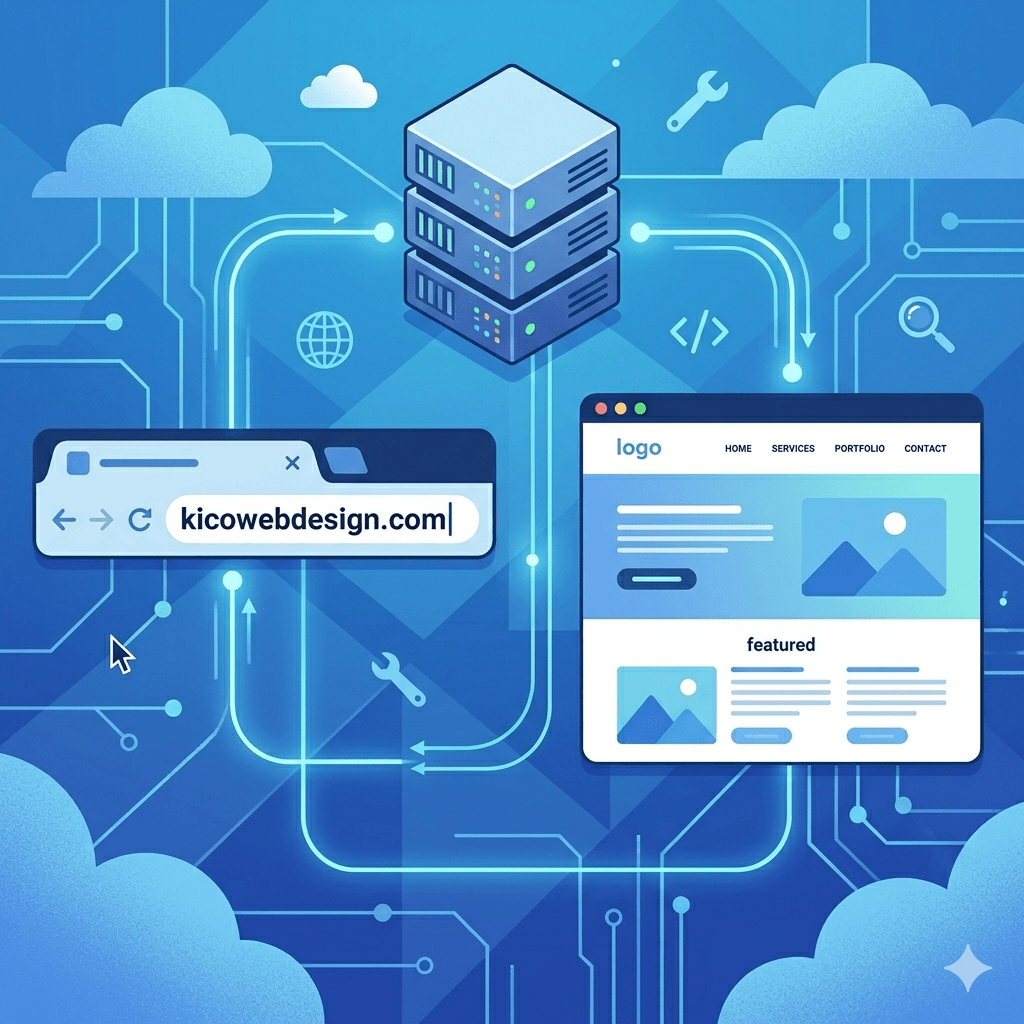
    A simplified browser address bar showing a domain name being typed

    A domain name is the unique web address people type into their browser to visit your website. For example, in the URL www.kicowebdesign.com, the domain name is kicowebdesign.com. It’s the digital identity of your business or brand online.

    You can think of a domain name like a phone number for your website. Just like people dial your number to reach you on the phone, they type your domain name to reach you on the internet. The only difference is that a domain name is easier to remember and much more professional.

    Every domain name has two key parts: the name itself (like “kicowebdesign”) and the extension (like “.com” or “.ug”). Together, they form a complete web address. Once you register a domain name, no one else can use that exact name for as long as you keep it active.

    3. Why You Need a Domain Name in Uganda

    Uganda’s digital economy is growing fast. More consumers are searching for products and services online every day. If your business doesn’t have a website with a proper domain name, you’re essentially invisible to a large part of your potential market.

    Here’s why registering a domain name matters for your business or personal brand:

    • Professionalism: A custom domain name like www.yourbusiness.com or www.yourbusiness.co.ug looks far more credible than a free subdomain from a website builder.

    • Brand identity: Your domain name is part of your brand. It tells people who you are and what you do at a glance.

    Better SEO: A good domain name that includes relevant keywords can help your website rank higher on Google.

    • Control: Owning your domain means no one can take it away from you or shut it down arbitrarily.

    • Customer trust: People are more likely to trust a business with its own domain name and professional email address.

    If you’re serious about growing your digital presence Uganda, securing a domain name is the logical first step.

    4. Types of Domain Extensions in Uganda
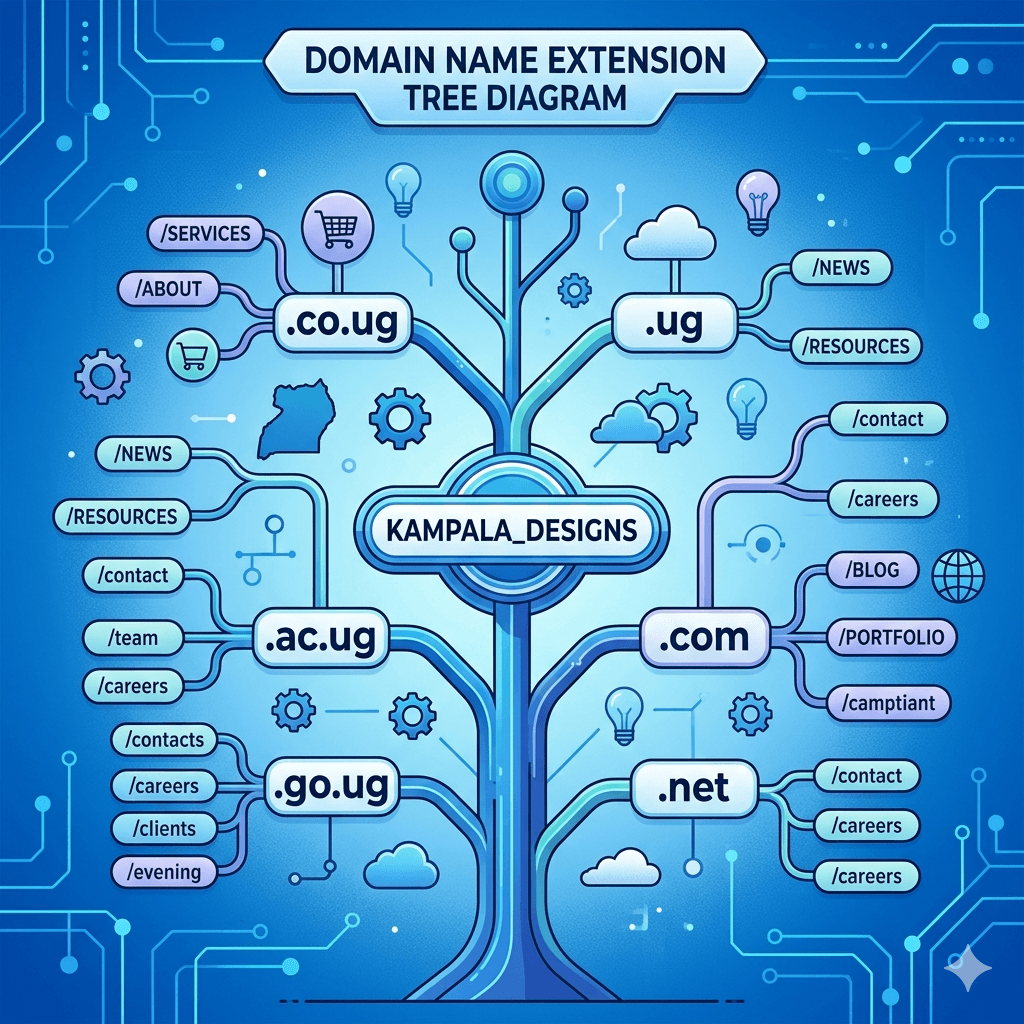
    A branching tree diagram growing from a central domain name

    When you buy a domain name in Uganda, you’ll come across several types of domain extensions. Each serves a slightly different purpose, and choosing the right one matters for your brand and SEO strategy.

    4.1 Country Code Domains (.ug)

    The .ug domain is Uganda’s official country code top-level domain (ccTLD). It signals to visitors and search engines that your website is specifically associated with Uganda. If your target audience is primarily in Uganda, a .ug domain extension is a strong choice. It also tends to rank well in local search results.

    4.2 Second-Level Domains (.co.ug, .ac.ug, .go.ug, etc.)

    Under the .ug umbrella, there are several second-level domain extensions that are used for different purposes:

    • .co.ug   Designed for commercial businesses operating in Uganda. This is the most popular choice for local companies.

    • .ac.ug   Reserved for academic institutions like universities and colleges.

    • .go.ug   Used exclusively by government entities.

    • .or.ug   Intended for organizations and NGOs.

    • .sc.ug   For schools and educational institutions at the secondary level.

    Understanding the difference between .ug and .co.ug will help you pick the one that best fits your purpose.

    4.3 International Domains (.com, .org, .net)

    These are global domain extensions not tied to any country. A .com domain is the most widely recognized and trusted worldwide. If your audience extends beyond Uganda or you have international ambitions, a .com domain makes sense. The .org extension is commonly used by nonprofits and NGOs, while .net is often associated with tech and network-focused companies.

    5. Benefits of Registering a .ug Domain

    Choosing a .ug domain registration comes with some real advantages, especially if your business operates primarily within Uganda.

    • Local SEO advantage: Google uses the domain extension as one of the signals to determine which region a website is most relevant to. A .ug domain helps your website appear in Ugandan search results.

    • Brand relevance: It immediately tells your audience that you are a Uganda-based business, which builds trust with local customers.

    • Availability: Because .ug domains are newer and less saturated than .com domains, you’re more likely to find your preferred name still available.

    • Credibility: A .ug domain can make your brand appear more established and locally committed.

    • Supports the local internet ecosystem: Registering a .ug domain contributes to the growth of Uganda’s digital infrastructure.

    If you’re building a business that serves Ugandan customers primarily, a .ug domain is definitely worth considering.

    6. Requirements for Registering a Domain in Uganda
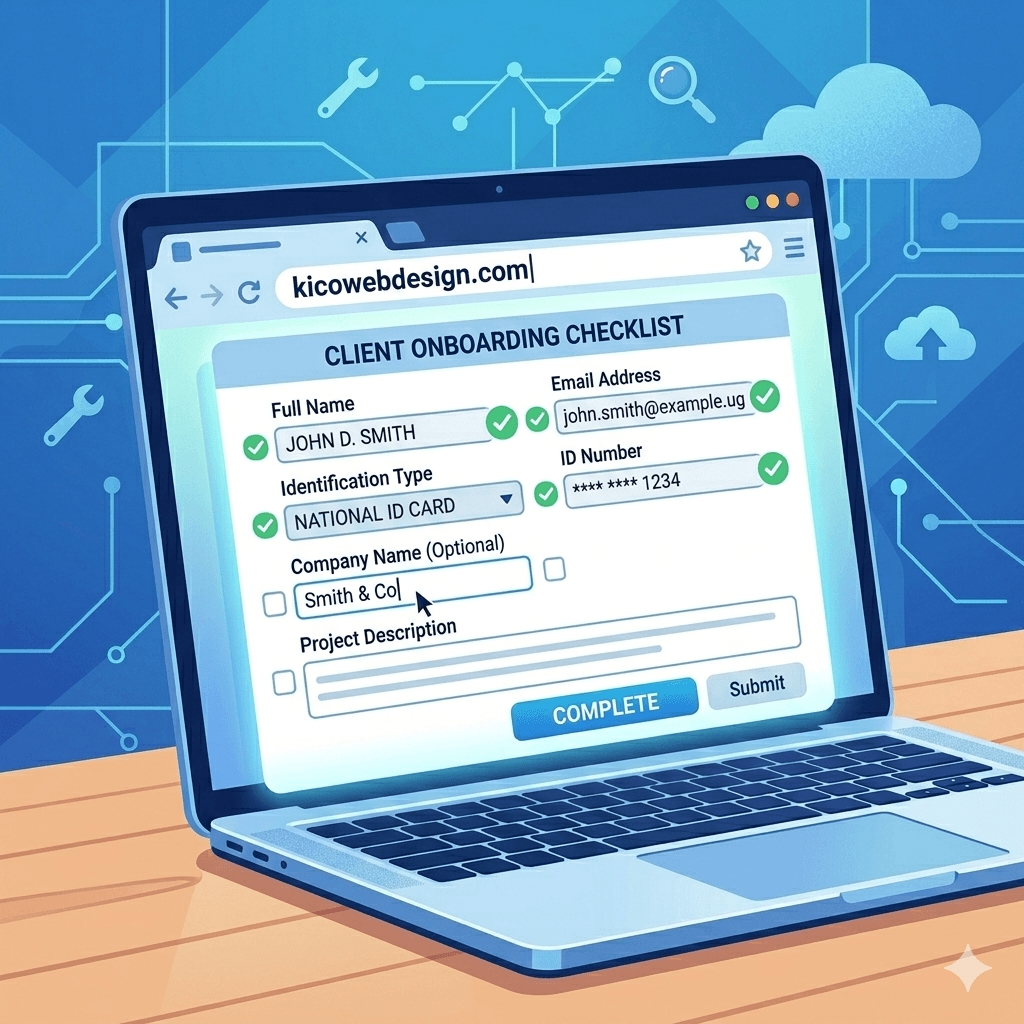
    A checklist interface being completed on a laptop with fields like name, email, and identification

    Before you proceed to register a domain name in Uganda, it’s important to know what you need. The requirements vary slightly depending on whether you’re registering as an individual or a business.

    6.1 Personal vs Business Registration

    Individuals can register domain names just as easily as businesses can. You don’t need to be a registered company to own a domain. However, if you’re registering a business domain, having your business registration documents ready is good practice, especially for extensions like .co.ug which are meant for commercial entities.

    6.2 Required Information and Documents

    For most domain registrations, you’ll need:

    • Your full name or business name

    • A valid email address

    • A phone number

    • A physical address (for billing and contact purposes)

    • Payment method (mobile money, credit/debit card, or bank transfer depending on the registrar)

    For second-level domains, some registrars may require additional verification. It’s always a good idea to check with your chosen registrar for their specific requirements before starting the process.

    7. How to Choose the Right Domain Name

    Choosing the right domain name is almost like naming your business. Get it right, and it becomes one of your most powerful branding assets. Get it wrong, and it can create confusion and cost you visitors. Here are some practical tips for choosing a domain name for business.

    7.1 Keep It Short and Simple

    A domain name that’s easy to type and remember is worth its weight in gold. Aim for something between 6 and 15 characters if possible. Shorter names are less prone to typos and easier to share verbally. Would you prefer to direct someone to “yourbrand.com” or “youramazingbrand2024.co.ug”? Exactly.

    7.2 Use Keywords for SEO

    Including a relevant keyword in your domain name can give your website a small SEO boost. For example, if you run a bakery in Kampala, something like “kampalachoicebakery.com” signals to both users and search engines what your site is about. For more on this, read our guide on

    7.3 Avoid Numbers and Hyphens

    Numbers and hyphens create confusion. If you tell someone your website is “best-deals-4-you.com”, they may not be sure whether to type the number 4 or the word “for”, or whether to include hyphens. Keep it clean and straightforward.

    7.4 Make It Brandable and Memorable

    The best domain names are unique, catchy, and aligned with your brand personality. Think about big names like Google, Amazon, or Jumia. None of these are dictionary words, yet they’re unforgettable. Try to create something distinct that sticks in people’s minds long after they’ve visited your site once.

    8. How to Register a Domain Name in Uganda (Step-by-Step)
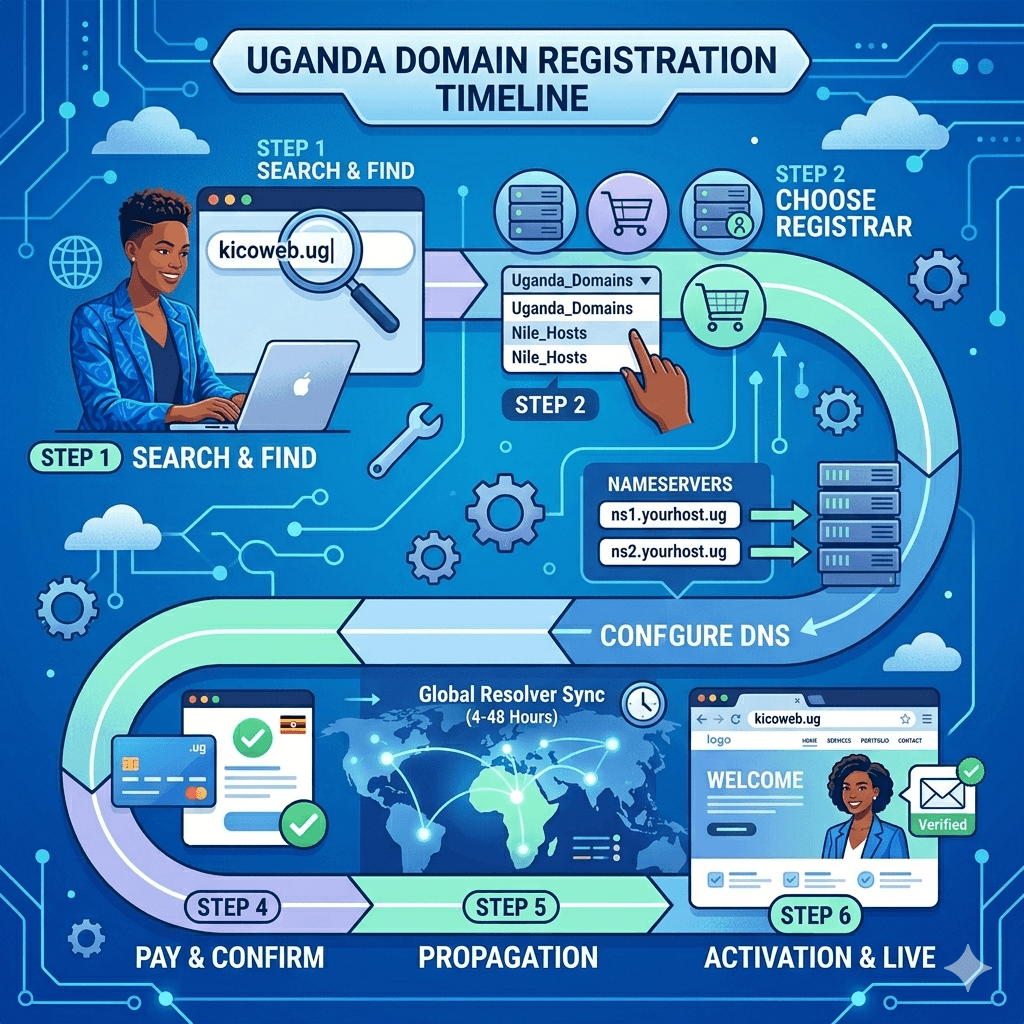
    A clean step-by-step timeline showing the full domain registration process from search to activation

    Here’s the part you’ve been waiting for   the actual domain name registration process. Follow these steps and you’ll have your domain secured within minutes.

    8.1 Choose a Domain Registrar

    A domain registrar is a company authorized to sell domain names. When looking for the best domain registrar Uganda has to offer, consider factors like pricing, customer support, ease of use, and renewal costs. Some popular registrars you can use in Uganda include:

    • REGISTRY.CO.UG   the official registrar for .ug domains

    • Namecheap   great for international domains like .com

    • GoDaddy   globally known with competitive pricing

    • Afriregister   focuses on African domain extensions

    For .ug domains specifically, registering through REGISTRY.CO.UG or an accredited local registrar is the most reliable route.

    8.2 Search for Domain Availability

    Once you’ve chosen a registrar, use their domain search tool to check if your desired name is available. This is how you check domain availability. Simply type in your preferred name and the tool will tell you instantly whether it’s taken or free. If your first choice is unavailable, the registrar will usually suggest alternatives.

    8.3 Select Your Domain Extension

    Decide whether you want a .ug, .co.ug, .com, or another extension. As discussed earlier, your choice should depend on your target audience and the nature of your website.

    8.4 Add to Cart and Proceed to Checkout

    Once you’ve found an available domain, add it to your cart. At this stage, you may also be offered optional add-ons like web hosting, SSL certificates, or privacy protection. We’ll talk more about what to do after registration shortly.

    8.5 Provide Registration Details

    Fill in your personal or business information accurately. This information goes into a database called WHOIS, which records who owns every registered domain. Make sure your email address is correct; you’ll need it to verify ownership.

    8.6 Make Payment

    Choose your preferred payment method. Many registrars in Uganda accept mobile money (MTN MoMo or Airtel Money), Visa or Mastercard, and sometimes bank transfers. Cheap domain names Uganda can start as low as UGX 60,000 per year for a .co.ug domain.

    8.7 Verify Ownership and Activate

    After payment, check your email for a verification link. Click it to confirm your email address and activate your domain. Once confirmed, your domain is live and officially yours. The whole process typically takes less than 30 minutes.

    9. Cost of Registering a Domain in Uganda

    The domain name cost in Uganda varies depending on the extension and registrar you choose. Here’s a rough estimate to guide your budget:

    • .co.ug domain: Approximately UGX 60,000 – 120,000 per year

    • .ug domain: Approximately UGX 100,000 – 200,000 per year

    • .com domain: Approximately UGX 45,000 – 90,000 per year (around USD 10–20)

    • .org or .net domain: Similar range to .com

    Keep in mind that some registrars offer discounted first-year pricing, then charge the full renewal rate from year two. Always check the renewal price before committing. If you want to understand the cost of building a full website, visit our

    10. Common Mistakes to Avoid When Registering a Domain

    Many first-time domain owners make avoidable mistakes that cause headaches later. Here’s what to watch out for:

    10.1 Choosing Complicated Names

    A domain name with unusual spelling, multiple hyphens, or a string of random words is hard to type and even harder to remember. Stick to something clean and intuitive. If you have to explain how to spell your domain name every time you share it verbally, it’s probably too complicated.

    10.2 Ignoring Renewal Dates

    Your domain is only yours for as long as you keep renewing it. Missing your renewal deadline can result in losing your domain   sometimes permanently. Set a reminder at least 30 days before your renewal date, or enable auto-renewal with your registrar.

    10.3 Not Checking Availability on Social Media

    Before finalizing your domain name, check if the same username is available on major social media platforms like Facebook, Instagram, and X (Twitter). Brand consistency across platforms matters for building a recognizable online identity.

    10.4 Registering the Wrong Extension

    Choosing the wrong domain extension can confuse your audience. If you’re a government agency registering a .co.ug instead of a .go.ug domain, or a school using .com instead of .sc.ug, it sends mixed signals. Pick the extension that best represents what your organization does.

    11. What to Do After Registering Your Domain
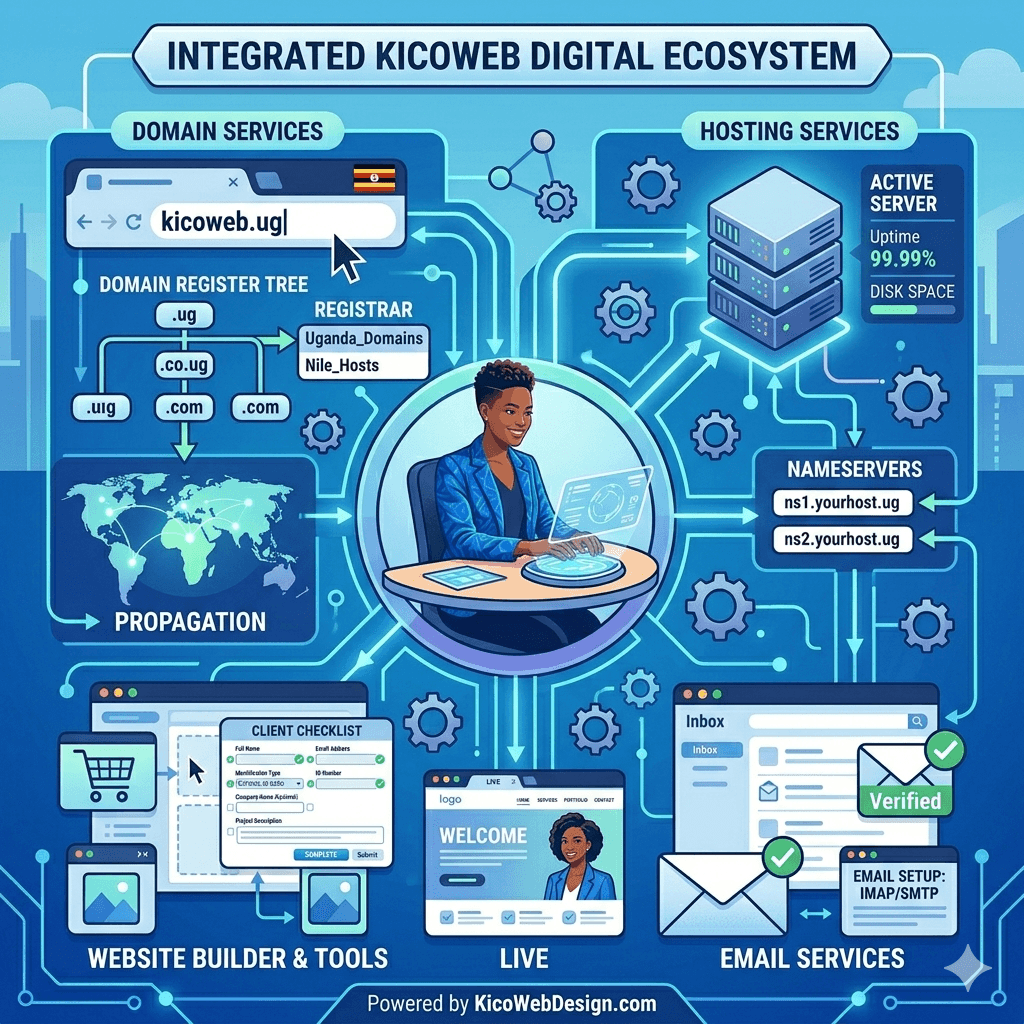
    A connected ecosystem showing domain, hosting, email, and website tools working together

    Congratulations! You’ve secured your domain name. But your work isn’t quite done yet. Here’s what to do next to make the most of your new domain.

    11.1 Connect to Web Hosting

    Your domain name is just an address   you still need hosting to store your website’s files. Web hosting is like the actual building that sits at your address. Read our guide on

    11.2 Create a Professional Email Address

    One of the best things about having your own domain is the ability to create a professional email address like info@yourbusiness.co.ug. This looks far more credible than a generic Gmail or Yahoo address and strengthens your brand every time you send an email.

    11.3 Build Your Website

    With your domain and hosting in place, it’s time to build your website. If you need expert help, our

    11.4 Secure Your Domain

    Enable domain privacy protection if your registrar offers it. This hides your personal contact details from the public WHOIS database, reducing spam and protecting your privacy. Also make sure your domain registrar account is protected with a strong password and two-factor authentication.

    12. Tips for Managing and Renewing Your Domain

    Once your domain is live, here are a few tips to keep it in good shape:

    • Enable auto-renewal so you never accidentally let your domain expire.

    • Keep your contact details up to date with your registrar, especially your email address.

    • Log in to your registrar account at least once every few months to check for any alerts or notifications.

    • Consider registering your domain for multiple years upfront   many registrars offer discounts for multi-year registrations.

    • Lock your domain against unauthorized transfers through your registrar’s control panel.

    • If you have a popular brand name, consider registering multiple extensions (.com, .ug, .co.ug) to protect your brand from competitors or domain squatters.

    Managing your domain doesn’t have to be complicated. With auto-renewal on and your details current, your domain will keep running smoothly in the background while you focus on growing your business.

    13. Frequently Asked Questions

    13.1 How long does it take to register a domain in Uganda?

    The process is usually very fast. Once you complete payment and verify your email, your domain can be active within minutes to a few hours. In some cases, especially for .ug domains with additional verification steps, it can take up to 24–48 hours.

    13.2 Can I register a domain without a business?

    Yes, absolutely. You don’t need to own a registered business to buy a domain name in Uganda. Individuals can register domain names for personal websites, blogs, portfolios, and more. The only exception is for specific second-level domains like .go.ug (reserved for government) or .ac.ug (reserved for academic institutions).

    13.3 What is the difference between .ug and .co.ug?

    A .ug domain is the country-level extension for Uganda and is very broad in its use. A .co.ug domain is a second-level domain specifically designed for commercial businesses. Both signal that you are Uganda-based, but .co.ug is more appropriate for business websites, while .ug can be used for a wider range of purposes.

    13.4 How much does a .ug domain cost?

    A .ug domain typically costs between UGX 100,000 and UGX 200,000 per year, while a .co.ug domain can start from around UGX 60,000 per year. Prices vary between registrars, so it pays to shop around for cheap domain names Uganda has to offer.

    13.5 Can I transfer my domain to another registrar?

    Yes. If you’re unhappy with your current registrar or find a better deal elsewhere, you can transfer your domain. Most registrars require that the domain has been registered for at least 60 days before a transfer is allowed. You’ll need an authorization code (also called an EPP code) from your current registrar to initiate the transfer.

    13.6 What happens if my domain expires?

    If you miss your renewal date, your domain will enter a grace period (usually 30–90 days) during which you can still renew it   often at a higher fee. After the grace period, it may be released back to the public or placed in an auction. In the worst case, someone else could register it and your website address becomes lost to you permanently.

    13.7 Can I own multiple domain names?

    Yes, there’s no limit to how many domain names you can own. Many businesses register multiple versions of their name, different extensions, common misspellings, and related keywords   to protect their brand and redirect all traffic to their main website.

    13.8 Do I need technical skills to register a domain?

    Not at all. Registering a domain name is a straightforward process that anyone can complete online, even without any technical knowledge. The step-by-step guide above covers everything you need. If you still feel unsure, you can always

    Ready to Build Your Online Presence?

    Registering your domain name is just the first step. The real journey begins when you pair it with great web design and solid SEO. At Kico Web Design, we help Ugandan businesses build professional websites that don’t just look good   they rank on Google and convert visitors into customers. See examples of websites we’ve built or explore our SEO services in Uganda to take your digital presence to the next level. Have questions? We’re always happy to help.
  • How to Start Selling Online in Uganda with Zero Budget 

    How to Start Selling Online in Uganda with Zero Budget 

    How to Start Selling Online in Uganda with Zero Budget

    1. Introduction

    You don’t need a shop. You don’t need millions of shillings. You don’t even need a laptop. If you have a smartphone and a product to sell, you already have everything you need to start selling online in Uganda today.

    The internet has flipped the script on traditional business. What used to require heavy investment in rent, signage, and staff can now be done from your bedroom or market stall using apps you probably already have installed.

    Uganda’s digital economy is growing fast. More Ugandans are shopping online every day. And the good news? The door is wide open for small sellers. Whether you want to sell clothes, food, electronics, or homemade crafts, you can tap into eCommerce in Uganda without spending a single shilling on setup. This guide will walk you through exactly how to do it, step by step.

    2. What Does Selling Online Mean in Uganda?

    Selling online simply means offering your products or services to buyers through the internet, instead of a physical shop. Think of it like running a market stall, but the market is open 24 hours a day and anyone in Uganda (or even beyond) can walk in.

    In Uganda, selling online can happen in several ways. You can post your products on WhatsApp, list them in Facebook groups, open a page on a platform like Jumia or Jiji, or even build a free online store. Customers see your products, ask questions, pay, and you arrange delivery.

    It’s not complicated. Many traders are already doing it without even calling it ‘eCommerce.’ If you’ve ever posted a product on your WhatsApp status and had someone buy it, congratulations   you’ve already sold online.

    The only difference between you and a full online business is a system. This guide helps you build that system, for free.

    3. Why Start Selling Online with Zero Budget?

    A person with empty pockets but holding a smartphone that glows with opportunities

    Starting with no money might sound risky, but it’s actually one of the smartest moves a beginner can make. Here’s why.

    First, you eliminate financial risk. When you invest zero, you can’t lose money. You learn what works and what doesn’t without putting your savings on the line.

    Second, free platforms already have millions of users. Facebook, WhatsApp, and Jiji are packed with people actively looking to buy things. You don’t need to build an audience from scratch.

    Third, starting lean forces you to focus on what actually matters: your product and your customer. Too many business owners get caught up in logos and websites before making a single sale. Starting with zero budget forces you to sell first, then invest.

    And lastly, Uganda’s mobile-first environment makes it possible. Most of your future customers shop from their phones. So the cheapest tools (social media, WhatsApp, mobile money) are also the most effective tools. You’re not compromising by starting free. You’re being strategic.

    4. Benefits of Selling Online in Uganda

    Selling online opens doors that a physical shop simply can’t. Here are the key benefits:

    • Reach more customers. A physical stall reaches people who pass by. An online shop reaches anyone with a phone across Kampala, Gulu, Mbarara, and beyond.

    • Lower operating costs. No rent. No electricity bills for a shop. No security guard. Your ‘overhead’ is just data bundles.

    • Sell 24/7. Your online shop doesn’t close at 6 PM. Customers can browse and order even when you’re asleep.

    • Build trust and reputation. Reviews, testimonials, and consistent posts build a reputation faster online than word of mouth alone.

    • Flexibility. You can run your online business from home, from the market, or while managing another job.

    • Scale faster. Once you crack the formula, scaling an online business is much easier than opening a second physical shop.

    In short, selling online levels the playing field. A small trader with a good phone and a great product can compete with larger brands. That’s a powerful opportunity.

    5. What You Need to Start

    A flat lay of essential tools smartphone, small product inventory, notebook

    The barriers to entry are lower than you think. Here’s the honest list of what you need:

    • A smartphone. Android works perfectly. This is your store, your camera, your payment terminal, and your customer service desk all in one.

    • Internet access. Even a basic daily bundle is enough to get started. Many of the tools in this guide are light on data.

    • A product to sell. It doesn’t have to be something you manufacture. You can resell items, offer services, or even do dropshipping.

    • A mobile money account. MTN Mobile Money or Airtel Money lets you receive payments instantly without needing a bank account.

    • Photos of your products. Clear pictures taken with your phone camera are enough to start.

    • Time and consistency. This is probably your most important resource. Showing up daily makes the difference between sellers who grow and those who don’t.

    That’s it. No laptop, no design skills, no technical knowledge required. If you have these six things, you’re ready to start selling online in Uganda.

    6. Best Free Platforms to Sell Online in Uganda

    Choosing the right platform is one of the most important decisions you’ll make. The good news is that all the best online selling platforms in Uganda have free options. Here’s a breakdown of the most effective ones.

    6.1 Social Media Platforms (Facebook, WhatsApp, Instagram)

    Social media is where most Ugandan online sellers start, and for good reason.

    • Facebook: Create a free business page or join buying and selling groups in your area. Facebook Marketplace also lets you list products for free and reach local buyers directly.

    • WhatsApp: Use WhatsApp Business (a free app) to set up a catalog of your products, post updates on your status, and communicate with customers. It’s the most personal and direct selling tool available in Uganda. Learn how to use WhatsApp to grow your business to get the best results from this platform.

    For a deeper strategy on this, read our guide on how to use WhatsApp to grow your business.

    • Instagram: Great if your products are visual   fashion, food, crafts, or décor. Post quality photos and use local hashtags like #UgandaShopping or #KampalaFinds.

    6.2 Online Marketplaces (Jumia, Jiji)

    • Jumia Uganda: One of Africa’s biggest online marketplaces. You can register as a seller and list your products for free. Jumia handles a lot of the trust and logistics infrastructure, which is great for beginners.

    • Jiji Uganda: A popular classifieds platform where you can post products for free. It’s widely used in Uganda for selling electronics, vehicles, clothes, and much more. Listings are simple and fast to create.

    6.3 Free Store Builder Tools

    If you want a more professional-looking setup without paying, there are free tools worth exploring:

    • Selar: Great for selling digital products like eBooks, courses, or designs.

    • Flutterwave Store: Allows you to build a simple free store and accept mobile money payments.

    • Payhip: Another free tool for digital and physical products with built-in payment support.

    If you want to compare options in more detail, check out free website builders vs paid options to see what’s right for your stage of business.

    6.4 Choosing the Right Platform for Your Business

    The right platform depends on what you sell and who your customers are. Selling fashion? Instagram and Facebook work best. Selling household goods or electronics? Try Jiji. Selling services? WhatsApp and Facebook pages win. When in doubt, start with WhatsApp and Facebook since you likely already have contacts there. You can also read how to choose the right eCommerce platform for a more detailed breakdown.

    7. How to Choose What to Sell

    A person analyzing different product options like clothes, electronics, and food

    This is where many beginners get stuck. They either try to sell everything or can’t decide on anything. Here’s a simple framework to help you choose wisely.

    7.1 Selling Products You Already Have

    The easiest starting point is products you already own or have access to. Do you have extra stock from your physical business? Old items you want to clear? Homemade goods? Start there. It costs you nothing extra and gives you practice without financial risk.

    7.2 Finding Fast-Moving Items in Your Area

    Look around your community. What are people buying most? Cooking oil, second-hand clothes, phone accessories, and baby products tend to move fast in many Ugandan communities. Talk to market vendors, check Facebook groups, and see what’s being advertised most. High demand + low local competition = a good opportunity.

    7.3 Reselling vs. Creating Your Own Products

    Reselling means buying products wholesale and selling at a profit. It’s lower risk and easier to start. Creating your own products (like handmade crafts, food, or clothing) gives you better margins and a unique selling point. Beginners often do best starting with reselling, then moving to their own products as they grow.

    7.4 Testing Demand Before Investing

    Before buying large quantities of anything, test demand. Post a picture of the product on WhatsApp status or a Facebook group and see who asks about it. If 5–10 people express interest, that’s a good sign. If no one responds, try something else. Testing costs you nothing and saves you from buying stock that doesn’t sell.

    8. How to Start Selling Online Step-by-Step

    Now for the practical part. Follow these steps and you’ll have your first product listed online within a few hours.

    8.1 Create Your Selling Account or Page

    Start with what you already use. If you’re on Facebook, create a dedicated page for your business (it’s free). Download WhatsApp Business and set up your profile with a business name, description, and profile photo. If you want to list on Jiji or Jumia, register a seller account   both are free and take less than 15 minutes.

    8.2 Take Clear Product Photos Using Your Phone

    Photos sell products. Bad photos kill sales. You don’t need a camera   your smartphone is enough. Use natural light (shoot near a window or outside). Use a plain background (a white wall or clean cloth works perfectly). Take photos from multiple angles. Show the product in use if possible. Avoid blurry or dark images   they create doubt in the customer’s mind.

    8.3 Write Simple Product Descriptions

    Your description should answer three questions: What is it? Who is it for? Why should they buy it now? Keep it simple and specific. Instead of writing ‘Nice shoes for sale,’ write ‘Ladies flat sandals, size 36–42, available in black and brown, perfect for office and casual wear.’ The more specific you are, the less back-and-forth you’ll have with customers.

    8.4 Set Competitive Prices

    Research what similar products are selling for on Jiji, Facebook groups, and local shops. Price slightly lower if you’re new and need to build trust. As you get reviews and a reputation, you can adjust your prices upward. Always factor in your costs (buying price, delivery, airtime) before setting a price.

    8.5 Share Your Products in Groups and Chats

    Don’t just post and wait. Join active buying and selling Facebook groups in your city. Share your listings there. Post on your WhatsApp status. Ask friends to share your posts. The first few customers often come from your existing network. Treat every post like a mini advertisement and think about what would make you stop scrolling.

    8.6 Communicate with Customers Effectively

    Speed matters. Respond to inquiries quickly   ideally within minutes. Be polite, clear, and helpful. Confirm orders, give delivery timelines, and follow up after delivery. Good communication builds trust, and trust generates repeat customers and referrals. Many successful Ugandan online sellers grow entirely through word of mouth sparked by great customer service.

    9. How to Receive Payments Without a Budget

    A smartphone displaying a successful mobile money transaction with confirmation icons,

    One of the biggest concerns for new online sellers is: how do I get paid? The good news is that Uganda’s mobile money infrastructure makes this easy and free.

    9.1 Mobile Money Options (MTN, Airtel)

    MTN Mobile Money and Airtel Money are the most widely used payment methods in Uganda. Almost every adult has access to one or both. Share your mobile money number with customers and they can send payment directly before or upon delivery. There are no setup fees. For those looking to scale, learn how to accept mobile money payments in Uganda on a more formal website or checkout page.

    9.2 Cash on Delivery

    Many Ugandan buyers prefer paying cash on delivery (COD). It removes their risk and builds trust. If you’re doing local deliveries, offering COD can significantly increase your conversions. The trade-off is that there’s a small risk of a customer refusing delivery. Mitigate this by asking for a small deposit via mobile money before dispatching.

    9.3 Building Trust with Buyers

    New sellers often struggle because buyers don’t trust them yet. Here’s how to build that trust quickly: use your real name and photo on your profile, show clear product photos, share testimonials from happy customers (even screenshots from WhatsApp chats work), and offer a simple return or exchange policy. Trust is currency in online business, especially for beginners.

    10. How to Deliver Products to Customers

    Delivery is often where beginner sellers get stuck. But it doesn’t have to be expensive or complicated.

    10.1 Meeting Points and Pickups

    The simplest and cheapest delivery method is a meeting point. Agree on a central location   a petrol station, shopping mall, taxi park, or market   where the customer picks up their order. This works well for nearby buyers and eliminates delivery costs entirely.

    10.2 Using Boda Boda Delivery

    For customers who can’t come to you, boda bodas (motorcycle taxis) are the most affordable and flexible delivery option in Uganda. You can negotiate flat rates with reliable boda boda riders in your area. For Kampala, delivery within a few kilometers can cost between UGX 3,000 and 10,000, which you can include in your pricing or charge separately.

    10.3 Partnering with Local Couriers

    As your order volume grows, consider partnering with courier services like SafeBoda, Glovo, or other local logistics providers. Some offer business accounts with reduced rates for regular deliveries. This is a smart move when you’re doing more than 5–10 deliveries per day.

    10.4 Reducing Delivery Costs

    Batch your deliveries. Instead of sending one item at a time, group orders by area and deliver them in one trip. This reduces your per-order delivery cost significantly. You can also offer free delivery as a promotion for orders above a certain amount to increase average order value while keeping costs manageable.

    11. Free Marketing Strategies That Work in Uganda

    A person sharing product updates on WhatsApp status while friends and contacts

    Marketing doesn’t have to cost money. These free strategies are used by Uganda’s most successful small online businesses.

    11.1 Posting in Facebook Groups

    Uganda has thousands of active Facebook buying and selling groups organized by city, product type, and interest. Join the most active groups in your niche and post regularly. Make sure your posts include a clear photo, a price, your location, and your contact number. Consistency is key   post at least 3–5 times per week in different groups.

    11.2 WhatsApp Status Marketing

    Your WhatsApp status is a free advertising slot seen by everyone in your contacts. Post product updates, promotions, and customer testimonials regularly. The more you post, the more visibility you get. Create a habit of posting at least once or twice a day. Keep it professional but personal   behind-the-scenes content and packaging videos perform surprisingly well.

    11.3 Word-of-Mouth Referrals

    In Uganda, referrals still drive a massive amount of business. Ask every satisfied customer to tell a friend. You can incentivize this by offering small discounts for referrals. A simple message like ‘If you refer a friend who buys, I’ll give you UGX 2,000 off your next order’ can create a viral loop that grows your customer base organically.

    11.4 Consistent Posting and Engagement

    Algorithms (on Facebook and Instagram) reward consistency. Sellers who post every day get more visibility than those who post once a week. Engage with comments on your posts, reply to DMs quickly, and interact with other posts in your community. The more active you are, the more visible you become.

    11.5 Using Simple Promotions and Offers

    Promotions don’t need to be expensive. ‘Buy 2 get 1 free,’ ‘Free delivery this weekend,’ or ‘First 5 customers get 10% off’ are all simple offers that create urgency and drive action. Run a promotion at least once or twice a month. Pair your promotions with strong social media posts for maximum impact. For a structured approach to digital promotion, explore content marketing on a budget to see how to plan your messaging effectively.

    12. Common Mistakes to Avoid

    Learning from other people’s mistakes is one of the fastest ways to grow. Here are the most common pitfalls new online sellers in Uganda fall into:

    • Poor product photos: Blurry or dark photos kill sales. Always prioritize image quality.

    • Ignoring customer messages: Slow responses lose sales. Check your messages at least three times a day.

    • No clear pricing: ‘DM for price’ annoys buyers. Always show your price upfront.

    • Selling everything at once: Focus on a few products and do them well. Confusion scares buyers away.

    • Giving up too early: Most sellers quit before they gain momentum. Give yourself at least 30–60 days of consistent effort before judging results.

    • Not asking for reviews: Every happy customer is a potential testimonial. Ask them to share feedback or a WhatsApp screenshot you can repost.

    • Overpromising on delivery: If you can’t deliver in 24 hours, say 48. Under-promise and over-deliver.

    13. Tips to Grow Your Online Business

    Once you start making sales, the goal shifts from starting to scaling. Here’s how to grow sustainably.

    13.1 Reinvesting Profits Wisely

    Your first profits should go back into the business. Buy more stock, upgrade your packaging, or invest in a small data bundle for more consistent posting. Avoid spending all your profits on personal expenses before your business is stable. Think of your first 90 days as a reinvestment phase.

    13.2 Expanding Your Product Range

    Once you know what sells, expand carefully. Add complementary products that your existing customers are already buying elsewhere. If you sell ladies shoes, adding handbags or scarves makes sense. If you sell phone accessories, cases and chargers are natural additions. Don’t expand randomly   follow the data.

    13.3 Building Repeat Customers

    A repeat customer costs nothing to acquire. Treat your existing buyers like VIPs. Send them exclusive offers, wish them on public holidays, and check in after their purchase. Building a loyal customer base is the foundation of a sustainable online business. Even a list of 50 loyal customers who buy monthly is more valuable than 500 one-time buyers.

    13.4 Improving Customer Service

    As you scale, you’ll face more questions, complaints, and delivery issues. Build simple systems to handle these FAQs message template, a complaint response script, and a clear refund policy. Great customer service is your biggest competitive advantage as a small seller. When you’re ready to invest further, consider gettinga professional business websiteto give your brand a more credible online presence, and explore how toimprove your visibility on Googleto bring in organic customers at zero ongoing cost.

    When you’re ready to build a full online store, professional eCommerce website development can take your business to the next level.

    14. Frequently Asked Questions

    14.1 Can I Really Start Selling Online with No Money?

    Yes, absolutely. Platforms like WhatsApp Business, Facebook, Jiji, and Jumia are all free to use. Your only real cost is internet data, and even that can be minimal if you manage your usage wisely. Many successful Ugandan online sellers started with zero capital.

    14.2 Which Platform Is Best for Beginners in Uganda?

    WhatsApp Business and Facebook are the best starting points because you likely already have contacts and followers there. Jiji is great if you want to reach buyers outside your network. Start with the platform your target customers already use.

    14.3 How Do I Get My First Customer?

    Your first customer is usually someone you already know   a friend, family member, or colleague. Post your products on your WhatsApp status and in Facebook groups. Tell people you’ve started an online business. Ask existing contacts to share your page. Your first sale is often closer than you think.

    14.4 Is Mobile Money Safe for Business Transactions?

    Yes. MTN Mobile Money and Airtel Money are widely trusted in Uganda. Always confirm payments before dispatching products. Save transaction screenshots as proof of payment. For larger businesses, mobile money APIs allow automated confirmation, but manual checking works fine when starting out.

    14.5 What Products Sell Fast in Uganda?

    Fast-moving products in Uganda include second-hand clothes (mitumba), phone accessories, cooking oil and foodstuffs, baby products, cosmetics and skincare, shoes, and household items. Electronics also sell well but require more trust-building before customers buy online.

    14.6 How Do I Handle Delivery If I Have No Transport?

    Use boda bodas for local deliveries. For meeting points, pick a central location accessible to both of you. For upcountry buyers, courier services like Posta Uganda or bus companies can help. Always charge for delivery or include it in your price so it doesn’t come out of your profit.

    14.7 Do I Need a Business License to Start?

    You do not need a formal business license to start selling small-scale online in Uganda. However, as your business grows, registering with URSB (Uganda Registration Services Bureau) is advisable for credibility and legal protection. For now, just start   registration can come later.

    14.8 How Can I Avoid Online Scams?

    Always confirm payment before dispatching goods. Be cautious of buyers who claim to have sent ‘more than expected’ and ask you to return the difference   this is a common scam. Use mobile money confirmation SMS messages as proof, and never send products based on screenshots alone. Meet in public places for cash transactions.

    14.9 How Long Does It Take to Make Profits?

    It depends on your product, pricing, and consistency. Some sellers make their first sale within a week. Building a consistent income usually takes 1–3 months of daily effort. The key is to keep posting, keep improving your photos and descriptions, and keep learning from what works.

    14.10 Can I Run This Business Using Only My Phone?

    Yes. Everything in this guide can be done from a smartphone. Posting products, communicating with customers, receiving mobile money payments, and marketing   all of it works on a phone. You don’t need a laptop or computer to build a successful online business in Uganda.

    Final Thoughts

    Starting an online business in Uganda has never been more accessible. You don’t need a big budget, a degree in marketing, or a fancy website to get started. You need a product, a phone, and the consistency to show up every day.

    Use the platforms that are already in your pocket. Build trust one customer at a time. Reinvest your profits and grow deliberately. The path from zero to a thriving online business is well-worn; many Ugandan sellers have walked it before you.

    Have more questions? Visit our frequently asked questions page or contact us for help   we’re happy to guide you on your journey.

    And if you want to understand how social media vs SEO for Ugandan businesses can take you further, explore that guide next.

  • Social Media vs SEO: Which Should Ugandan Businesses Invest In? 

    Social Media vs SEO: Which Should Ugandan Businesses Invest In? 

    1. Introduction

    You have a business idea. Maybe you are selling clothes from your home in Kampala, offering freelance graphic design, or running a small catering service in Jinja. The big question on your mind is: how do I get customers online?

    You keep hearing two terms tossed around: social media and SEO. Some people swear by Facebook and TikTok. Others say Google is where the real money is. And if you are just starting out, trying to figure out which one to focus on feels like choosing between a boda-boda and a taxi   both can get you there, but the right choice depends on where you are going and how fast you need to arrive.

    This article breaks down both strategies clearly. No tech jargon. No confusing formulas. Just practical, honest advice that fits the Ugandan context   so you can make the right call for your business and budget. Whether you are leaning toward social media marketing in Uganda or exploring SEO services in Uganda, this guide has you covered.

    You can also check out Website vs Social Media: Which is Better for Your Ugandan Business for more context before diving in.

    2. What is Social Media Marketing?

    Social media marketing is simply using platforms like Facebook, Instagram, TikTok, YouTube, or X (formerly Twitter) to promote your business. You post content, run paid ads, engage with your audience, and build a community around your brand.

    Think of it like setting up a stall in a busy market. People walk by, see what you are selling, and can interact with you directly. The goal is to create content that stops people mid-scroll and makes them want to learn more about what you offer.

    For many Ugandan entrepreneurs, social media marketing is the first step into the world of digital marketing for small business. It is fast, relatively affordable, and does not require a website to get started. You just need a smartphone, a strategy, and the willingness to show up consistently.

    Whether you are promoting handmade bags, tutoring services, or a small restaurant, social media marketing for beginners is very accessible. The barrier to entry is low, which makes it an appealing starting point for most new businesses.

    3. What is SEO?

    A laptop screen showing a search bar with results ranked in order

    SEO stands for Search Engine Optimization. In plain language, it means making your website or content easy for Google to find and rank highly when someone searches for something related to your business.

    Imagine Google as a huge library. SEO is the process of organizing and labeling your book   your website   so the librarian (Google) can easily find it and put it on the recommended shelf. When someone types “best tailor in Kampala” or “affordable web design Uganda” into Google, SEO determines whether your business shows up on the first page or gets buried somewhere on page ten where nobody looks.

    Understanding how SEO works is not as complicated as people make it sound. At its core, it involves writing useful content, using the right keywords, getting other websites to link to yours, and making sure your website loads fast and works well on mobile phones.

    SEO is a long-term strategy. You might not see instant results, but the traffic you earn through search engine ranking is free and sustainable   and that makes it a powerful tool for online business in Uganda.

    4. How Social Media Works for Ugandan Businesses

    Social media platforms are designed to connect people. For businesses, they offer a direct line to potential customers without the need for expensive advertising campaigns or a polished website. Here is how it all plays out in the Ugandan context.

    4.1 Popular Platforms in Uganda

    Facebook remains the dominant platform for business marketing in Uganda. With millions of active Ugandan users, it is where many buyers and sellers meet. WhatsApp Business is also widely used for direct customer communication and sending product catalogs.

    TikTok has been growing fast, especially among younger audiences. Instagram works well for visual products like fashion, food, and interior decor. YouTube is excellent for tutorials, product demos, and educational content. Knowing which platform your target audience uses most is the first step in building a strong social media marketing in Uganda strategy.

    4.2 How Businesses Gain Visibility

    On social media, visibility comes through two main routes: organic content and paid advertising. Organic means you post regularly and build a following over time. Paid means you boost posts or run targeted ads to reach specific people based on their age, location, interests, and behavior.

    The beauty of paid social media ads in Uganda is that you can start with a very small budget   sometimes as little as 5,000 to 10,000 UGX per day   and still reach hundreds of potential customers. This makes it one of the most accessible online marketing strategies for startups and side hustlers.

    4.3 Types of Content That Perform Well

    Not all content performs the same. In Uganda, content that tends to get the most engagement includes short videos showing how a product works, before-and-after transformation photos, customer testimonials, behind-the-scenes clips, and posts that speak directly to local culture and everyday life.

    Humor, relatable scenarios, and local language elements   like mixing in Luganda or other local phrases   tend to boost engagement significantly. If you want to go deeper on this, check out How to Master Content Creation in Uganda for practical strategies tailored to the Ugandan market.

    5. How SEO Works for Ugandan Businesses

    A website climbing a ladder of search engine rankings with steps labeled as keywords

    SEO might sound technical, but the basic idea is straightforward: help Google understand what your business does so it can show your website to people who are searching for exactly that. Here is how it breaks down.

    5.1 How Search Engines Rank Content

    Google uses a complex algorithm   basically a very detailed scoring system   to decide which websites appear at the top of search results. It looks at things like how relevant your content is to the search query, how fast your website loads, how many other reputable websites link to yours, and how long people stay on your site once they visit.

    The more you tick these boxes, the higher your search engine ranking. It is not a one-time task. SEO is ongoing, and the businesses that stay consistent tend to win in the long run.

    5.2 Local SEO and Google Visibility

    Local SEO is specifically about helping your business show up when people nearby search for your services. For example, if someone in Ntinda types “pizza delivery near me” or “plumber Kampala,” local SEO determines whether your business appears in those results.

    One of the most effective and free tools for local SEO is Google Business Profile. Setting up and optimizing your listing there can dramatically improve your online visibility in local searches. If you are running a location-based business, this is non-negotiable. You can explore more in Local SEO for Kampala Businesses: A Beginner’s Guide.

    5.3 Content and Keywords Basics

    Keywords are the words and phrases people type into Google when looking for something. If you run a printing company in Kampala, your potential customers might search for “business card printing Kampala” or “affordable flyer design Uganda.” Your job is to create content that naturally includes these phrases.

    This does not mean stuffing your pages with keywords   Google is smart enough to penalize that. It means writing genuinely helpful content that naturally covers the topics your audience cares about. Learn more about this process in How to Do Keyword Research for a Ugandan Audience.

    6. Benefits of Social Media Marketing

    Understanding the benefits of social media marketing helps you see why so many Ugandan businesses start here. Let us look at the biggest advantages.

    6.1 Fast Audience Reach

    One of the biggest wins with social media is speed. You can create a post today and have it seen by thousands of people within hours. If your content goes viral   or even just gets shared a few times   your reach multiplies without you spending a single shilling more.

    This speed is especially useful when you are launching a new product, promoting a limited-time offer, or trying to build brand awareness quickly. No other channel can match social media when it comes to rapid, wide-reaching visibility.

    6.2 Low Startup Costs

    Creating a Facebook page, Instagram account, or TikTok profile costs nothing. You can start posting content today with just a smartphone. Even paid ads can be started with very small budgets, making social media one of the most budget-friendly online marketing strategies for entrepreneurs just starting out.

    This low barrier is a major reason why social media or SEO for new business discussions almost always recommend social media as the starting point   it simply costs less to get going.

    6.3 Direct Customer Interaction

    Social media lets you have real conversations with your customers. You can answer questions in the comments, respond to DMs, run polls, and get direct feedback on your products. This two-way communication builds trust and loyalty faster than almost any other marketing channel.

    It is like being able to chat with every customer who walks past your shop   except your shop is open 24 hours and your reach is not limited by geography.

    7. Benefits of SEO

    A website receiving continuous incoming visitors represented by arrows flowing in from search results

    The benefits of SEO for small business are real   but they tend to show up later and last longer. Here is what you stand to gain.

    7.1 Long-Term Traffic Growth

    The biggest advantage of SEO is that it keeps working long after you have done the initial work. A blog post that ranks on the first page of Google can bring in visitors every single day for years   without you spending money on ads.

    Think of SEO like planting a fruit tree. It takes time to grow, but once it does, it provides fruit season after season. Social media is more like selling fruit at a market   you have to show up every day to make sales.

    To understand how to make this work for your business, read How to Get Your Ugandan Business on the First Page of Google.

    7.2 Builds Trust and Credibility

    When your website appears at the top of Google search results, people automatically trust it more. Most users assume that if Google ranks a business highly, it must be credible. This perceived authority is incredibly valuable   especially when you are trying to compete with more established businesses.

    Unlike social media followers, which can feel superficial, organic traffic from Google tends to convert better because those visitors are actively searching for what you offer.

    7.3 Passive Lead Generation

    Once your SEO is working, your website generates leads without you constantly creating new content or spending on ads. This is what marketers call passive lead generation. Your website works for you even while you sleep.

    For entrepreneurs who want to build a business that does not rely entirely on their daily attention, this is a game-changer. See more in How to Get Your Ugandan Business on the First Page of Google.

    8. Challenges of Social Media Marketing

    Social media is not all easy wins. Here are some real challenges you need to be aware of before going all in.

    8.1 Requires Constant Posting

    Social media algorithms reward consistency. If you stop posting for a week, your reach drops significantly. Building and maintaining a social media presence requires ongoing time and creative energy. For a solo entrepreneur juggling multiple responsibilities, this can quickly become exhausting.

    Many Ugandan business owners start strong and then burn out after a few weeks because they underestimate how demanding regular content creation can be.

    8.2 Algorithm Changes

    Social media platforms frequently change how their algorithms work. A strategy that gets you strong results today might deliver much weaker results six months from now   simply because the platform changed its rules. Facebook, in particular, has reduced organic reach dramatically over the years, meaning fewer people now see your posts unless you pay to promote them.

    This unpredictability is one of the biggest SEO vs social media pros and cons talking points   SEO, while slower, is generally more stable.

    8.3 Limited Organic Reach

    As platforms have grown more commercial, organic reach   the number of people who see your posts without paid promotion   has steadily declined. On Facebook, a post from a business page might only reach 2% to 5% of its followers organically. This means that even if you have 10,000 followers, as few as 200 to 500 might see any given post unless you pay to boost it.

    9. Challenges of SEO

    A person working on content and technical settings on a laptop

    SEO has its own set of hurdles. Understanding them upfront will save you frustration later.

    9.1 Takes Time to See Results

    This is the most common complaint about SEO: it is slow. In most cases, it takes three to six months   sometimes longer   before you start seeing meaningful results from your SEO efforts. For a business that needs customers this week, that timeline can feel impossible.

    This is why SEO vs social media for startups discussions often recommend social media for immediate traction while building SEO in parallel for long-term growth.

    9.2 Requires Content Creation

    SEO does not work without content. You need to create blog posts, web pages, articles, or videos that are optimized for search. This takes time, skill, and consistency. If writing is not your strength, you may need to hire someone   which adds to your cost.

    The good news is that the content you create for SEO can often be repurposed for social media as well, which helps you get double the value from your effort.

    9.3 Technical Learning Curve

    Beyond content, SEO involves technical elements like website speed, mobile optimization, meta tags, sitemaps, and backlinks. While you do not need to understand all of this at once, there is a learning curve that can be intimidating for beginners.

    The good news: many of the most impactful SEO actions   like creating quality content, optimizing your Google Business Profile, and building local citations   do not require deep technical knowledge.

    10. Social Media vs SEO: Key Differences

    When comparing social media vs SEO, it helps to look at how they differ across four key dimensions. Understanding the difference between SEO and social media gives you a clearer picture of what each can and cannot do for your business.

    Also, explore Website vs Social Media: Which is Better for Your Ugandan Business for a broader comparison.

    10.1 Speed of Results

    Social media delivers results fast. You can post today and have people reaching out tomorrow. SEO is a slow burn   you plant seeds today and harvest months later. If speed matters, social media wins. If sustainability matters more, SEO takes the lead.

    10.2 Cost and Investment

    Social media has low startup costs but can get expensive if you rely on paid ads for reach. SEO requires more upfront effort   creating content, building a website   but the long-term cost per visitor tends to be much lower once you start ranking. In terms of marketing ROI, SEO often wins over time.

    10.3 Skill Requirements

    Social media is more intuitive for most people. Posting, responding, and creating content feels natural because we already use these platforms personally. SEO requires learning about keywords, content strategy, and technical optimization. The digital marketing tips for beginners community tends to point to social media as the easier starting point.

    10.4 Sustainability

    Social media traffic stops the moment you stop posting or paying for ads. SEO traffic, once earned, continues to flow even if you step away for a while. This makes SEO more sustainable as a long-term strategy   especially for businesses that want to reduce their dependence on paid advertising.

    11. Which is Better for Beginners in Uganda?

    Honestly? There is no single answer, because it depends on your business type, your budget, and your goals. But if you are just starting out and need to make a decision right now, here is a practical take.

    Start with social media. It is cheaper, faster, and does not require a website. You can test your product ideas, build an audience, and start making sales relatively quickly. Platforms like Facebook, WhatsApp Business, and TikTok are already where many of your potential customers spend their time.

    At the same time, do not ignore SEO completely. Even as a beginner, you can set up a free Google Business Profile, make sure your business is listed correctly online, and start learning the basics of keyword research. This lays the groundwork for future SEO growth without overwhelming you.

    The smartest marketing strategy for small business in Uganda is to use social media for immediate results while gradually building your SEO foundation   so that over time, your website traffic growth becomes more predictable and less reliant on constant posting or ad spend.

    12. When to Choose Social Media

    A small startup using only a smartphone to promote products online

    12.1 Small Budgets

    If your marketing budget is very limited, social media is your best friend. You can create and post content for free, engage with potential customers at no cost, and run paid promotions with as little as 5,000 UGX. This makes it the ideal choice for entrepreneurs who need to promote a business online with a low budget.

    12.2 New Businesses

    When you are brand new, you need visibility fast. Social media gives you that. You can announce your business, share what you offer, and start generating interest immediately. Building a social media following takes time, but you can start getting customers from day one if your content speaks to the right people.

    For online marketing for startups, social media is almost always the recommended first channel. It is the quickest way to validate your business idea and start generating revenue.

    12.3 Visual or Trend-Based Products

    If you sell something visual   fashion, food, decor, beauty products, event services   social media is tailor-made for you. Platforms like Instagram and TikTok are built for visual storytelling, and trend-based products can go viral quickly when the content is engaging and relatable.

    Social media also lets you tap into trending topics and hashtags to reach audiences that do not yet know you exist.

    13. When to Choose SEO

    13.1 Long-Term Business Growth

    If you are thinking beyond the next few months and want to build a business that will still be attracting customers years from now, SEO is worth the investment. The organic traffic you earn through SEO is essentially free   and it compounds over time as you create more content and earn more backlinks.

    Read more about How to Get Your Ugandan Business on the First Page of Google to understand the long game.

    13.2 Niche or Informational Businesses

    If your business answers specific questions or solves niche problems   like legal consulting, accounting services, IT support, or health information   SEO is extremely powerful. People searching for answers to specific questions on Google are already primed to take action. Ranking for those searches puts you in front of a highly motivated audience.

    13.3 Building Authority Online

    SEO builds credibility in a way that social media cannot fully replicate. When your website consistently appears at the top of Google for your industry’s keywords, people see you as an authority. That brand awareness and trust is hard to build through social media alone.

    Businesses that combine authority content with good SEO become the go-to names in their industries   and that kind of reputation is worth more than any ad campaign.

    14. How to Combine Social Media and SEO

    The question of SEO vs social media marketing does not always have to be either/or. In fact, the most effective online marketing strategies use both together. Here is how to make them work as a team.

    14.1 Using Social Media to Promote Content

    Whenever you publish a new blog post or web page, share it on your social media platforms. This drives immediate traffic to your site and signals to Google that people are engaging with your content   which can help improve your search rankings.

    Social media also helps you build backlinks naturally. When people share your content, other websites may link to it   and those backlinks are gold for your SEO.

    14.2 Driving Traffic to Websites

    Use your social media bio, stories, and posts to consistently direct people to your website. If you run a promotion, send people to a landing page. If you publish a helpful article, link to it. Every visit to your website helps improve your site’s authority over time.

    Think of social media as the highway and your website as the destination. The more traffic you drive there, the better your website traffic growth metrics become   which positively influences your SEO.

    14.3 Repurposing Content Across Platforms

    You do not have to create completely different content for every platform. A single blog post can become a series of social media posts, a short video, an infographic, and a WhatsApp broadcast message. This is called content repurposing, and it saves enormous time and energy.

    A strong content marketing strategy uses this approach to stretch every piece of content as far as possible. For detailed guidance, visit How to Master Content Creation in Uganda. This approach powers both your social media presence and your SEO simultaneously.

    15. Tools for Social Media and SEO Beginners

    A workspace with a laptop displaying dashboards

    You do not need expensive software to get started. Here are some reliable free tools to help with both digital marketing in Uganda approaches.

    15.1 Free Social Media Tools

    • Canva   Create professional-looking graphics, flyers, and social media posts even if you have no design experience.

    • Meta Business Suite   Manage your Facebook and Instagram pages, schedule posts, and view analytics all in one place.

    • CapCut   A simple video editing app that is perfect for creating TikTok-style videos on your phone.

    • Buffer (free plan)   Schedule your social media posts in advance so you do not have to post manually every day.

    15.2 Free SEO Tools

    • Google Search Console   Shows you which keywords your website is already ranking for and highlights technical issues.

    • Ubersuggest (free tier)   Helps you find keywords and see what your competitors are ranking for.

    • Google Business Profile   Essential for local SEO and getting found by customers searching near your location.

    • Yoast SEO (for WordPress)   A plugin that guides you in optimizing each page of your website for search engines.

    15.3 Analytics and Tracking Tools

    • Google Analytics   Tracks who visits your website, where they come from, and what they do on your site.

    • Meta Insights   Shows how your Facebook and Instagram content is performing.

    • Google Search Console   Tracks your search visibility and flags any issues that might be hurting your rankings.

    16. Practical Tips for Ugandan Entrepreneurs

    Here is straightforward advice for making the most of digital marketing for small business in Uganda, whether you are just starting out or looking to level up.

    16.1 Start Small and Scale Gradually

    Do not try to be everywhere at once. Pick one or two social media platforms and one SEO goal to begin with. Master those before expanding. Many entrepreneurs make the mistake of spreading themselves thin across five platforms and doing none of them well.

    Start with what you can consistently manage. Consistency beats perfection every time.

    16.2 Focus on One Platform First

    If you are doing social media, commit to one platform where your target audience is most active. For most Ugandan businesses targeting adults, that is Facebook. For a younger audience, TikTok or Instagram might be better. Master the platform before adding another one to the mix.

    The same applies to SEO: focus on one content theme or keyword cluster first. Build authority in one area before branching out.

    16.3 Track What Works

    Pay attention to your numbers. Look at which posts get the most engagement, which pages on your website get the most visits, and which keywords bring in traffic. Use this data to do more of what works and less of what does not.

    You do not need complex analytics tools to start. Even the basic insights on Facebook or the overview in Google Search Console will tell you a lot. Make a habit of reviewing your numbers once a week and adjusting your strategy accordingly.

    17. Frequently Asked Questions

    17.1 Is social media or SEO cheaper to start in Uganda?

    Social media is generally cheaper to start. You can create a business page and start posting for free. SEO may require building a website, which involves hosting and domain costs. However, both can be started on a very small budget if you are willing to do the work yourself.

    17.2 How long does SEO take to work?

    Most businesses start seeing meaningful results from SEO after three to six months of consistent effort. Competitive markets may take longer. Local SEO, especially with a well-optimized Google Business Profile, can show results more quickly   sometimes within a few weeks.

    17.3 Can I run a business using only social media?

    Yes, many Ugandan businesses operate entirely through social media   especially using Facebook, WhatsApp Business, and Instagram. However, over time, having a website gives you more credibility, more control, and better long-term visibility through SEO. Relying solely on social media also means your business is vulnerable to algorithm changes and platform disruptions.

    17.4 Do I need a website for SEO?

    In most cases, yes. SEO typically involves optimizing a website so Google can rank it in search results. However, your Google Business Profile can rank in local searches even without a website, so you can get some local SEO benefits before building a full site.

    17.5 Which platform is best for Ugandan businesses?

    Facebook is the most widely used platform for business marketing in Uganda and works well for most business types. WhatsApp Business is excellent for direct sales and customer communication. TikTok and Instagram work best for visual, lifestyle, or youth-focused products.

    17.6 How much should I budget for marketing?

    As a beginner, you can start with as little as 100,000 to 200,000 UGX per month for social media ads. For SEO, the primary investment is time   especially if you are creating content yourself. As your business grows, aim to reinvest 5% to 10% of your revenue into marketing.

    17.7 Is SEO too technical for beginners?

    It can feel that way at first, but no   the basics of SEO are accessible to anyone. Starting with content creation, keyword research, and setting up your Google Business Profile does not require technical skills. As you grow, you can learn or outsource the more technical aspects.

    17.8 Can I do both SEO and social media alone?

    Yes, many solo entrepreneurs manage both on their own, especially in the beginning. The key is to use tools that save time   like scheduling apps for social media and SEO plugins for your website   and to repurpose content across both channels so you are not creating everything from scratch twice.

    As your business grows, consider outsourcing one or both to a digital marketing in Uganda professional so you can focus on running your business.