
Tag: Small Business Uganda

  • Why Kampala Restaurants Need a Website More Than a Facebook Page 

    Why Kampala Restaurants Need a Website More Than a Facebook Page 

    1. Introduction

    Picture this: a tourist lands in Entebbe, checks into a hotel in Kampala, and pulls out their phone to search for a good place to eat. They type “best restaurants in Kampala” into Google. What comes up? Probably not your Facebook page.

    That is the reality many restaurant owners in Kampala are missing. While Facebook is a great tool for staying connected with your current audience, it was never designed to replace a proper business website. And when new customers are actively searching online, not having a website means you are invisible to them.

    This article breaks down why relying only on a Facebook page could be holding your restaurant back   and why a dedicated website for your restaurant business is one of the smartest investments you can make right now. Whether you are just starting out or already have a loyal following on social media, this guide is for you.

    2. What Is a Business Website?

    A business website is your own digital space on the internet, a place you own and control completely. Think of it like your own shop or office, but online. It has your own web address (like www.yourrestaurant.com), and people can visit it any time, day or night, without needing a social media account.

    For a restaurant, a website typically includes things like your menu, location, opening hours, photos of your food, a contact form, and sometimes even an online ordering or reservation system. It works for you around the clock, even when you are in the kitchen or sleeping.

    Most importantly, your website belongs to you. Nobody can change how it looks or who sees it   except you. That kind of control is something social media simply cannot offer. And with the right setup, it can even help you rank on Google so that people searching for places to eat in Kampala can find you easily.

    3. What Is a Facebook Page for Business?

    A smartphone displaying a restaurant social media page with posts

    A Facebook page is a free profile that businesses can create on the Facebook platform. You can post updates, share photos of your food, reply to comments, run promotions, and even chat with customers through Facebook Messenger. It is a powerful social tool, and it is no surprise that thousands of Ugandan restaurants use it.

    Setting up a Facebook page takes less than an hour. You do not need technical skills or any money to get started. You can start posting your menu and food photos the same day. That ease of use is a big reason why many restaurant owners in Kampala treat it as their main online presence.

    But here is the thing: a Facebook page is not the same as having a website. It is more like renting a stall in someone else’s market. You can set up shop, display your products, and talk to customers, but the market owner (Facebook) sets all the rules. And those rules can change anytime without warning. That is where the problems begin.

    4. Key Differences Between a Website and a Facebook Page

    Understanding the difference between a Facebook page and a proper business website can completely change how you think about your restaurant’s online presence. Let us look at the four most important differences.

    4.1 Ownership and Control

    When you build a website, you own it. You decide what goes on it, how it looks, and who it speaks to. When you create a Facebook page, Facebook owns the platform. They can restrict your page, change the layout, or even delete it. You are building on borrowed land, and that is a risky foundation for a business.

    4.2 Visibility on Search Engines

    One of the biggest advantages of a website is that it can appear on Google. When someone searches for restaurants in Kampala or the best nyama choma in town, a properly set-up website has a real chance of showing up in those results. A Facebook page, on the other hand, has very limited visibility on Google. It can show up occasionally, but it is not reliable. To explore how customers find restaurants on Google, check out our guide on local SEO for Kampala businesses.

    4.3 Customer Trust and Professionalism

    First impressions matter. A professional website instantly signals that your restaurant is serious, established, and trustworthy. Many customers, especially tourists, corporate clients, and first-time visitors   feel more confident making a reservation or placing an order through a website than through a Facebook message. A website adds a level of credibility that a Facebook page alone cannot match.

    4.4 Functionality and Features

    Websites can do things Facebook pages simply cannot. You can integrate online ordering systems, booking forms, customer reviews, loyalty programs, photo galleries, and even links to food delivery platforms. You have full flexibility to build the experience you want your customers to have   all under one roof.

    5. Why Kampala Restaurants Rely Too Much on Facebook

    Crowd of small business owners gathered around smartphones using social media apps

    It is easy to understand why Facebook became the go-to platform for restaurant marketing in Kampala. Here are the three main reasons:

    5.1 Low Setup Cost

    Creating a Facebook page is completely free. For a new restaurant owner watching every shilling, free is very attractive. There are no hosting fees, no domain names to buy, and no developers to hire. You can be up and running with a business profile in under an hour.

    5.2 Ease of Use

    Facebook is something most Ugandans already know how to use. Posting a photo of your daily special or updating your phone number takes seconds. There is no learning curve, no technical knowledge needed, and no maintenance headaches. That simplicity is genuinely useful   especially when you are just getting started.

    5.3 Popularity of Social Media in Uganda

    Uganda has millions of active social media users, and Facebook is still one of the most-used platforms in the country. It makes sense to be where your audience already is. For local restaurant marketing ideas, Facebook feels like a natural first step   and it is. The mistake is treating it as the only step.

    6. Limitations of Using Only a Facebook Page

    Facebook is a useful tool, but using it as your only online presence comes with serious limitations. Here is what many restaurant owners in Kampala do not realise until it is too late:

    6.1 Limited Reach Without Paid Ads

    Facebook used to show your posts to most of your followers for free. Those days are long gone. Today, the average Facebook page post reaches only a tiny fraction of its audience, sometimes as little as 2 to 5 percent. If you want more people to see your content, you have to pay. If you decide to invest in paid promotion, our guide on running Facebook ads for your restaurant can help you do it right.

    6.2 Algorithm Changes

    Facebook regularly changes its algorithm to the rules that decide who sees what. One month your posts are getting hundreds of likes and comments. The next month, after an update, engagement drops significantly, and you have no idea why. You have no say in these changes, and your restaurant’s visibility can suffer as a result.

    6.3 Lack of Full Branding Control

    On Facebook, every business page looks more or less the same. You can change your profile photo and cover image, but that is about it. You cannot change the layout, the fonts, the colors, or the overall feel. Your restaurant gets squeezed into the same template as every other page, making it hard to stand out or create a truly unique brand experience.

    6.4 Poor Search Visibility on Google

    This is perhaps the biggest limitation. When someone who has never heard of your restaurant types a search for great food in Kampala into Google, your Facebook page is unlikely to appear. Google does not prioritise Facebook pages in its search results. If you want to be found by new customers searching online, you need a website. For a deeper look at this, read our article on why your website may not appear on Google.

    7. Benefits of Having a Website for Your Restaurant

    Happy customers placing orders and reservations through a website interface

    Now let us talk about what a website actually does for your restaurant. The restaurant website benefits go far beyond just having an online presence   they directly affect how many customers you attract and how much trust you build.

    7.1 Builds Credibility and Trust

    A well-designed website tells customers that you are serious about your business. It shows that you have invested in your brand and that you care about the experience you offer   online and offline. When people see a professional website, they are more likely to trust you with their money and their time. You can learn how to build trust with your website and make every visitor feel confident in choosing your restaurant.

    7.2 Appears in Google Search Results

    A properly built and optimised website can appear in Google search results when people search for food in Kampala. That means you are reaching people who are actively looking for a place to eat, not just people who already follow you on Facebook. This is called search engine optimization (SEO), and it is one of the most powerful forms of restaurant marketing online. Our team can also help you rank your restaurant on Google and grow your visibility over time.

    7.3 Full Control Over Branding

    With your own website, you decide everything. The colors, fonts, layout, photos, language, and tone of voice   all of it reflects your restaurant’s personality. You are not locked into anyone else’s template. This freedom allows you to create a brand experience that feels uniquely yours and makes a lasting impression on visitors.

    7.4 Better Customer Experience

    A restaurant website can be designed around your customer’s journey. They land on your page, see beautiful food photos, check your menu and prices, find your location on a map, and book a table   all without leaving your site. That smooth experience builds confidence and makes it far more likely they will actually show up.

    7.5 Enables Online Ordering and Bookings

    One of the most practical restaurant website benefits is the ability to take orders and reservations directly through your site. Customers can browse your menu, choose their meals, and pay online. No missed phone calls, no lost orders. For busy Kampala restaurants, this can significantly increase revenue and reduce the workload on your staff.

    8. How a Website Helps You Get More Customers in Kampala

    A website is not just a digital brochure   it is an active tool that works every day to bring new customers through your door. Here is how:

    8.1 Attracting Tourists and New Customers

    Kampala attracts thousands of tourists, business travellers, and expats every year. These are people who do not know your city and rely heavily on Google to find places to eat. A website optimised for local search terms can put your restaurant directly in front of these high-value customers. This kind of Kampala restaurant marketing can make a real difference to your monthly revenue.

    8.2 Showing Menus and Pricing Clearly

    Customers want to know what you offer and how much it costs before they commit to visiting. A website lets you display a clear, well-organised menu with descriptions, photos, and prices. This saves time, sets expectations, and reduces the number of “how much is…” messages clogging up your Facebook inbox.

    8.3 Making It Easy to Find Your Location

    Many restaurants in Kampala are tucked away in estates, plazas, or off the main roads. A website can include an embedded Google Map, written directions, and landmark references to help new customers find you without frustration. You can also set up your business on Google Maps so your restaurant appears when people search nearby, even on their phones.

    8.4 Accepting Reservations Online

    Imagine filling your tables for Friday night without a single phone call. An online reservation system on your website lets customers book a table at any time of day, even when you are closed. They get instant confirmation, you get organised bookings   it is a win for everyone.

    9. Website vs Facebook Page: Which Should You Choose?

    Balanced scale weighing a website on one side and a social media page

    The honest answer? You need both. But they serve very different roles, and understanding that difference is key.

    9.1 Why You Need Both

    Your Facebook page is great for community building, sharing daily specials, replying to comments, running promotions, and staying top of mind with people who already know you. Your website is your foundation, it is where you send new customers to learn about you, trust you, and take action. One without the other leaves a gap. For a full breakdown of how these two channels compare, read our article on website vs social media marketing and how to choose the right strategy for your business.

    9.2 How They Work Together

    Think of your website as your home base and your Facebook page as a signpost that directs people there. You post engaging content on Facebook, build interest, and then drive followers to your website where they can book a table, view the full menu, or place an order. The two channels complement each other beautifully when used together.

    10. Essential Features Every Restaurant Website Should Have

    If you are going to invest in a website, make sure it has these key elements. These are not optional extras; they are the core features that make a restaurant website work.

    10.1 Mobile-Friendly Design

    Most people in Uganda browse the internet on their phones. Your website must look great and load quickly on a mobile screen. If visitors have to pinch and zoom to read your menu, they will leave within seconds. A mobile-friendly design is non-negotiable.

    10.2 Menu Page

    Your menu is the heart of your restaurant website. Make it easy to read, well-organised, and up to date. Include photos where possible   people eat with their eyes first. If your menu changes seasonally or weekly, make sure your website reflects that.

    10.3 Contact and Location Details

    Include your phone number, email address, physical address, and opening hours in an easy-to-find place   ideally on every page. A Google Map embed is a huge plus. The easier you make it for customers to reach you, the more likely they will try.

    10.4 Online Ordering or Booking

    An online ordering website for restaurants is one of the fastest ways to increase revenue. Whether it is a simple WhatsApp order button, a full e-commerce system, or a reservation form, giving customers a way to take action directly on your website is incredibly valuable.

    10.5 Photo Gallery

    Food photography sells. A gallery of your best dishes, your restaurant ambiance, and even behind-the-scenes moments helps visitors visualise the experience before they arrive. Invest in good photos,  it is one of the highest-return decisions you can make for your restaurant’s online presence.

    11. How to Get a Website for Your Restaurant in Uganda

    A business owner choosing between hiring a designer and using a website builder, represented by two clear paths

    Getting a website does not have to be complicated or expensive. Here are your main options:

    11.1 Hiring a Web Designer

    For the best results, work with a professional. A local web designer who understands the Ugandan market can build you a custom site that reflects your brand, works on mobile, and is set up for Google visibility. Our restaurant website design in Uganda service is designed specifically for restaurants and food businesses. You get a site that looks great and actually brings in customers.

    11.2 Using Website Builders

    Platforms like Wix, Squarespace, and WordPress allow you to build a basic website yourself using ready-made templates. These are good options if you have the time to learn and a very tight budget. However, they have limitations in terms of customisation, SEO performance, and scalability.

    11.3 Budget Considerations

    The cost of building a restaurant website in Uganda varies depending on what you need. A basic website can start from a few hundred thousand shillings, while a more advanced site with online ordering and bookings will cost more. There are also annual costs for your domain name and web hosting. Read our full breakdown of free vs paid website options to understand what you are actually paying for. If you are starting with very little, we also have a guide on how to start your business online with no budget.

    11.4 Maintenance and Updates

    A website is not a one-time project. It needs regular updates   new menu items, fresh photos, updated opening hours, blog posts, and occasional technical updates. Factor this into your budget. Many web designers offer affordable maintenance packages. Alternatively, platforms like WordPress are beginner-friendly enough that you can make basic updates yourself.

    12. Common Mistakes to Avoid

    Building a website is a great first step. But there are some common pitfalls that can undermine all your efforts:

    12.1 Relying Only on Social Media

    We have covered this in detail, but it bears repeating. Social media should support your website, not replace it. If all your online presence lives on Facebook or Instagram, you are one algorithm change away from losing it all. Diversify   your website is the only online asset you truly own.

    12.2 Ignoring Mobile Users

    If your website does not work properly on a phone, you are turning away the majority of your potential visitors. Always test your website on multiple mobile devices before launching. A mobile-first approach is not optional in Uganda’s internet landscape   it is essential.

    12.3 Not Updating Information

    Outdated menus, wrong phone numbers, or old photos can frustrate customers and damage trust. Make it a habit to review your website every few months and update anything that has changed. An inaccurate website can be worse than no website at all.

    12.4 Poor Design and Navigation

    A confusing or poorly designed website drives people away. If visitors cannot find what they are looking for within a few seconds, they leave. Keep your design clean, your navigation simple, and your most important information   menu, location, contact   easy to find. Good professional web design services will always prioritise user experience alongside aesthetics.

    13. Conclusion

    Facebook is a useful part of your restaurant’s digital strategy   but it is not the foundation. A website gives you something Facebook never can: ownership, control, and real visibility on Google.

    In Kampala’s growing food scene, the restaurants that will stand out are the ones that invest in a proper online presence   not just a social media page. A website helps you attract tourists, earn the trust of new customers, take reservations, and grow your brand on your own terms.

    If you are ready to take that step, we are here to help. Check out our restaurant website design in Uganda service and let us build something great for your restaurant. And if you want to go deeper on getting found online, our SEO services in Uganda can help your website rank on Google and keep the customers coming.

    14. Frequently Asked Questions

    14.1 Do I still need a website if I have a Facebook page?

    Yes, absolutely. A Facebook page is great for engaging with existing followers, but it cannot replace a website. A website appears in Google search results, gives you full control over your brand, and allows features like online ordering and bookings that a Facebook page cannot provide. Think of your website as your home base and Facebook as one of the roads that leads customers there.

    14.2 How much does it cost to build a restaurant website in Uganda?

    Costs vary depending on your needs. A basic restaurant website in Uganda can start from a few hundred thousand shillings, with more advanced sites costing more. You will also need to budget for annual domain and hosting fees. Our guide on the cost of building a website in Uganda gives a full breakdown.

    14.3 Can I take orders through my website?

    Yes. An online ordering system can be added to your website, allowing customers to browse your menu and place orders directly. This can be a simple WhatsApp-linked button or a fully integrated e-commerce system, depending on your budget and needs.

    14.4 Is a website hard to manage?

    Not at all. Modern website platforms, especially WordPress, are designed to be beginner-friendly. Once your site is set up, updating your menu, adding photos, or changing your opening hours is straightforward. Many web designers also offer training so you can handle basic updates yourself.

    14.5 How long does it take to build a website?

    A basic restaurant website can typically be built in one to three weeks. A more complex site with online ordering, custom design, and SEO setup may take four to six weeks. The more clearly you communicate your needs upfront, the faster the process goes.

    14.6 Will a website help me get more customers?

    Yes   especially if it is properly optimised for search engines. A website that ranks on Google can bring in new customers every single day without any paid advertising. It works 24/7 to promote your restaurant while you focus on cooking great food.

    14.7 Can I link my website to my Facebook page?

    Absolutely. In fact, you should. Add your website link to your Facebook page profile, include it in posts, and encourage followers to visit for more information, bookings, or to place orders. The two platforms work best when they support each other.

    14.8 What platform is best for beginners?

    WordPress is one of the most beginner-friendly and flexible platforms available. Wix and Squarespace are also easy to use if you prefer a simpler drag-and-drop experience. For restaurants that want a professional result without the learning curve, working with a web designer who specialises in restaurant website design is often the best choice.
  • Local SEO for Kampala Businesses: A Beginner’s Guide

    Local SEO for Kampala Businesses: A Beginner’s Guide

    Introduction

    Picture this: someone in Nakasero is hungry and pulls out their phone to search for the best restaurant nearby. Or a homeowner in Ntinda types “plumber in Kampala” into Google. In both cases, Google doesn’t just show random results   it shows businesses that are close by, relevant, and trusted online.

    That’s local SEO at work. And right now, most Kampala businesses are either missing from those search results or buried so far down the page that potential customers never find them.

    If you run a shop, restaurant, salon, clinic, law firm, or any other local business in Kampala, this guide is for you. You don’t need to be a tech expert to get started. You just need to understand what local SEO is, why it matters, and what steps to take   and that’s exactly what we’ll walk through here.

    By the time you finish reading, you’ll have a clear, practical roadmap for improving your local search visibility, attracting more nearby customers, and growing your business using the power of Google.

    1. What is Local SEO?

    SEO stands for Search Engine Optimization. It’s the process of making your business easier to find on search engines like Google. Local SEO is a more specific version of that   it focuses on helping your business show up when people nearby are searching for what you offer.

    Think of Google as a very smart matchmaker. When someone searches for a hair salon in Kampala, Google tries to match them with the most relevant, trustworthy salons in the area. Local SEO is how you make sure your business looks like the best match.

    Local SEO is different from general SEO because it takes physical location into account. Instead of competing with every salon in the world, you’re competing with salons in your neighbourhood or city   which makes it a much more achievable goal for small business owners.

    Local SEO includes things like setting up your Google Business Profile, using location-specific keywords on your website, building consistent business listings across the internet, and collecting positive customer reviews. We’ll go into each of these in detail throughout this guide.

    The good news is that local SEO in Kampala is still a relatively open field. Many businesses haven’t fully optimised their local presence yet, which means there’s a real opportunity for you to stand out if you start now.

    2. Why Local SEO Matters for Kampala Businesses

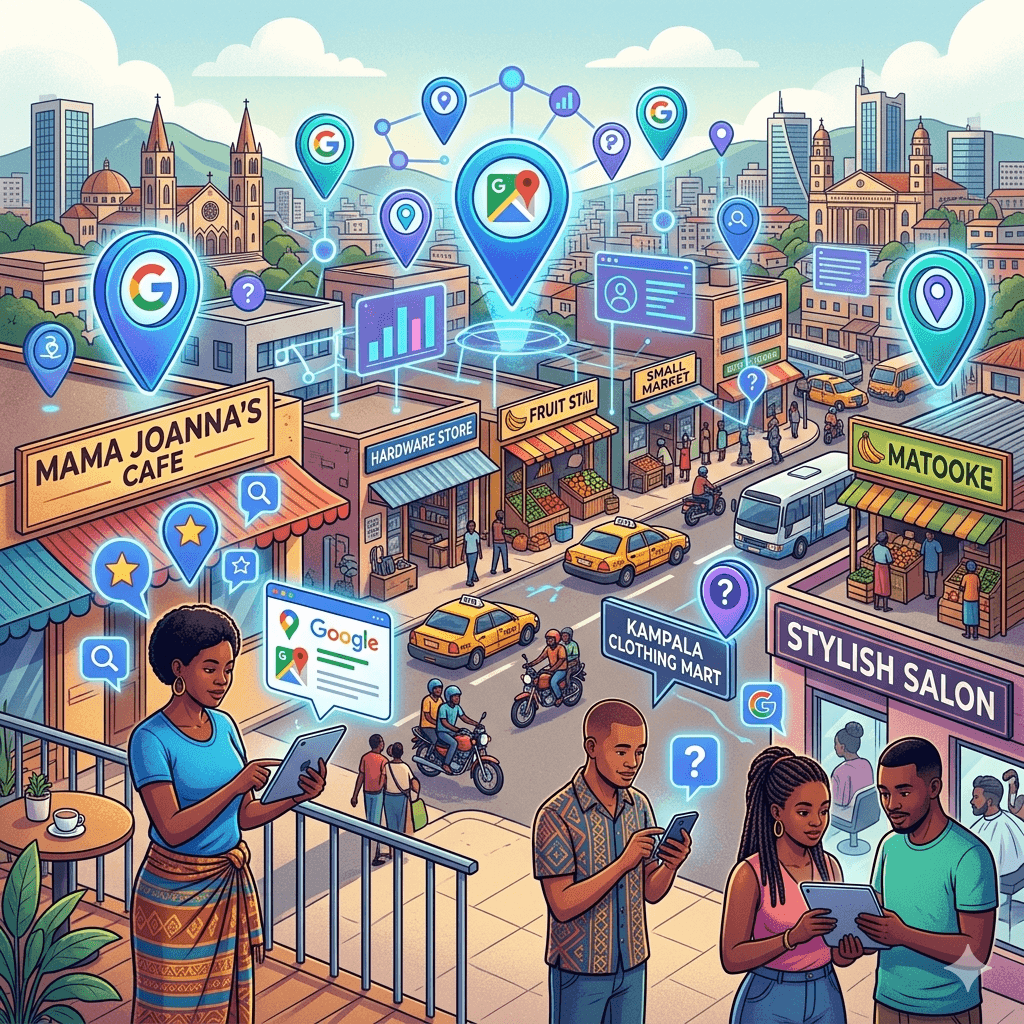
    Illustration of customers discovering a Kampala café on their smartphones

    Uganda’s internet usage is growing fast. More people are using smartphones to search for products and services every day. In Kampala especially, people are searching for things like “supermarket near me,” “clinic in Kololo,” or “affordable mechanic Kampala”   and they expect Google to give them good answers quickly.

    If your business doesn’t appear in those results, you’re invisible to a huge group of potential customers. That’s money walking out the door before it ever reaches you.

    Here’s why local search optimization matters for Ugandan businesses right now:

    • High buying intent: People who search locally are usually ready to act. They’re not just browsing   they want to buy, book, or call.

    • Mobile searches are growing: Most Ugandans access the internet via smartphone, and mobile searches heavily favour local results.

    • Less competition right now: Many local businesses in Kampala haven’t yet invested in local SEO, so getting started gives you an early advantage.

    • Google Maps visibility: When your business is optimised for local search, it can appear on Google Maps, which is often the first thing people check when looking for a business nearby.

    • Trust and credibility: Appearing at the top of local search results makes your business look more established and trustworthy, even if you’re just starting out.

    Simply put, local SEO is one of the most cost-effective ways to grow a small business in Kampala. Unlike paid ads that stop working the moment you stop paying, local SEO builds long-term visibility that keeps working for you around the clock.

    If you’re also interested in how a well-designed website can support your local visibility, our web design services are built with local search performance in mind.

    3. Key Components of Local SEO

    Local SEO isn’t one single thing   it’s a combination of several interconnected elements. Understanding each one helps you build a stronger overall strategy. Let’s break them down.

    3.1 Google Business Profile Optimization

    Your Google Business Profile (formerly called Google My Business) is the single most important tool in your local SEO toolkit. It’s the listing that appears on Google Search and Google Maps when someone searches for your business or a business like yours.

    A fully optimised Google Business Profile Kampala listing includes your business name, address, phone number, website, opening hours, photos, and customer reviews. When filled out completely, it tells Google   and your potential customers   exactly who you are, what you do, and where to find you.

    Businesses with complete, accurate Google Business Profiles are significantly more likely to appear in the Local Pack   the box of three local results that appears at the top of Google search results. Getting into that Local Pack can transform how many people find your business.

    3.2 Local Keywords and Search Intent

    Keywords are the words and phrases people type into Google when they’re searching for something. For local SEO, you want to focus on keywords that include your location or service area   things like “dentist in Kampala,” “affordable wedding photographer Uganda,” or “car wash Ntinda.”

    Understanding search intent is just as important as knowing the keywords. Search intent is the reason behind a search. Someone looking for DIY plumbing tips has a very different need from someone typing “plumber Kampala emergency”   who is ready to hire someone right now. You want to optimise your content and listings for the second type of search   high intent, location-specific.

    Local keywords for Kampala businesses should reflect both what you offer and where you offer it. We’ll cover how to find the right keywords in the step-by-step section below.

    3.3 NAP Consistency (Name, Address, Phone Number)

    NAP stands for Name, Address, and Phone Number. NAP consistency for local SEO means that every time your business information appears online   on your website, Google Business Profile, social media pages, or any directory listing   it should be exactly the same.

    Even small differences, like writing “Plot 45, Kampala Road” in one place and “45 Kampala Road” in another, can confuse Google and hurt your local search rankings. Google uses NAP data to verify that your business is real and trustworthy, so consistency is key.

    Before you do anything else, make sure your business name, address, and phone number are uniform across every online platform you use.

    3.4 Local Citations and Listings

    A citation is any online mention of your business name, address, and phone number. This includes entries in online directories, listing sites, social media platforms, and local blogs.

    Getting your business listed on relevant local directory listings in Uganda   like Yellow Pages Uganda, Craigslist, or industry-specific directories   signals to Google that your business is legitimate and well-established in your area. The more consistent, quality citations you have, the more Google trusts you.

    Think of each citation as a vote of confidence. The more reputable sites that mention your business with accurate information, the higher Google will rank you in local searches.

    3.5 Online Reviews and Reputation Management

    Reviews are one of the most powerful elements of local SEO. They influence both your search rankings and the decisions potential customers make when they find your listing.

    A business with 50 genuine, positive reviews almost always outranks a competitor with none   all else being equal. More importantly, people trust reviews. When someone in Kampala is choosing between two restaurants or mechanics, they’ll often go with the one that has better ratings and more responses from the owner.

    Encouraging happy customers to leave reviews, and responding to all reviews professionally (both positive and negative), is an essential part of building a strong local online reputation.

    4. How to Perform Local SEO Step by Step

    A Kampala shop owner claiming their Google Business Profile on a laptop

    Now let’s get practical. Here’s a step-by-step guide to implementing a local SEO strategy that Kampala businesses can actually follow   even with limited time or technical knowledge.

    4.1 Claim and Optimize Your Google Business Profile

    Start by going to google.com/business and claiming your business listing. If your business already exists on Google (sometimes it’s auto-generated), you just need to claim and verify it. If it doesn’t exist yet, create a new listing.

    Once you have access, here’s what to fill in:

    • Business name (exactly as it appears on your signage and website)

    • Full address   be precise, including the building name or plot number

    • Phone number   a number that customers can actually reach you on

    • Website URL

    • Business category   choose the most accurate primary category

    • Opening hours   and update them for public holidays

    • Business description   write a short, clear description using relevant local keywords

    • Photos   upload high-quality photos of your premises, products, and team

    Knowing how to optimize your Google Business Profile properly means keeping it updated, posting regular updates (like offers or events), and answering questions customers leave on your listing.

    For deeper guidance on how a strong web presence supports your Google profile, check out our SEO services page.

    4.2 Research and Use Local Keywords

    Before you can optimize your website or Google listing, you need to know what people are actually searching for. Here’s a simple way to do local keyword research in Uganda:

    • Start with Google: Type your service into Google and look at the autocomplete suggestions. These are real things people search for.

    • Check “People Also Ask”: When you search something on Google, you’ll often see a box of related questions. These give you content ideas.

    • Use Google Keyword Planner: It’s free with a Google Ads account and shows you search volume for specific terms.

    • Think like your customer: What would someone in Kampala type if they needed your service right now?

    For a salon in Kololo, useful keywords might include “hair salon Kololo Kampala,” “braiding near Kololo,” or “natural hair salon Uganda.” For a Wi-Fi cafe in Kampala, you’d want to target terms like “Wi-Fi cafe Kampala,” “cafe with fast internet Kampala,” or “work from cafe Kampala.”

    To learn more about how to write content that targets the right keywords, read our article on how to write website content that ranks on Google in Uganda.

    4.3 Optimize Your Website for Local Search

    If you have a website, it needs to be optimised for local search   not just for your industry in general. Here’s how:

    • Include location in key places: Add Kampala or your specific neighbourhood to your page titles, meta descriptions, headings, and throughout your content.

    • Create a dedicated contact page: Include your full address, phone number, and an embedded Google Map.

    • Add your NAP to the footer: Make sure your name, address, and phone number appear on every page.

    • Make your site mobile-friendly: Most people searching locally are on phones. A site that doesn’t work well on mobile will hurt your rankings.

    • Improve your page speed: Slow sites lose visitors quickly. Compress images and use a reliable hosting provider.

    • Create local content: Write blog posts or service pages that mention your city, neighbourhood, or local events.

    If you don’t yet have a website, or your current one isn’t performing well, our web design services can help you build something that’s both attractive and search-engine ready.

    4.4 Build Local Citations and Directory Listings

    Getting your business listed in online directories helps Google verify that you’re a legitimate local business. Here are some platforms to start with:

    • Google Business Profile (the most important one)

    • Yellow Pages Uganda

    • Yelp

    • Facebook Business Page

    • LinkedIn Company Page

    • Industry-specific directories relevant to your niche

    When listing your business anywhere, always use the exact same business name, address, and phone number. Consistency across all listings is what makes citations valuable for your local SEO.

    Also, check if your business information appears correctly on any sites that may have pulled your data automatically. If there are errors, claim the listing and correct them.

    4.5 Encourage Customer Reviews

    Reviews don’t just happen   you have to ask for them. Here’s how to get reviews for your business in Kampala without being pushy:

    • After a successful transaction, ask the customer directly: “Would you mind leaving us a quick Google review? It really helps us.”

    • Send a follow-up WhatsApp or SMS with a direct link to your Google review page

    • Put a small sign at your counter with a QR code linking to your Google review page

    • Respond to every review   thank happy customers and address concerns from unhappy ones

    A steady flow of genuine reviews not only boosts your ranking but also converts more visitors into customers. People trust other people’s opinions, especially in a close-knit market like Kampala.

    4.6 Use Social Media to Boost Local Presence

    Social media doesn’t directly affect Google rankings, but it supports your local SEO in several important ways. When people find your business on Facebook or Instagram and then search for you on Google, that activity sends positive signals to the algorithm.

    Here’s how to use social media for local SEO:

    • Keep your business name, address, and phone number consistent across all social profiles

    • Tag your location in posts   especially photos and videos

    • Mention local landmarks, events, or neighbourhoods in your captions

    • Engage with local community groups on Facebook

    • Share local news or events related to your industry

    For a broader look at how digital channels can work together to grow your business, explore our digital marketing services.

    4.7 Monitor and Track Local SEO Performance

    Local SEO isn’t a one-time task   it’s an ongoing process. To know whether your efforts are working, you need to track your performance regularly.

    Key things to monitor include:

    • How many people are finding your Google Business Profile in searches

    • How many people are clicking “Get Directions” or calling you from Google

    • Your ranking position for key local search terms

    • Website traffic from organic (non-paid) search

    • The number and quality of your reviews over time

    We’ll go into the specific tools for tracking in a later section.

    5. Common Local SEO Mistakes to Avoid

    Conceptual illustration of pitfalls like broken links, inconsistent NAP

    Even with the best intentions, it’s easy to make mistakes that hold your local SEO back. Here are the most common ones to watch out for.

    Inconsistent NAP Information

    Using slightly different versions of your business name, address, or phone number across different platforms confuses Google and dilutes your credibility. Always use the same format everywhere.

    Ignoring Your Google Business Profile

    A Google Business Profile that’s incomplete or outdated sends the wrong message to both Google and potential customers. Keep it updated with current hours, fresh photos, and regular posts.

    Not Asking for Reviews

    Many business owners feel awkward asking for reviews. But if you don’t ask, most satisfied customers won’t bother leaving one. Make it easy and natural to request reviews after every positive interaction.

    Keyword Stuffing

    Forcing keywords into your content in an unnatural way can actually hurt your rankings. Google has become very good at recognizing when content is written for humans versus when it’s been stuffed with keywords. Write naturally, and include keywords where they fit organically.

    Ignoring Mobile Users

    A large portion of local searches in Uganda happen on mobile devices. If your website isn’t mobile-friendly, you’re losing a massive chunk of potential traffic. Test your site on multiple devices regularly.

    Not Responding to Reviews

    Leaving reviews unanswered   especially negative ones   looks neglectful. Responding professionally to negative reviews actually improves your reputation because it shows you care about customer experience.

    Using the Wrong Business Category on Google

    Choosing a vague or incorrect category for your Google Business Profile can prevent you from showing up in the right searches. Be as specific as possible   “Italian Restaurant” is better than just “Restaurant.”

    Neglecting Local Content

    Your website should mention your location naturally. If you have a restaurant, blog about Kampala food culture. If you offer cleaning services, create a page specifically for cleaning services in Kampala. Local content builds relevance.

    6. Tools and Resources for Local SEO

    You don’t need expensive software to do local SEO well. Here are some beginner-friendly tools that can make the process easier and more effective.

    6.1 Keyword Research Tools

    • Google Keyword Planner: Free with a Google Ads account. Great for finding search volumes for local keywords.

    • Ubersuggest: Offers a free version with keyword ideas, search volume data, and competitor insights.

    • Google Search Console: Free tool that shows you which keywords are already bringing visitors to your website.

    • Google Autocomplete: Simply typing your service into Google gives you real search phrases people are using right now.

    6.2 Listing and Citation Management Tools

    • Google Business Profile Manager: The official tool for managing your Google listing.

    • Moz Local: Helps you find and fix inconsistent business listings across the web.

    • BrightLocal: A comprehensive local SEO platform with citation tracking and audit features.

    6.3 Review Monitoring Tools

    • Google Business Profile: You can monitor and respond to Google reviews directly from your profile dashboard.

    • ReviewTrackers: Aggregates reviews from multiple platforms so you can manage them in one place.

    • Mention: Tracks online mentions of your business name across the web, including social media.

    7. Measuring the Success of Your Local SEO

     Business owner analyzing local traffic and engagement metrics on a colorful dashboard

    How do you know if your local SEO is working? You track the right numbers. Here are the key areas to measure.

    7.1 Google Analytics Insights

    Google Analytics (free) shows you how people are finding your website and what they do when they get there. Key metrics to watch:

    • Organic search traffic   visits from people who found you through Google

    • Traffic by location   are people from Kampala actually visiting your site?

    • Bounce rate   are visitors staying to read or leaving immediately?

    • Conversions   are visitors taking action, like filling a contact form or calling you?

    7.2 Google Business Profile Insights

    Inside your Google Business Profile dashboard, you’ll find an Insights section that shows:

    • How many people searched for your business (directly or by category)

    • How many people requested directions to your location

    • How many people clicked to call you

    • How many people visited your website from your profile

    These numbers tell you directly how well your Google listing is performing as a local customer acquisition tool.

    7.3 Local Search Rankings Tracking

    To track where your business appears in search results for your target keywords, you can use:

    • BrightLocal: Tracks your local search rankings over time and compares you to competitors.

    • Whitespark: Another solid tool for tracking local keyword rankings.

    • Manual checks: Simply search your target keywords from an incognito browser in Kampala to see where you appear   just be aware this isn’t perfectly accurate.

    Aim to check your key rankings at least once a month. This lets you spot trends, see what’s working, and catch any sudden drops before they become bigger problems.

    8. Frequently Asked Questions

    8.1 What is the fastest way to improve my local search ranking?

    The fastest wins come from claiming and fully optimising your Google Business Profile, ensuring your NAP is consistent everywhere, and actively getting customer reviews. These three actions alone can produce noticeable results within a few weeks.

    8.2 How often should I update my Google Business Profile?

    Aim to update it at least once a month. Post new photos regularly, update your hours for holidays, and add posts about promotions, events, or new products. Regular activity signals to Google that your business is active and relevant.

    8.3 Are online reviews really important for local SEO?

    Yes   reviews are one of the strongest ranking factors for local search. They also directly influence whether potential customers choose your business. A business with consistent, positive reviews will almost always outrank one with none.

    8.4 How do I find the best local keywords for my business?

    Start with Google Autocomplete   type your service and location and see what suggestions come up. Use Google Keyword Planner to check search volumes. Also think about what a customer in Kampala would type when they need your service urgently   that often reveals your best keywords.

    8.5 Can social media impact my local SEO?

    Indirectly, yes. Social media doesn’t directly affect Google rankings, but it drives brand awareness, sends signals about your business’s activity, and helps build citations if your profiles include accurate NAP information. A strong social presence also builds the trust that makes people more likely to seek you out on Google.

    8.6 How long does it take to see results from local SEO?

    It depends on how competitive your market is and how much effort you put in. For most small businesses in Kampala, you can expect to see meaningful improvements in your Google Business Profile performance within one to three months. Ranking improvements for more competitive keywords can take three to six months or longer.

    8.7 Do I need a website to rank locally?

    Not necessarily   many businesses rank well with just a Google Business Profile. However, having a well-optimised website significantly increases your chances of ranking higher and gives customers a place to learn more before contacting you. If you’re ready to build one, check out our web design services.

    8.8 How can I fix incorrect business information online?

    For your Google Business Profile, log in and edit the details directly. For other directories, you’ll need to claim those listings and update them individually. Tools like Moz Local can help you find and fix inconsistencies across multiple platforms at once.

    8.9 What are the most common local SEO mistakes to avoid?

    The biggest ones are inconsistent NAP information, an incomplete Google Business Profile, ignoring reviews, and having a website that isn’t mobile-friendly. Also avoid keyword stuffing and neglecting to create locally-relevant content on your site.

    8.10 Is local SEO different for service-based vs retail businesses?

    Yes, slightly. Retail businesses benefit enormously from Google Maps visibility and “near me” searches since people want to walk in. Service-based businesses (like plumbers or tutors) should focus more on service-area keywords and showing their coverage area on Google. Both types benefit from reviews, citations, and an optimised Google Business Profile. For industry-specific strategies, we also offer resources for restaurant website design and hotel website design.

    Ready to Get Your Kampala Business Found Online?

    Local SEO is one of the most valuable investments you can make in your business right now. The tools are mostly free, the opportunity is real, and the businesses that start early will build a significant advantage over those that wait.

    Start with the basics: claim your Google Business Profile, get your NAP consistent, ask your best customers for reviews, and make sure your website mentions where you are and what you do. Then build from there.

    If you want help putting a proper local SEO strategy together for your Kampala business   or if you need a well-optimised website to support your efforts   we’re here to help. Check out our SEO services, visit our pricing page, or contact us today to get started.

    You can also explore how local businesses can drive more enquiries online in our article on how Uganda’s real estate agents can generate more leads through their website   the strategies apply to any local business looking to grow.

    Your customers are already searching. Make sure they find you.