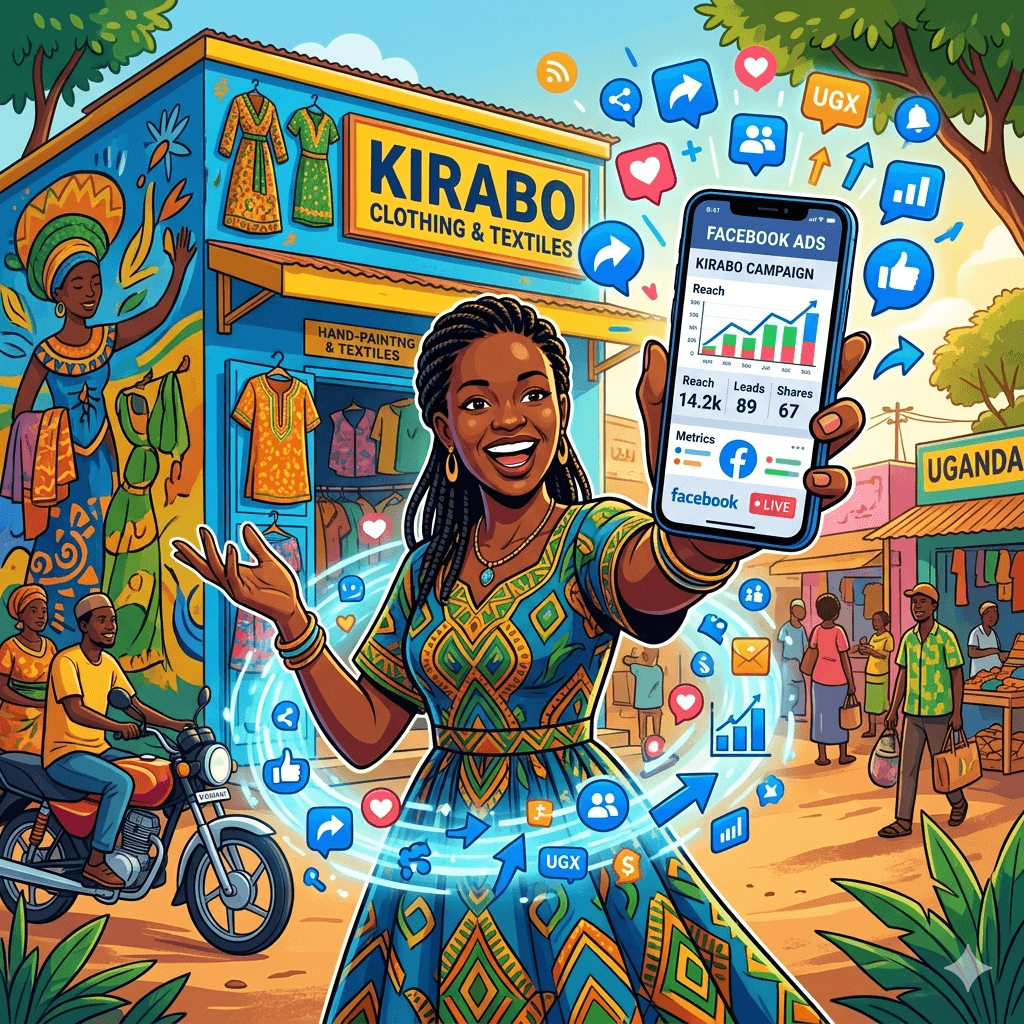
Tag: Social Media Marketing

  • How to Run Successful Facebook Ads for a Ugandan Business

    How to Run Successful Facebook Ads for a Ugandan Business

    Introduction

    Let’s be honest   running a business in Uganda is not easy. Between managing stock, handling customers, and keeping costs low, the last thing most business owners want to worry about is complicated digital marketing.

    But here’s the thing: Facebook ads have quietly become one of the most powerful tools available to Ugandan businesses right now. Whether you sell clothing in Kampala’s Owino Market, run a salon in Entebbe, or offer logistics services across the country, Facebook advertising Uganda gives you a direct line to your ideal customers   at a fraction of what traditional advertising costs.

    Uganda has over 3 million Facebook users, and that number keeps growing every year. These are real people scrolling through their feeds while waiting for a boda boda, during lunch breaks, and in the evenings at home. With the right Facebook ads strategy for small businesses, you can put your product or service right in front of them.

    This guide is for you   the business owner who wants to use Facebook and Instagram ads Uganda-style, on a real budget, without needing to hire an expensive agency (though we’ll share where to get expert help too). By the time you finish reading, you’ll understand how Facebook ads work, how to set them up step by step, how to target the right people in Uganda, and how to grow without wasting your money.

    Let’s dive in.

    1. What Are Facebook Ads?

    Think of Facebook ads like a very smart billboard   but instead of showing your message to everyone who drives past, it only shows your ad to the specific type of person you choose. That might be women aged 25 to 40 in Kampala who are interested in beauty products, or men in Jinja who have shown interest in farming.

    Facebook ads are paid promotions that appear inside the Facebook app, Instagram, and across other websites in Meta’s advertising network. When someone scrolls through their timeline, they might see a post from a friend, then an ad, then another post. That ad in between? That’s a Facebook ad.

    Meta (the company that owns Facebook and Instagram) gives businesses a platform called Ads Manager, where you can create campaigns, choose your audience, set a budget, design your ad, and track its performance   all in one place.

    The beauty of Facebook advertising Uganda is that you don’t need a huge budget or a marketing degree. You need a Facebook Business Page, a clear message, and a basic understanding of who your customer is. The platform does a lot of the heavy lifting for you.

    Meta ads Uganda work on an auction system. You set how much you’re willing to spend, and Facebook uses its algorithm to show your ad to people who are most likely to engage with it. The more relevant your ad is to the audience you target, the less you end up paying per result.

    2. Why Facebook Ads Work for Ugandan Businesses

    Map of Uganda with small businesses highlighted, connected by floating Facebook ad symbols

    You might be wondering: with so many platforms out there, why focus on Facebook?

    The answer comes down to three things: reach, relevance, and affordability.

    First, Facebook is the most widely used social media platform in Uganda. More Ugandans are on Facebook than any other platform. That makes it the best place to find and connect with your audience, whether they’re in Kampala, Gulu, Mbarara, or Mbale.

    Second, the platform lets you get incredibly specific with who sees your ads. You can target people based on their location, age, gender, language, interests, behaviors, and even their connection to your existing customers. This kind of Facebook ads targeting Uganda feature means your money goes to people who actually care about what you sell.

    Third, the cost of running ads on Facebook in Uganda is relatively low compared to many other countries. Because the market here is still developing, competition among advertisers is lower, which keeps costs down. You can reach thousands of people with a budget that fits a small business.

    On top of all that, Facebook and Instagram ads Uganda let you track everything. Unlike newspaper ads or radio spots where you never really know who saw it, Facebook shows you exactly how many people saw your ad, clicked it, and took action. This data is gold for any business owner who wants to spend wisely.

    And because Facebook owns Instagram, running a campaign on both platforms at the same time is as simple as clicking one checkbox. That doubles your visibility without doubling your work.

    3. Benefits of Running Facebook Ads

    Let’s get practical. Here’s what Facebook ads can actually do for your business:

    Increase brand visibility. Even if someone doesn’t click your ad the first time, they see your name and logo. Over time, this builds familiarity. People buy from businesses they recognize and trust.

    Generate leads and enquiries. Facebook ads can be set up to collect phone numbers, WhatsApp messages, or emails directly through the platform. Lead generation ads are especially powerful for service-based businesses like salons, schools, real estate agents, or consultants.

    Drive traffic to your website or shop. If you have a professional website, Facebook ads can send a steady stream of interested visitors directly to it. More visitors often means more sales.

    Boost online sales. For businesses with an ecommerce setup, Facebook ads are one of the fastest ways to drive purchases. You can even target people who visited your website but didn’t buy.

    Retarget existing customers. People who already bought from you are your warmest audience. Facebook lets you show ads specifically to your past customers, encouraging them to come back.

    Grow your social media following. Page likes and follower campaigns can build your audience organically over time, giving you a long-term asset you can market to for free.

    Compete with bigger brands. This is perhaps the most exciting benefit for small businesses. A well-crafted Facebook ad from a small Kampala business can outperform a poorly-done ad from a large company. Creative content and smart targeting level the playing field.

    4. Understanding Facebook Ad Costs in Uganda

    A visual breakdown of ad spending coins, small bills, and digital ad symbols floating around a laptop screen

    One of the first questions every business owner asks is: how much will this cost me?

    The honest answer is: it depends. But here’s what you need to know to plan your budget well.

    Facebook ads cost Uganda businesses in different ways depending on your goal. You might pay per click (CPC), per thousand impressions (CPM), per lead, or per purchase. The average cost-per-click in Uganda typically ranges from around UGX 200 to UGX 1,500, depending on your industry and audience size.

    For a beginner running a low budget Facebook ads strategy, you can start with as little as UGX 10,000 to 20,000 per day (roughly $3–$5 USD). That’s enough to test whether an ad works before scaling it up.

    Your ad costs are affected by several factors:

    • Audience size: A very narrow audience can become expensive. A very broad one wastes money on uninterested people. Find the sweet spot.

    • Ad quality: Facebook rewards ads that people engage with. A great ad will cost you less per result than a poor one.

    • Time of year: Costs can spike during busy periods like Christmas, back-to-school, or major events when more businesses are advertising.

    • Campaign objective: Awareness campaigns are cheaper than conversion campaigns because the goal is harder to achieve.

    The best approach is to start small, test your ads, see what works, and then increase your budget on the winners. Think of it like planting seeds   you test a few before planting a whole field.

    Need help calculating your ad ROI? Check out our pricing page for guidance on digital marketing investment.

    5. Types of Facebook Ads You Can Use

    Facebook gives you several ad formats to work with. Each one serves a different purpose. Here’s a breakdown of the most useful ones for small Ugandan businesses:

    5.1 Image Ads

    Image ads are the simplest type. They use a single photo with a headline, some text, and a call-to-action button. They’re quick to create and work well for promoting a product, an offer, or raising awareness.

    A good image ad is clean, eye-catching, and immediately clear about what you’re offering. Use high-quality photos   blurry or dark images will hurt your results.

    5.2 Video Ads

    Video ads are among the most engaging Facebook ad creatives you can use. A 15 to 60-second video showing your product in use, a customer testimonial, or a behind-the-scenes look at your business can drive strong results.

    The key with video ads: capture attention in the first 3 seconds. Most people scroll fast, so your video needs to hook them immediately   ideally without relying on sound, since many users watch with the sound off.

    5.3 Carousel Ads

    Carousel ads let you show multiple images or videos in a single ad that users can swipe through. They’re perfect for showcasing a range of products, telling a story in steps, or highlighting different features of one product.

    For example, a clothing boutique in Kampala could use a carousel to show five different outfits, each with its price and a link to buy. Each card in the carousel can have its own headline and call-to-action.

    5.4 Collection Ads

    Collection ads are designed for mobile shopping. They combine a main video or image with smaller product images below it. When someone taps on the ad, it opens a full-screen experience inside Facebook where they can browse and buy without leaving the app.

    This format works best for businesses with multiple products listed in a Facebook Shop or connected to an ecommerce website. Check out how we’ve helped businesses like Cash and Carry build ecommerce platforms that work seamlessly with Facebook ads.

    6. How to Set Up a Facebook Business Account

    Step-by-step digital illustration showing a Ugandan entrepreneur creating a Facebook

    Before you can run any ad, you need to set up your business account properly. Here’s how to do it step by step.

    6.1 Creating a Facebook Business Page

    Your business needs a Facebook Page   not just a personal profile. Here’s how to create one:

    • Log into your personal Facebook account.

    • Click the menu icon (the grid) and select “Pages,” then click “Create New Page.”

    • Enter your business name, choose a category (e.g., Local Business, Retail, Restaurant), and add a description.

    • Upload a profile photo (your logo works great) and a cover photo.

    • Add your contact details   phone number, WhatsApp, website, and physical address if applicable.

    • Click “Create Page” and you’re done.

    Make sure your page looks complete and professional before you start running ads. A half-empty page will make potential customers lose trust in your business.

    6.2 Setting Up Business Manager

    Facebook Business Manager (now called Meta Business Suite) is the central hub for managing your ads, pages, and payment methods. It keeps your business separate from your personal profile.

    • Go to business.facebook.com and click “Create Account.”

    • Enter your business name, your name, and your work email.

    • Follow the prompts to connect your Facebook Business Page.

    • Once inside, navigate to “Ads Manager” from the left menu to start creating campaigns.

    Using Business Manager also lets you add team members to help manage your ads without giving them access to your personal Facebook account.

    6.3 Connecting a Payment Method

    Facebook accepts a few payment methods that work in Uganda:

    • Visa or Mastercard debit/credit cards (many Ugandan banks issue these)

    • PayPal (requires linking a card)

    • Some mobile money options via third-party services

    To add a payment method, go to Ads Manager, click the menu, and select “Billing & Payments.” Enter your card details, and Facebook will charge your card as your ads run.

    A common challenge for Ugandans is that some local bank cards may be declined. If this happens, try using a Visa card from a larger bank like Stanbic, Centenary, or Absa. Some business owners also use dollar accounts to avoid currency conversion issues.

    7. How to Define Your Target Audience

    Targeting is the engine of Facebook advertising. If you get this wrong, you’ll spend money showing ads to people who will never buy from you. Get it right, and your results can be remarkable.

    7.1 Using Location Targeting in Uganda

    Facebook lets you target people by country, region, city, or even a specific radius around a location. For Facebook ads targeting Uganda, this is incredibly useful.

    For example, if you run a restaurant in Nakasero, you can target only people within 5 kilometers of your location. If you offer delivery across Kampala, set the radius to cover the whole city. If you sell nationwide, select Uganda as your country.

    You can also target multiple cities at once. If you have branches in Kampala and Mbarara, you can include both locations in the same campaign.

    7.2 Demographics and Interests

    After location, you can refine your audience using demographics and interests:

    • Age: Most Ugandan Facebook users are between 18 and 44. Start by targeting adults in this range and refine based on who actually engages with your ads.

    • Gender: If your product is gender-specific, limit your targeting accordingly to avoid wasting budget.

    • Language: Targeting English speakers works well for most business ads in Uganda.

    • Interests: Facebook tracks what users engage with   pages they follow, things they click on, events they attend. You can target people who are interested in things relevant to your business, like fashion, farming, real estate, or cooking.

    • Behaviors: This includes things like people who shop online frequently, business owners, or frequent travelers.

    7.3 Custom and Lookalike Audiences

    These are two of the most powerful   and underused   targeting tools available:

    Custom Audiences: Upload your customer list (phone numbers or emails), and Facebook will match them to user accounts. You can then show ads specifically to these people   great for re-engaging existing customers or running loyalty campaigns.

    Lookalike Audiences: Once you have a Custom Audience, Facebook can find other users in Uganda who share similar characteristics. This is like cloning your best customers. It’s one of the most effective Facebook ads targeting tips for scaling a campaign once you know your core audience works.

    For more on how targeting fits into a full digital strategy, explore our digital marketing services.

    8. How to Create Effective Facebook Ad Content

    A creative workspace with a Ugandan entrepreneur designing ad visuals on a laptop

    Even the best targeting in the world won’t save a bad ad. Your content   the image, the headline, the words   is what makes someone stop scrolling and pay attention.

    8.1 Crafting Compelling Headlines

    Your headline is the first thing people read. It needs to do one job: make them want to keep reading.

    Here’s a simple formula: Lead with a benefit, not a feature. Instead of “We sell fresh juice” try “Stay energized all day with our cold-pressed Kampala juice.”

    Other tips for strong headlines:

    • Use numbers: “5 outfits under UGX 50,000” grabs attention.

    • Ask a question: “Looking for a trusted plumber in Kampala?”

    • Create urgency: “Only 10 spots left for our weekend workshop.”

    • Speak to the problem your customer has: “Tired of slow internet at your office?”

    8.2 Choosing Engaging Images or Videos

    Your visual is the very first thing people see. It determines whether they stop or scroll past.

    For image ads, use photos that are bright, clear, and relevant. Real photos of your actual products or your team tend to outperform generic stock photos. Ugandan audiences connect better with content that feels local and authentic.

    For video ads, keep them short (15–30 seconds), add subtitles (since most people watch without sound), and make the first frame visually interesting enough to stop a scroll.

    Struggling with design? A well-designed landing page and ad creative from a professional web design service can make a huge difference in your ad performance.

    8.3 Writing Clear Call-to-Actions

    A call-to-action (CTA) tells your audience what to do next. Never leave people guessing.

    Strong CTAs for Ugandan businesses include:

    • “WhatsApp us now”   perfect since WhatsApp is widely used in Uganda

    • “Order now”   for product-based businesses

    • “Book a free consultation”   for service providers

    • “Visit our shop”   for local businesses with a physical location

    • “Learn more”   for awareness campaigns where you want people to visit your website

    Match your CTA to the goal of the ad. If you want calls, put your number in the ad and make “Call Now” the button. If you want website visits, link to a relevant landing page on your site.

    9. How to Set a Budget and Schedule Ads

    Managing your budget well is what separates businesses that grow from those that burn through money with nothing to show for it.

    9.1 Daily vs. Lifetime Budget

    Facebook gives you two budget types:

    Daily Budget: Facebook will spend up to this amount each day. Good for ongoing campaigns you plan to run long-term. You can start with as little as UGX 10,000–15,000 per day and scale up once you see results.

    Lifetime Budget: You set a total amount for the entire campaign duration. Facebook distributes the spending across the campaign period. Better for short-term campaigns with a fixed end date   like a sale or an event.

    For beginners, start with a daily budget. It’s easier to control and adjust. Think of your first campaign as an experiment   you’re learning, not just advertising.

    9.2 Best Times to Run Ads in Uganda

    Facebook allows you to schedule your ads to run only at certain times of day or on specific days of the week.

    Based on general usage patterns, Ugandans tend to be most active on Facebook during:

    • Morning commutes: 7–9 AM

    • Lunch breaks: 12–2 PM

    • Evening relaxation: 7–10 PM

    However, the best approach is to test different times and let Facebook’s own data guide you. After running your ad for a week, check the performance by hour in Ads Manager to see when your audience is most active.

    9.3 Adjusting Budgets Based on Performance

    Never set your budget and forget it. Check your ads every few days.

    • If an ad is getting cheap clicks and generating leads, increase the daily budget gradually   no more than 20–30% at a time to avoid disrupting the algorithm.

    • If an ad is getting lots of impressions but no clicks, pause it and review your creative or targeting.

    • If one ad is clearly outperforming another, shift your budget to the winner.

    This is what separates smart spenders from wasteful ones.

    10. Monitoring and Optimizing Your Facebook Ads

    A laptop screen showing Facebook Ads Manager metrics with charts, graphs

    Running an ad is only the beginning. The real work   and the real opportunity   lies in reading your results and improving your campaigns over time.

    10.1 Understanding Facebook Ads Manager Metrics

    Facebook Ads Manager gives you a dashboard packed with data. Here are the key metrics every Ugandan business owner should understand:

    • Reach: How many unique people saw your ad.

    • Impressions: How many times your ad was shown (including repeat views).

    • Click-Through Rate (CTR): The percentage of people who saw your ad and clicked it. A higher CTR means your ad is resonating.

    • Cost Per Click (CPC): How much you’re paying for each click. Lower is better.

    • Cost Per Result: How much you’re paying per lead, purchase, or whichever goal you set.

    • Frequency: How many times the average person has seen your ad. If this goes above 3–4, your audience may be getting tired of it. Time to refresh your creative.

    • ROAS (Return on Ad Spend): For ecommerce, this tells you how much revenue you earned per shilling spent on ads.

    These Facebook ads performance metrics are your compass. Check them regularly to understand what’s working and what’s not.

    10.2 A/B Testing Ads

    A/B testing means running two versions of an ad at the same time to see which performs better. Change only one element at a time   like the headline, image, or audience   so you know exactly what made the difference.

    For example, run the same ad with two different images and see which one gets more clicks. Then take the winner and test it against a new headline. Over time, you’ll build up a clear picture of what works for your audience.

    Facebook has a built-in A/B testing feature in Ads Manager that makes this straightforward, even for beginners.

    10.3 Scaling Successful Ads

    Once you find an ad that works   good click-through rate, low cost per result, consistent leads or sales   it’s time to scale.

    Scaling means increasing the budget so the ad reaches more people. But do it gradually. A sudden big budget jump can disrupt Facebook’s algorithm and actually worsen your results. The golden rule: increase budget by no more than 20–30% every 3–4 days.

    You can also scale by duplicating the winning ad and targeting a Lookalike Audience   new people who share the traits of those who responded to your ad.

    Need help setting up and scaling campaigns professionally? Our team at Kico Web Design offers expert support for Facebook advertising strategies.

    11. Common Mistakes to Avoid

    Learning from other people’s mistakes is cheaper than making your own. Here are the most common pitfalls that waste money and kill results:

    11.1 Targeting Too Broadly or Narrowly

    One of the most common errors in Facebook ads for business Uganda is getting the audience size wrong.

    Target too broadly (e.g., “everyone in Uganda”) and you’ll waste budget on people who have zero interest in your product. Target too narrowly (e.g., “women aged 28–30 in Kololo who love yoga”) and your audience is so small that Facebook can’t optimize your ads properly.

    Aim for an audience size between 50,000 and 500,000 people. This gives Facebook enough room to find the right people while still keeping your targeting relevant.

    11.2 Ignoring Ad Metrics

    Many business owners run ads, hope for the best, and never look at the data. This is like driving blindfolded. Your metrics tell you where you’re going and whether you need to turn.

    Commit to checking your Ads Manager at least every 2–3 days. Look at what’s working, what isn’t, and adjust accordingly. Small tweaks based on data can dramatically improve results.

    11.3 Poor Visuals or Messaging

    A low-quality photo or a confusing message will kill your campaign before it starts. People make split-second decisions when scrolling. If your ad looks unprofessional or says nothing clear, they’ll scroll right past.

    Invest in decent photos, clear copy, and a simple message. You don’t need a big-budget photoshoot   a well-lit phone photo can work perfectly. What matters most is that your ad clearly answers: “What is this, and why should I care?”

    Good web design services can help you create visually consistent ad materials and landing pages that convert visitors into customers.

    12. Frequently Asked Questions (FAQs)

    12.1 How much should I spend on my first Facebook ad?

    Start small   around UGX 10,000 to 20,000 per day is enough to test an ad and get meaningful data within a week. Your goal at this stage is learning, not scaling. Once you know what works, increase your budget gradually.

    12.2 Can I run ads on Instagram at the same time?

    Yes! When you create an ad in Facebook Ads Manager, you can choose to place it on both Facebook and Instagram with just one checkbox. Since many Ugandans use both platforms, running Facebook and Instagram ads Uganda simultaneously is a smart strategy to increase reach without extra cost.

    12.3 What if my ads don’t get any clicks?

    First, don’t panic. It’s normal for new ads to take 24–48 hours before they fully optimize. If after 3–4 days you’re still getting no clicks, review your image (is it attention-grabbing?), your headline (is it clear and relevant?), and your targeting (are you reaching the right people?). Make one change at a time and retest.

    12.4 How often should I change my ad content?

    If your ad frequency (the number of times the average person has seen your ad) climbs above 3–4, it’s time for a refresh. Otherwise, a well-performing ad can run for several weeks. Don’t change things just for the sake of it   if an ad is delivering results, let it run.

    12.5 Can I target customers outside Uganda?

    Absolutely. If you have products or services you can deliver to other African countries or globally, simply add those locations to your targeting. Ugandan diaspora communities in the UK, USA, or Canada can also be targeted if your product appeals to them. Adjust your messaging to fit the location you’re targeting.

    12.6 What type of content works best for small businesses?

    Authentic, local content tends to win. Real photos of your products, honest customer testimonials, and content that speaks directly to everyday Ugandan life outperform polished but generic images. Show real people using your product. Share stories. Be human. You don’t need a big production budget to create content that connects.

    12.7 How do I measure return on investment (ROI)?

    Track your ad spend and compare it to the revenue it generated. For example, if you spent UGX 100,000 on ads and made UGX 500,000 in sales that you can trace back to those ads, your ROI is 400%. Facebook Ads Manager helps track conversions directly if your website is set up with the Facebook Pixel   a small piece of code that tracks actions people take on your site after clicking your ad.

    12.8 Is it better to run video ads or image ads?

    Both can work well. Video ads tend to generate more engagement and are better for storytelling or demonstrating a product. Image ads are faster to create and work well for simple offers or promotions. The best approach is to test both. Some businesses find image ads outperform videos; others see the opposite. Let your data decide.

    12.9 Can I manage ads without hiring an expert?

    Yes   and this guide is proof that you can learn the basics yourself. Many small business owners in Uganda successfully manage their own ad campaigns. However, as your budget grows and your campaigns become more complex, having an expert review your strategy can save you a lot of wasted spend. If you’d like professional support, feel free to contact our team for a consultation. You can also learn more about our experience helping Ugandan businesses grow online.

    Final Thoughts

    Running successful Facebook ads for your Ugandan business is not magic, and it’s not reserved for large corporations or tech-savvy marketers. It’s a skill   and like any skill, it gets better with practice.

    Start small, learn as you go, and let the data guide you. Your first campaign might not be perfect, and that’s okay. What matters is that you start, you track your results, and you keep improving.

    Ugandan businesses that invest in digital marketing today are building a real competitive advantage. The opportunity is here, the audience is waiting, and the tools are more accessible than ever.

    Ready to take your digital presence to the next level? Explore how our SEO services, professional website development, and digital marketing services can work hand-in-hand with your Facebook advertising to drive real growth for your business.

    Take a look at how we’ve helped real businesses succeed   from the BT Repair Centre in Kampala to the Cattle Farmers Network Platform Uganda. The same level of support is available for your business too.

    Start today. Your future customers are already on Facebook   it’s time to reach them.
  • Social Media vs SEO: Which Should Ugandan Businesses Invest In? 

    Social Media vs SEO: Which Should Ugandan Businesses Invest In? 

    1. Introduction

    You have a business idea. Maybe you are selling clothes from your home in Kampala, offering freelance graphic design, or running a small catering service in Jinja. The big question on your mind is: how do I get customers online?

    You keep hearing two terms tossed around: social media and SEO. Some people swear by Facebook and TikTok. Others say Google is where the real money is. And if you are just starting out, trying to figure out which one to focus on feels like choosing between a boda-boda and a taxi   both can get you there, but the right choice depends on where you are going and how fast you need to arrive.

    This article breaks down both strategies clearly. No tech jargon. No confusing formulas. Just practical, honest advice that fits the Ugandan context   so you can make the right call for your business and budget. Whether you are leaning toward social media marketing in Uganda or exploring SEO services in Uganda, this guide has you covered.

    You can also check out Website vs Social Media: Which is Better for Your Ugandan Business for more context before diving in.

    2. What is Social Media Marketing?

    Social media marketing is simply using platforms like Facebook, Instagram, TikTok, YouTube, or X (formerly Twitter) to promote your business. You post content, run paid ads, engage with your audience, and build a community around your brand.

    Think of it like setting up a stall in a busy market. People walk by, see what you are selling, and can interact with you directly. The goal is to create content that stops people mid-scroll and makes them want to learn more about what you offer.

    For many Ugandan entrepreneurs, social media marketing is the first step into the world of digital marketing for small business. It is fast, relatively affordable, and does not require a website to get started. You just need a smartphone, a strategy, and the willingness to show up consistently.

    Whether you are promoting handmade bags, tutoring services, or a small restaurant, social media marketing for beginners is very accessible. The barrier to entry is low, which makes it an appealing starting point for most new businesses.

    3. What is SEO?

    A laptop screen showing a search bar with results ranked in order

    SEO stands for Search Engine Optimization. In plain language, it means making your website or content easy for Google to find and rank highly when someone searches for something related to your business.

    Imagine Google as a huge library. SEO is the process of organizing and labeling your book   your website   so the librarian (Google) can easily find it and put it on the recommended shelf. When someone types “best tailor in Kampala” or “affordable web design Uganda” into Google, SEO determines whether your business shows up on the first page or gets buried somewhere on page ten where nobody looks.

    Understanding how SEO works is not as complicated as people make it sound. At its core, it involves writing useful content, using the right keywords, getting other websites to link to yours, and making sure your website loads fast and works well on mobile phones.

    SEO is a long-term strategy. You might not see instant results, but the traffic you earn through search engine ranking is free and sustainable   and that makes it a powerful tool for online business in Uganda.

    4. How Social Media Works for Ugandan Businesses

    Social media platforms are designed to connect people. For businesses, they offer a direct line to potential customers without the need for expensive advertising campaigns or a polished website. Here is how it all plays out in the Ugandan context.

    4.1 Popular Platforms in Uganda

    Facebook remains the dominant platform for business marketing in Uganda. With millions of active Ugandan users, it is where many buyers and sellers meet. WhatsApp Business is also widely used for direct customer communication and sending product catalogs.

    TikTok has been growing fast, especially among younger audiences. Instagram works well for visual products like fashion, food, and interior decor. YouTube is excellent for tutorials, product demos, and educational content. Knowing which platform your target audience uses most is the first step in building a strong social media marketing in Uganda strategy.

    4.2 How Businesses Gain Visibility

    On social media, visibility comes through two main routes: organic content and paid advertising. Organic means you post regularly and build a following over time. Paid means you boost posts or run targeted ads to reach specific people based on their age, location, interests, and behavior.

    The beauty of paid social media ads in Uganda is that you can start with a very small budget   sometimes as little as 5,000 to 10,000 UGX per day   and still reach hundreds of potential customers. This makes it one of the most accessible online marketing strategies for startups and side hustlers.

    4.3 Types of Content That Perform Well

    Not all content performs the same. In Uganda, content that tends to get the most engagement includes short videos showing how a product works, before-and-after transformation photos, customer testimonials, behind-the-scenes clips, and posts that speak directly to local culture and everyday life.

    Humor, relatable scenarios, and local language elements   like mixing in Luganda or other local phrases   tend to boost engagement significantly. If you want to go deeper on this, check out How to Master Content Creation in Uganda for practical strategies tailored to the Ugandan market.

    5. How SEO Works for Ugandan Businesses

    A website climbing a ladder of search engine rankings with steps labeled as keywords

    SEO might sound technical, but the basic idea is straightforward: help Google understand what your business does so it can show your website to people who are searching for exactly that. Here is how it breaks down.

    5.1 How Search Engines Rank Content

    Google uses a complex algorithm   basically a very detailed scoring system   to decide which websites appear at the top of search results. It looks at things like how relevant your content is to the search query, how fast your website loads, how many other reputable websites link to yours, and how long people stay on your site once they visit.

    The more you tick these boxes, the higher your search engine ranking. It is not a one-time task. SEO is ongoing, and the businesses that stay consistent tend to win in the long run.

    5.2 Local SEO and Google Visibility

    Local SEO is specifically about helping your business show up when people nearby search for your services. For example, if someone in Ntinda types “pizza delivery near me” or “plumber Kampala,” local SEO determines whether your business appears in those results.

    One of the most effective and free tools for local SEO is Google Business Profile. Setting up and optimizing your listing there can dramatically improve your online visibility in local searches. If you are running a location-based business, this is non-negotiable. You can explore more in Local SEO for Kampala Businesses: A Beginner’s Guide.

    5.3 Content and Keywords Basics

    Keywords are the words and phrases people type into Google when looking for something. If you run a printing company in Kampala, your potential customers might search for “business card printing Kampala” or “affordable flyer design Uganda.” Your job is to create content that naturally includes these phrases.

    This does not mean stuffing your pages with keywords   Google is smart enough to penalize that. It means writing genuinely helpful content that naturally covers the topics your audience cares about. Learn more about this process in How to Do Keyword Research for a Ugandan Audience.

    6. Benefits of Social Media Marketing

    Understanding the benefits of social media marketing helps you see why so many Ugandan businesses start here. Let us look at the biggest advantages.

    6.1 Fast Audience Reach

    One of the biggest wins with social media is speed. You can create a post today and have it seen by thousands of people within hours. If your content goes viral   or even just gets shared a few times   your reach multiplies without you spending a single shilling more.

    This speed is especially useful when you are launching a new product, promoting a limited-time offer, or trying to build brand awareness quickly. No other channel can match social media when it comes to rapid, wide-reaching visibility.

    6.2 Low Startup Costs

    Creating a Facebook page, Instagram account, or TikTok profile costs nothing. You can start posting content today with just a smartphone. Even paid ads can be started with very small budgets, making social media one of the most budget-friendly online marketing strategies for entrepreneurs just starting out.

    This low barrier is a major reason why social media or SEO for new business discussions almost always recommend social media as the starting point   it simply costs less to get going.

    6.3 Direct Customer Interaction

    Social media lets you have real conversations with your customers. You can answer questions in the comments, respond to DMs, run polls, and get direct feedback on your products. This two-way communication builds trust and loyalty faster than almost any other marketing channel.

    It is like being able to chat with every customer who walks past your shop   except your shop is open 24 hours and your reach is not limited by geography.

    7. Benefits of SEO

    A website receiving continuous incoming visitors represented by arrows flowing in from search results

    The benefits of SEO for small business are real   but they tend to show up later and last longer. Here is what you stand to gain.

    7.1 Long-Term Traffic Growth

    The biggest advantage of SEO is that it keeps working long after you have done the initial work. A blog post that ranks on the first page of Google can bring in visitors every single day for years   without you spending money on ads.

    Think of SEO like planting a fruit tree. It takes time to grow, but once it does, it provides fruit season after season. Social media is more like selling fruit at a market   you have to show up every day to make sales.

    To understand how to make this work for your business, read How to Get Your Ugandan Business on the First Page of Google.

    7.2 Builds Trust and Credibility

    When your website appears at the top of Google search results, people automatically trust it more. Most users assume that if Google ranks a business highly, it must be credible. This perceived authority is incredibly valuable   especially when you are trying to compete with more established businesses.

    Unlike social media followers, which can feel superficial, organic traffic from Google tends to convert better because those visitors are actively searching for what you offer.

    7.3 Passive Lead Generation

    Once your SEO is working, your website generates leads without you constantly creating new content or spending on ads. This is what marketers call passive lead generation. Your website works for you even while you sleep.

    For entrepreneurs who want to build a business that does not rely entirely on their daily attention, this is a game-changer. See more in How to Get Your Ugandan Business on the First Page of Google.

    8. Challenges of Social Media Marketing

    Social media is not all easy wins. Here are some real challenges you need to be aware of before going all in.

    8.1 Requires Constant Posting

    Social media algorithms reward consistency. If you stop posting for a week, your reach drops significantly. Building and maintaining a social media presence requires ongoing time and creative energy. For a solo entrepreneur juggling multiple responsibilities, this can quickly become exhausting.

    Many Ugandan business owners start strong and then burn out after a few weeks because they underestimate how demanding regular content creation can be.

    8.2 Algorithm Changes

    Social media platforms frequently change how their algorithms work. A strategy that gets you strong results today might deliver much weaker results six months from now   simply because the platform changed its rules. Facebook, in particular, has reduced organic reach dramatically over the years, meaning fewer people now see your posts unless you pay to promote them.

    This unpredictability is one of the biggest SEO vs social media pros and cons talking points   SEO, while slower, is generally more stable.

    8.3 Limited Organic Reach

    As platforms have grown more commercial, organic reach   the number of people who see your posts without paid promotion   has steadily declined. On Facebook, a post from a business page might only reach 2% to 5% of its followers organically. This means that even if you have 10,000 followers, as few as 200 to 500 might see any given post unless you pay to boost it.

    9. Challenges of SEO

    A person working on content and technical settings on a laptop

    SEO has its own set of hurdles. Understanding them upfront will save you frustration later.

    9.1 Takes Time to See Results

    This is the most common complaint about SEO: it is slow. In most cases, it takes three to six months   sometimes longer   before you start seeing meaningful results from your SEO efforts. For a business that needs customers this week, that timeline can feel impossible.

    This is why SEO vs social media for startups discussions often recommend social media for immediate traction while building SEO in parallel for long-term growth.

    9.2 Requires Content Creation

    SEO does not work without content. You need to create blog posts, web pages, articles, or videos that are optimized for search. This takes time, skill, and consistency. If writing is not your strength, you may need to hire someone   which adds to your cost.

    The good news is that the content you create for SEO can often be repurposed for social media as well, which helps you get double the value from your effort.

    9.3 Technical Learning Curve

    Beyond content, SEO involves technical elements like website speed, mobile optimization, meta tags, sitemaps, and backlinks. While you do not need to understand all of this at once, there is a learning curve that can be intimidating for beginners.

    The good news: many of the most impactful SEO actions   like creating quality content, optimizing your Google Business Profile, and building local citations   do not require deep technical knowledge.

    10. Social Media vs SEO: Key Differences

    When comparing social media vs SEO, it helps to look at how they differ across four key dimensions. Understanding the difference between SEO and social media gives you a clearer picture of what each can and cannot do for your business.

    Also, explore Website vs Social Media: Which is Better for Your Ugandan Business for a broader comparison.

    10.1 Speed of Results

    Social media delivers results fast. You can post today and have people reaching out tomorrow. SEO is a slow burn   you plant seeds today and harvest months later. If speed matters, social media wins. If sustainability matters more, SEO takes the lead.

    10.2 Cost and Investment

    Social media has low startup costs but can get expensive if you rely on paid ads for reach. SEO requires more upfront effort   creating content, building a website   but the long-term cost per visitor tends to be much lower once you start ranking. In terms of marketing ROI, SEO often wins over time.

    10.3 Skill Requirements

    Social media is more intuitive for most people. Posting, responding, and creating content feels natural because we already use these platforms personally. SEO requires learning about keywords, content strategy, and technical optimization. The digital marketing tips for beginners community tends to point to social media as the easier starting point.

    10.4 Sustainability

    Social media traffic stops the moment you stop posting or paying for ads. SEO traffic, once earned, continues to flow even if you step away for a while. This makes SEO more sustainable as a long-term strategy   especially for businesses that want to reduce their dependence on paid advertising.

    11. Which is Better for Beginners in Uganda?

    Honestly? There is no single answer, because it depends on your business type, your budget, and your goals. But if you are just starting out and need to make a decision right now, here is a practical take.

    Start with social media. It is cheaper, faster, and does not require a website. You can test your product ideas, build an audience, and start making sales relatively quickly. Platforms like Facebook, WhatsApp Business, and TikTok are already where many of your potential customers spend their time.

    At the same time, do not ignore SEO completely. Even as a beginner, you can set up a free Google Business Profile, make sure your business is listed correctly online, and start learning the basics of keyword research. This lays the groundwork for future SEO growth without overwhelming you.

    The smartest marketing strategy for small business in Uganda is to use social media for immediate results while gradually building your SEO foundation   so that over time, your website traffic growth becomes more predictable and less reliant on constant posting or ad spend.

    12. When to Choose Social Media

    A small startup using only a smartphone to promote products online

    12.1 Small Budgets

    If your marketing budget is very limited, social media is your best friend. You can create and post content for free, engage with potential customers at no cost, and run paid promotions with as little as 5,000 UGX. This makes it the ideal choice for entrepreneurs who need to promote a business online with a low budget.

    12.2 New Businesses

    When you are brand new, you need visibility fast. Social media gives you that. You can announce your business, share what you offer, and start generating interest immediately. Building a social media following takes time, but you can start getting customers from day one if your content speaks to the right people.

    For online marketing for startups, social media is almost always the recommended first channel. It is the quickest way to validate your business idea and start generating revenue.

    12.3 Visual or Trend-Based Products

    If you sell something visual   fashion, food, decor, beauty products, event services   social media is tailor-made for you. Platforms like Instagram and TikTok are built for visual storytelling, and trend-based products can go viral quickly when the content is engaging and relatable.

    Social media also lets you tap into trending topics and hashtags to reach audiences that do not yet know you exist.

    13. When to Choose SEO

    13.1 Long-Term Business Growth

    If you are thinking beyond the next few months and want to build a business that will still be attracting customers years from now, SEO is worth the investment. The organic traffic you earn through SEO is essentially free   and it compounds over time as you create more content and earn more backlinks.

    Read more about How to Get Your Ugandan Business on the First Page of Google to understand the long game.

    13.2 Niche or Informational Businesses

    If your business answers specific questions or solves niche problems   like legal consulting, accounting services, IT support, or health information   SEO is extremely powerful. People searching for answers to specific questions on Google are already primed to take action. Ranking for those searches puts you in front of a highly motivated audience.

    13.3 Building Authority Online

    SEO builds credibility in a way that social media cannot fully replicate. When your website consistently appears at the top of Google for your industry’s keywords, people see you as an authority. That brand awareness and trust is hard to build through social media alone.

    Businesses that combine authority content with good SEO become the go-to names in their industries   and that kind of reputation is worth more than any ad campaign.

    14. How to Combine Social Media and SEO

    The question of SEO vs social media marketing does not always have to be either/or. In fact, the most effective online marketing strategies use both together. Here is how to make them work as a team.

    14.1 Using Social Media to Promote Content

    Whenever you publish a new blog post or web page, share it on your social media platforms. This drives immediate traffic to your site and signals to Google that people are engaging with your content   which can help improve your search rankings.

    Social media also helps you build backlinks naturally. When people share your content, other websites may link to it   and those backlinks are gold for your SEO.

    14.2 Driving Traffic to Websites

    Use your social media bio, stories, and posts to consistently direct people to your website. If you run a promotion, send people to a landing page. If you publish a helpful article, link to it. Every visit to your website helps improve your site’s authority over time.

    Think of social media as the highway and your website as the destination. The more traffic you drive there, the better your website traffic growth metrics become   which positively influences your SEO.

    14.3 Repurposing Content Across Platforms

    You do not have to create completely different content for every platform. A single blog post can become a series of social media posts, a short video, an infographic, and a WhatsApp broadcast message. This is called content repurposing, and it saves enormous time and energy.

    A strong content marketing strategy uses this approach to stretch every piece of content as far as possible. For detailed guidance, visit How to Master Content Creation in Uganda. This approach powers both your social media presence and your SEO simultaneously.

    15. Tools for Social Media and SEO Beginners

    A workspace with a laptop displaying dashboards

    You do not need expensive software to get started. Here are some reliable free tools to help with both digital marketing in Uganda approaches.

    15.1 Free Social Media Tools

    • Canva   Create professional-looking graphics, flyers, and social media posts even if you have no design experience.

    • Meta Business Suite   Manage your Facebook and Instagram pages, schedule posts, and view analytics all in one place.

    • CapCut   A simple video editing app that is perfect for creating TikTok-style videos on your phone.

    • Buffer (free plan)   Schedule your social media posts in advance so you do not have to post manually every day.

    15.2 Free SEO Tools

    • Google Search Console   Shows you which keywords your website is already ranking for and highlights technical issues.

    • Ubersuggest (free tier)   Helps you find keywords and see what your competitors are ranking for.

    • Google Business Profile   Essential for local SEO and getting found by customers searching near your location.

    • Yoast SEO (for WordPress)   A plugin that guides you in optimizing each page of your website for search engines.

    15.3 Analytics and Tracking Tools

    • Google Analytics   Tracks who visits your website, where they come from, and what they do on your site.

    • Meta Insights   Shows how your Facebook and Instagram content is performing.

    • Google Search Console   Tracks your search visibility and flags any issues that might be hurting your rankings.

    16. Practical Tips for Ugandan Entrepreneurs

    Here is straightforward advice for making the most of digital marketing for small business in Uganda, whether you are just starting out or looking to level up.

    16.1 Start Small and Scale Gradually

    Do not try to be everywhere at once. Pick one or two social media platforms and one SEO goal to begin with. Master those before expanding. Many entrepreneurs make the mistake of spreading themselves thin across five platforms and doing none of them well.

    Start with what you can consistently manage. Consistency beats perfection every time.

    16.2 Focus on One Platform First

    If you are doing social media, commit to one platform where your target audience is most active. For most Ugandan businesses targeting adults, that is Facebook. For a younger audience, TikTok or Instagram might be better. Master the platform before adding another one to the mix.

    The same applies to SEO: focus on one content theme or keyword cluster first. Build authority in one area before branching out.

    16.3 Track What Works

    Pay attention to your numbers. Look at which posts get the most engagement, which pages on your website get the most visits, and which keywords bring in traffic. Use this data to do more of what works and less of what does not.

    You do not need complex analytics tools to start. Even the basic insights on Facebook or the overview in Google Search Console will tell you a lot. Make a habit of reviewing your numbers once a week and adjusting your strategy accordingly.

    17. Frequently Asked Questions

    17.1 Is social media or SEO cheaper to start in Uganda?

    Social media is generally cheaper to start. You can create a business page and start posting for free. SEO may require building a website, which involves hosting and domain costs. However, both can be started on a very small budget if you are willing to do the work yourself.

    17.2 How long does SEO take to work?

    Most businesses start seeing meaningful results from SEO after three to six months of consistent effort. Competitive markets may take longer. Local SEO, especially with a well-optimized Google Business Profile, can show results more quickly   sometimes within a few weeks.

    17.3 Can I run a business using only social media?

    Yes, many Ugandan businesses operate entirely through social media   especially using Facebook, WhatsApp Business, and Instagram. However, over time, having a website gives you more credibility, more control, and better long-term visibility through SEO. Relying solely on social media also means your business is vulnerable to algorithm changes and platform disruptions.

    17.4 Do I need a website for SEO?

    In most cases, yes. SEO typically involves optimizing a website so Google can rank it in search results. However, your Google Business Profile can rank in local searches even without a website, so you can get some local SEO benefits before building a full site.

    17.5 Which platform is best for Ugandan businesses?

    Facebook is the most widely used platform for business marketing in Uganda and works well for most business types. WhatsApp Business is excellent for direct sales and customer communication. TikTok and Instagram work best for visual, lifestyle, or youth-focused products.

    17.6 How much should I budget for marketing?

    As a beginner, you can start with as little as 100,000 to 200,000 UGX per month for social media ads. For SEO, the primary investment is time   especially if you are creating content yourself. As your business grows, aim to reinvest 5% to 10% of your revenue into marketing.

    17.7 Is SEO too technical for beginners?

    It can feel that way at first, but no   the basics of SEO are accessible to anyone. Starting with content creation, keyword research, and setting up your Google Business Profile does not require technical skills. As you grow, you can learn or outsource the more technical aspects.

    17.8 Can I do both SEO and social media alone?

    Yes, many solo entrepreneurs manage both on their own, especially in the beginning. The key is to use tools that save time   like scheduling apps for social media and SEO plugins for your website   and to repurpose content across both channels so you are not creating everything from scratch twice.

    As your business grows, consider outsourcing one or both to a digital marketing in Uganda professional so you can focus on running your business.