Tag: Website vs social media

  • Why Kampala Restaurants Need a Website More Than a Facebook Page 

    Why Kampala Restaurants Need a Website More Than a Facebook Page 

    1. Introduction

    Picture this: a tourist lands in Entebbe, checks into a hotel in Kampala, and pulls out their phone to search for a good place to eat. They type “best restaurants in Kampala” into Google. What comes up? Probably not your Facebook page.

    That is the reality many restaurant owners in Kampala are missing. While Facebook is a great tool for staying connected with your current audience, it was never designed to replace a proper business website. And when new customers are actively searching online, not having a website means you are invisible to them.

    This article breaks down why relying only on a Facebook page could be holding your restaurant back   and why a dedicated website for your restaurant business is one of the smartest investments you can make right now. Whether you are just starting out or already have a loyal following on social media, this guide is for you.

    2. What Is a Business Website?

    A business website is your own digital space on the internet, a place you own and control completely. Think of it like your own shop or office, but online. It has your own web address (like www.yourrestaurant.com), and people can visit it any time, day or night, without needing a social media account.

    For a restaurant, a website typically includes things like your menu, location, opening hours, photos of your food, a contact form, and sometimes even an online ordering or reservation system. It works for you around the clock, even when you are in the kitchen or sleeping.

    Most importantly, your website belongs to you. Nobody can change how it looks or who sees it   except you. That kind of control is something social media simply cannot offer. And with the right setup, it can even help you rank on Google so that people searching for places to eat in Kampala can find you easily.

    3. What Is a Facebook Page for Business?

    A smartphone displaying a restaurant social media page with posts

    A Facebook page is a free profile that businesses can create on the Facebook platform. You can post updates, share photos of your food, reply to comments, run promotions, and even chat with customers through Facebook Messenger. It is a powerful social tool, and it is no surprise that thousands of Ugandan restaurants use it.

    Setting up a Facebook page takes less than an hour. You do not need technical skills or any money to get started. You can start posting your menu and food photos the same day. That ease of use is a big reason why many restaurant owners in Kampala treat it as their main online presence.

    But here is the thing: a Facebook page is not the same as having a website. It is more like renting a stall in someone else’s market. You can set up shop, display your products, and talk to customers, but the market owner (Facebook) sets all the rules. And those rules can change anytime without warning. That is where the problems begin.

    4. Key Differences Between a Website and a Facebook Page

    Understanding the difference between a Facebook page and a proper business website can completely change how you think about your restaurant’s online presence. Let us look at the four most important differences.

    4.1 Ownership and Control

    When you build a website, you own it. You decide what goes on it, how it looks, and who it speaks to. When you create a Facebook page, Facebook owns the platform. They can restrict your page, change the layout, or even delete it. You are building on borrowed land, and that is a risky foundation for a business.

    4.2 Visibility on Search Engines

    One of the biggest advantages of a website is that it can appear on Google. When someone searches for restaurants in Kampala or the best nyama choma in town, a properly set-up website has a real chance of showing up in those results. A Facebook page, on the other hand, has very limited visibility on Google. It can show up occasionally, but it is not reliable. To explore how customers find restaurants on Google, check out our guide on local SEO for Kampala businesses.

    4.3 Customer Trust and Professionalism

    First impressions matter. A professional website instantly signals that your restaurant is serious, established, and trustworthy. Many customers, especially tourists, corporate clients, and first-time visitors   feel more confident making a reservation or placing an order through a website than through a Facebook message. A website adds a level of credibility that a Facebook page alone cannot match.

    4.4 Functionality and Features

    Websites can do things Facebook pages simply cannot. You can integrate online ordering systems, booking forms, customer reviews, loyalty programs, photo galleries, and even links to food delivery platforms. You have full flexibility to build the experience you want your customers to have   all under one roof.

    5. Why Kampala Restaurants Rely Too Much on Facebook

    Crowd of small business owners gathered around smartphones using social media apps

    It is easy to understand why Facebook became the go-to platform for restaurant marketing in Kampala. Here are the three main reasons:

    5.1 Low Setup Cost

    Creating a Facebook page is completely free. For a new restaurant owner watching every shilling, free is very attractive. There are no hosting fees, no domain names to buy, and no developers to hire. You can be up and running with a business profile in under an hour.

    5.2 Ease of Use

    Facebook is something most Ugandans already know how to use. Posting a photo of your daily special or updating your phone number takes seconds. There is no learning curve, no technical knowledge needed, and no maintenance headaches. That simplicity is genuinely useful   especially when you are just getting started.

    5.3 Popularity of Social Media in Uganda

    Uganda has millions of active social media users, and Facebook is still one of the most-used platforms in the country. It makes sense to be where your audience already is. For local restaurant marketing ideas, Facebook feels like a natural first step   and it is. The mistake is treating it as the only step.

    6. Limitations of Using Only a Facebook Page

    Facebook is a useful tool, but using it as your only online presence comes with serious limitations. Here is what many restaurant owners in Kampala do not realise until it is too late:

    6.1 Limited Reach Without Paid Ads

    Facebook used to show your posts to most of your followers for free. Those days are long gone. Today, the average Facebook page post reaches only a tiny fraction of its audience, sometimes as little as 2 to 5 percent. If you want more people to see your content, you have to pay. If you decide to invest in paid promotion, our guide on running Facebook ads for your restaurant can help you do it right.

    6.2 Algorithm Changes

    Facebook regularly changes its algorithm to the rules that decide who sees what. One month your posts are getting hundreds of likes and comments. The next month, after an update, engagement drops significantly, and you have no idea why. You have no say in these changes, and your restaurant’s visibility can suffer as a result.

    6.3 Lack of Full Branding Control

    On Facebook, every business page looks more or less the same. You can change your profile photo and cover image, but that is about it. You cannot change the layout, the fonts, the colors, or the overall feel. Your restaurant gets squeezed into the same template as every other page, making it hard to stand out or create a truly unique brand experience.

    6.4 Poor Search Visibility on Google

    This is perhaps the biggest limitation. When someone who has never heard of your restaurant types a search for great food in Kampala into Google, your Facebook page is unlikely to appear. Google does not prioritise Facebook pages in its search results. If you want to be found by new customers searching online, you need a website. For a deeper look at this, read our article on why your website may not appear on Google.

    7. Benefits of Having a Website for Your Restaurant

    Happy customers placing orders and reservations through a website interface

    Now let us talk about what a website actually does for your restaurant. The restaurant website benefits go far beyond just having an online presence   they directly affect how many customers you attract and how much trust you build.

    7.1 Builds Credibility and Trust

    A well-designed website tells customers that you are serious about your business. It shows that you have invested in your brand and that you care about the experience you offer   online and offline. When people see a professional website, they are more likely to trust you with their money and their time. You can learn how to build trust with your website and make every visitor feel confident in choosing your restaurant.

    7.2 Appears in Google Search Results

    A properly built and optimised website can appear in Google search results when people search for food in Kampala. That means you are reaching people who are actively looking for a place to eat, not just people who already follow you on Facebook. This is called search engine optimization (SEO), and it is one of the most powerful forms of restaurant marketing online. Our team can also help you rank your restaurant on Google and grow your visibility over time.

    7.3 Full Control Over Branding

    With your own website, you decide everything. The colors, fonts, layout, photos, language, and tone of voice   all of it reflects your restaurant’s personality. You are not locked into anyone else’s template. This freedom allows you to create a brand experience that feels uniquely yours and makes a lasting impression on visitors.

    7.4 Better Customer Experience

    A restaurant website can be designed around your customer’s journey. They land on your page, see beautiful food photos, check your menu and prices, find your location on a map, and book a table   all without leaving your site. That smooth experience builds confidence and makes it far more likely they will actually show up.

    7.5 Enables Online Ordering and Bookings

    One of the most practical restaurant website benefits is the ability to take orders and reservations directly through your site. Customers can browse your menu, choose their meals, and pay online. No missed phone calls, no lost orders. For busy Kampala restaurants, this can significantly increase revenue and reduce the workload on your staff.

    8. How a Website Helps You Get More Customers in Kampala

    A website is not just a digital brochure   it is an active tool that works every day to bring new customers through your door. Here is how:

    8.1 Attracting Tourists and New Customers

    Kampala attracts thousands of tourists, business travellers, and expats every year. These are people who do not know your city and rely heavily on Google to find places to eat. A website optimised for local search terms can put your restaurant directly in front of these high-value customers. This kind of Kampala restaurant marketing can make a real difference to your monthly revenue.

    8.2 Showing Menus and Pricing Clearly

    Customers want to know what you offer and how much it costs before they commit to visiting. A website lets you display a clear, well-organised menu with descriptions, photos, and prices. This saves time, sets expectations, and reduces the number of “how much is…” messages clogging up your Facebook inbox.

    8.3 Making It Easy to Find Your Location

    Many restaurants in Kampala are tucked away in estates, plazas, or off the main roads. A website can include an embedded Google Map, written directions, and landmark references to help new customers find you without frustration. You can also set up your business on Google Maps so your restaurant appears when people search nearby, even on their phones.

    8.4 Accepting Reservations Online

    Imagine filling your tables for Friday night without a single phone call. An online reservation system on your website lets customers book a table at any time of day, even when you are closed. They get instant confirmation, you get organised bookings   it is a win for everyone.

    9. Website vs Facebook Page: Which Should You Choose?

    Balanced scale weighing a website on one side and a social media page

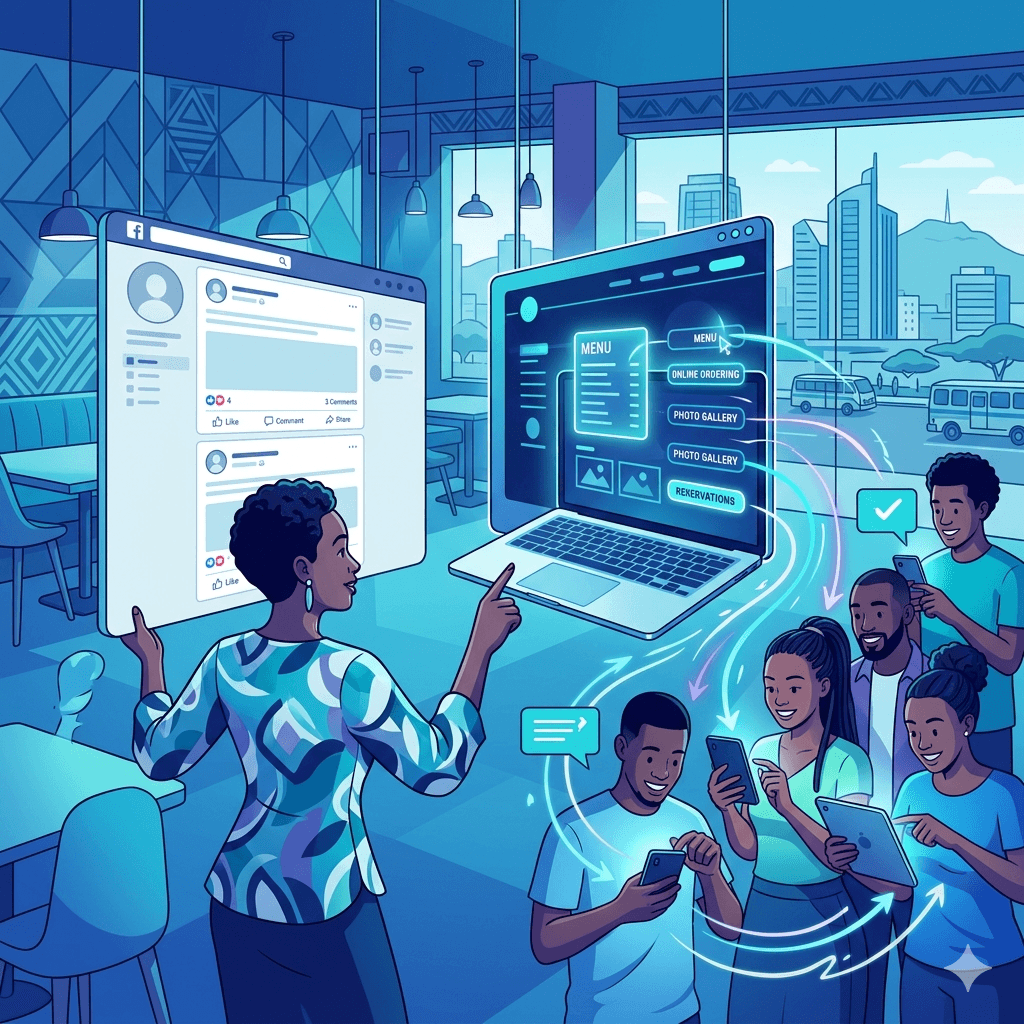
    The honest answer? You need both. But they serve very different roles, and understanding that difference is key.

    9.1 Why You Need Both

    Your Facebook page is great for community building, sharing daily specials, replying to comments, running promotions, and staying top of mind with people who already know you. Your website is your foundation, it is where you send new customers to learn about you, trust you, and take action. One without the other leaves a gap. For a full breakdown of how these two channels compare, read our article on website vs social media marketing and how to choose the right strategy for your business.

    9.2 How They Work Together

    Think of your website as your home base and your Facebook page as a signpost that directs people there. You post engaging content on Facebook, build interest, and then drive followers to your website where they can book a table, view the full menu, or place an order. The two channels complement each other beautifully when used together.

    10. Essential Features Every Restaurant Website Should Have

    If you are going to invest in a website, make sure it has these key elements. These are not optional extras; they are the core features that make a restaurant website work.

    10.1 Mobile-Friendly Design

    Most people in Uganda browse the internet on their phones. Your website must look great and load quickly on a mobile screen. If visitors have to pinch and zoom to read your menu, they will leave within seconds. A mobile-friendly design is non-negotiable.

    10.2 Menu Page

    Your menu is the heart of your restaurant website. Make it easy to read, well-organised, and up to date. Include photos where possible   people eat with their eyes first. If your menu changes seasonally or weekly, make sure your website reflects that.

    10.3 Contact and Location Details

    Include your phone number, email address, physical address, and opening hours in an easy-to-find place   ideally on every page. A Google Map embed is a huge plus. The easier you make it for customers to reach you, the more likely they will try.

    10.4 Online Ordering or Booking

    An online ordering website for restaurants is one of the fastest ways to increase revenue. Whether it is a simple WhatsApp order button, a full e-commerce system, or a reservation form, giving customers a way to take action directly on your website is incredibly valuable.

    10.5 Photo Gallery

    Food photography sells. A gallery of your best dishes, your restaurant ambiance, and even behind-the-scenes moments helps visitors visualise the experience before they arrive. Invest in good photos,  it is one of the highest-return decisions you can make for your restaurant’s online presence.

    11. How to Get a Website for Your Restaurant in Uganda

    A business owner choosing between hiring a designer and using a website builder, represented by two clear paths

    Getting a website does not have to be complicated or expensive. Here are your main options:

    11.1 Hiring a Web Designer

    For the best results, work with a professional. A local web designer who understands the Ugandan market can build you a custom site that reflects your brand, works on mobile, and is set up for Google visibility. Our restaurant website design in Uganda service is designed specifically for restaurants and food businesses. You get a site that looks great and actually brings in customers.

    11.2 Using Website Builders

    Platforms like Wix, Squarespace, and WordPress allow you to build a basic website yourself using ready-made templates. These are good options if you have the time to learn and a very tight budget. However, they have limitations in terms of customisation, SEO performance, and scalability.

    11.3 Budget Considerations

    The cost of building a restaurant website in Uganda varies depending on what you need. A basic website can start from a few hundred thousand shillings, while a more advanced site with online ordering and bookings will cost more. There are also annual costs for your domain name and web hosting. Read our full breakdown of free vs paid website options to understand what you are actually paying for. If you are starting with very little, we also have a guide on how to start your business online with no budget.

    11.4 Maintenance and Updates

    A website is not a one-time project. It needs regular updates   new menu items, fresh photos, updated opening hours, blog posts, and occasional technical updates. Factor this into your budget. Many web designers offer affordable maintenance packages. Alternatively, platforms like WordPress are beginner-friendly enough that you can make basic updates yourself.

    12. Common Mistakes to Avoid

    Building a website is a great first step. But there are some common pitfalls that can undermine all your efforts:

    12.1 Relying Only on Social Media

    We have covered this in detail, but it bears repeating. Social media should support your website, not replace it. If all your online presence lives on Facebook or Instagram, you are one algorithm change away from losing it all. Diversify   your website is the only online asset you truly own.

    12.2 Ignoring Mobile Users

    If your website does not work properly on a phone, you are turning away the majority of your potential visitors. Always test your website on multiple mobile devices before launching. A mobile-first approach is not optional in Uganda’s internet landscape   it is essential.

    12.3 Not Updating Information

    Outdated menus, wrong phone numbers, or old photos can frustrate customers and damage trust. Make it a habit to review your website every few months and update anything that has changed. An inaccurate website can be worse than no website at all.

    12.4 Poor Design and Navigation

    A confusing or poorly designed website drives people away. If visitors cannot find what they are looking for within a few seconds, they leave. Keep your design clean, your navigation simple, and your most important information   menu, location, contact   easy to find. Good professional web design services will always prioritise user experience alongside aesthetics.

    13. Conclusion

    Facebook is a useful part of your restaurant’s digital strategy   but it is not the foundation. A website gives you something Facebook never can: ownership, control, and real visibility on Google.

    In Kampala’s growing food scene, the restaurants that will stand out are the ones that invest in a proper online presence   not just a social media page. A website helps you attract tourists, earn the trust of new customers, take reservations, and grow your brand on your own terms.

    If you are ready to take that step, we are here to help. Check out our restaurant website design in Uganda service and let us build something great for your restaurant. And if you want to go deeper on getting found online, our SEO services in Uganda can help your website rank on Google and keep the customers coming.

    14. Frequently Asked Questions

    14.1 Do I still need a website if I have a Facebook page?

    Yes, absolutely. A Facebook page is great for engaging with existing followers, but it cannot replace a website. A website appears in Google search results, gives you full control over your brand, and allows features like online ordering and bookings that a Facebook page cannot provide. Think of your website as your home base and Facebook as one of the roads that leads customers there.

    14.2 How much does it cost to build a restaurant website in Uganda?

    Costs vary depending on your needs. A basic restaurant website in Uganda can start from a few hundred thousand shillings, with more advanced sites costing more. You will also need to budget for annual domain and hosting fees. Our guide on the cost of building a website in Uganda gives a full breakdown.

    14.3 Can I take orders through my website?

    Yes. An online ordering system can be added to your website, allowing customers to browse your menu and place orders directly. This can be a simple WhatsApp-linked button or a fully integrated e-commerce system, depending on your budget and needs.

    14.4 Is a website hard to manage?

    Not at all. Modern website platforms, especially WordPress, are designed to be beginner-friendly. Once your site is set up, updating your menu, adding photos, or changing your opening hours is straightforward. Many web designers also offer training so you can handle basic updates yourself.

    14.5 How long does it take to build a website?

    A basic restaurant website can typically be built in one to three weeks. A more complex site with online ordering, custom design, and SEO setup may take four to six weeks. The more clearly you communicate your needs upfront, the faster the process goes.

    14.6 Will a website help me get more customers?

    Yes   especially if it is properly optimised for search engines. A website that ranks on Google can bring in new customers every single day without any paid advertising. It works 24/7 to promote your restaurant while you focus on cooking great food.

    14.7 Can I link my website to my Facebook page?

    Absolutely. In fact, you should. Add your website link to your Facebook page profile, include it in posts, and encourage followers to visit for more information, bookings, or to place orders. The two platforms work best when they support each other.

    14.8 What platform is best for beginners?

    WordPress is one of the most beginner-friendly and flexible platforms available. Wix and Squarespace are also easy to use if you prefer a simpler drag-and-drop experience. For restaurants that want a professional result without the learning curve, working with a web designer who specialises in restaurant website design is often the best choice.
  • Website or Social Media: Which One Actually Grows a Ugandan Business?

    Website or Social Media: Which One Actually Grows a Ugandan Business?

    You’ve probably asked yourself this question at least once: “Do I really need a website, or can I just use Facebook and Instagram?”

    It’s a fair question. After all, everyone in Uganda is on social media these days. Your customers are scrolling through their feeds right now. So why would you spend money building a website when you can just post on WhatsApp Status or share products on your Facebook page?

    Here’s the thing: choosing between a website and social media isn’t always an either-or decision. But understanding what each one does best will help you make smarter choices about where to invest your time and money. In this guide, we’ll break down everything you need to know about websites and social media for your Ugandan business so you can build an online presence that actually works.

    What is a Website?

    A business website homepage displayed on a large computer monitor

    Think of a website as your own piece of digital real estate. It’s a collection of web pages that live at a specific address (your domain name, like www.yourbusiness.com) that you own and control completely.

    Unlike renting a shop in someone else’s building, a website is your own property on the internet. You decide what it looks like, what information appears there, how it’s organized, and who can access it. Whether it’s a simple one-page site introducing your business or a full online store with hundreds of products, your website serves as your central hub a place where customers can learn about you, contact you, and do business with you on your terms.

    Many Ugandan businesses start by exploring professional web design services to create a site that reflects their brand and serves their customers effectively.

    What is Social Media for Business?

    Social media platforms are the digital town squares where people gather to connect, share, and discover. For businesses, platforms like Facebook, Instagram, Twitter (X), TikTok, and LinkedIn offer powerful ways to reach customers where they already spend their time.

    When you use social media for business, you’re essentially setting up shop in these busy public spaces. You create business profiles or pages, post content regularly, engage with followers through comments and messages, run advertisements, and build a community around your brand.

    The beauty of social media is that it’s interactive and immediate. You can share a photo of your new product in the morning and start getting reactions, comments, and even sales inquiries within minutes. It’s digital marketing at its most dynamic and accessible.

    Benefits of Having a Website

    Let’s talk about why having your own website might be one of the smartest investments you make for your business.

    Establishing Credibility and Trust

    When someone hears about your business and wants to learn more, where do they go? Many potential customers will search for your business name on Google. If they find a professional website, it sends a powerful message: “This is a real, serious business.”

    A website gives you legitimacy. It shows you’ve invested in your business and you’re here for the long term. Think about it would you feel more confident buying from a company with a polished website or one that only has a Facebook page with sporadic updates?

    In Uganda’s growing digital economy, customers are becoming more discerning. A professional website helps you stand out as trustworthy and established, especially when competing against informal traders.

    Full Control Over Content and Branding

    This is huge. On your website, you’re the boss. You choose the colors, fonts, layout, images, and every single word. No one can change your content, delete your posts, or restrict who sees your information.

    Compare this to social media, where platform updates can change how your page looks overnight, or algorithm shifts can suddenly hide your posts from followers who used to see everything you shared. Your website remains consistent, reflecting your brand exactly as you want it, every single time someone visits.

    Improved Search Engine Visibility

    Here’s where websites really shine. When someone in Kampala searches Google for “best plumber near me” or “affordable catering services Entebbe,” a well-optimized website can appear in those search results. Social media posts rarely show up in Google searches.

    By applying basic SEO tips, your website can attract customers who are actively looking for exactly what you offer. This is organic traffic people finding you without you having to pay for every single visitor. Over time, good SEO can bring a steady stream of potential customers to your digital doorstep.

    Collecting Customer Data and Leads

    Your website allows you to gather valuable information from visitors. You can add contact forms, email subscription boxes, download offers, and more. When someone fills out a form on your website, you own that data completely.

    This means you can build an email list, follow up with potential customers, send newsletters, and create marketing campaigns all without depending on any social media platform. If Facebook shut down tomorrow (unlikely, but imagine), your customer database would be safe because it lives on your own server.

    Benefits of Using Social Media

    Multiple devices showing social media engagement metrics and notifications

    Now, let’s give social media its due credit. There are excellent reasons why millions of Ugandan businesses rely heavily on these platforms.

    Access to a Large Audience Quickly

    Social media gives you instant access to millions of users. In Uganda alone, millions of people use Facebook, Instagram, WhatsApp, and TikTok daily. You can set up a business page in minutes and immediately start reaching potential customers.

    There’s no waiting period, no technical setup, no complicated processes. Just create your profile, post your first piece of content, and you’re in business. This speed and accessibility make social media incredibly attractive for small businesses just starting out.

    Direct Engagement with Customers

    Social media thrives on conversation. When customers comment on your posts, send you direct messages, or share your content, you can respond immediately. This back-and-forth interaction builds relationships in ways that websites simply can’t match.

    Think about it: a customer posts a question on your Facebook page at 2 PM, and you answer within an hour. That responsiveness creates trust and loyalty. Social media turns your business into something approachable and human, not just a faceless entity.

    Cost-Effective Marketing Options

    Here’s the truth: you can run a complete social media marketing strategy with zero money spent. Create organic posts, engage with followers, join relevant groups, and grow your audience all for free.

    Even when you do invest in advertising, social media ads can be remarkably affordable. You can run Facebook ads targeting specific demographics in Kampala for as little as UGX 20,000 per day. Compare that to traditional advertising like newspaper ads or radio spots, and you’ll see why social media marketing for small business is so popular.

    Viral Potential and Sharing

    When you post something interesting, funny, or valuable on social media, people can share it with their networks instantly. One share becomes ten, then a hundred, then thousands. This organic reach content spreading through shares and tags is powerful and completely free.

    I’ve seen Ugandan businesses go from unknown to household names because one post went viral. A clever video, a heartwarming customer story, or even a controversy can catapult your brand into the spotlight overnight. That kind of exposure is nearly impossible to achieve through a website alone.

    Limitations of Websites for Small Businesses

    A small business owner overwhelmed by website maintenance tasks

    Let’s be honest: websites aren’t perfect, and they’re not for everyone. Here are some real challenges you need to consider.

    First, there’s the upfront cost. Building a professional website requires investment. You need to pay for domain registration, web hosting, design work (unless you do it yourself), and possibly ongoing maintenance. While these costs have decreased significantly, they still represent a barrier for businesses operating on extremely tight budgets. Understanding the website cost breakdown can help you plan accordingly.

    Second, websites require some technical knowledge. Even with user-friendly platforms like WordPress or website builders, you need to understand basics like updating content, managing plugins, troubleshooting issues, and keeping your site secure. Not every business owner has these skills or the time to learn them.

    Third, websites don’t bring instant results. Unlike social media where you can get engagement within hours, a new website takes time to gain traction. It needs content, SEO optimization, backlinks, and consistent effort before it starts ranking in search engines and attracting organic traffic. For businesses needing immediate visibility, this waiting period can feel frustrating.

    Finally, websites require active promotion. Simply having a website doesn’t mean people will find it. You need to drive traffic through SEO, advertising, social media links, or other marketing efforts. A website sitting alone in cyberspace without promotion is like a beautiful shop on a deserted road it doesn’t matter how nice it is if no one knows it exists.

    Limitations of Social Media for Small Businesses

    Social media is powerful, but it comes with significant drawbacks that business owners need to understand.

    The biggest issue is platform dependency. You don’t own your social media presence Facebook, Instagram, or TikTok does. If they decide to change their rules, suspend your account, or shut down entirely, your entire online presence could disappear overnight. I’ve seen Ugandan businesses lose pages with thousands of followers due to unexplained account restrictions. All that work, all those connections gone.

    Algorithm changes are another constant headache. Social platforms regularly tweak their algorithms the systems that decide who sees your content. One month, your posts might reach 1,000 people organically. The next month, after an algorithm update, that same post might only reach 100 people. You have zero control over this.

    Organic reach is declining across all major platforms. Facebook, for instance, now shows business posts to only a small fraction of followers unless you pay to “boost” them. What started as free marketing increasingly requires advertising spend just to reach the people who already chose to follow you.

    There’s also limited control over your content’s presentation. Social media platforms dictate the format, layout, and structure of your posts. You can’t customize how your profile looks beyond basic options. Your brand has to fit into their template, not the other way around.

    Finally, social media content has a short lifespan. A post you spend hours creating might be relevant for a day or two, then gets buried under newer content. Unlike website pages that remain accessible and searchable for years, social posts disappear into the feed, requiring constant new content creation to maintain visibility.

    Website vs Social Media: Cost Comparison

    Let’s break down the money side of things because budget matters especially for small businesses.

    Website Costs:

    • Domain name: UGX 40,000-150,000 per year
    • Web hosting: UGX 200,000-1,000,000 per year (depending on quality and features)
    • Design and development: UGX 500,000-5,000,000+ (one-time, though you might update occasionally)
    • Maintenance and updates: UGX 100,000-500,000 per year (if you hire someone)
    • SSL certificate: Often free or around UGX 100,000 per year
    • Total first-year estimate: UGX 840,000-6,750,000+

    Social Media Costs:

    • Setting up accounts: Free
    • Creating organic content: Free (except your time)
    • Graphic design tools: UGX 0-200,000 per year (Canva Pro, etc.)
    • Social media advertising: Variable you could spend UGX 50,000 per month or millions
    • Social media management tools: UGX 0-500,000 per year (optional)
    • Total first-year estimate: UGX 0-8,400,000+ (depending on ad spend)

    At first glance, social media looks cheaper. And for pure startup costs, it is. You can literally start with zero shillings. However, the long-term picture changes. A website is primarily an upfront investment that decreases over time, while social media often requires increasing ad spend to maintain visibility as organic reach declines.

    Think of it this way: a website is like buying land and building your own shop, while social media is like renting stall space in a busy market. Both approaches work, but they serve different strategies and come with different long-term costs.

    Website vs Social Media: Long-Term Strategy

    A roadmap visual showing website growth and social media growth over time

    When planning for the future of your business, you need to think beyond next month or even next year.

    A website is a long-term asset. Every blog post you publish, every product page you optimize, every customer review you collect these all accumulate value over time. Your website becomes more authoritative, ranks better in search engines, and attracts more organic traffic as it matures. In five years, your website could be your most valuable marketing asset, bringing in customers without ongoing advertising costs.

    Social media requires constant feeding. It’s like a fire that needs regular wood to keep burning. Stop posting for a week, and your visibility drops. Stop for a month, and your audience might forget you exist. Social platforms reward consistent, fresh content, which means you’re always working to maintain your position.

    For brand building, websites offer unmatched consistency. Your website remains stable same look, same message, same experience building recognition and trust. Social media, by contrast, is fluid and changing, making it harder to establish a consistent brand identity.

    Customer loyalty also develops differently. A customer who finds your website through search, browses your products, signs up for your newsletter, and makes a purchase has taken several intentional steps. They’re more invested in your brand. A social media follower might like your page on impulse and never engage again.

    The smart long-term strategy? Most successful businesses use both. They treat their website as their foundation their permanent home base and use social media as their outreach tool, directing traffic back to that central hub where they have full control.

    How to Decide Which is Best for Your Ugandan Business

    You’re probably thinking, “Okay, but what should I do?” Here’s a practical framework to help you decide.

    Identify Your Target Audience

    Where do your customers spend their time online? If you’re selling to young Ugandans (18-35), they’re almost certainly active on Instagram, TikTok, and Twitter. If your market is older professionals, Facebook and LinkedIn might be more relevant. If you’re in B2B services, a professional website becomes essential because businesses expect it.

    Research where your competitors are active. Look at who’s engaging with similar businesses. Ask your existing customers how they prefer to interact with businesses online. Their habits should guide your strategy.

    Define Your Business Goals

    What do you want to achieve online?

    If your goal is immediate sales and engagement, social media offers faster results. If you want to build lasting credibility and authority in your industry, a website is crucial. If you need to showcase complex products or services with detailed information, a website provides the space to do that properly.

    If you’re offering professional services (legal, consulting, medical), a website establishes the professional presence clients expect. If you’re selling trending consumer products to young people, social media might give you better reach and conversion.

    Assess Your Budget and Resources

    Be realistic about what you can afford both financially and in terms of time and energy.

    If your budget is very limited (under UGX 1,000,000 to invest), starting with social media makes sense. Build your following, generate some revenue, then invest in a website later. If you have moderate resources (UGX 1,000,000-3,000,000), consider a simple website plus active social media presence. If you have substantial resources, invest in both from the start with professional support.

    Remember: budget isn’t just money. It’s also time. If you’re a solopreneur already working 12-hour days, managing both a website and multiple social media accounts might overwhelm you. Choose what you can sustain.

    Consider Your Marketing Skills or Support

    Be honest about your abilities and willingness to learn.

    Are you comfortable with technology? Can you learn basic website management, or does tech frustrate you? Are you naturally good at creating engaging social content, or does writing posts feel like pulling teeth?

    If you’re not tech-savvy and have no one to help, social media is more forgiving you can learn as you go with less risk. If you’re tech-comfortable or can hire affordable help, a website becomes more manageable.

    Combine Both Strategically if Possible

    Here’s my honest recommendation for most Ugandan small businesses: start where you can afford to start, but work toward having both.

    If money is tight, begin with social media. Build your audience, establish your brand, generate some income. Then invest some of those profits into a simple website. If you have moderate resources from the start, create a basic website (even just 3-5 pages) and actively promote it through social media.

    The most powerful strategy uses each platform’s strengths: social media for engagement and traffic, website for credibility and conversion. Post regularly on social platforms, but always direct serious inquiries and sales to your website where you control the experience.

    Tips for Maximizing Online Presence

    A dashboard showing both website and social media analytic

    Whether you choose websites, social media, or both, these strategies will help you succeed.

    Keep Content Consistent Across Platforms

    Your brand should feel cohesive everywhere customers encounter it. Use the same logo, colors, and tone of voice on your website and all social platforms. If your website says you’re professional and formal, your social media shouldn’t be overly casual and chaotic (unless that’s intentionally your brand personality).

    Consistency builds recognition and trust. When customers see your post on Instagram and later visit your website, they should immediately recognize it’s the same business.

    Track Performance with Simple Analytics

    You can’t improve what you don’t measure. Use free tools like Google Analytics for your website and built-in insights on social platforms to understand what’s working.

    Pay attention to which posts get the most engagement, which website pages people visit most, where your traffic comes from, and which efforts actually lead to sales or inquiries. Double down on what works; cut what doesn’t.

    You don’t need to become a data scientist. Just check your basic numbers weekly and look for patterns. Is your Facebook engagement dropping? Try different content types. Are people leaving your website quickly? Maybe your pages load too slowly or don’t provide the information they need.

    Prioritize Mobile-Friendly Designs

    In Uganda, most internet users access the web through their phones, not computers. This makes mobile optimization non-negotiable.

    Your website absolutely must look good and function well on mobile devices. Text should be readable without zooming, buttons should be easy to tap, pages should load quickly even on slower data connections. A website that frustrates mobile users is worse than no website at all.

    Similarly, when creating social media content, always preview how it looks on a phone screen. Most of your audience will see it on mobile, so optimize for that experience.

    Engage Actively with Your Audience

    Online presence isn’t passive it’s interactive. When customers comment on your posts, reply. When they send messages, respond promptly. When they leave reviews (good or bad), acknowledge them professionally.

    This engagement does two things: it builds relationships with individual customers, and it signals to platform algorithms that your content is worth showing to more people. Social platforms reward active, engaging accounts with better reach.

    Even on your website, add features that encourage interaction: contact forms that you actually respond to, comment sections if appropriate, live chat if you can manage it.

    Frequently Asked Questions (FAQs)

    Do I Need a Website if I Already Use Social Media?

    You don’t absolutely need one in the sense that your business can survive without it. Many Ugandan businesses operate successfully using only social media. However, a website adds significant value: credibility, SEO visibility, data ownership, and protection against platform changes.

    Think of social media as your marketing megaphone and your website as your actual store. The megaphone helps people find you, but the store is where serious business happens. If you’re growing and want to be taken seriously, especially by corporate clients or educated consumers, a website becomes increasingly important.

    Which Platform is Cheaper to Start With?

    Social media is undeniably cheaper to start with literally free. You can create accounts, post content, and start building an audience without spending a single shilling. A website, even a basic one, requires some investment in domain, hosting, and design.

    However, “cheaper to start” doesn’t mean cheaper long-term. As your social presence grows, you’ll likely need to spend on advertising to maintain visibility. Meanwhile, a website’s costs decrease over time while its value increases. Choose based on your current budget and long-term plans.

    How Long Does it Take to See Results Online?

    This depends entirely on which platform and what kind of “results” you’re measuring.

    On social media, you can see engagement (likes, comments, shares) within hours or days of posting. However, building a substantial following and seeing meaningful sales impact typically takes 3-6 months of consistent effort.

    For websites, SEO results take longer usually 6-12 months before you see significant organic traffic from search engines. However, if you drive traffic through paid ads or social media links, you can see results immediately.

    The key is consistency and patience. Online marketing isn’t a sprint; it’s a marathon. Businesses that stick with it for a year or more see dramatically better results than those who quit after a few weeks.

    Can I Manage Both a Website and Social Media Alone?

    Yes, but it depends on your business size, available time, and personal capacity. Many solo entrepreneurs successfully manage both by being strategic and focused.

    The trick is not trying to be everywhere at once. Instead of managing five social platforms poorly, focus on one or two where your customers actually are. Instead of building a 20-page website you can’t maintain, start with 5 essential pages and expand gradually.

    Use scheduling tools to batch-create social content in advance. Use simple website platforms that don’t require constant technical attention. Set realistic expectations maybe you post on social media three times per week and update your website monthly. That’s better than burning out trying to post daily everywhere.

    If your business grows and you can afford it, hiring part-time help for content creation or technical management is a smart investment.

    Which is Better for Selling Products Online?

    For pure e-commerce functionality, a website (specifically, an online store with shopping cart and payment integration) provides the best experience. You can showcase unlimited products, organize them into categories, provide detailed descriptions, collect payments securely, and manage inventory.

    However, social media can also facilitate sales effectively, especially in Uganda where many transactions happen through DMs and mobile money. Facebook and Instagram shops, WhatsApp catalogs, and direct messaging with payment instructions work well for simpler product lines.

    The ideal approach: use social media to showcase products and engage customers, then direct serious buyers to your website for the actual transaction. This gives you the reach of social media with the professionalism and functionality of an e-commerce site.

    How Do I Drive Traffic to My Website from Social Media?

    This is where social media and websites work beautifully together. Here are practical tactics:

    Include your website link in all your social media bios. Post content on social platforms that teases valuable information, then encourage people to visit your website for the complete article, guide, or resource. Create short video clips or infographics on social media with “link in bio to learn more.” Run social media ads that direct to specific landing pages on your website. Share blog posts from your website on your social channels with compelling captions that make people want to click.

    The strategy is giving enough value on social media to build trust while positioning your website as the place for deeper engagement, purchases, or premium information.

    Should I Hire a Professional or Do it Myself?

    This depends on your budget, skills, timeline, and how important quality is for your specific business.

    DIY makes sense if you’re tech-comfortable, have time to learn, need to minimize costs, and can accept that your first attempts might look amateurish. There are excellent free resources, templates, and tools that make DIY more accessible than ever.

    Hiring professionals makes sense if you lack technical skills or time, want guaranteed quality from the start, operate in an industry where appearance matters significantly (luxury goods, professional services), or have budget available for investment.

    A middle-ground approach works well for many: hire professionals for the initial setup (website design, branding, strategy), then manage day-to-day content and updates yourself. This gives you a professional foundation without ongoing expense.

    How Often Should I Update My Website or Social Pages?

    For social media, consistency matters more than frequency. It’s better to post three quality pieces of content per week consistently than to post twice daily for two weeks and then go silent for a month. Most successful small businesses post 3-5 times per week on their primary platform.

    For websites, the update frequency depends on your site type. E-commerce sites need frequent updates (new products, stock changes, promotions). Service business websites might only need updates monthly or when services change. Adding new blog posts weekly or monthly helps with SEO and gives visitors reasons to return.

    The minimum: ensure your website information is always accurate (contact details, prices, services). Nothing damages credibility faster than outdated information.

    Final Thoughts

    So, website vs social media which is better for your Ugandan business?

    The honest answer is that it’s not really an either-or question. Both have unique strengths, and both have real limitations. The best choice for your business depends on your specific situation: your goals, budget, target audience, and long-term vision.

    If I had to give simple starting advice, it would be this: start with what you can afford and manage right now, but keep working toward a strategy that includes both. Use social media to meet customers where they are, build relationships, and generate immediate engagement. Use a website to establish credibility, control your message, and create a lasting asset that grows in value over time.

    Your online presence is too important to ignore in today’s digital economy. Whether you start with just a Facebook page or invest in a full website from day one, the important thing is that you start. Learn, adjust, and improve as you go.

    The businesses that thrive online aren’t necessarily the ones with the biggest budgets they’re the ones that understand their customers, stay consistent, and use their chosen platforms strategically. You can be one of them.