Category: SEO

seo services in uganda

  • How To Make Money Online In Uganda

    How To Make Money Online In Uganda

    1. Introduction

    Imagine waking up in the morning, making yourself a cup of tea, and earning money   all without leaving your house. Sounds like a dream, right? For many people in Uganda, that dream is becoming real every single day.

    The internet has changed everything. Today, you do not need a university degree, a lot of money, or years of experience to start earning online. All you need is a phone or computer, an internet connection, and the willingness to learn.

    Whether you are a student, a stay-at-home parent, or someone who just needs extra income, there are legitimate online earning opportunities Uganda has to offer. This guide will walk you through everything   from what it means to make money online to the exact steps you need to take to get started today.

    Let us dive in.

    2. What Does Making Money Online Mean?

    A conceptual illustration of digital income flow, showing money moving from a laptop screen into a mobile wallet

    Making money online simply means earning income through the internet. Instead of going to a physical office or workplace, you use your phone or computer to do tasks, sell things, or provide services   and you get paid for it.

    Think of it like a regular job, but done digitally. You could be typing data, answering survey questions, writing blog posts, or even managing someone’s social media pages. The work happens online, and so does the payment.

    Online jobs in Uganda range from simple tasks that anyone can do (like filling in forms) to more advanced work like graphic design or website designing. The good news is that you do not need to start with anything complicated. Many beginners earn their first money online doing the simplest tasks available.

    The key thing to understand is that making money online is real. It is not magic. It takes effort, just like any other job   but it also offers flexibility that most office jobs never will.

    3. Why Make Money Online in Uganda?

    Uganda’s economy is growing, but many people still struggle to find stable, well-paying jobs. The job market is competitive, and not everyone gets a formal employment opportunity right away. That is where online work changes the game.

    Here is why more Ugandans are turning to work from home Uganda opportunities:

    • Mobile internet is widely available. MTN and Airtel have expanded internet access across the country, making it easier than ever to get online.

    • Mobile money makes payments simple. With platforms like MTN Mobile Money and Airtel Money, receiving payments from online platforms has become straightforward.

    • The cost of living is manageable. Even a modest online income can go a long way in Uganda compared to some other countries.

    • You can work from anywhere. Whether you are in Kampala, Mbarara, or a rural area, as long as you have the internet, you can earn money online.

    Online earning opportunities Uganda presents are real and growing. The only question is: are you ready to take advantage of them?

    4. Benefits of Online Income

    A balanced lifestyle illustration showing a person working on a laptop

    There are many reasons why people choose online income over traditional jobs. Here are the biggest benefits:

    • Flexible schedule. You choose when to work. If you have other responsibilities during the day, you can work at night or on weekends.

    • No commute. Forget about spending money on boda-boda rides or sitting in Kampala traffic. Your workplace is wherever you are.

    • Low startup cost. Most online jobs in Uganda require little to no money to begin. Your phone is often enough to start.

    • Multiple income streams. You can do two or three online gigs at the same time, which means more money without needing another physical job.

    • Global opportunities. When you work online, you are not limited to Ugandan clients. You can earn from employers in the UK, USA, Canada, or anywhere in the world.

    • Skill building. As you work, you naturally learn new skills   writing, marketing, design   that increase your value over time.

    The beauty of earning money online Uganda style is that it meets you where you are. You do not have to change your whole life to get started.

    5. Requirements to Get Started

    One of the best things about online work is how little you need to begin. Here is a basic checklist:

    • A smartphone or computer. Most tasks can be done on an Android phone. A laptop gives you more options, but it is not always required at the start.

    • Internet connection. You need a reliable data connection. Mobile data works fine for most tasks. Where possible, Wi-Fi helps reduce costs.

    • Email address. You will need a Gmail or any other email account to sign up for platforms and receive communications.

    • Mobile money account. MTN Mobile Money or Airtel Money is how most online earners in Uganda receive their payments. Make sure your account is active.

    • Basic digital literacy. You should be comfortable browsing the internet, filling in online forms, and sending emails. If you are not yet confident here, practice for a few days before starting.

    • Patience and consistency. This is arguably the most important requirement. Online income is not instantaneous for most people. Those who stay consistent are the ones who succeed.

    That is honestly all you need to earn money online Uganda opportunities require. No fancy equipment. No big budget. Just you and your phone.

    6. Best Ways to Make Money Online in Uganda

    A collage-style illustration showing multiple online income methods like typing, surveys

    Now we get to the heart of it. Here are the best and most realistic methods to start earning online in Uganda today.

    6.1 Data Entry Jobs

    Data entry is one of the easiest and most beginner-friendly online jobs available. The work usually involves typing information into spreadsheets, databases, or online forms. It does not require any special skills   just accuracy and the ability to type.

    Online data entry jobs in Uganda for beginners are available on platforms like Upwork, Freelancer, and PeoplePerHour. These sites let you create a profile and bid on data entry tasks posted by clients around the world.

    The pay varies. You might earn anywhere from $2 to $10 per task as a beginner. It is not a fortune, but it is a solid way to build experience and start getting paid. As you complete more jobs and build your reputation, clients will offer better-paying work.

    Tip: When applying for data entry work, highlight your accuracy, attention to detail, and internet speed. These are the qualities clients care about most.

    6.2 Online Surveys

    Taking online surveys is probably the simplest way to start earning money with just a phone. Companies and researchers pay people to share their opinions on products, services, and ideas. You do not need any skills   just honest answers.

    Platforms like Swagbucks, Survey Junkie, Toluna, and ySense accept participants from Uganda. You sign up, fill in your profile, and start receiving surveys that match your background. Each survey pays between $0.50 and $5 depending on length and complexity.

    Online surveys will not make you rich, but they are a great first step. Many beginners in Uganda use surveys to get comfortable with online platforms and earn their first few dollars before moving on to higher-paying tasks.

    Important note: Never pay to join a survey site. All legitimate survey platforms are free to join.

    6.3 Freelance Writing

    If you can write clearly in English, freelance writing can become one of your best online side hustles Uganda offers. Businesses, blogs, and websites around the world need content   and they are willing to pay for it.

    As a freelance writer, you could write blog posts, product descriptions, social media captions, or news articles. The pay starts at around $5 to $20 per article for beginners, but experienced writers earn much more.

    To get started, create a profile on Upwork or Fiverr. Write a few sample articles to show potential clients what you can do. You do not need a degree in English   you just need to be clear, informative, and reliable.

    Freelance writing is one of the best online jobs for beginners because your skills only get better with time, and better skills mean higher pay.

    6.4 Social Media Management

    Businesses in Uganda and abroad need help managing their Facebook, Instagram, Twitter, and TikTok pages. If you already spend time on social media, why not get paid for it?

    A social media manager creates posts, responds to comments, schedules content, and grows a brand’s online presence. This is a part-time online job Uganda opportunity that can pay between $100 and $500 per month per client, depending on the workload.

    You can offer this service to small local businesses in Uganda who want to grow online but do not know how. Start by approaching shops, salons, or restaurants in your area. Show them sample posts you could create for their pages.

    As you gain experience, you can manage multiple clients at once and increase your income significantly.

    6.5 Selling Products Online

    You do not need a physical shop to sell products. With platforms like Jumia, Facebook Marketplace, and WhatsApp, you can sell almost anything from your home. This is one of the most practical start selling online methods for Ugandans with little startup capital.

    You can sell handmade crafts, second-hand clothes, food products, or even digital items like e-books and design templates. The key is to find a product people want and make it easy for them to buy from you.

    Start with what you already have or can easily access. Take clear photos, write simple descriptions, and list your items. Respond to inquiries quickly and deliver on time. Good reviews will bring more customers.

    Selling products online is a great way to earn money online Uganda residents of all backgrounds can explore   even those with no prior online experience.

    6.6 Affiliate Marketing

    Affiliate marketing means promoting someone else’s product and earning a commission every time someone buys through your link. It is like being a sales agent, but entirely online.

    For example, if you promote a product from Jumia’s affiliate program and someone clicks your link and buys it, you earn a percentage of the sale. The beauty of this is that you do not need your own product, and it can generate passive income ideas. Uganda earners love   money coming in even when you are sleeping.

    To start, sign up for affiliate programs like Jumia Affiliate, Amazon Associates, or ClickBank. Share your affiliate links on social media, WhatsApp groups, or a blog. Every sale you generate earns you a commission.

    Affiliate marketing takes time to build, but once your audience grows, it can become a steady and largely hands-off income stream.

    6.7 YouTube or Content Creation

    Creating content on YouTube or a blog is one of the best long-term ways to earn money online in Uganda. It takes time to build an audience, but once you do, the earning potential is significant. You can make money blogging and through YouTube ads, sponsorships, and affiliate links all from the same content.

    You do not need expensive equipment to start. Many successful Ugandan YouTubers began with just a smartphone. Pick a topic you know or love   cooking, fitness, tech reviews, local travel   and start creating videos or blog posts around it.

    YouTube pays through its Partner Program once you reach 1,000 subscribers and 4,000 watch hours. Until then, focus on building your audience and monetising through affiliate links and sponsorships.

    Content creation is a digital side hustle Uganda opportunity that grows over time. The more content you create, the more people find you   and the more you earn.

    7. How to Start Making Money Online (Step-by-Step)

    A person progressing through stages from beginner to earning online

    Knowing the methods is one thing. Actually starting is another. Here is a simple, practical roadmap to get you from zero to earning.

    7.1 Choose a Simple Method

    Do not try to do everything at once. Pick one method from the list above that matches your current abilities and interests. If you are good with words, try freelance writing. If you just want to start immediately with no skills, try surveys or data entry.

    Starting with one focused approach is like learning to ride a bicycle. You get better faster when you stop splitting your attention. Master one thing first, then expand.

    7.2 Set Up Basic Tools (Phone/Computer & Internet)

    Make sure your phone or computer is working properly. Clear out storage if needed to make it run smoothly. Get a reliable data bundle   or find a place with free Wi-Fi if data is costly for you.

    Set up a Gmail account if you do not already have one. This will be your main contact email for all platforms you join. Use a professional-sounding username, ideally your name or a combination of your name and a number.

    7.3 Create Accounts on Trusted Platforms

    Sign up on legitimate platforms that match the method you chose. We will list these platforms in detail in Section 8. Take your time to fill in your profile completely   this builds trust with potential clients or employers.

    For freelance platforms, your profile is your first impression. Use a clear photo, write a simple bio that explains what you can do, and list any relevant experience, even if it is just personal projects.

    7.4 Start Small Tasks and Build Experience

    When you are just starting, focus on completing tasks, not on how much you are earning. Your first goal is to build a track record. Complete jobs on time, do your best work, and ask clients for reviews.

    Think of this phase as an apprenticeship. You are learning the ropes of online work. Every task you complete teaches you something new. In a few weeks, you will have the experience and confidence to take on bigger, better-paying work.

    On survey sites, start by completing your profile fully   this qualifies you for more and higher-paying surveys.

    7.5 Withdraw Your Earnings

    Once you have earnings to withdraw, make sure you understand how each platform pays. Most freelance platforms offer PayPal, Payoneer, or direct bank transfers. Survey sites often use PayPal or gift cards.

    In Uganda, you can link your Payoneer account to your mobile money wallet for easy withdrawals. Some platforms also allow direct mobile money payments, which makes things much simpler.

    Always withdraw your earnings regularly rather than letting them sit in platform accounts. This motivates you to keep working and keeps your money accessible.

    8. Best Platforms to Use in Uganda

    Not all platforms work well for Ugandans. Here are the ones that are accessible, reliable, and actually pay.

    8.1 Freelance Platforms

    • Upwork   Best for data entry, writing, and virtual assistant work. Free to sign up.

    • Fiverr   Great for offering services starting at $5. Good for writing, design, and social media tasks.

    • Freelancer.com   Similar to Upwork with a wide variety of tasks available for beginners.

    • PeoplePerHour   UK-based platform that works well for Ugandan freelancers offering writing or admin services.

    8.2 Survey Websites

    • Swagbucks   One of the most popular survey sites. Also pays for watching videos and searching the web.

    • ySense   Formerly ClixSense, accepts Ugandan users and offers surveys, tasks, and referral bonuses.

    • Toluna   Pays for sharing opinions on brands and products. Easy to use on mobile.

    • Timebucks   Offers surveys, social media tasks, and more. Works well in Uganda.

    8.3 Selling Platforms

    • Jumia Uganda   Uganda’s biggest online marketplace. You can register as a seller and list products.

    • Facebook Marketplace   Completely free and widely used in Uganda for buying and selling everything.

    • WhatsApp Business   Use it to run a simple online shop and communicate directly with customers.

    8.4 Payment Methods (Mobile Money, PayPal, etc.)

    Getting paid is the most exciting part. Here is how it works in Uganda. Understanding mobile money payments is key because it is the most used and convenient method for most Ugandans online.

    • MTN Mobile Money   The most widely used payment method. Many platforms can pay directly to your MTN MoMo number.

    • Airtel Money   Works similarly to MTN MoMo and is accepted on several platforms.

    • Payoneer   A global payment platform that works well in Uganda. You can link it to your mobile money account for withdrawals.

    • PayPal   Widely used internationally, though withdrawing to a Ugandan bank account can be tricky. Using Payoneer as a bridge often works better.

    • Wise (formerly TransferWise)   Great for receiving international payments at low fees.

    9. Common Mistakes to Avoid

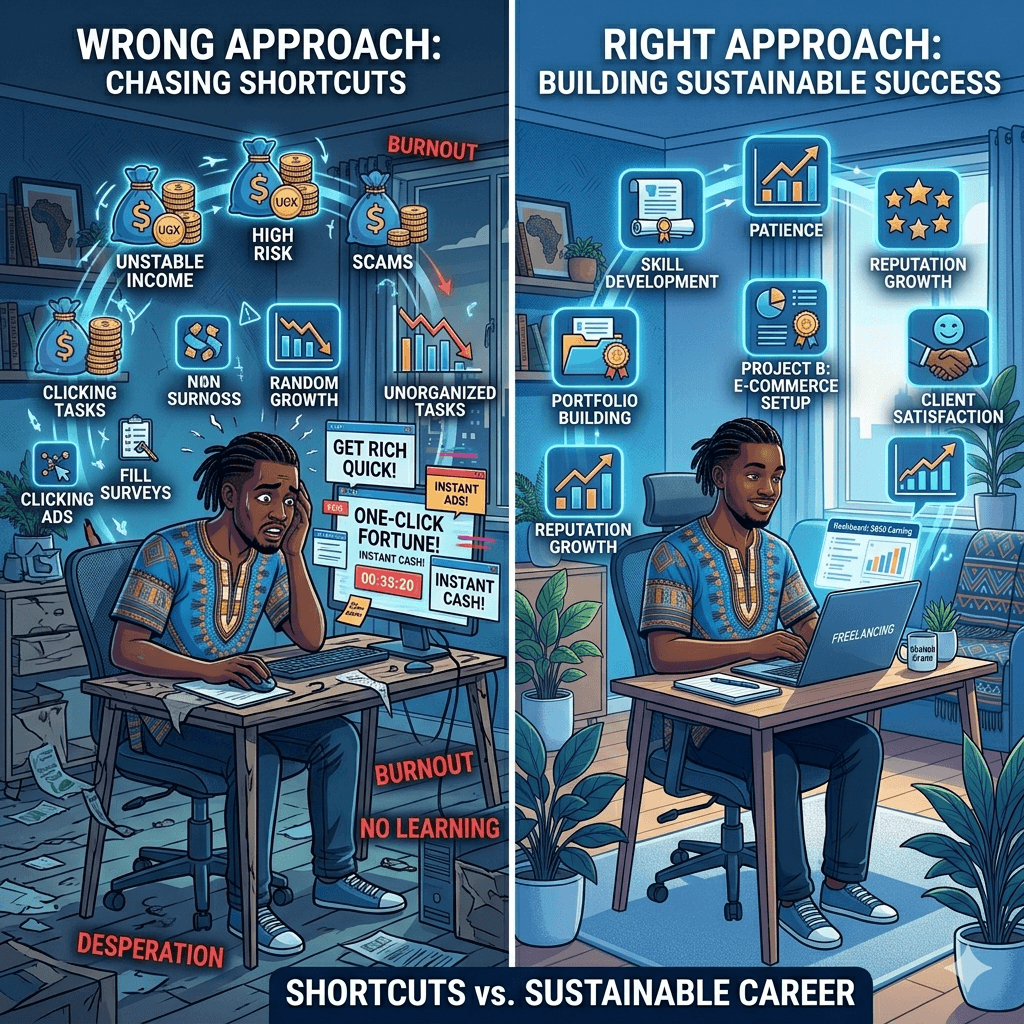
    A comparison showing wrong vs right approaches, highlighting poor decisions like chasing quick money versus consistent effort

    Many beginners lose time and money because of avoidable mistakes. Here are the most common ones   and how to steer clear.

    9.1 Falling for Scams

    If someone promises you UGX 500,000 a day for doing nothing, it is a scam. Legitimate online work pays real but reasonable amounts. Always research a platform before signing up. Check for reviews on Google and YouTube from other Ugandan users.

    Never send money to anyone as a “registration fee” to access online work. Legit platforms are always free to join.

    9.2 Expecting Quick Riches

    Online income is real, but it rarely happens overnight. Most beginners take two to four weeks before earning their first payment. Some methods, like content creation, take months to generate meaningful income.

    Approach online work with the same patience you would give a new job. Set realistic goals, maybe UGX 50,000 in your first month   and build from there.

    9.3 Ignoring Skill Development

    The more skilled you are, the more you earn. Many beginners get stuck at the same level because they never invest time in improving. Spend even 30 minutes a day watching tutorials on YouTube or taking free courses on platforms like Google Digital Garage or Coursera.

    Small improvements in your skills lead to big jumps in your income over time.

    9.4 Using Unverified Platforms

    Stick to well-known platforms, especially when starting out. Avoid obscure websites that have no reviews, no clear ownership, or that ask for upfront payments. If you are not sure about a platform, search for reviews from other Ugandans before committing your time.

    Best websites to make money online in Uganda are the ones that have been around for years and have thousands of verified users worldwide.

    10. Tips to Increase Your Earnings

    Once you get the basics down, here is how to start earning more.

    10.1 Stay Consistent

    Consistency is the single biggest factor in online income success. Set a schedule of even just two hours per day   and stick to it. People who treat online work casually earn casually. People who show up every day earn every day.

    Track your earnings weekly. Watching your income grow, even slowly, is motivating and helps you stay on track.

    10.2 Learn Basic Online Skills

    You do not need to become a tech expert, but learning a few basics can double or triple your earning potential. Consider learning simple graphic design on Canva, basic copywriting, or how to use Google Sheets. These skills open up higher-paying job categories on platforms like Upwork and Fiverr.

    Free courses on YouTube, Alison, and Google Digital Garage are a great place to start. You can learn at your own pace and apply what you learn immediately.

    10.3 Use Multiple Income Sources

    Do not rely on just one platform or one type of work. Diversifying your online income is like planting different crops   if one fails, the others keep you fed.

    For instance, you might do data entry on Upwork while also running surveys on Swagbucks and promoting an affiliate product on social media. You can even look into how to automate income streams so that some of your work keeps earning even when you are not actively working.

    10.4 Manage Your Time Well

    Time is your most valuable resource when working online. Use a simple daily schedule to block out your work hours and protect them from distractions. Apps like Google Calendar or even a basic notebook can help.

    Focus on income-generating tasks first, the tasks that actually pay you. Avoid spending hours on things that look like work but do not produce results, like endlessly tweaking your profile instead of actually applying for jobs.

    11. How to Avoid Online Scams

    Scams are the biggest threat to beginner online earners. They can waste your time, steal your money, and damage your confidence. Here is how to spot and avoid them.

    • Never pay to join a platform. Genuine online work platforms are free. Any site asking for a registration fee is almost certainly a scam.

    • Too good to be true always is. If a listing promises you $500 a day with no skills and minimal work, walk away. Legitimate online income reflects real effort.

    • Research every platform before signing up. Google the platform name followed by ‘review’ or ‘scam’. Check YouTube for honest user experiences from Africans or Ugandans specifically.

    • Protect your personal information. Never share your bank PIN, mobile money password, or national ID photos with anyone online unless you are working with a verified institution.

    • Use trusted payment methods. Stick to platforms that pay through Payoneer, PayPal, or mobile money. Be cautious of platforms that only offer cryptocurrency payments to new users.

    • Trust your instincts. If something feels off about a client, an offer, or a platform, trust that feeling. It is better to miss one opportunity than to lose money or personal data.
    Online scams are unfortunately common, but they are also avoidable if you stay informed and take your time. Legit online jobs Uganda platforms exist in plenty   you do not need to rush into anything that feels suspicious.

    12. Frequently Asked Questions

    12.1 Can I make money online in Uganda with just a phone?

    Yes, absolutely. Many Ugandans make money online with phone Uganda resources alone. Tasks like surveys, data entry, social media management, and affiliate marketing can all be done on a smartphone. You do not need a laptop to start, though having one gives you access to more types of work.

    12.2 How much can beginners earn online?

    Beginners typically earn between $10 and $100 per month in their first few months, depending on how much time they put in and what methods they use. As skills and experience grow, this can increase significantly. Some freelancers in Uganda earn $500 to $2,000 per month after a year or two of consistent work.

    12.3 Are online jobs legit or scams?

    Both exist. There are many legit online jobs Uganda offers, but there are also scams. The key is to stick to well-known, reviewed platforms and never pay money to access work. If in doubt, search for the platform’s reviews from other Ugandans before signing up.

    12.4 What is the easiest way to start?

    The easiest way to start making money online in Uganda for beginners is through online surveys or simple data entry tasks. They require no skills, pay within days or weeks, and are easy to access from a smartphone. Once you are comfortable, you can move on to higher-paying methods.

    12.5 Do I need any skills to begin?

    No   many no experience online jobs Uganda platforms offer require nothing more than the ability to read, follow instructions, and use a smartphone. However, developing basic digital skills like typing, writing, or using spreadsheets will quickly open up better-paying opportunities.

    12.6 How do I receive payments in Uganda?

    Most online workers in Uganda receive payments through Payoneer (linked to mobile money), PayPal, or directly via MTN Mobile Money or Airtel Money. Payoneer is especially popular because it bridges international payments with local mobile money withdrawals. Always check which payment methods a platform supports before signing up.

    12.7 How long does it take to earn money online?

    It depends on the method. Surveys can pay within a few days once you accumulate enough points. Freelancing may take one to three weeks before you land your first client. Content creation like YouTube or blogging can take three to six months before significant earnings begin. Patience and consistency are key.

    12.8 Which platform is best for beginners?

    For surveys, start with Swagbucks or ySense. For freelancing, Fiverr is beginner-friendly because you create your service and wait for buyers to come to you, rather than bidding against experienced competitors. For selling, Facebook Marketplace and Jumia Uganda are easy to use and widely trusted locally.

    Final Thoughts

    Making money online in Uganda is not a myth, it is a real, growing opportunity that thousands of Ugandans are already taking advantage of. You do not need to be rich, highly educated, or technically skilled to get started. You just need a phone, internet access, and the commitment to show up consistently.

    Start small, stay focused, avoid scams, and keep learning. The internet is a big place, and there is more than enough opportunity for everyone willing to put in the effort. Your online income journey starts with one small step. Why not take it today?


    ZK Local Brushfire Biz WEBPEAK

  • How Kico Web Design Builds Websites Differently from Other Uganda Agencies 

    How Kico Web Design Builds Websites Differently from Other Uganda Agencies 

    If you have ever searched for web design in Uganda, you already know the landscape can feel overwhelming. There are dozens of agencies, freelancers, and one-person shops all promising beautiful websites at competitive prices. But here is the truth: not all websites are built the same, and not all agencies approach the work with the same level of care.

    A great business website is not just about good looks. It needs to load fast, work perfectly on mobile phones, show up on Google, and actually turn visitors into customers. In today’s competitive Ugandan market, a website that only looks nice but fails to perform is not much better than having no website at all.

    This is where Kico Web Design stands apart. While many agencies in Uganda focus on delivering a finished design and moving on, Kico takes a different path. Every project starts with strategy, runs through careful planning, and ends with a website built to grow your business. In this article, we will break down exactly how that difference plays out in real projects and why it matters for your business.

    1. What Makes a Website Trustworthy in Uganda

    Trust is everything in business. Before a potential customer picks up the phone or fills in a contact form, they make a quick judgment about your business based on your website. If it looks outdated, loads slowly, or breaks on their phone, they are gone in seconds.

    So what actually makes a website trustworthy for a Ugandan audience? Let us start with the basics.

    Clean and Professional Visual Design

    A cluttered website sends the wrong message. When someone lands on your page and sees too many colors, mismatched fonts, and low-quality images, their brain registers it as unprofessional. Clean design, on the other hand, says: this business is organized, serious, and worth my time.

    Mobile-First Responsiveness

    The majority of internet users in Uganda browse on smartphones. If your website does not adapt to smaller screens, you are instantly losing a massive chunk of your potential customers. Good UI/UX design ensures your site feels natural and easy to use on any device, whether someone is visiting from a Kampala office desktop or a phone in Gulu.

    Fast Loading Speeds for Local Internet Conditions

    Uganda’s internet infrastructure, while improving, still has moments of slow connectivity. A website that takes more than three seconds to load will lose visitors before they even see your homepage. Performance optimization is not optional here. It is a baseline requirement for any professional website design in Uganda.

    Clear Contact Information and Credibility Signals

    Trust signals matter deeply. Things like a visible phone number, a physical address, clear social media links, customer reviews, and a professional email address all tell visitors that you are a real business they can reach. A website missing these details raises instant red flags.

    2. How Kico Web Design Approaches Website Strategy

    A strategic planning session showing UX designers mapping user journeys on a large digital board

    Most web design agencies in Uganda jump straight into design. You share your logo and brand colors, they build something that looks decent, hand it over, and the job is done. Kico Web Design works differently from the very first conversation.

    User-Focused Planning Before Design Begins

    Before a single pixel is placed, Kico starts by asking questions about your business. Who are your customers? What actions do you want people to take on your site? What problems are you solving? This discovery phase ensures the website is built around real user needs, not just personal preferences.

    Aligning Websites with Business Goals

    Every business has different goals. A restaurant wants reservations and foot traffic. A consultancy wants enquiry calls and email leads. An e-commerce shop wants product purchases. Kico builds websites that are specifically designed to support your unique goals, whether that means sales, leads, brand awareness, or all three. This is professional website design Uganda businesses can actually use as a business tool.

    Research into Ugandan Customer Behavior and Expectations

    Understanding how Ugandan users interact with websites is a key part of Kico’s process. Local customers tend to prefer WhatsApp for quick inquiries over email. They respond well to social proof like testimonials. They need reassurance that your business is real and accessible. Kico builds these local behavioral insights directly into the website structure and content.

    Emphasis on Conversion-Driven Structure

    Conversion-focused website design means every element on the page has a purpose. Headlines guide attention. Buttons lead visitors to the next step. Contact forms are short and easy. Content answers the questions customers are already asking. This approach turns your website from a digital brochure into an active sales tool.

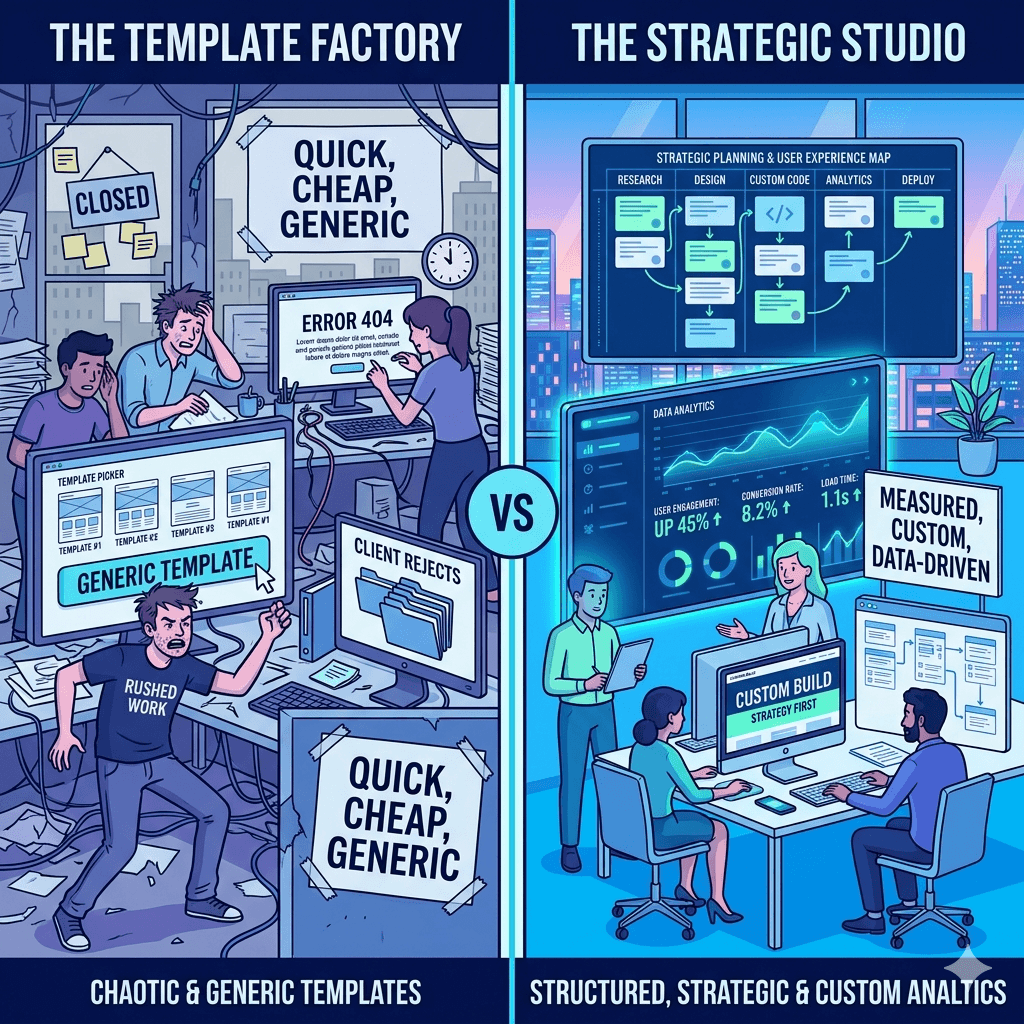
    3. Differences Between Kico Web Design and Other Agencies

    A comparison split screen showing two web agencies one chaotic with generic templates

    Let us get specific. When you compare Kico Web Design to many other website design companies in Uganda, several key differences stand out clearly.

    Strategy-First vs Design-Only Approach

    A design-only agency hands you something that looks good. A strategy-first agency like Kico hands you something that works. The difference shows up in your website analytics, your enquiry volume, and your search engine rankings. Pretty without purpose is just decoration.

    Custom Solutions vs Template-Heavy Builds

    Many agencies in Uganda rely heavily on pre-built templates. These are fast to set up but come with serious limitations. They are rarely optimized for performance, they look generic, and they are hard to customize as your business grows. Kico builds custom website design Uganda businesses actually own and control. For a closer look at why this matters, explore the comparison of website platforms and how each stacks up against real business needs.

    Focus on Local Market Behavior vs Generic Global Designs

    A website designed for a European or American audience will not automatically work in Uganda. Customer expectations, internet speeds, device types, payment preferences, and communication habits are all different here. Kico builds websites with the Ugandan market in mind from day one. This local expertise is one of the things that makes Kico one of the best web design companies in Uganda for locally-focused businesses.

    Stronger Emphasis on Performance and SEO Readiness

    SEO web design Uganda businesses need goes beyond just adding keywords. Kico integrates SEO best practices into the website architecture itself. This includes proper heading structures, fast-loading code, mobile responsiveness, metadata optimization, and clean URL structures. All of this helps your website show up when potential customers are searching online.

    Ongoing Support and Optimization vs One-Time Delivery

    Many agencies disappear after they hand over your website. Kico offers ongoing support and optimization to ensure your site continues to perform well as your business evolves. This long-term relationship approach makes a real difference for small businesses that do not have in-house technical teams.

    4. Key Features Included in Kico Web Design Projects

    When you work with Kico Web Design Uganda, you are not just getting a website. You are getting a carefully assembled set of features designed to make your online presence strong from day one.

    Mobile Optimization and Responsive Layouts

    Every website Kico builds is fully responsive. That means it adjusts automatically to look great on smartphones, tablets, and desktop screens. Given that most Ugandan internet users are on mobile, this is non-negotiable for any professional website design Uganda business owners should expect.

    SEO-Friendly Structure and Metadata Setup

    Kico sets up your website with proper on-page SEO from the start. This includes optimized page titles, meta descriptions, alt text on images, proper heading hierarchy, and schema markup where applicable. Getting this right from the beginning saves businesses significant time and money later.

    Secure Hosting and Performance Optimization

    A slow or insecure website is a liability. Kico recommends and sets up reliable hosting solutions, installs SSL certificates for security, and optimizes images and code for speed. If you want to understand more about the technical side of this, there is a detailed guide on website speed that explains exactly what good performance looks like for Uganda’s unique internet conditions.

    Conversion-Focused Landing Pages

    Whether you need a product page, a service overview, or a lead capture page, Kico designs pages with conversion as the primary goal. Every section is intentional, every call to action is tested, and every form is optimized for completion.

    Integration with Social Media and WhatsApp Contact Tools

    Ugandan customers love WhatsApp. Kico integrates WhatsApp chat buttons, social media feeds, and sharing tools directly into your website. This makes it seamless for customers to reach you the way they prefer, which means more conversions and fewer missed opportunities.

    5. Benefits for Ugandan Businesses Working with a Strategy-Driven Agency

    Ugandan business owner celebrating increased online sales as a website dashboard shows rising traffic, leads, and conversions represented by upward glowing graphs and icons

    Choosing a strategy-first web development Uganda partner does not just give you a better website. It gives you a business advantage.

    Increased Customer Trust and Engagement

    When your website looks professional, loads fast, and answers customer questions clearly, people stay longer and trust you more. That trust is the first step toward a sale.

    Higher Conversion Rates from Website Traffic

    A conversion-focused website design turns more of your visitors into actual leads or customers. Even a small improvement in conversion rate can have a massive impact on your revenue over time.

    Better Visibility on Search Engines

    A well-built website that follows SEO best practices will rank higher on Google. More visibility means more organic traffic without spending money on ads. To build on this, a solid SEO strategy alongside good web design creates a powerful combination for long-term growth.

    Improved Brand Credibility in Competitive Markets

    In competitive industries like finance, hospitality, real estate, and professional services, a strong online presence signals that your business is serious. It sets you apart from competitors still relying on social media alone.

    Long-Term Scalability of Digital Presence

    A well-architected website grows with your business. Adding new pages, products, blog posts, or services is easy when the foundation is built correctly. This is the kind of long-term thinking that defines affordable web design Uganda businesses can actually rely on for years.

    6. Common Mistakes Ugandan Businesses Make with Websites

    A chaotic website dashboard showing slow loading symbols, broken layouts, and confusing navigation elements

    Understanding what not to do is just as important as knowing what to do. Here are some of the most common website mistakes we see from businesses across Uganda.

    Using Outdated or Poorly Optimized Templates

    Free or cheap templates might seem like a good deal upfront, but they often come loaded with bloated code, poor security, and zero customization. They look generic and rarely convert well. Custom website design Uganda businesses invest in pays for itself quickly in better results.

    Ignoring Mobile Users

    A website that only looks good on a desktop is leaving money on the table. With smartphone usage dominating internet access in Uganda, mobile-friendly website design Uganda businesses need is an absolute must.

    Lack of Clear Calls-to-Action

    Many websites are built with no clear direction for the visitor. What should they do next? If your website does not tell people to call, book, buy, or enquire, most of them will simply leave without doing anything.

    Slow Hosting and Poor Performance

    Budget hosting might save money upfront, but a slow-loading website frustrates users and hurts your Google rankings. Fast loading website Uganda standards require solid hosting infrastructure and proper technical optimization.

    Not Optimizing for Local Search Intent

    Many businesses build websites without thinking about how local customers actually search. Phrases like “web design services Kampala” or “best restaurant in Nakasero” reflect how people search in Uganda. Ignoring local SEO means missing highly relevant, ready-to-buy traffic.

    7. How to Choose the Right Web Design Partner in Uganda

    Not all web design agencies in Uganda are created equal. Here is what to look for when making your decision.

    Evaluating Portfolio and Past Work Quality

    Always ask to see examples of websites the agency has built. Look for clean design, fast loading, mobile responsiveness, and clear calls to action. If their own website is slow or looks dated, that tells you something.

    Checking SEO and Performance Understanding

    A good website design company in Uganda should be able to talk about SEO, page speed, and mobile performance without needing to look anything up. If they only talk about colors and layouts, be cautious.

    Assessing Communication and Support Services

    Will they be available after the website launches? Do they offer ongoing maintenance? Clear, responsive communication before the project starts is a good indicator of how things will go after.

    Understanding Pricing vs Value Offered

    The cheapest option is rarely the best one. Focus on value, not just price. A slightly higher investment in a strategy-driven agency can deliver returns that far outweigh the cost difference.

    Looking for Local Market Experience

    An agency that understands Ugandan consumers, local internet infrastructure, and regional business culture will always do better work than one using a generic global playbook. For a comprehensive guide on making this decision, read this detailed piece on choosing agency that walks you through the full evaluation process.

    8. Future of Website Design for Ugandan Businesses

    A futuristic cityscape of Kampala with glowing digital websites floating above buildings, representing the rise of online business ecosystems and digital transformation

    The digital landscape in Uganda is evolving fast, and website design is changing with it. Here is what to expect in the coming years.

    Rise of AI-Assisted Web Development

    Artificial intelligence tools are making it easier and faster to build certain parts of websites. However, strategy, creativity, and local market understanding remain deeply human skills. Agencies that combine AI efficiency with human expertise will have a clear edge.

    Increased Focus on Mobile-First and Speed Optimization

    As mobile internet usage continues to grow in Uganda, mobile-first design will shift from being a best practice to an absolute baseline. Responsive website design Uganda businesses invest in now will be even more critical tomorrow.

    Growth of E-Commerce and Online Service Platforms

    More Ugandan businesses are moving sales and services online. Ecommerce website development Uganda is growing quickly across retail, food delivery, hospitality, and professional services. Businesses that build strong e-commerce foundations now will have a major head start.

    Stronger Competition Requiring Better UX and Branding

    As more businesses get online, standing out will require more than just having a website. Superior user experience, strong branding, and genuine value for visitors will separate the winners from the crowd. This is exactly why the strategy-first approach that defines Kico Web Design is only going to become more valuable over time.

    9. Frequently Asked Questions

    What makes a good business website in Uganda?

    A good business website in Uganda is fast, mobile-friendly, easy to navigate, and clear about what your business offers and how to contact you. It should also be optimized for search engines so customers can find you on Google.

    How long does it take to build a professional website?

    A basic professional website typically takes two to four weeks. More complex websites with multiple pages, e-commerce functionality, or custom features can take six to ten weeks depending on the scope and how quickly content is provided.

    Why is mobile optimization important for Ugandan users?

    The majority of internet users in Uganda access websites through smartphones. If your website does not work well on mobile devices, you will lose most of your potential customers before they even read what you offer.

    Do small businesses really need SEO for their website?

    Yes. SEO helps your website show up when people search for the products or services you offer. Without it, your website relies entirely on word-of-mouth and social media to bring in visitors. With SEO, you get a steady stream of free, targeted traffic from people already looking for what you sell.

    How much does professional website design cost in Uganda?

    Costs vary depending on the complexity of the project. A basic professional website for a small business in Uganda typically ranges from a few hundred thousand to a few million Ugandan shillings. The key is to focus on the value delivered, not just the upfront price.

    What is the difference between custom and template websites?

    Template websites use pre-built designs that are quick to set up but limited in flexibility and originality. Custom websites are built specifically for your business, your audience, and your goals. They perform better, look more professional, and give you full ownership of your digital presence.

    How can a website help increase customer trust?

    A professional website with clear contact information, customer testimonials, a secure connection (https), and high-quality images sends a strong signal that your business is legitimate and serious. It removes doubt and makes people more comfortable reaching out.

    Can I update my website after it is built?

    Yes. Most professional websites are built on content management systems that allow you to update text, images, and pages without technical knowledge. Your agency should also provide training and ongoing support if needed.

    What platforms are best for business websites?

    WordPress is the most widely used platform for professional business websites in Uganda because of its flexibility, SEO capabilities, and large support community. Other options like Shopify are great for e-commerce. The best choice depends on your business type and goals.

    How do I know if my website is performing well?

    You can measure website performance using tools like Google Analytics and Google Search Console. Key indicators include the number of monthly visitors, how long people stay on your site, how many enquiries or sales you generate, and where your pages rank on Google.

    Final Thoughts

    The difference between a website that looks good and one that actually works for your business comes down to strategy, local knowledge, and technical execution. Kico Web Design Uganda brings all three together in every project.

    Whether you are starting from scratch, looking for a website redesign services Uganda agency you can trust, or simply trying to make your existing website perform better, working with a team that understands your market and your goals makes all the difference.

    Your website is often the first impression your business makes. Make it count.

  • Kampala vs Entebbe vs Jinja: Where Are Uganda’s Best Web Designers? 

    Kampala vs Entebbe vs Jinja: Where Are Uganda’s Best Web Designers? 

    1. Introduction

    If you’ve ever tried to find a reliable web designer in Uganda, you know how overwhelming the search can get. There are dozens of options spread across different cities, each with its own strengths, pricing, and working style. Whether you’re launching a new business or giving your existing website a much-needed upgrade, the city where your designer is based can make a real difference.

    Three cities dominate Uganda’s web design conversation: Kampala, Entebbe, and Jinja. Kampala is the commercial heartbeat of the country. Entebbe is a quieter hub with a growing tech presence. Jinja is emerging as a creative and entrepreneurial hotspot. But which one has the best web designers for your specific needs?

    This article breaks it all down   the strengths, weaknesses, costs, quality levels, and ideal use cases for each city. By the end, you’ll know exactly where to look and what to ask for.

    2. What Makes a Great Web Designer?

    Before we compare cities, let’s get clear on what separates a great web designer from an average one. It’s more than just knowing how to build a website. A truly skilled designer brings together several core qualities.

    First, technical skill matters. A strong web designer should be comfortable working with platforms like WordPress, Shopify, or custom-coded solutions. They should understand HTML, CSS, and at least basic JavaScript.

    Second, design sense is critical. Good designers understand layout, color psychology, typography, and user experience (UX). They build websites that don’t just look nice, they guide visitors toward action.

    Third, SEO awareness is non-negotiable in today’s digital landscape. The best web designers in Kampala and across Uganda know that a beautiful website with no search visibility is essentially a billboard in a forest.

    Fourth, communication skills matter enormously. A designer who listens well and keeps you updated is worth far more than a technically brilliant one who goes silent for weeks.

    Finally, reliability and after-launch support set professionals apart from hobbyists. Great designers deliver on time, stay within budget, and offer ongoing maintenance.

    3. Why Location Matters in Choosing a Web Designer

    A detailed global connectivity map showing three Ugandan cities—Kampala, Entebbe

    You might wonder: in the age of Zoom and WhatsApp, does location really matter? Honestly, yes   more than many people expect.

    When your web designer is based nearby, in-person meetings become possible. That matters for businesses with complex requirements, specific brand guidelines, or frequent revision cycles. Face-to-face conversations reduce miscommunication and speed up approval processes.

    Location also influences pricing. Designers operating from Kampala’s high-cost commercial zones may charge more than those based in Entebbe or Jinja, even for similar skill levels. Understanding this pricing geography helps you get better value.

    There’s also the question of local market knowledge. A web designer who lives and works in your city understands local customer behavior, local competitors, and the unique digital landscape of your market. That context translates into smarter design decisions.

    And finally, support and accountability improve with proximity. If something breaks on your website at a critical time, a local designer is easier to reach and has more incentive to respond quickly than a remote freelancer with no local reputation at stake.

    4. Overview of Web Design in Uganda

    Uganda’s web design industry has matured considerably over the past decade. What was once dominated by a handful of agencies in Kampala has expanded into a dynamic ecosystem of freelancers, boutique studios, and full-service digital agencies spread across multiple cities.

    Website design services in Uganda now cover everything from basic brochure sites to complex e-commerce platforms, custom web applications, and SEO-optimized content sites. The demand has been driven by a growing entrepreneurial culture and the rapid adoption of smartphones and mobile internet.

    According to digital market observers, more Ugandan businesses are investing in professional online presence as competition increases, especially in sectors like retail, hospitality, education, and professional services. This demand has attracted a new generation of skilled web developers in Uganda who are trained, creative, and internationally aware.

    The three cities covered in this article   Kampala, Entebbe, and Jinja   represent distinct segments of this growing market. Understanding each city’s unique digital culture helps you make a smarter hiring decision.

    5. Web Designers in Kampala: Strengths and Weaknesses

    A highly detailed modern tech agency environment in Kampala showing a busy open-plan office

    Kampala is Uganda’s largest city and its undisputed commercial capital. It’s no surprise that it hosts the highest concentration of web designers in Uganda. From large agencies with dedicated teams to talented freelancers working from co-working spaces, the options are vast.

    If you want to see what skilled Kampala designers are capable of producing, you can browse through some excellent website examples from top Uganda businesses.

    5.1 Strengths of Kampala-Based Designers

    • Diverse talent pool: Kampala has the largest number of best web designers in Kampala available for hire, from entry-level freelancers to senior developers with years of experience.

    • Agency-level expertise: Several web design agencies in Kampala Uganda offer end-to-end services including strategy, design, development, SEO, and digital marketing under one roof.

    • Competitive market: Because competition is high, Kampala designers tend to be up-to-date with trends, tools, and client expectations.

    • Wide industry exposure: Working in Uganda’s business capital means these designers have served clients across industries, giving them broad problem-solving experience.

    • Infrastructure and connectivity: Better internet infrastructure in Kampala enables faster file transfers, video calls, and quicker project turnaround times.

    5.2 Weaknesses of Kampala-Based Designers

    • Higher prices: The cost of living and doing business in Kampala pushes design rates up. Some website designers in Kampala charge premium rates regardless of the project size.

    • Inconsistent quality: The large number of providers means quality varies wildly. Not every designer who markets themselves as a professional has the portfolio to back it up.

    • Overextended agencies: Larger agencies often juggle many clients at once, which can mean slower communication and less personalized attention for smaller projects.

    • Traffic and logistics: Arranging in-person meetings in Kampala can be frustrating due to traffic congestion, especially in central business areas.

    6. Web Designers in Entebbe: Strengths and Weaknesses

    Entebbe sits about 40 kilometers from Kampala, along the shores of Lake Victoria. Known primarily for its airport and relaxed atmosphere, Entebbe is quietly building a reputation as a growing base for freelance web designers and small digital studios.

    Many entrepreneurs and businesses in Entebbe serve the tourism, hospitality, and export sectors   industries that often require sophisticated, visually compelling websites. This demand has shaped a local design community with a specific flair for high-end digital experiences.

    6.1 Strengths of Entebbe-Based Designers

    • Niche expertise: Entebbe web designers often specialize in hospitality, tourism, and lifestyle brands, giving them strong visual sensibilities for those sectors.

    • More competitive pricing: Affordable web design in Uganda is more accessible in Entebbe, where overhead costs are lower than in Kampala.

    • Closer client relationships: With a smaller client base, Entebbe designers typically offer more personalized service and greater responsiveness.

    • Quieter work environment: Less urban pressure often means more creative focus and timely project delivery.

    6.2 Weaknesses of Entebbe-Based Designers

    • Smaller talent pool: The overall number of web designers in Entebbe is significantly smaller, which limits your choices, especially for specialized technical projects.

    • Limited agency options: Most providers in Entebbe are freelancers or very small teams. Comprehensive agency-level services are harder to find locally.

    • Possible capacity issues: Smaller operations may struggle with tight deadlines or multiple concurrent projects.

    • Less exposure to competitive industries: Designers based exclusively in Entebbe may have less experience with fast-paced sectors like fintech, e-commerce, or corporate services.

    7. Web Designers in Jinja: Strengths and Weaknesses

    A modest web design workspace in Jinja showing a lone designer working in a simplified setup with limited digital tools

    Jinja is Uganda’s third-largest city and an increasingly vibrant hub for tourism, small business, and youth entrepreneurship. It has attracted a wave of young, digitally savvy creatives, many of whom have built skills through online training platforms and international remote work experience.

    Website designers in Jinja Uganda bring a fresh, modern energy to the field. They’re often self-taught digital natives who stay current with global design trends while keeping their rates accessible for local businesses.

    7.1 Strengths of Jinja-Based Designers

    • Creative and innovative: Jinja’s emerging creative culture means designers there tend to bring fresh perspectives and bold design choices.

    • Affordable rates: Web design costs in Jinja are generally the most affordable of the three cities, making them ideal for startups and small businesses.

    • International exposure: Many Jinja-based designers have worked with international clients through platforms like Upwork or Fiverr, raising their quality standards.

    • Quick adoption of new tools: Younger designers in Jinja are often early adopters of emerging design and development tools, which can benefit clients looking for modern solutions.

    7.2 Weaknesses of Jinja-Based Designers

    • Varying experience levels: The Jinja design scene includes many talented newcomers but also inexperienced beginners. Due diligence in portfolio review is essential.

    • Fewer established agencies: Full-service digital agencies are rare in Jinja. Most providers are independent freelancers or very small teams.

    • Internet reliability: Connectivity in some parts of Jinja can be inconsistent, occasionally affecting turnaround times and communication.

    • Limited industry specialization: Jinja website developers may have less exposure to complex corporate, legal, or financial industry requirements.

    8. Cost Comparison: Kampala vs Entebbe vs Jinja

    Cost is usually the first question people ask. And fair enough   budget matters. But understanding what drives pricing in each city helps you avoid the trap of choosing the cheapest option at the expense of quality. For a detailed breakdown of what you should expect to pay, check out our guide on website cost in Uganda.

    8.1 Average Pricing in Each City

    Kampala: A basic business website from a professional designer typically ranges from UGX 1,500,000 to UGX 4,000,000. Full-service agency projects can go significantly higher, especially for e-commerce or custom web applications.

    Entebbe: Expect to pay between UGX 1,000,000 and UGX 3,000,000 for a similar scope. Affordable web design in Entebbe is possible without compromising on visual quality, especially for hospitality or service businesses.

    Jinja: Rates in Jinja tend to start lower, with many freelancers offering complete websites from UGX 700,000 to UGX 2,500,000. This makes it the most budget-friendly option overall.

    8.2 Factors That Affect Pricing

    Regardless of city, several factors push website design prices in Uganda up or down:

    • Number of pages: A 5-page site costs far less than a 20-page site with custom functionality.

    • E-commerce requirements: Adding a shopping cart, payment gateway, and product management system significantly increases cost.

    • Custom vs template design: Custom-designed websites are more expensive but offer unique branding. Template-based designs are faster and cheaper.

    • SEO setup: Proper on-page SEO optimization adds to the cost but pays for itself in organic traffic over time.

    • Revisions and project scope: Well-defined scopes with limited revisions keep costs predictable.

    • Ongoing maintenance: Monthly retainers for hosting, updates, and security monitoring add to your long-term investment.

    9. Quality and Expertise Comparison

    A multi-panel comparison showing three websites of varying quality levels

    Price is one thing. Quality is another. Fortunately, the two don’t always go hand in hand in Uganda’s web design market. Skilled designers exist at every price point if you know how to look.

    9.1 Experience Levels

    Kampala has the highest concentration of experienced professionals, particularly those who have worked with large corporations, NGOs, and international clients. Entebbe designers often have specialized experience in specific niches. Jinja’s pool skews younger, with more fresh talent that brings energy and modern skills but less proven track records for complex projects.

    9.2 Technical Skills and Tools

    Across all three cities, the best web designers in Uganda are proficient in WordPress, with strong expertise in Elementor, Divi, or custom theme development. Responsive web design   ensuring websites display correctly on mobile devices   is now a baseline expectation. UX/UI design capabilities are strongest among Kampala-based agencies, though talented individuals in all three cities can deliver excellent results.

    E-commerce website design in Uganda is most sophisticated in Kampala, where designers have more experience integrating MTN Mobile Money, Airtel Money, and other local payment systems into WooCommerce or Shopify stores.

    9.3 SEO and Performance Capabilities

    One area where many designers across all cities fall short is SEO. Building a beautiful website that no one can find is a common and costly mistake. When comparing designers, ask specifically about their approach to on-page SEO, page speed optimization, and structured data.

    For businesses that want serious online visibility, understanding local SEO is critical. It’s what helps your website appear when potential customers in your city search for your services.

    10. Communication and Support Differences

    Communication can make or break a web design project. Even the most technically skilled designer becomes a liability if they don’t respond to messages, miss deadlines, or disappear after launch.

    Kampala-based agencies typically have more structured communication systems, project management tools, dedicated account managers, and formal progress reports. This makes them better suited for larger, more complex projects where structured oversight matters.

    Entebbe designers tend to offer a more personal touch. Because they work with fewer clients, you often communicate directly with the person actually building your site. This leads to faster decisions and fewer misunderstandings.

    Jinja freelancers vary widely in communication quality. Some are highly responsive and proactive. Others need more follow-up. The key is to assess communication during the proposal stage. If a designer takes three days to respond to your initial inquiry, that’s a preview of how they’ll behave mid-project.

    Regardless of city, always establish clear expectations upfront: preferred communication channel, response time standards, progress update frequency, and how revisions will be handled.

    11. Which City Is Best for Your Business Needs?

    There’s no single “best” city for web design in Uganda. The right choice depends entirely on your budget, project complexity, industry, and working style. Here’s a practical breakdown:

    11.1 Best for Startups and Small Budgets

    If you’re launching a new business and working with a tight budget, Jinja or Entebbe give you the most value for money. You can find professional, capable designers at accessible price points, especially for straightforward business websites or portfolios. Freelance web designers in Kampala can also be affordable, but you need to search more carefully to find the right balance of cost and quality.

    11.2 Best for Established Businesses

    If you’re running an established business and need a high-performance, fully optimized website with SEO integration, e-commerce capability, or complex functionality, Kampala is your best bet. Web design agencies in Kampala Uganda have the team size, tools, and track record to handle ambitious projects. The higher cost typically reflects the higher level of service and accountability.

    11.3 Best for Creative and Niche Projects

    Entebbe shines for visually driven projects in tourism, hospitality, lifestyle, or the arts. Its designers have a natural affinity for beautiful, emotionally resonant design. Jinja is increasingly strong for creative and purpose-driven projects. If your brand has a bold, youthful identity, a Jinja-based designer might surprise you with their work.

    12. How to Choose the Right Web Designer

    A step-by-step visual workflow showing a business owner moving through stages of decision-making

    Choosing a web designer is one of the most important business decisions you’ll make this year. Get it wrong, and you’re looking at wasted money, a website that underperforms, and months of frustration. Here’s a clear framework to help you choose designer confidently.

    12.1 Define Your Goals and Budget

    Before reaching out to anyone, get clear on what you actually need. Are you looking for a simple informational site, a lead-generating business website, or a full e-commerce store? Define your goals in plain terms: more phone calls, more product sales, more bookings. Set a realistic budget range and know which features are must-haves versus nice-to-haves.

    12.2 Review Portfolios and Past Work

    Every professional web designer in Uganda should have a portfolio. Review it critically. Look for variety, attention to detail, mobile responsiveness, and visual consistency. Ask whether the sites in their portfolio actually rank on Google   not just look good. A beautiful site with no SEO value is like a sports car with no engine.

    12.3 Check Reviews and Testimonials

    Ask for client references and actually contact them. Online reviews on Google Business, social media, or LinkedIn provide independent validation of a designer’s reliability and quality. Be cautious of designers who only show you hand-picked testimonials with no external verification.

    12.4 Ask About SEO and Performance

    Ask specifically: “How do you build websites for search engine visibility?” and “What steps do you take to ensure fast page load times?” A designer who gives vague answers or dismisses SEO as “something we can do later” is likely to deliver a website that struggles to attract organic traffic.

    12.5 Evaluate Communication and Support

    Pay attention to how they communicate during the proposal stage. Are they prompt, clear, and professional? Do they ask good questions to understand your business? Also clarify post-launch support: what happens if something breaks? Is ongoing maintenance included or billed separately?

    13. Common Mistakes to Avoid When Hiring

    Even experienced business owners make predictable mistakes when hiring web designers. Knowing these pitfalls in advance can save you time, money, and serious headaches.

    13.1 Choosing Based on Price Alone

    Affordable web design in Uganda is available, but the cheapest quote is rarely the best deal. A very low price often signals limited experience, template shortcuts, or corners cut on functionality and SEO. The real cost of a cheap website shows up later   in poor performance, security vulnerabilities, or the need to rebuild from scratch within a year. Before comparing prices alone, understand the free vs paid trade-offs in full.

    13.2 Ignoring SEO and Mobile Optimization

    A website that isn’t mobile-friendly in 2025 is not a professional website, it’s a liability. Similarly, launching without basic SEO is like opening a shop with no signage. Always confirm that your designer builds mobile-first, responsive websites and handles on-page SEO as part of the standard package, not as an add-on.

    13.3 Not Defining Project Scope Clearly

    Vague project briefs lead to endless revisions, scope creep, delayed launches, and disputed invoices. Before signing anything, make sure the contract specifies the number of pages, required features, revision rounds, delivery timeline, and what happens if either party needs to make changes. Clear scope documentation protects both you and your designer.

    14. Tips for Getting the Best Results

    Hiring the right designer is only half the battle. How you work with them determines whether the finished product meets your expectations.

    14.1 Prepare Clear Requirements

    Come to the first meeting with a document that outlines your business goals, target audience, preferred design styles (with examples of websites you like), required pages, and any technical integrations needed. The clearer your brief, the better the output. Designers work best when they have strong direction, not vague mandates.

    14.2 Collaborate Effectively

    Give feedback promptly and specifically. Instead of saying “I don’t like it,” say “The font feels too formal for our brand” or “The hero image doesn’t reflect our target audience.” Concrete, actionable feedback speeds up the revision process and leads to a better final result. Treat your designer as a creative partner, not just an order taker.

    14.3 Plan for Ongoing Maintenance

    Your website isn’t a one-time purchase, it’s a living digital asset. Budget for ongoing maintenance including hosting, security updates, content updates, and periodic redesigns. Establish a maintenance agreement with your designer before launch. A neglected website loses rankings, loads slowly, and becomes vulnerable to hacking. Treat website maintenance the same way you’d treat maintaining your office or equipment.

    15. Conclusion: Making the Right Choice

    Uganda’s web design market is full of talent   and the best web designers in Uganda aren’t all in one place. Kampala leads in scale, diversity, and agency-level capability. Entebbe offers niche expertise and personalized service. Jinja brings creativity and affordability for businesses ready to take a chance on emerging talent.

    The right choice isn’t about geography alone. It’s about matching your project’s needs, budget, and working style to the right designer   wherever they’re located. Use the framework in this article to evaluate your options systematically rather than defaulting to whoever responds first or charges least.

    A professional, SEO-optimized, mobile-friendly website is one of the highest-return investments any business in Uganda can make today. Take your time, do your research, and choose a designer who genuinely understands your vision   and has the skills to bring it to life.

    16. Frequently Asked Questions

    16.1 Which city has the most affordable web designers in Uganda?

    Jinja generally offers the most affordable web design rates, followed by Entebbe. Kampala has a wider range   from budget-friendly freelancers to premium agencies. The key is that affordability varies by individual designer, not just city. Always compare quotes from multiple providers before deciding.

    16.2 Are Kampala web designers better than those in Entebbe or Jinja?

    Not necessarily. While Kampala has more experienced designers and established agencies, talented professionals exist in all three cities. Entebbe designers often excel in hospitality and lifestyle design. Jinja-based designers frequently bring fresh, modern perspectives. The best approach is to evaluate individual portfolios rather than making location-based assumptions.

    16.3 How much does a professional website cost in Uganda?

    A basic professional website in Uganda typically costs between UGX 700,000 and UGX 4,000,000, depending on location, complexity, and the provider’s experience level. E-commerce sites, custom designs, and SEO-optimized builds push costs higher. Always ask for a detailed quote and compare what’s included in each package.

    16.4 Can I hire a web designer remotely instead of locally?

    Yes, and many businesses do. Remote hiring widens your talent pool significantly. However, local designers offer advantages in market knowledge, accountability, and the ability to meet in person. For straightforward projects, remote works well. For complex or brand-sensitive builds, local proximity can be an advantage.

    16.5 What should I look for in a web designer’s portfolio?

    Look for diversity across industries, mobile responsiveness, fast loading speeds, clean visual design, and evidence that the sites are actually live and functioning. Ask whether any portfolio sites rank well in search results. Also look for relevance. A designer who has built sites similar to your industry is more likely to understand your needs quickly.

    16.6 How long does it take to build a website?

    A basic business website typically takes 2 to 4 weeks from start to finish. More complex projects   e-commerce stores, custom web applications, or sites requiring heavy content creation   can take 6 to 12 weeks or longer. Timeline depends heavily on how quickly you provide feedback, content, and approvals.

    16.7 Do web designers in Uganda offer SEO services?

    Many do, but the depth of SEO knowledge varies widely. Some designers offer basic on-page SEO as part of their standard package. Others work alongside dedicated SEO specialists. When evaluating a designer, ask specifically what SEO deliverables are included and how they measure website performance post-launch.

    16.8 Is it better to hire a freelancer or an agency?

    It depends on your project scope and working preferences. Freelancers are often more affordable and offer direct, personal communication. Agencies bring team-based expertise, structured processes, and greater capacity for large or ongoing projects. For most small to medium businesses, a skilled freelancer or boutique studio strikes the best balance of cost and quality. For complex, multi-department digital projects, an agency’s structure and accountability are worth the premium.

  • Wix vs WordPress vs Custom Design: Which is Right for Uganda? 

    Wix vs WordPress vs Custom Design: Which is Right for Uganda? 

    1. Introduction

    Building a website for your business today feels both exciting and overwhelming. There are so many options out there that choosing the right one can feel like picking a phone from a hundred models on a shelf. Do you go with something quick and easy, something powerful and flexible, or something built just for you?

    In Uganda, more businesses are going online every day. Whether you run a salon in Kampala, a logistics company in Mbarara, or a startup with big dreams, your website is often the first place customers find you. So the platform you choose matters more than most people think.

    The three most common options you will hear about are Wix, WordPress, and custom website design. Each one has its strengths, its weaknesses, and the right audience. This guide breaks down what each option is, what it costs, and which one makes the most sense for your situation right here in Uganda.

    2. What Is Wix?

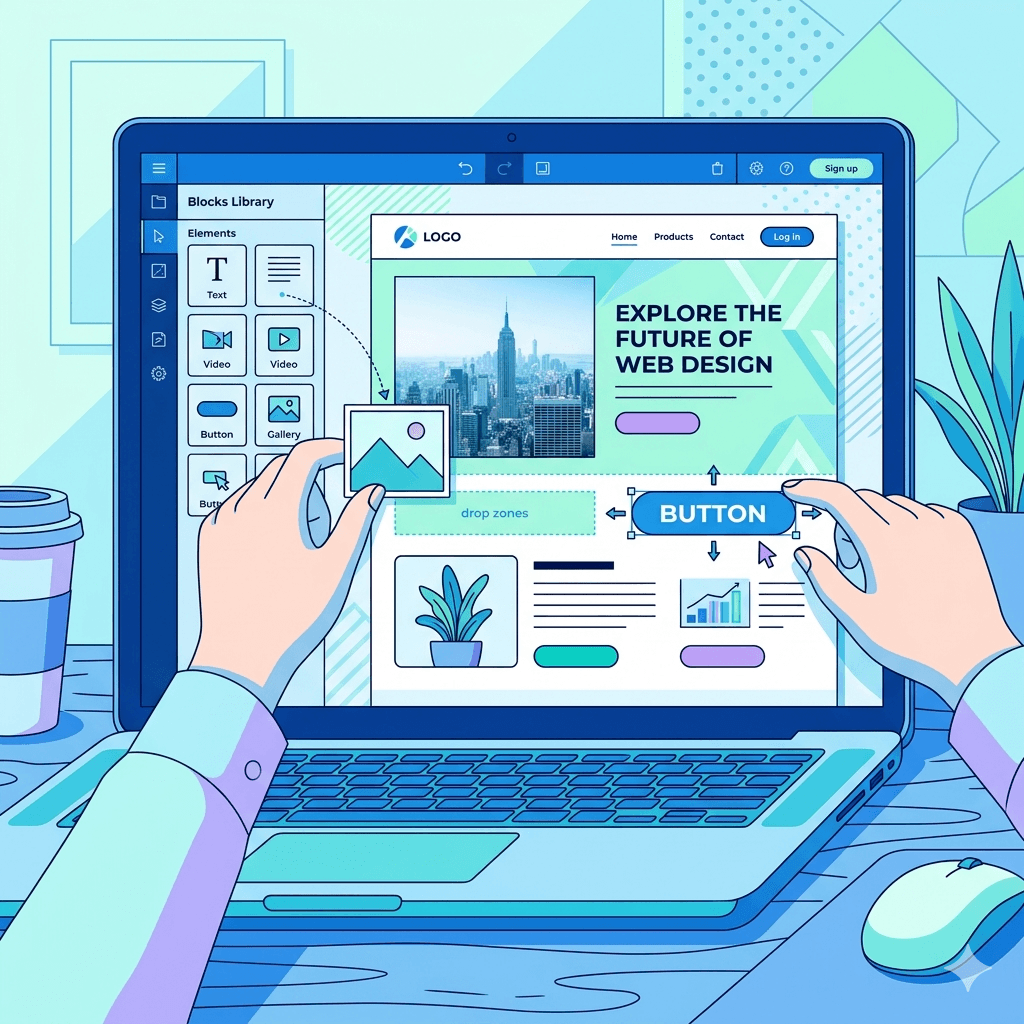
    A drag-and-drop website builder interface displayed on a laptop screen

    Wix is a cloud-based website builder that lets you create a website without writing a single line of code. Think of it like building with LEGO blocks. You pick a template, drag elements where you want them, and your site is live within hours.

    Wix was launched in 2006 and has grown to serve over 230 million users globally. It handles everything for you, including hosting, security updates, and technical maintenance. All you need to do is sign up, choose a plan, and start designing.

    For small businesses, bloggers, and entrepreneurs who want a professional online presence without hiring a developer, Wix is a popular starting point. It offers hundreds of templates, built-in apps for bookings, eCommerce, and contact forms, and a beginner-friendly interface that most people can figure out in a single afternoon.

    In short, Wix is the drag-and-drop website builder that trades deep flexibility for ease of use.

    3. What Is WordPress?

    WordPress is the world’s most popular content management system, or CMS. It powers over 43% of all websites on the internet, from personal blogs to major news outlets. Unlike Wix, WordPress is not a hosted platform. You download the software, install it on your own web hosting server, and build from there.

    WordPress comes in two versions. WordPress.com is a hosted version similar to Wix. WordPress.org is the self-hosted, open-source version that gives you full control over your website. Most developers and serious website owners use WordPress.org.

    The power of WordPress lies in its flexibility. With thousands of free and premium themes, plus over 59,000 plugins, you can build almost anything, from a simple blog to a complex online store.

    That flexibility comes with a learning curve, though. WordPress requires a bit more technical know-how than Wix, but it rewards that effort with scalability and control that Wix simply cannot match.

    4. What Is Custom Website Design?

    A developer working on a laptop with code flowing into a fully designed website interface

    Custom website design means hiring a professional web designer or development team to build a website specifically for your business from scratch. There are no templates or pre-built frameworks to limit what you can create. Every element, from the layout to the color scheme to the database structure, is designed to meet your exact needs.

    Custom websites are often built using technologies like HTML, CSS, JavaScript, PHP, or frameworks like React or Laravel. The process usually involves a discovery phase, wireframing, design mockups, development, testing, and finally launch.

    This approach gives you complete control over how your website looks, performs, and grows. It also means you are not locked into any platform’s rules or pricing structure.

    Custom design is typically the most expensive option upfront, but for businesses with specific needs, complex workflows, or ambitious growth plans, it can be the most cost-effective long-term investment. Many web design services in Uganda offer this kind of tailored development at competitive rates.

    5. Key Differences Between Wix, WordPress, and Custom Design

    At a glance, these three platforms might seem to do the same thing, but they are actually quite different animals.

    Wix is a closed, all-in-one platform. Everything, including hosting, design tools, and updates, lives inside Wix’s ecosystem. You do not own the platform; you rent space on it. That is convenient, but it limits how far you can take your site.

    WordPress is open-source and self-hosted. You own your data and your website. You can move it to any host, customize it endlessly, and scale it however you need. But that freedom means you are also responsible for security, updates, and maintenance.

    Custom design sits in its own category entirely. You are not using anyone else’s platform. You own 100% of everything, and the site is built exactly to your specifications. The trade-off is time and cost.

    Here is a simple comparison:

    • Ease of Use: Wix wins for beginners, WordPress is moderate, custom design requires professionals

    • Cost: Wix has low entry cost, WordPress is moderate, custom design has higher upfront cost

    • Flexibility: Custom design wins, followed by WordPress, then Wix

    • Ownership: WordPress and custom design give full ownership; Wix does not

    • Scalability: Custom design and WordPress scale better than Wix

    6. Pros and Cons of Wix

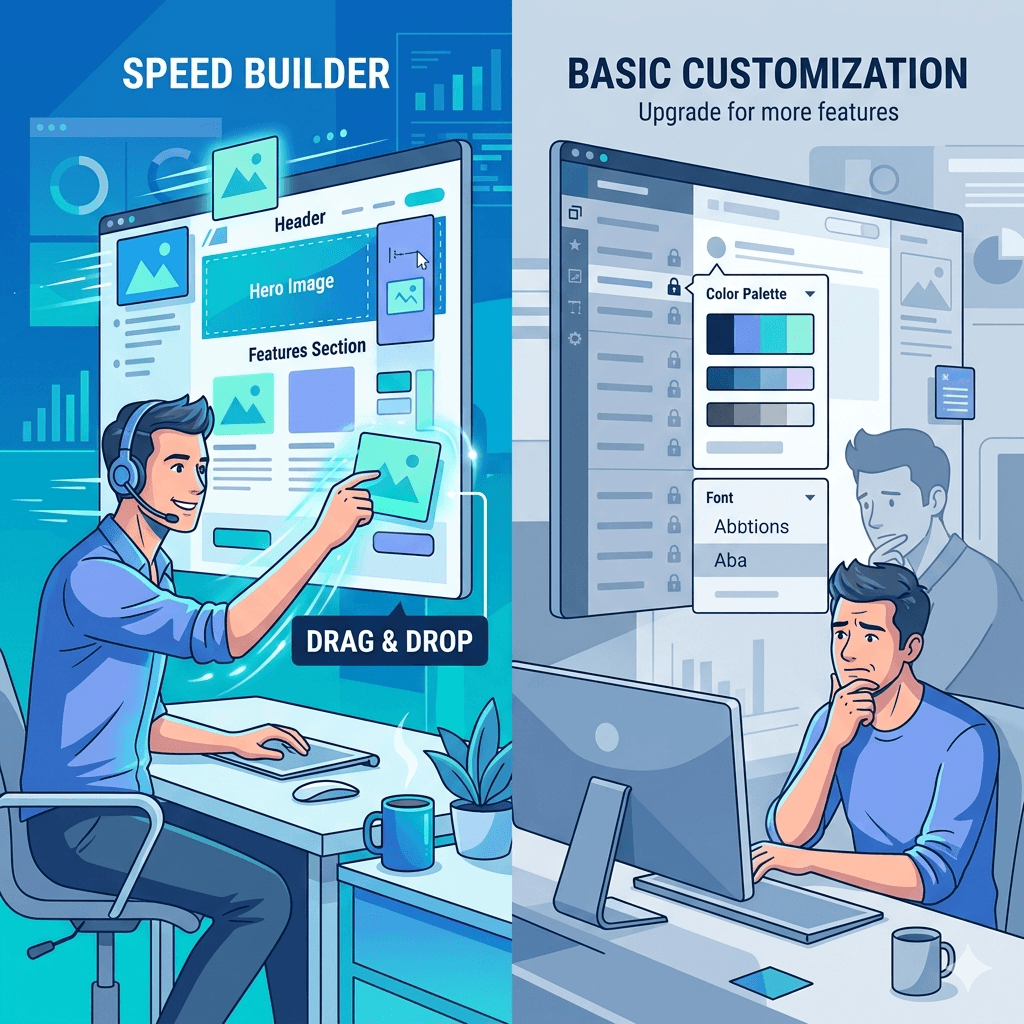
    A user quickly building a website on one side while another panel shows limited customization options

    6.1 Advantages of Wix

    The biggest advantage of Wix is how fast you can go from zero to a live website. You do not need any technical skills. The drag-and-drop editor is intuitive, and hundreds of professionally designed templates mean your site can look great without any design experience.

    Wix also handles all the behind-the-scenes work. Hosting, SSL certificates, automatic updates, and security patches all happen without you lifting a finger. For someone running a business and juggling ten other tasks, that is a huge relief.

    Other advantages include:

    • Built-in tools for bookings, eCommerce, blogging, and contact forms

    • A large library of apps through the Wix App Market

    • 24/7 customer support

    • No coding required at any stage

    • Free plan available for testing before committing

    6.2 Limitations of Wix

    The trade-off for all that convenience is limited control. Once you pick a template on Wix, you cannot switch to a different one without rebuilding your site. That is a frustrating constraint as your brand evolves.

    Wix also struggles with advanced SEO compared to WordPress. While it covers the basics, serious search engine optimization requires more control than Wix allows. Page speed can also be an issue, especially in Uganda where internet bandwidth is often limited.

    Additionally:

    • Your site is locked into Wix’s platform. You cannot migrate it elsewhere easily

    • The free plan includes Wix-branded ads on your site

    • Wix pricing can add up when you add premium apps

    • Not ideal for large, complex websites

    7. Pros and Cons of WordPress

    7.1 Advantages of WordPress

    WordPress gives you power and flexibility that Wix simply cannot match. Because it is open-source, there is a massive global community of developers building themes, plugins, and tutorials for it. Whatever feature you need, there is almost certainly a plugin that does it.

    From an SEO perspective, WordPress is superior. Plugins like Yoast SEO and Rank Math give you detailed control over how your site appears in search results, which is critical if you want customers in Uganda to find you on Google.

    Other advantages include:

    • Full ownership of your website and data

    • Thousands of free and premium themes to choose from

    • Highly scalable, from a simple blog to a large eCommerce store

    • Better long-term SEO capabilities

    • Large developer community for support and customization

    7.2 Limitations of WordPress

    WordPress requires more technical involvement. You need to manage your own hosting, handle software updates, and keep plugins up to date. Security is also your responsibility, which is why practices like regular WordPress backup are essential. Neglecting these things can leave your site vulnerable to hacks or crashes.

    Other limitations include:

    • Steeper learning curve for complete beginners

    • Costs can add up when purchasing premium themes, plugins, and hosting

    • Plugin conflicts can sometimes break your site

    • Ongoing maintenance is your responsibility

    8. Pros and Cons of Custom Website Design

    A premium, fully customized website interface being crafted from scratch

    8.1 Advantages of Custom Design

    A custom-built website is like having a suit tailored specifically for your body. It fits perfectly because it was made for you. Nothing is borrowed, templated, or compromised.

    Custom websites load faster because the code is lean and purpose-built. There is no bloated theme code or unused plugin features slowing things down. For businesses in Uganda where internet speed matters, this performance advantage is significant.

    Other advantages include:

    • Complete creative and functional control

    • Unique design that stands out from template-based competitors

    • Built to your exact business processes and workflows

    • Better performance and faster loading speeds

    • No platform dependency or lock-in

    • Scales precisely as your business grows

    8.2 Limitations of Custom Design

    The most obvious limitation is cost. A custom website requires hiring designers and developers, which means a higher upfront investment compared to Wix or WordPress. It also takes more time, often weeks or months, before your site is live.

    Other limitations include:

    • You depend on the development team for major changes

    • Ongoing costs for maintenance, updates, and support

    • Not practical for businesses that need a site up within days

    • Requires a clear brief and good communication with your team

    9. Cost Comparison in Uganda

    9.1 Initial Setup Costs

    Understanding the true website cost in Uganda means looking beyond the advertised price.

    Wix: A free plan exists but is very limited. Paid plans start at around $17 per month (roughly UGX 63,000). Business plans with full eCommerce features start at $36 per month or more.

    WordPress: The software itself is free, but you need to pay for hosting. Good hosting in Uganda typically costs between UGX 50,000 and UGX 200,000 per month. A premium theme might add another UGX 150,000 to UGX 500,000. Add a domain, and your initial setup might run between UGX 300,000 and UGX 1,500,000.

    Custom Design: This varies widely based on complexity. Simple brochure websites built by Kampala web designers might cost between UGX 1,500,000 and UGX 5,000,000. Complex eCommerce or business systems can reach UGX 10,000,000 to UGX 30,000,000 or more.

    9.2 Ongoing Maintenance Costs

    Wix ongoing costs are predictable. You pay your monthly subscription and that is mostly it. Hosting, security, and updates are included.

    WordPress ongoing costs include hosting renewals, domain renewals, plugin license renewals, and the time or money to keep things updated and secure.

    Custom website ongoing costs typically include hosting, domain renewal, and retainer or ad-hoc fees for any updates or fixes your developer handles.

    9.3 Hidden Costs to Consider

    With Wix, hidden costs often come from premium apps in the Wix App Market. Each app adds to your monthly bill. With WordPress, costs can creep up through premium plugin renewals, security tools, and backup services. With custom websites, rushing the project or poor planning often leads to extra development hours and increased costs.

    The honest truth is that no platform is truly cheap if you want it done right. Budget for quality, not just the lowest price.

    10. Ease of Use and Learning Curve

    A staircase illustration showing increasing difficulty levels from beginner-friendly tools to advanced coding environments

    10.1 Beginner Friendliness

    Wix is the clear winner for absolute beginners. You can have a functional website live in a few hours with no prior experience. The interface is visual and intuitive. If you can drag a file into a folder on your computer, you can use Wix.

    WordPress has a moderate learning curve. Setting up hosting, installing WordPress, choosing a theme, and installing plugins takes more effort. But once you get past that initial setup, it becomes much easier to manage. Thousands of video tutorials and guides make the learning process accessible even without technical training.

    Custom design requires no hands-on effort from you during the build process, since professionals handle everything. However, you need strong communication skills to convey your vision clearly to the team.

    10.2 Technical Skills Required

    Wix requires zero technical skills to get started. WordPress requires basic technical understanding but no coding. Custom design is handled entirely by developers, so technical skills are not required from the business owner, only clear communication and decision-making.

    11. Design Flexibility and Customization

    Design flexibility is where the three options truly separate themselves.

    Wix offers hundreds of templates, and you can customize them using the visual editor. However, there are limits to what you can change. The underlying code is not accessible, which means a developer cannot come in and make deep structural changes. What you see in the editor is what you get.

    WordPress offers significantly more design flexibility. You can install any theme, modify it with CSS, use page builder tools like Elementor or Beaver Builder, and add virtually any functionality through plugins. With a developer’s help, you can make WordPress look and work almost exactly as you imagine.

    Custom design offers unlimited flexibility. Every pixel is intentional. There are no template constraints, no platform limitations, and no workarounds needed. If you can design it, a skilled development team can build it. For businesses in Uganda with strong brand identities or unique workflow requirements, this level of control is invaluable.

    12. SEO and Performance Comparison

    12.1 Built-in SEO Features

    All three platforms support basic SEO practices, but they do so at different levels of depth.

    Wix has improved its SEO tools significantly over the years. You can edit meta titles, descriptions, alt text, and URLs. However, it still lacks some of the advanced control that WordPress provides.

    WordPress, especially with plugins like Yoast SEO or Rank Math, gives you granular control over every SEO element. Schema markup, canonical tags, XML sitemaps, and breadcrumb navigation are all manageable through free tools. This is why most serious businesses and bloggers choose WordPress when search engine visibility is a priority.

    Custom websites can be built with SEO best practices baked in from the very first line of code, which often gives them an edge in performance and structure.

    12.2 Speed and Performance

    Page speed affects both user experience and search rankings. Slow websites lose visitors. In Uganda, where bandwidth can be inconsistent, website speed is not just a technical concern. It is a business concern.

    Wix websites can be slow due to the platform’s code structure. Custom design and well-optimized WordPress sites generally perform better, especially when hosted on quality servers with content delivery networks.

    12.3 Mobile Optimization

    All three platforms support responsive web design and mobile-friendly websites. Wix automatically adjusts your layout for mobile, though the result is sometimes imperfect and requires manual tweaking. WordPress themes designed with responsive web design in mind perform well on all screen sizes. Custom websites can be built mobile-first, ensuring flawless performance across devices, which is especially important in Uganda where most users access websites on smartphones.

    13. Best Option for Different Types of Users

    Different user personas (business owner, blogger, startup founder

    13.1 Small Business Owners

    If you own a small business in Uganda and need a clean, professional website without the complexity, Wix or WordPress on a managed hosting plan is a solid starting point. Wix works well for service businesses like salons, restaurants, and retail shops that need simple pages and a booking or contact feature. WordPress suits those who plan to grow and need better SEO capabilities from day one.

    13.2 Startups and Entrepreneurs

    Startups often need speed and flexibility simultaneously. WordPress is a strong choice here because it can grow with your business. If your startup plans to build an online store, comparing the right eCommerce platform options early saves you from costly migrations later. Custom design becomes worth considering when your startup has a product or service that requires a truly unique digital experience to compete.

    13.3 Bloggers and Content Creators

    WordPress was built for content publishing and it remains the best platform for bloggers and content creators. The editorial tools, content scheduling, category and tag systems, and SEO plugins make it ideal for anyone who publishes regularly. Wix can handle simple blogging, but for serious content strategies, WordPress wins every time.

    13.4 Established Businesses

    Established businesses with serious revenue, complex workflows, and long-term digital strategies are usually best served by either a custom website or a heavily customized WordPress build. At this level, investing in quality web design services in Uganda pays dividends in brand perception, performance, and conversion rates. The extra cost is justified by the results.

    14. How to Choose the Right Platform for Your Needs

    14.1 Define Your Goals

    Start by asking yourself what the website needs to do. Is it a digital business card? An online store? A content hub? A booking platform? Different goals point to different platforms. A brochure site is fine on Wix. A content-heavy blog is better on WordPress. A complex store or application benefits from custom development.

    14.2 Set Your Budget

    Be honest about what you can afford both upfront and on an ongoing basis. Wix has the lowest barrier to entry but recurring monthly fees. WordPress has moderate setup costs with ongoing hosting and maintenance. Custom design has higher upfront investment but can be the most cost-efficient over a five-year horizon for growing businesses.

    14.3 Consider Your Technical Skills

    If you have no technical background and no plans to hire a developer, Wix is the safest bet. If you are willing to learn or have a tech-savvy team member, WordPress offers far more reward for the effort. If you want to focus entirely on running your business and let experts handle the website, partnering with a reliable web design company in Uganda for a custom build makes the most sense.

    14.4 Think Long-Term

    Whatever platform you choose today, think about where your business will be in three to five years. Switching platforms later is possible but painful. Choose something that grows with you rather than something you outgrow quickly. If you need help evaluating your options, working with an experienced web design company in Uganda can save you time, money, and frustration in the long run.

    15. Common Mistakes to Avoid

    15.1 Choosing Based Only on Price

    The cheapest option today can become the most expensive option tomorrow. Choosing Wix because the free plan is available, then realizing you need features that require upgrades and add-ons, often costs more than a well-planned WordPress site from the start. Always calculate total cost of ownership, not just the entry price.

    15.2 Ignoring Scalability

    Your website needs to grow with your business. A platform that works perfectly for 100 visitors a month may buckle under 10,000. Choose a scalable website solution from the beginning, especially if you have growth ambitions. Rebuilding your site from scratch in two years is a costly and disruptive mistake many Uganda businesses make.

    15.3 Overlooking SEO and Performance

    Many business owners focus entirely on how the website looks and forget about how it performs. A beautiful site that loads slowly or ranks nowhere on Google will not generate leads. Before you launch, make sure your chosen platform supports solid SEO-friendly website design, fast load times, and mobile-friendly websites. These are not optional extras. They are baseline requirements for any website that wants to compete online in Uganda today.

    16. Final Verdict: Which Is Right for Uganda?

    There is no single answer that works for everyone, but there are clear patterns.

    Choose Wix if you are just starting out, have a tight budget, need a simple website quickly, and do not plan to do heavy SEO or complex functionality.

    Choose WordPress if you are serious about growing online, need strong SEO capabilities, want to scale your website over time, and are willing to invest a bit more effort or money into setup and maintenance.

    Choose custom website design if you have a clear business need that templates cannot meet, want a website that truly represents your brand, have a bigger budget, or are running an established business that requires a competitive digital edge.

    For most small business owners and entrepreneurs in Uganda, WordPress is the sweet spot. It offers the best balance of flexibility, cost, SEO, and long-term scalability. But whatever you choose, building your website with intention and a clear strategy will always beat picking randomly and hoping for the best.

    17. Frequently Asked Questions

    17.1 Is Wix good for small businesses in Uganda?

    Yes, Wix is a solid option for small businesses in Uganda that need a simple, attractive website without technical complexity. It works well for service businesses, local shops, and solo entrepreneurs. However, if SEO and long-term growth are priorities, WordPress may serve you better.

    17.2 Is WordPress better than Wix for SEO?

    Yes. WordPress gives you significantly more control over SEO elements, especially when combined with plugins like Yoast or Rank Math. For businesses that rely on organic search traffic in Uganda, WordPress is the stronger choice.

    17.3 How much does it cost to build a website in Uganda?

    Costs vary widely. A basic Wix website might cost UGX 50,000 to UGX 200,000 per month depending on your plan. A WordPress website setup can range from UGX 300,000 to UGX 1,500,000 initially, with ongoing hosting fees. Custom websites start from UGX 1,500,000 and can go much higher depending on complexity.

    17.4 Do I need coding skills for WordPress or Wix?

    No. Wix requires zero coding. WordPress requires no coding for basic setups, especially when using page builders like Elementor. Coding becomes helpful when you need advanced customizations, but most everyday tasks can be done without writing a single line of code.

    17.5 When should I choose custom website design?

    Choose custom design when your business has unique requirements that templates cannot meet, when brand differentiation is critical, when you need specific integrations with business systems, or when you are an established business investing in a serious digital presence.

    17.6 Which platform is best for eCommerce in Uganda?

    WordPress with WooCommerce is the most popular and powerful eCommerce solution for Uganda businesses at most price points. Wix also supports online stores but with more limitations. Custom eCommerce solutions make sense for high-volume or complex online businesses.

    17.7 Can I switch platforms later?

    Yes, but it is not easy. Moving from Wix to WordPress, for example, requires rebuilding your site almost entirely since Wix does not allow direct data export. Moving between WordPress and custom design is more manageable. The safest approach is to choose the right platform from the start.

    17.8 Which option is fastest to launch?

    Wix is the fastest option. You can have a basic website live within a single day. WordPress typically takes a few days to a couple of weeks, depending on the setup. Custom website design takes the longest, usually several weeks to a few months, depending on the project scope.

  • Why Law Firms in Uganda Need a Professional Website in 2026

    Why Law Firms in Uganda Need a Professional Website in 2026

    Why Law Firms in Uganda Need a Professional Website in 2026

    1. Introduction

    Imagine a potential client in Kampala searching for a lawyer to handle a land dispute. They pull out their phone, type a quick search, and start scrolling. If your law firm doesn’t show up, you’ve already lost that client   and you didn’t even know they were looking.

    That’s the reality of doing business in Uganda today. The internet has changed how people find services, including legal help. A professional law firm website is no longer a luxury for big firms with deep pockets. It’s a basic business tool that every legal practice needs, whether you’re a solo advocate or managing a growing firm.

    This article breaks down exactly why your law firm needs a professional website in 2026, what it should include, and how it can bring in more clients without you having to make a single cold call.

    2. What Is a Professional Law Firm Website?

    A clean, structured website interface displayed on a laptop showing sections like services, contact, testimonials

    A professional law firm website is more than just a page on the internet with your firm’s name and phone number. Think of it as your firm’s digital office   one that’s open 24 hours a day, seven days a week, ready to answer questions, showcase your expertise, and connect with clients.

    A well-built legal website clearly explains what areas of law your firm handles, who your lawyers are, and how clients can reach you. It looks polished, loads quickly, and works just as well on a mobile phone as it does on a desktop computer.

    More importantly, a professional website builds trust before a client ever walks through your door. It tells visitors, “We take our work seriously, and we’ll take your case seriously too.” That first impression can be the deciding factor between a client calling you or calling your competitor.

    3. The Digital Landscape in Uganda in 2026

    Uganda’s internet penetration has been growing steadily over the last decade. With mobile internet access spreading across cities and rural areas alike, millions of Ugandans now rely on their smartphones to search for products, services, and professional help. According to recent data, Uganda has over 22 million internet users, and that number keeps climbing.

    In Kampala and other urban centres, online searches have become the first stop for people looking for legal help. Whether someone needs help with a property transaction, a business contract, or a family matter, the first thing many of them do is search online.

    At the same time, social media platforms like WhatsApp, Facebook, and X (formerly Twitter) are widely used. But social media alone isn’t enough. Profiles on these platforms don’t carry the same professional weight as a dedicated, well-designed website. If your firm doesn’t have one, you might be invisible to a large and growing segment of potential clients. Understanding why your website is not showing on Googleis the first step toward fixing that gap.

    The legal market in Uganda is also becoming more competitive. Firms that embrace digital tools now will have a significant head start.

    4. Why Law Firms in Uganda Need a Professional Website

    A lawyer gaining clients through online channels with arrows pointing from search engines to their website and then to consultations

    Uganda’s legal market is becoming more competitive every year. New law firms are opening, and clients are becoming more selective about who they hire. In this environment, your reputation and visibility matter more than ever.

    Here’s the honest truth: most people looking for a lawyer will search online before making a call. If they can’t find you or if what they find looks outdated or unprofessional, they’ll move on to someone else. A law firm without a website in 2026 is like an office with no signboard   people walk right past without knowing you’re there.

    A professional website for lawyers does several things at once. It introduces your firm to new clients, explains your services clearly, and gives people a reason to trust you before they’ve even met you. It also makes it easy for satisfied clients to refer others to you, since they can simply share a link instead of trying to remember your phone number.

    Beyond visibility, a website supports your entire marketing strategy. From search engine optimization to content marketing, your website is the foundation of your law firm online presence. Without it, every other digital effort you make is much harder to sustain.

    5. Key Benefits of Having a Professional Website

    5.1 Increased Visibility on Search Engines

    When someone searches for advocate or lawyer services in Kampala, Google decides which firms to show based on how well their websites are built. A professionally designed website, optimized with the right keywords and structure, gives your firm a real chance to appear in those results. Without a website, you’re simply not in the game. Learning how to get your business on the first page of Google can make a dramatic difference for your firm.

    5.2 Builds Trust and Credibility

    People hire lawyers they trust. A clean, professional website signals that your firm is legitimate, established, and serious. It gives visitors a place to read about your team, learn about your track record, and understand your approach to legal work. Knowing how to design a website that builds trust is especially important for law firms, where clients are often dealing with sensitive and high-stakes matters.

    5.3 Attracts More Qualified Clients

    A well-structured legal website doesn’t just bring in more visitors, it brings in the right ones. When your service pages clearly explain what you do and who you help, people who need exactly what you offer are more likely to reach out. This means fewer wasted consultations and more cases that are a genuine fit for your practice.

    5.4 24/7 Accessibility for Clients

    Your office closes at 5 PM. Your website never does. A potential client going through a stressful situation at 11 PM on a Friday can still visit your site, learn about your services, read client testimonials, and fill out a contact form. By morning, you have a warm lead waiting in your inbox, no effort required on your part.

    5.5 Competitive Advantage in the Legal Market

    Many law firms in Uganda still haven’t built a proper online presence. That’s actually good news for you. Every day you have a professional website and your competitors don’t, you’re ahead. And as more firms eventually catch up, the quality of your website will become the differentiator. Getting started now puts you in a strong position for years to come.

    6. Common Mistakes Law Firms Make Without a Website

    A frustrated lawyer waiting in an empty office while competitors attract clients online

    6.1 Relying Only on Referrals

    Referrals are valuable, but they have limits. If your entire client pipeline depends on word of mouth, you’re vulnerable. What happens during a slow period? What if a key referral source moves away or retires? A website creates a second, always-on channel for new client acquisition that works even when your network goes quiet.

    6.2 Using Outdated or Free Platforms

    Some firms try to solve the website problem by using free website builders or directory listings. While these can help a little, they don’t give you the control, the credibility, or the search engine performance of a proper, custom-designed site. Clients can tell the difference, and Google’s algorithms can too.

    6.3 Poor Online Branding

    A law firm’s brand is built on trust and professionalism. If your online presence is scattered   a Facebook page here, a WhatsApp number there   it sends mixed signals. A unified website gives your firm a consistent, professional face that reinforces your brand every time someone finds you online.

    6.4 Lack of Contact Information

    This one seems obvious, but it’s surprisingly common. Law firms without a website are often hard to reach online. Even when someone hears about your firm and wants to get in touch, they may struggle to find a current address, phone number, or email. A website solves this instantly and makes it easy for any interested client to take the next step.

    7. Essential Features of a High-Performing Law Firm Website

    7.1 Clear Service Pages

    Each area of law your firm handles should have its own dedicated page. Whether it’s conveyancing, family law, commercial litigation, or employment matters   spell it out clearly. Don’t make visitors guess what you do. Use plain, everyday language so that non-lawyers can understand what help you offer and whether it fits their situation.

    7.2 Mobile-Friendly Design

    More than half of web traffic in Uganda comes from mobile phones. If your website doesn’t work well on a small screen   if text is tiny, buttons are hard to tap, or pages load slowly   you’ll lose visitors before they even see what your firm has to offer. A mobile-responsive design is non-negotiable in 2026.

    7.3 Fast Loading Speed

    Website speed isn’t just a technical issue   it’s a user experience issue. Research consistently shows that visitors abandon pages that take more than three seconds to load. For law firms competing for attention online, a slow website is like a slow receptionist: it creates a bad impression before the relationship even starts.

    7.4 Easy Navigation

    Visitors should be able to find what they’re looking for in two or three clicks. A clear menu, logical structure, and well-organized content keep people on your site longer and make them more likely to get in touch. Think of your navigation like a well-organized filing system   everything in its place, easy to find.

    7.5 Contact Forms and Calls-to-Action

    Every page on your website should make it easy for visitors to take the next step. That means visible phone numbers, clickable email addresses, and simple contact forms. A strong call-to-action   something like Book a Free Consultation or Get Legal Advice Today   removes any friction between a visitor’s interest and their decision to reach out.

    7.6 Client Testimonials and Case Results

    Testimonials from satisfied clients are among the most powerful trust-building tools on a law firm website. When a potential client reads that someone in a similar situation was helped by your firm and walked away happy, it reduces their hesitation significantly. Where possible and appropriate within professional guidelines, share case outcomes that demonstrate your firm’s track record.

    8. How a Website Helps Generate More Clients

    A funnel illustration showing visitors entering a website and converting into paying clients

    8.1 Search Engine Optimization (SEO)

    SEO is the process of making your website easier for search engines to find and rank. When done right, it means that someone searching for “land dispute lawyer Kampala” is more likely to find your firm on the first page of results. Investing in SEO services for law firms is one of the most cost-effective long-term strategies for growing your client base.

    8.2 Local Search Visibility (Google Maps)

    Setting up a Google Business Profile and linking it to your website helps your firm appear in local map results. When someone nearby searches for legal help, your firm can show up with your address, phone number, and star rating right there on the map. This is especially powerful for attracting clients in your immediate area. A solid foundation in local SEO for Kampala businesses will help you dominate these local search results.

    8.3 Content Marketing (Blogs and Articles)

    Publishing helpful articles on legal topics is a smart way to attract visitors who are already looking for information related to your services. When someone reads your article on “how to handle a tenancy dispute in Uganda” and finds it useful, they’re far more likely to contact your firm when they need legal help. It builds authority and trust at the same time.

    8.4 Lead Capture Strategies

    Your website can do the work of a receptionist by capturing visitor information even before they call. A well-placed form offering a free case review, a downloadable legal guide, or a newsletter signup can turn an anonymous browser into an identifiable lead. With the right follow-up system in place, these leads can become paying clients.

    9. How to Create a Professional Law Firm Website

    9.1 Define Your Target Audience

    Before designing anything, get clear on who your ideal clients are. Are you focused on individual clients dealing with family or property matters? Or do you serve businesses with commercial and employment needs? Knowing your audience shapes every decision   from the tone of your content to the design of your pages.

    9.2 Choose a Domain Name and Hosting

    Your domain name is your web address. Choose something that includes your firm’s name and is easy to spell and remember. Avoid hyphens and complicated words. For hosting, choose a reliable provider with strong uptime guarantees and local support if possible.

    9.3 Design with User Experience in Mind

    Good design isn’t just about looking nice   it’s about making things easy for visitors. Work with a team that understands professional web design services and can create a layout that guides users naturally from landing on your site to reaching out for help.

    9.4 Add Essential Pages

    At a minimum, your website should include a homepage, an about page, individual service pages, a contact page, and a blog section. Each page should have a clear purpose and guide visitors toward making contact with your firm.

    9.5 Optimize for SEO

    Use relevant keywords on each page, write clear meta descriptions, add your location to your content, and make sure your site loads quickly and works on mobile. These technical steps are what help search engines understand what your site is about and who it should be shown to.

    9.6 Launch and Test

    Before going live, test your website on multiple devices and browsers. Click every link, submit every form, and make sure all phone numbers and email addresses are correct. Ask a colleague to navigate the site and tell you if anything is confusing. A clean, error-free launch builds confidence in your brand from day one.

    10. Cost of Building a Law Firm Website in Uganda

    A pricing comparison chart showing different website packages and features

    The cost of building a law firm website in Uganda varies depending on the complexity of the site, the features required, and the team you hire. A basic professional website might start from around UGX 1,500,000 to UGX 4,000,000. More complex sites with custom features, advanced SEO, and content creation can go higher. Check out current website pricing in Uganda to get a clearer picture of what to budget.

    It’s worth comparing the cost of a professional website against alternatives. Before committing to a free builder, read about the real difference between

    free website builders vs professional designers   the hidden costs often outweigh the initial savings.

    Think of your website as a long-term investment. A well-built site that consistently brings in one or two new clients per month pays for itself many times over in the first year alone. The real question isn’t whether you can afford a website, it’s whether you can afford not to have one.

    11. Tips for Maintaining and Updating Your Website

    11.1 Regular Content Updates

    A website that hasn’t been updated in a year sends a quiet message to visitors: nobody’s home. Adding new blog posts, updating your service pages, and refreshing your team bios regularly shows that your firm is active, engaged, and keeping up with changes in the law.

    11.2 Security and Backups

    Your website holds sensitive information, contact details, inquiry forms, and client-facing content. Make sure your site is protected with an SSL certificate (the padlock that appears in the browser), that software is kept up to date, and that regular backups are made so nothing is lost if something goes wrong.

    11.3 Performance Monitoring

    Use tools like Google Analytics and Google Search Console to track how people are finding and using your website. These free tools show you which pages are popular, how long people stay, and where they’re dropping off. This information helps you improve your site over time.

    11.4 Updating Legal Information

    Laws change. Regulations are updated. Court procedures evolve. Make it a habit to review your website’s legal content at least twice a year to make sure everything is accurate and current. Outdated information can mislead potential clients and harm your firm’s credibility.

    12. Future Trends in Law Firm Websites (2026 and Beyond)

    12.1 AI Chatbots for Client Support

    More law firm websites are now integrating AI-powered chatbots that can answer basic questions, qualify leads, and book consultations automatically. These tools work around the clock, reducing the burden on your administrative staff while keeping potential clients engaged.

    12.2 Voice Search Optimization

    As voice assistants become more common, more people are searching by speaking rather than typing. Optimizing your website content for natural, conversational queries   the kind someone would speak aloud   will become increasingly important for maintaining search visibility.

    12.3 Video Content Integration

    Short explainer videos, attorney introductions, and client testimonial videos are becoming powerful tools on legal websites. Video content builds a personal connection faster than text alone and can significantly increase the time visitors spend on your site.

    12.4 Enhanced Mobile Experiences

    Mobile design will continue to evolve beyond simple responsiveness. Expect to see more law firm websites designed with a mobile-first philosophy   prioritizing touch-friendly navigation, fast mobile load times, and features like click-to-call buttons that make it effortless for smartphone users to reach out.

    13. Conclusion

    Building a professional website isn’t just a trend, it’s a foundational step for any law firm that wants to grow in Uganda’s increasingly digital marketplace. A well-designed site gives your firm visibility, builds trust, attracts the right clients, and works for you around the clock.

    Whether you’re just starting out or looking to upgrade an outdated online presence, now is the right time to act. Your competitors are waking up to this reality, and the firms that invest in their digital presence today will have the edge tomorrow.

    Ready to take that step? Explore our law firm website design in Uganda services, view our portfolio of past work, or contact a web design expert today to discuss how we can help your firm stand out online.

    14. Frequently Asked Questions

    14.1 How much does a law firm website cost in Uganda?

    The cost typically ranges from UGX 1,500,000 to UGX 6,000,000 or more, depending on the size of the site, features included, and whether you need ongoing SEO and content services. A basic but professional site is affordable for most small and mid-sized firms.

    14.2 How long does it take to build a professional website?

    A professional law firm website usually takes between two to six weeks to design and launch, depending on how quickly content and feedback are provided. More complex sites with custom features may take longer.

    14.3 Can I create a law firm website without technical skills?

    Yes. You don’t need to know how to code. You just need to provide the content   information about your services, team bios, and your contact details. A professional web design team handles all the technical work, from design to launch and beyond.

    14.4 What pages should a law firm website include?

    At a minimum, your site should have a homepage, an about page, individual pages for each service area you offer, a contact page with a form, and a blog section for publishing helpful legal content.

    14.5 How do I get clients through my website?

    Combine SEO to rank higher in search results, compelling content that answers client questions, clear calls-to-action, and lead capture forms. Over time, a consistent content strategy and local SEO work will bring a steady stream of qualified inquiries.

    14.6 Is SEO necessary for law firms in Uganda?

    Absolutely. Without SEO, your website is like a beautiful office in a building with no signs   hard to find. Digital marketing for law firms that includes SEO ensures that people who need your services can actually find you online.

    14.7 How often should I update my website?

    Aim to publish a new blog post or update your content at least once a month. Review your service pages and legal information every three to six months to make sure everything is accurate and current.

    14.8 What makes a law firm website trustworthy?

    A trustworthy legal website has a clean professional design, clearly states who the lawyers are and what they specialize in, includes real client testimonials, shows professional credentials, has clear contact information, and uses an SSL certificate (shown as a padlock in the browser). You can also learn more about our team at

    learn more about our team to see how we approach building credible, trust-focused websites for legal professionals in Uganda.

  • How Uganda’s Tourism Industry Can Win More Bookings Through SEO

    How Uganda’s Tourism Industry Can Win More Bookings Through SEO

    1. Introduction

    Uganda is one of Africa’s most remarkable travel destinations. From gorilla trekking in Bwindi to wildlife safaris in Queen Elizabeth National Park, the country offers experiences that travelers around the world are actively searching for. Yet many tour operators are missing out on bookings simply because potential clients cannot find them online.

    This is where Uganda tours SEO comes in. Search engine optimization is one of the most powerful and cost-effective tools available to small and medium-sized tour businesses. When done right, SEO helps your website show up when someone in London, New York, or Nairobi types “best Uganda wildlife tours” or “book safari tours Uganda” into Google.

    This article walks you through practical, proven SEO strategies designed specifically for Uganda tour operators and travel businesses. Whether you run Uganda safari tour packages, cultural tours, or eco-tourism experiences, these insights will help you attract more visitors to your website and turn them into paying customers.

    2. What Is SEO and Why It Matters for Tour Operators

    An illustration of a tour operator surrounded by floating SEO elements like magnifying glasses

    SEO, or search engine optimization, is the process of making your website more visible on search engines like Google. Think of Google as a massive travel directory. When someone searches for “Uganda gorilla trekking tours” or “Uganda cultural tours booking,” Google scans millions of websites and ranks the most relevant ones at the top. SEO is how you earn that top spot.

    For tour operators, online visibility directly drives bookings. Studies consistently show that the majority of travelers research and book trips online. If your business does not appear on the first page of search results, you are essentially invisible to most potential clients. Paid ads can help in the short term, but organic search for travel bookings through SEO delivers long-term, sustainable traffic without paying for every click.

    Uganda’s tourism industry has a genuine competitive advantage here. Many local operators are not yet investing heavily in SEO for tour operators in East Africa, which means there is still a window of opportunity to rank well for high-value searches. Getting in early and doing it right can put your business miles ahead of competitors.

    3. Benefits of SEO for Uganda’s Tourism Industry

    Increase Website Traffic and Leads

    Every day, thousands of people search for phrases like “wildlife safari tours in Uganda,” “family friendly Uganda tours,” and “private Uganda safari packages.” Good SEO puts your website directly in front of these potential clients at the exact moment they are looking to book. More relevant traffic means more inquiries and ultimately more confirmed bookings.

    Build Brand Credibility and Trust

    Websites that rank highly on Google are automatically perceived as more trustworthy. Most travelers associate a top search ranking with legitimacy and expertise. When your site consistently appears for searches related to Uganda adventure travel experiences or eco-tourism experiences in Uganda, it builds brand authority that no paid ad can replicate. People trust organic results more than sponsored links.

    Improve Cost Efficiency Compared to Paid Ads

    Running Google Ads or Facebook campaigns gets expensive fast, especially for small and medium-sized businesses with tight marketing budgets. SEO requires an upfront investment of time and effort, but once your pages rank, they continue attracting visitors without you paying for each click. Over time, the cost per booking through organic search is significantly lower than through paid advertising, making SEO a smart long-term investment for tour operators across East Africa.

    4. Key SEO Strategies for Tour Operators

    A creative dashboard-style illustration showing a tour operator optimizing website elements like mobile layou

    4.1 Optimizing Your Website for Search Engines

    Your website is your most important digital asset, and it needs to be built for both users and search engines. A well-structured, fast-loading website is the foundation of any strong tour operator SEO strategy.

    Mobile-friendly design is non-negotiable. More than half of all travel searches now happen on smartphones. Google prioritizes mobile-optimized websites in its rankings, so if your site is hard to navigate on a phone, you are losing both rankings and bookings. Fast page loading speeds are equally critical. A slow website frustrates visitors and signals poor quality to Google.

    Clear navigation and a great user experience keep visitors on your site longer, which signals to Google that your content is valuable. Make it easy for visitors to find tours, read descriptions, see pricing, and book directly. If you need help building a site that checks all these boxes, a professionally built

     tourism website designed specifically for Uganda’s tourism industry can give you a significant head start. You can also explore options for professional website development that prioritizes speed, responsiveness, and SEO from the ground up.

    4.2 Keyword Research for Tourism Businesses

    Keyword research is the process of finding the exact phrases your ideal customers type into Google. It is one of the most important steps in any travel SEO keyword research strategy.

    Start with high-intent travel keywords that show someone is ready to book, such as “book safari tours Uganda,” “Uganda safari tour packages,” or “Uganda gorilla trekking tours.” These phrases attract visitors who are not just browsing but are actively looking to make a purchase.

    Do not overlook long-tail travel keywords Uganda. These are longer, more specific phrases like “best time to visit Uganda safari,” “Uganda safari itineraries SEO,” or “eco-tourism experiences in Uganda.” They may have lower search volumes individually, but they attract highly targeted visitors who know exactly what they want and convert at higher rates.

    Destination keywords Uganda tourism are also powerful. Phrases like “wildlife safari tours in Uganda” or “Uganda adventure travel experiences” help you capture travelers who are researching specific regions or activities. Use free tools like Google Keyword Planner or Ubersuggest to identify the best opportunities for your specific offerings.

    4.3 Creating Engaging, SEO-Friendly Content

    Content is the engine that drives SEO. Think of each blog post, tour page, and destination guide as a door that opens onto your website. The more high-quality doors you have, the more people can find their way in.

    Travel content marketing SEO works best when you create genuinely useful content. Write blog posts about Uganda tour blog ideas such as “Top 10 Things to Do in Bwindi,” “How to Plan a Uganda Safari Itinerary,” or “Uganda Cultural Tours: What to Expect.” These articles answer real questions travelers have and help you rank for dozens of additional keywords.

    Visual content is equally important. Use high-quality images and videos of your tours and destinations, and always include descriptive alt text for every image. Alt text like “gorilla trekking guide in Bwindi Impenetrable Forest Uganda” helps search engines understand your visuals and improves your chances of appearing in image searches. See examples of how effective visual storytelling looks in action by exploring our

    portfolio of adventure and hiking websites we have built for tourism clients.

    4.4 On-Page and Technical SEO

    On-page SEO involves optimizing the individual elements of each page on your website. Every page should have a unique, keyword-rich meta title and meta description. For example, a page about gorilla trekking might have a meta title like “Uganda Gorilla Trekking Tours | Book Now with [Your Company].” These elements appear in search results and directly influence whether someone clicks on your link.

    Use clear header tags (H1, H2, H3) to structure your pages, and include your target keywords naturally within them. A clean URL structure also matters. A URL like yoursite.com/uganda-gorilla-trekking-tours is far better for SEO than yoursite.com/page?id=47.

    Structured data, also called schema markup, helps Google understand what type of content your page contains, such as a tour product, review, or FAQ. Internal linking connects your pages to each other, spreading SEO authority across your site and helping visitors discover more of what you offer. Professional

    SEO services can handle the more technical aspects of this if you are not confident doing it yourself.

    4.5 Building Quality Backlinks

    A backlink is when another website links to yours. Google treats backlinks like votes of confidence. The more quality websites that link to you, the more authoritative your site appears in Google’s eyes.

    For Uganda tour operators, some of the best backlink opportunities come from partnering with established travel blogs, working with Uganda Tourism Board, and listing your business on reputable travel directories like TripAdvisor, SafariBookings, and Lonely Planet. Getting featured in articles like “Best Uganda Safari Companies” or “Top Tour Operators in East Africa” can earn you powerful links.

    You can also request backlinks from complementary businesses such as hotels, lodges, and airlines that serve your clients. Even listing your

    travel agency website on local business directories and tourism associations provides a steady stream of legitimate backlinks that boost your overall domain authority.

    5. Leveraging Local SEO to Attract Tourists

    Illustration of a Uganda map with pins marking popular tourist destinations

    Local SEO for tour operators is about making sure your business shows up when people search for services in your specific area. This is especially important because many travelers search for tour operators by destination, using phrases like “tour operators in Kampala” or “safari companies near Entebbe.”

    The single most impactful thing you can do is claim and fully optimize your Google Business Profile. Fill in every detail: business name, phone number, address, website, operating hours, photos, and a compelling description that includes relevant keywords. A complete, well-maintained profile dramatically improves your chances of appearing in Google’s local map pack, the section that shows up prominently at the top of local search results.

    Encourage every satisfied client to leave a review on Google. Reviews are a major ranking signal for local SEO and they also build social proof that converts new visitors into bookings. User-generated content such as photos your clients share on their profiles and tag your business in also helps boost local visibility.

    Create location-specific landing pages for major destinations you serve. For example, a dedicated page titled “Bwindi Impenetrable Forest Gorilla Trekking Tours” or “Queen Elizabeth National Park Safari Packages” helps you rank for those specific destination searches. Pair this with a well-designed

    hotel booking website if you also offer accommodation bookings, and you create a seamless online experience that captures travelers at multiple stages of their planning journey.

    6. Measuring SEO Success for Tour Operators

    One of the great things about digital marketing is that everything is measurable. You do not have to guess whether your SEO efforts are working. You just need to know which metrics to track.

    Start with website traffic. Google Analytics shows you how many people are visiting your site, where they come from, which pages they view, and how long they stay. Pay particular attention to organic traffic, visits that come directly from search engines, as this is the clearest indicator of SEO performance.

    Track your keyword rankings using tools like Google Search Console, SEMrush, or Ahrefs. Are you moving up for searches like “Uganda tours SEO” or “Uganda travel packages SEO”? Improving rankings for high-intent keywords directly correlates with more inquiries and bookings.

    Conversions are the most important metric of all. A conversion could be a completed booking, an inquiry form submission, or a call to your business. Google Analytics lets you set up goals to track these actions, so you can see exactly which pages and keywords are driving real revenue.

    Review your data at least once a month. Look for what is working and invest more effort there, and identify what is not working so you can adjust. SEO is not a set-and-forget strategy; it rewards consistent attention. Your

    digital marketing strategy should be built around these insights, continuously refining your approach based on real-world performance data.

    7. Common SEO Mistakes to Avoid

    A visual metaphor of tourists getting “lost” while searching online due to poor mobile optimization or ignored local SEO

    Even well-intentioned SEO efforts can backfire if you fall into common traps. Here are the most frequent mistakes tour operators make and how to avoid them.

    Keyword stuffing is one of the biggest offenders. This means cramming keywords unnaturally into your content in an attempt to rank higher. Google’s algorithms are sophisticated enough to detect this, and it results in penalties that push your site down in rankings rather than up. Always write for humans first and let keywords flow naturally.

    Publishing low-quality content is equally damaging. Thin, generic pages that do not genuinely help travelers will not rank and will not convert visitors. Every piece of content you publish should answer a real question or provide genuine value.

    Ignoring mobile optimization is a critical error in 2025. With the majority of travel searches now happening on mobile devices, a site that is not mobile-responsive will lose both rankings and bookings.

    Overlooking local SEO opportunities is perhaps the most common missed opportunity for Uganda tour operators. What is local SEO for travel? It is the combination of Google Business Profile optimization, local keywords, location-specific landing pages, and review management that helps you appear in searches for tours and operators in specific areas of Uganda. Neglecting this means leaving a steady stream of high-intent, locally-relevant searches unanswered.

    8. Frequently Asked Questions

    8.1 How long does it take to see results from SEO?

    SEO is a long-term strategy, not a quick fix. Most tour businesses start seeing meaningful improvements in traffic and rankings within three to six months of consistent effort. Highly competitive keywords may take longer, while local and long-tail keywords often show results faster. The key is consistency. Businesses that stick with SEO for twelve months or more typically see compounding returns as their domain authority grows.

    8.2 What is the best way to choose keywords for a tour business?

    Start by thinking like your customer. What phrases would they type into Google when looking for what you offer? Then use tools like Google Keyword Planner, Ubersuggest, or Google’s autocomplete suggestions to validate and expand that list. Prioritize a mix of high-intent commercial keywords like “book safari tours Uganda” and specific long-tail phrases like “best time to visit Uganda safari” that have lower competition but highly qualified search intent.

    8.3 Should I focus more on content or technical SEO?

    You need both, but if you are just starting out, content often delivers quicker visible wins. Great content with the right keywords can rank even on a technically imperfect site. That said, technical issues like slow loading speeds or a non-mobile-friendly design can cap how well even excellent content performs. Aim to get the technical foundations solid early, then invest heavily in ongoing content creation.

    8.4 How can I get local tourists to find my tours online?

    Focus on local SEO. Claim your Google Business Profile, optimize it fully, and actively encourage reviews. Create pages on your website targeting specific destinations and activities within Uganda. Use location-specific keywords in your content and meta tags. Being listed on local business directories and local tourism association websites also helps local visitors find you through organic search.

    8.5 Are backlinks really important for small tourism businesses?

    Yes, backlinks remain one of Google’s most important ranking signals. Even a small number of high-quality backlinks from reputable travel blogs, tourism boards, or travel directories can significantly boost your rankings. Focus on earning links naturally by creating genuinely useful content, reaching out to travel writers, and ensuring your business is listed on the major travel platforms. You do not need hundreds of backlinks to make a real difference.

    8.6 Can social media affect SEO for my tours?

    Social media does not directly influence Google rankings, but it plays an important supporting role. Active social profiles help drive traffic to your website, increase brand awareness, and can lead to earned backlinks when people share your content. Platforms like Instagram and Facebook are also where many travelers discover destinations and tour operators, so strong social presence complements your overall travel booking trends in East Africa and SEO strategy.

    8.7 How often should I update my website content?

    Aim to publish new content at least two to four times per month. This could be blog posts, updated tour pages, destination guides, or travel tips. Google favors websites that are regularly updated, as it signals that the site is active and current. Beyond adding new content, revisit and refresh your existing pages at least once or twice a year to ensure information is accurate and to incorporate new keywords you want to target.

    8.8 Do I need to hire an SEO expert or can I do it myself?

    Many of the foundational SEO practices covered in this article can be implemented without hiring an expert, especially if you are comfortable with basic digital tools. However, technical SEO, in-depth keyword research, and building a structured content strategy can be complex. If you want to accelerate results or tackle more competitive keywords, partnering with a professional who understands how to rank a travel business on Google and the specific dynamics of tourism SEO best practices can deliver a strong return on investment. For businesses serious about growing their online bookings, professional SEO support is often worth the investment.

    Uganda’s tourism industry is full of extraordinary experiences just waiting to be discovered by travelers worldwide. SEO is the bridge that connects those travelers to your business. Start with the fundamentals, stay consistent, and keep learning from your data. The tour operators who invest in SEO today are the ones who will be filling their calendars with bookings tomorrow. If you are ready to take your online presence to the next level, explore how

    Kico Web Design’s full suite of digital solutions can help you build, optimize, and grow your tourism business online.

  • How Churches in Uganda Can Use Websites to Grow Their Congregation

    How Churches in Uganda Can Use Websites to Grow Their Congregation

    How Churches in Uganda Can Use Websites to Grow Their Congregation

    1. Introduction

    If you lead a church in Uganda, you already know that reaching people takes more than Sunday services. The world has changed. People search for answers online before they walk through any door, including a church door.

    A church website is no longer a luxury. It is one of the most powerful tools you can use to grow your congregation, share your message, and connect with people who are searching for a faith community.

    Think of your website as your church’s open door, available 24 hours a day, seven days a week. Whether someone is looking for a place to worship in Kampala or Gulu, your website can be the first thing they see. In this guide, you will learn exactly how to build and use a church website to attract new visitors, engage your existing members, and expand your ministry online. For help getting started, explore our church website design in Uganda services.

    2. What Is a Church Website?

    A simple yet engaging interface of a church website displayed on a large screen with buttons for sermons

    A church website is simply a set of web pages on the internet that represents your church. It tells people who you are, what you believe, when and where you meet, and how they can get involved.

    It is different from a social media page. While Facebook or WhatsApp lets you share updates, a website gives you a permanent, professional home online that you fully control. You can publish sermons, list events, accept donations, and share your church’s story, all in one place.

    A good church website works like a well-organised church notice board, except it never gets rained on and anyone in the world can read it at any time. It is your digital front door, and it deserves the same care and attention you give to your physical building.

    3. Why Churches in Uganda Need a Website

    Uganda has one of the fastest-growing internet user populations in East Africa. Millions of Ugandans access the internet every day, many using mobile phones. That means your potential congregation is already online and searching.

    When someone moves to a new town, experiences a personal crisis, or simply wants to find a church near them, the first thing they do is search on Google. If your church does not have a website, you are invisible to those people.

    A church website Uganda gives you a direct channel to reach those seekers. It also helps you stay connected with members who travel, live far away, or cannot attend services in person. Online ministry Uganda has become a real and growing part of church life, especially since more people now expect digital engagement from the organisations they trust.

    Beyond new visitors, a website builds credibility. It shows your community that your church is organised, active, and serious about its mission. Church outreach Uganda is no longer limited to flyers and word of mouth. Your website multiplies your reach every single day.

    4. Benefits of Using a Website to Grow Your Church

    Church leaders and members celebrating while digital charts and graphs float above

    A church website does much more than just look good. Here are the key benefits:

    • Reach new people: Anyone searching for a church in your area can find you through Google and other search engines.

    • Stay connected with members: Post updates, sermons, and announcements so your congregation never misses important information.

    • Share your message beyond your walls: Your teachings can reach people who cannot physically attend church.

    • Build trust and credibility: A professional website agency in uganda makes your church website look established and dependable.

    • Accept donations online: Make it easy for members and supporters to give, even when they are not physically present.

    • Promote events: Advertise crusades, youth programs, prayer nights, and other activities to a wider audience.

    • Grow your congregation: Church growth strategies that include digital tools consistently outperform those that rely on offline methods alone.

    In short, a website is one of the highest-return investments a church can make in its growth and outreach efforts.

    5. Key Features Every Church Website Should Have

    Not all church websites are created equal. If you want your website to actually work for you, it needs to have the right features. Here are the most important ones:

    5.1 Clear Service Times and Location

    This is the first thing a visitor wants to know. When do you meet? Where are you located? Make these details easy to find on your homepage. Include a map if possible. Nothing frustrates a potential visitor more than having to search through a whole website just to find out your Sunday service time.

    5.2 Sermons and Teachings Online

    Uploading your sermons, whether as audio, video, or written summaries, is one of the most powerful things you can do. It lets people experience your teaching before they visit. It also keeps members engaged during the week and allows those who missed a service to catch up.

    5.3 Contact Information and Forms

    Make it easy for people to reach you. Include a phone number, email address, and a simple contact form. When visitors feel they can easily communicate with your church, they are more likely to take the next step and actually come in person.

    5.4 Mobile-Friendly Design

    Most Ugandans browse the internet on their mobile phones. If your website does not look good and work well on a phone screen, you are losing a huge portion of your potential audience. A mobile-friendly design is not optional, it is essential. This is a core part of good church website design.

    5.5 Online Giving Options

    Allow members to give tithes and offerings through your website using mobile money or other payment options popular in Uganda. This makes it convenient for members and can significantly increase your church’s income.

    6. How to Create a Church Website

    A church leader brainstorming domain name ideas on a laptop

    Creating a church website might sound complicated, but it does not have to be. Here is a simple step-by-step guide. If you would prefer professional help, you can always work with a team that offers professional web design services tailored for churches.

    6.1 Choose a Domain Name

    Your domain name is your web address, for example, www.gracechurchkampala.ug. Choose something short, easy to remember, and clearly connected to your church’s name. Try to get a .ug domain if you can, as it signals that your church is locally based.

    6.2 Select a Website Platform

    A website platform is the tool you use to build and manage your site. WordPress is the most popular and flexible option for churches. Other platforms like Wix or Squarespace are easier for beginners. The best website builder for churches is one that your team can actually learn to use and update regularly.

    6.3 Pick a Simple Design

    You do not need a complicated design. Choose a clean, welcoming template that reflects your church’s identity. Use your church’s colours and include real photos of your congregation. Authentic imagery builds trust far better than stock photos.

    6.4 Add Essential Pages

    At minimum, your website should have these pages: Home, About Us, Services (times and location), Sermons, Events, Contact, and Give. Each page should have a clear purpose and be easy to navigate.

    6.5 Launch Your Website

    Once you have added your content, review every page carefully. Check that all links work, all information is correct, and the website looks good on both a computer and a mobile phone. Then publish it and start sharing the link everywhere.

    7. How to Use Your Website to Attract New Visitors

    Having a website is just the start. You also need to actively use it to bring in new people. Here is how:

    7.1 Share Helpful Content

    Write blog posts or articles that answer questions people in your community are asking. Topics like “How to find peace during hard times” or “What the Bible says about family” attract people who may not yet be churchgoers. Think of it as a content marketing strategy that serves your mission. Learning how to write website content that ranks on search engines will help your articles reach a much wider audience.

    7.2 Optimize for Search Engines (SEO)

    Search Engine Optimisation, or SEO, is the process of making your website more visible on Google. When someone searches “church in Kampala” or “Sunday service near me”, you want your website to appear in the results. Use relevant keywords on your pages, write clear page titles, and make sure your website loads quickly. Our SEO services can help your church appear where people are already searching. You can also learn about local SEO strategies to reach people in your specific area.

    7.3 Use Clear Calls-to-Action

    A call-to-action is simply an invitation for the visitor to do something next. Examples include: “Join us this Sunday”, “Watch our latest sermon”, or “Send us a prayer request”. Every page should have at least one clear next step for the visitor to take.

    7.4 Highlight Community Activities

    Show visitors that your church is a vibrant, active community. Share photos and stories from outreach programs, community events, youth groups, and charity work. People are attracted to churches where they can see real, positive impact in the community.

    8. How to Engage Your Congregation Online

    A church website displaying a regularly updated sermon library

    Your website is not just for attracting new visitors. It is also a powerful tool for keeping your existing members connected, informed, and spiritually nourished during the week.

    8.1 Post Sermons and Updates Regularly

    Make it a habit to upload sermons shortly after each service. Members who missed a service can catch up, and those who attended can revisit key points. Regular updates also signal to Google that your website is active, which helps with search rankings.

    8.2 Create Event Announcements

    Use your website to announce upcoming events: crusades, fasting programs, fellowship meetings, youth camps, and more. Include dates, times, locations, and registration links where relevant. This keeps your congregation informed and excited about what is coming.

    8.3 Add Prayer Request Forms

    A prayer request form is a simple but deeply meaningful feature. It invites members and visitors to share their needs privately and feel the support of their faith community. It also gives your prayer team a structured way to intercede for others.

    8.4 Use Blogs or Devotionals

    A short weekly devotional or blog post keeps members spiritually engaged between services. It also gives them something to share with friends and family, which brings more people to your website organically. Consider building this into your email marketing strategy by sending weekly devotionals directly to subscribers’ inboxes.

    9. How to Promote Your Church Website

    A great website only works if people know it exists. Here is how to get the word out:

    9.1 Share on Social Media

    Every time you post a new sermon, blog post, or event announcement, share the link on your church’s Facebook, Instagram, and Twitter pages. This drives traffic back to your website. You can also consider running targeted Facebook ads to reach people in your local area who are searching for a church community.

    9.2 Announce During Church Services

    Remind your congregation about your website during services. Tell them what they can find there: sermons, events, the offering link. Encourage them to visit and share it with others. A simple weekly mention from the pulpit can dramatically increase traffic.

    9.3 Use WhatsApp Groups and SMS

    WhatsApp is one of the most popular communication tools in Uganda. Share your website link in your church’s WhatsApp groups whenever you post new content. You can also send SMS messages to members with links to important pages. Learn more about WhatsApp marketing strategies that work in the Ugandan context.

    9.4 Add Website to Printed Materials

    Include your website address on all printed materials: flyers, bulletins, banners, business cards, and letterheads. Every physical touchpoint should point people to your digital home.

    9.5 Encourage Members to Share

    Your congregation is your greatest marketing team. Encourage them to share your website link with friends, neighbours, and family members. Word of mouth, now digital, remains one of the most powerful forms of church outreach Uganda has ever known.

    10. Common Mistakes to Avoid

    Even well-intentioned church websites can fall into these common traps. Knowing them in advance will save you time and frustration.

    10.1 Outdated Information

    Nothing drives a visitor away faster than finding that your website still shows events from two years ago or wrong service times. Outdated information signals that your church is disorganised. Commit to keeping your content fresh and accurate.

    10.2 Complicated Navigation

    If visitors cannot find what they are looking for within a few clicks, they will leave. Keep your menus simple and your most important information easy to find. Think about it from the perspective of someone visiting for the first time.

    10.3 Ignoring Mobile Users

    With so many Ugandans browsing on mobile phones, a website that does not work well on small screens is a serious problem. Always test your website on a mobile phone before and after making any changes.

    10.4 Lack of Clear Purpose

    Every page on your website should have a clear goal. What do you want the visitor to do after reading this page? If you cannot answer that question, the page needs more work. Keep your church online presence focused and purposeful.

    11. Simple Tools to Manage Your Church Website

    Illustration showing floating web page elements being arranged by a leader

    You do not need to be a tech expert to manage a church website. Here are some simple tools to help:

    11.1 Website Builders

    Platforms like WordPress, Wix, and Squarespace give you drag-and-drop tools to build and update your site without writing code. WordPress is generally the best choice for churches that want flexibility and long-term control.

    11.2 Content Management Systems

    A Content Management System, or CMS, lets you add new pages, blog posts, and updates without any technical knowledge. WordPress is the most widely used CMS in the world and has many free and affordable templates specifically designed as church website examples.

    11.3 Analytics Tools

    Google Analytics is a free tool that shows you how many people are visiting your website, which pages they read most, and where they come from. This information helps you understand what is working and where to improve. Tracking this data is part of a smart digital marketing strategies approach. If you notice that your sermon page gets many visits but people leave quickly, that is a signal to improve the page.

    12. Tips for Keeping Your Website Updated

    A church website that is not updated regularly quickly becomes useless. Here is how to stay on top of it:

    12.1 Set a Weekly Update Schedule

    Decide on a specific day each week to update your website. This could be every Monday morning after Sunday service. Routine is the key to consistency. Treat it like any other church responsibility.

    12.2 Assign Responsibility to a Team Member

    Do not leave website updates to chance. Identify one person in your church, perhaps a young, tech-savvy member, whose responsibility it is to keep the site updated. Give them clear guidelines and check in with them regularly.

    12.3 Reuse Content from Sermons

    You are already producing valuable content every Sunday. Turn sermon points into short blog posts. Use quotes from your pastor’s message as social media posts that link back to the website. This approach makes content creation much easier and more sustainable for busy ministry teams.

    13. Conclusion

    Growing your church congregation in Uganda today means meeting people where they already are, and they are online. A well-built, regularly updated church website is one of the most effective tools you have for reaching new people, nurturing your current members, and expanding your ministry beyond your local community.

    You do not have to do it all at once. Start simple. Get the basics right: your service times, location, a few sermons, and a contact form. Then build from there. Every small step you take online is a step toward a larger, more connected congregation.

    Whether you are just starting out or looking to improve an existing site, the resources and guidance you need are available. Check out our website design pricing to find an option that fits your church’s budget, view our recent website projects for inspiration, or contact us to discuss how we can help your church grow online.

    14. Frequently Asked Questions

    14.1 How much does it cost to build a church website in Uganda?

    The cost varies depending on the features you need and whether you build it yourself or hire a professional. Basic websites can cost anywhere from a few hundred thousand shillings to several million. Affordable church website design options are available for small churches on tight budgets. Visit our website design pricing page for specific options.

    14.2 Can I create a church website without technical skills?

    Yes, absolutely. Website builders like WordPress and Wix are designed for people with no coding experience. However, if you want a more polished, customised result, working with a professional team will save you time and produce a better outcome.

    14.3 How often should a church website be updated?

    Ideally, at least once a week. At minimum, update your events calendar monthly and upload a new sermon after every service. Regular updates keep visitors coming back and also help with search engine rankings.

    14.4 What content should a church website include?

    Church website content ideas include: service times and location, sermon recordings, event announcements, a church history or about page, a statement of faith, a contact form, a giving page, and a blog or devotional section.

    14.5 How can a website help attract new members?

    When people search for a church online, your website is what they find first. A clear, welcoming, and informative website encourages them to take the next step and visit in person. Good church SEO tips and regular content help you appear in more searches. You can also learn how to get on the first page of Google to maximise your visibility.

    14.6 Is social media better than a website for churches?

    Social media and a website serve different purposes. Social media is great for quick updates and community interaction. A website is your permanent, professional home online that you own and control. Both work best when used together. Think of social media as the invitation and your website as the house people enter.

    14.7 How do I get people to visit our church website?

    Share it on social media, announce it during services, add it to all printed materials, and use WhatsApp groups to distribute links. Investing in church SEO also helps people find you through Google searches. Good keyword research ensures your content appears when people search relevant topics. If your site is not showing up, read about why your website is not showing on Google for practical solutions.

    14.8 Can we collect donations through our website?

    Yes. You can integrate mobile money options such as MTN Mobile Money and Airtel Money, as well as bank payments, directly into your website. This makes it easy for members to give tithes and offerings from anywhere at any time, and for supporters abroad to contribute to your ministry.

  • Why Kampala Restaurants Need a Website More Than a Facebook Page 

    Why Kampala Restaurants Need a Website More Than a Facebook Page 

    1. Introduction

    Picture this: a tourist lands in Entebbe, checks into a hotel in Kampala, and pulls out their phone to search for a good place to eat. They type “best restaurants in Kampala” into Google. What comes up? Probably not your Facebook page.

    That is the reality many restaurant owners in Kampala are missing. While Facebook is a great tool for staying connected with your current audience, it was never designed to replace a proper business website. And when new customers are actively searching online, not having a website means you are invisible to them.

    This article breaks down why relying only on a Facebook page could be holding your restaurant back   and why a dedicated website for your restaurant business is one of the smartest investments you can make right now. Whether you are just starting out or already have a loyal following on social media, this guide is for you.

    2. What Is a Business Website?

    A business website is your own digital space on the internet, a place you own and control completely. Think of it like your own shop or office, but online. It has your own web address (like www.yourrestaurant.com), and people can visit it any time, day or night, without needing a social media account.

    For a restaurant, a website typically includes things like your menu, location, opening hours, photos of your food, a contact form, and sometimes even an online ordering or reservation system. It works for you around the clock, even when you are in the kitchen or sleeping.

    Most importantly, your website belongs to you. Nobody can change how it looks or who sees it   except you. That kind of control is something social media simply cannot offer. And with the right setup, it can even help you rank on Google so that people searching for places to eat in Kampala can find you easily.

    3. What Is a Facebook Page for Business?

    A smartphone displaying a restaurant social media page with posts

    A Facebook page is a free profile that businesses can create on the Facebook platform. You can post updates, share photos of your food, reply to comments, run promotions, and even chat with customers through Facebook Messenger. It is a powerful social tool, and it is no surprise that thousands of Ugandan restaurants use it.

    Setting up a Facebook page takes less than an hour. You do not need technical skills or any money to get started. You can start posting your menu and food photos the same day. That ease of use is a big reason why many restaurant owners in Kampala treat it as their main online presence.

    But here is the thing: a Facebook page is not the same as having a website. It is more like renting a stall in someone else’s market. You can set up shop, display your products, and talk to customers, but the market owner (Facebook) sets all the rules. And those rules can change anytime without warning. That is where the problems begin.

    4. Key Differences Between a Website and a Facebook Page

    Understanding the difference between a Facebook page and a proper business website can completely change how you think about your restaurant’s online presence. Let us look at the four most important differences.

    4.1 Ownership and Control

    When you build a website, you own it. You decide what goes on it, how it looks, and who it speaks to. When you create a Facebook page, Facebook owns the platform. They can restrict your page, change the layout, or even delete it. You are building on borrowed land, and that is a risky foundation for a business.

    4.2 Visibility on Search Engines

    One of the biggest advantages of a website is that it can appear on Google. When someone searches for restaurants in Kampala or the best nyama choma in town, a properly set-up website has a real chance of showing up in those results. A Facebook page, on the other hand, has very limited visibility on Google. It can show up occasionally, but it is not reliable. To explore how customers find restaurants on Google, check out our guide on local SEO for Kampala businesses.

    4.3 Customer Trust and Professionalism

    First impressions matter. A professional website instantly signals that your restaurant is serious, established, and trustworthy. Many customers, especially tourists, corporate clients, and first-time visitors   feel more confident making a reservation or placing an order through a website than through a Facebook message. A website adds a level of credibility that a Facebook page alone cannot match.

    4.4 Functionality and Features

    Websites can do things Facebook pages simply cannot. You can integrate online ordering systems, booking forms, customer reviews, loyalty programs, photo galleries, and even links to food delivery platforms. You have full flexibility to build the experience you want your customers to have   all under one roof.

    5. Why Kampala Restaurants Rely Too Much on Facebook

    Crowd of small business owners gathered around smartphones using social media apps

    It is easy to understand why Facebook became the go-to platform for restaurant marketing in Kampala. Here are the three main reasons:

    5.1 Low Setup Cost

    Creating a Facebook page is completely free. For a new restaurant owner watching every shilling, free is very attractive. There are no hosting fees, no domain names to buy, and no developers to hire. You can be up and running with a business profile in under an hour.

    5.2 Ease of Use

    Facebook is something most Ugandans already know how to use. Posting a photo of your daily special or updating your phone number takes seconds. There is no learning curve, no technical knowledge needed, and no maintenance headaches. That simplicity is genuinely useful   especially when you are just getting started.

    5.3 Popularity of Social Media in Uganda

    Uganda has millions of active social media users, and Facebook is still one of the most-used platforms in the country. It makes sense to be where your audience already is. For local restaurant marketing ideas, Facebook feels like a natural first step   and it is. The mistake is treating it as the only step.

    6. Limitations of Using Only a Facebook Page

    Facebook is a useful tool, but using it as your only online presence comes with serious limitations. Here is what many restaurant owners in Kampala do not realise until it is too late:

    6.1 Limited Reach Without Paid Ads

    Facebook used to show your posts to most of your followers for free. Those days are long gone. Today, the average Facebook page post reaches only a tiny fraction of its audience, sometimes as little as 2 to 5 percent. If you want more people to see your content, you have to pay. If you decide to invest in paid promotion, our guide on running Facebook ads for your restaurant can help you do it right.

    6.2 Algorithm Changes

    Facebook regularly changes its algorithm to the rules that decide who sees what. One month your posts are getting hundreds of likes and comments. The next month, after an update, engagement drops significantly, and you have no idea why. You have no say in these changes, and your restaurant’s visibility can suffer as a result.

    6.3 Lack of Full Branding Control

    On Facebook, every business page looks more or less the same. You can change your profile photo and cover image, but that is about it. You cannot change the layout, the fonts, the colors, or the overall feel. Your restaurant gets squeezed into the same template as every other page, making it hard to stand out or create a truly unique brand experience.

    6.4 Poor Search Visibility on Google

    This is perhaps the biggest limitation. When someone who has never heard of your restaurant types a search for great food in Kampala into Google, your Facebook page is unlikely to appear. Google does not prioritise Facebook pages in its search results. If you want to be found by new customers searching online, you need a website. For a deeper look at this, read our article on why your website may not appear on Google.

    7. Benefits of Having a Website for Your Restaurant

    Happy customers placing orders and reservations through a website interface

    Now let us talk about what a website actually does for your restaurant. The restaurant website benefits go far beyond just having an online presence   they directly affect how many customers you attract and how much trust you build.

    7.1 Builds Credibility and Trust

    A well-designed website tells customers that you are serious about your business. It shows that you have invested in your brand and that you care about the experience you offer   online and offline. When people see a professional website, they are more likely to trust you with their money and their time. You can learn how to build trust with your website and make every visitor feel confident in choosing your restaurant.

    7.2 Appears in Google Search Results

    A properly built and optimised website can appear in Google search results when people search for food in Kampala. That means you are reaching people who are actively looking for a place to eat, not just people who already follow you on Facebook. This is called search engine optimization (SEO), and it is one of the most powerful forms of restaurant marketing online. Our team can also help you rank your restaurant on Google and grow your visibility over time.

    7.3 Full Control Over Branding

    With your own website, you decide everything. The colors, fonts, layout, photos, language, and tone of voice   all of it reflects your restaurant’s personality. You are not locked into anyone else’s template. This freedom allows you to create a brand experience that feels uniquely yours and makes a lasting impression on visitors.

    7.4 Better Customer Experience

    A restaurant website can be designed around your customer’s journey. They land on your page, see beautiful food photos, check your menu and prices, find your location on a map, and book a table   all without leaving your site. That smooth experience builds confidence and makes it far more likely they will actually show up.

    7.5 Enables Online Ordering and Bookings

    One of the most practical restaurant website benefits is the ability to take orders and reservations directly through your site. Customers can browse your menu, choose their meals, and pay online. No missed phone calls, no lost orders. For busy Kampala restaurants, this can significantly increase revenue and reduce the workload on your staff.

    8. How a Website Helps You Get More Customers in Kampala

    A website is not just a digital brochure   it is an active tool that works every day to bring new customers through your door. Here is how:

    8.1 Attracting Tourists and New Customers

    Kampala attracts thousands of tourists, business travellers, and expats every year. These are people who do not know your city and rely heavily on Google to find places to eat. A website optimised for local search terms can put your restaurant directly in front of these high-value customers. This kind of Kampala restaurant marketing can make a real difference to your monthly revenue.

    8.2 Showing Menus and Pricing Clearly

    Customers want to know what you offer and how much it costs before they commit to visiting. A website lets you display a clear, well-organised menu with descriptions, photos, and prices. This saves time, sets expectations, and reduces the number of “how much is…” messages clogging up your Facebook inbox.

    8.3 Making It Easy to Find Your Location

    Many restaurants in Kampala are tucked away in estates, plazas, or off the main roads. A website can include an embedded Google Map, written directions, and landmark references to help new customers find you without frustration. You can also set up your business on Google Maps so your restaurant appears when people search nearby, even on their phones.

    8.4 Accepting Reservations Online

    Imagine filling your tables for Friday night without a single phone call. An online reservation system on your website lets customers book a table at any time of day, even when you are closed. They get instant confirmation, you get organised bookings   it is a win for everyone.

    9. Website vs Facebook Page: Which Should You Choose?

    Balanced scale weighing a website on one side and a social media page

    The honest answer? You need both. But they serve very different roles, and understanding that difference is key.

    9.1 Why You Need Both

    Your Facebook page is great for community building, sharing daily specials, replying to comments, running promotions, and staying top of mind with people who already know you. Your website is your foundation, it is where you send new customers to learn about you, trust you, and take action. One without the other leaves a gap. For a full breakdown of how these two channels compare, read our article on website vs social media marketing and how to choose the right strategy for your business.

    9.2 How They Work Together

    Think of your website as your home base and your Facebook page as a signpost that directs people there. You post engaging content on Facebook, build interest, and then drive followers to your website where they can book a table, view the full menu, or place an order. The two channels complement each other beautifully when used together.

    10. Essential Features Every Restaurant Website Should Have

    If you are going to invest in a website, make sure it has these key elements. These are not optional extras; they are the core features that make a restaurant website work.

    10.1 Mobile-Friendly Design

    Most people in Uganda browse the internet on their phones. Your website must look great and load quickly on a mobile screen. If visitors have to pinch and zoom to read your menu, they will leave within seconds. A mobile-friendly design is non-negotiable.

    10.2 Menu Page

    Your menu is the heart of your restaurant website. Make it easy to read, well-organised, and up to date. Include photos where possible   people eat with their eyes first. If your menu changes seasonally or weekly, make sure your website reflects that.

    10.3 Contact and Location Details

    Include your phone number, email address, physical address, and opening hours in an easy-to-find place   ideally on every page. A Google Map embed is a huge plus. The easier you make it for customers to reach you, the more likely they will try.

    10.4 Online Ordering or Booking

    An online ordering website for restaurants is one of the fastest ways to increase revenue. Whether it is a simple WhatsApp order button, a full e-commerce system, or a reservation form, giving customers a way to take action directly on your website is incredibly valuable.

    10.5 Photo Gallery

    Food photography sells. A gallery of your best dishes, your restaurant ambiance, and even behind-the-scenes moments helps visitors visualise the experience before they arrive. Invest in good photos,  it is one of the highest-return decisions you can make for your restaurant’s online presence.

    11. How to Get a Website for Your Restaurant in Uganda

    A business owner choosing between hiring a designer and using a website builder, represented by two clear paths

    Getting a website does not have to be complicated or expensive. Here are your main options:

    11.1 Hiring a Web Designer

    For the best results, work with a professional. A local web designer who understands the Ugandan market can build you a custom site that reflects your brand, works on mobile, and is set up for Google visibility. Our restaurant website design in Uganda service is designed specifically for restaurants and food businesses. You get a site that looks great and actually brings in customers.

    11.2 Using Website Builders

    Platforms like Wix, Squarespace, and WordPress allow you to build a basic website yourself using ready-made templates. These are good options if you have the time to learn and a very tight budget. However, they have limitations in terms of customisation, SEO performance, and scalability.

    11.3 Budget Considerations

    The cost of building a restaurant website in Uganda varies depending on what you need. A basic website can start from a few hundred thousand shillings, while a more advanced site with online ordering and bookings will cost more. There are also annual costs for your domain name and web hosting. Read our full breakdown of free vs paid website options to understand what you are actually paying for. If you are starting with very little, we also have a guide on how to start your business online with no budget.

    11.4 Maintenance and Updates

    A website is not a one-time project. It needs regular updates   new menu items, fresh photos, updated opening hours, blog posts, and occasional technical updates. Factor this into your budget. Many web designers offer affordable maintenance packages. Alternatively, platforms like WordPress are beginner-friendly enough that you can make basic updates yourself.

    12. Common Mistakes to Avoid

    Building a website is a great first step. But there are some common pitfalls that can undermine all your efforts:

    12.1 Relying Only on Social Media

    We have covered this in detail, but it bears repeating. Social media should support your website, not replace it. If all your online presence lives on Facebook or Instagram, you are one algorithm change away from losing it all. Diversify   your website is the only online asset you truly own.

    12.2 Ignoring Mobile Users

    If your website does not work properly on a phone, you are turning away the majority of your potential visitors. Always test your website on multiple mobile devices before launching. A mobile-first approach is not optional in Uganda’s internet landscape   it is essential.

    12.3 Not Updating Information

    Outdated menus, wrong phone numbers, or old photos can frustrate customers and damage trust. Make it a habit to review your website every few months and update anything that has changed. An inaccurate website can be worse than no website at all.

    12.4 Poor Design and Navigation

    A confusing or poorly designed website drives people away. If visitors cannot find what they are looking for within a few seconds, they leave. Keep your design clean, your navigation simple, and your most important information   menu, location, contact   easy to find. Good professional web design services will always prioritise user experience alongside aesthetics.

    13. Conclusion

    Facebook is a useful part of your restaurant’s digital strategy   but it is not the foundation. A website gives you something Facebook never can: ownership, control, and real visibility on Google.

    In Kampala’s growing food scene, the restaurants that will stand out are the ones that invest in a proper online presence   not just a social media page. A website helps you attract tourists, earn the trust of new customers, take reservations, and grow your brand on your own terms.

    If you are ready to take that step, we are here to help. Check out our restaurant website design in Uganda service and let us build something great for your restaurant. And if you want to go deeper on getting found online, our SEO services in Uganda can help your website rank on Google and keep the customers coming.

    14. Frequently Asked Questions

    14.1 Do I still need a website if I have a Facebook page?

    Yes, absolutely. A Facebook page is great for engaging with existing followers, but it cannot replace a website. A website appears in Google search results, gives you full control over your brand, and allows features like online ordering and bookings that a Facebook page cannot provide. Think of your website as your home base and Facebook as one of the roads that leads customers there.

    14.2 How much does it cost to build a restaurant website in Uganda?

    Costs vary depending on your needs. A basic restaurant website in Uganda can start from a few hundred thousand shillings, with more advanced sites costing more. You will also need to budget for annual domain and hosting fees. Our guide on the cost of building a website in Uganda gives a full breakdown.

    14.3 Can I take orders through my website?

    Yes. An online ordering system can be added to your website, allowing customers to browse your menu and place orders directly. This can be a simple WhatsApp-linked button or a fully integrated e-commerce system, depending on your budget and needs.

    14.4 Is a website hard to manage?

    Not at all. Modern website platforms, especially WordPress, are designed to be beginner-friendly. Once your site is set up, updating your menu, adding photos, or changing your opening hours is straightforward. Many web designers also offer training so you can handle basic updates yourself.

    14.5 How long does it take to build a website?

    A basic restaurant website can typically be built in one to three weeks. A more complex site with online ordering, custom design, and SEO setup may take four to six weeks. The more clearly you communicate your needs upfront, the faster the process goes.

    14.6 Will a website help me get more customers?

    Yes   especially if it is properly optimised for search engines. A website that ranks on Google can bring in new customers every single day without any paid advertising. It works 24/7 to promote your restaurant while you focus on cooking great food.

    14.7 Can I link my website to my Facebook page?

    Absolutely. In fact, you should. Add your website link to your Facebook page profile, include it in posts, and encourage followers to visit for more information, bookings, or to place orders. The two platforms work best when they support each other.

    14.8 What platform is best for beginners?

    WordPress is one of the most beginner-friendly and flexible platforms available. Wix and Squarespace are also easy to use if you prefer a simpler drag-and-drop experience. For restaurants that want a professional result without the learning curve, working with a web designer who specialises in restaurant website design is often the best choice.

  • Content Marketing Strategy for Ugandan SMEs on a Budget

    Content Marketing Strategy for Ugandan SMEs on a Budget

    1. Introduction

    Running a small or medium-sized business in Uganda is no small feat. Between managing operations, keeping customers happy, and watching every shilling, marketing can easily fall to the bottom of the priority list. But here is the thing: if people do not know your business exists, it does not matter how great your product or service is.

    The good news? You do not need a massive budget to market your business effectively. A smart content marketing strategy can help you reach more customers, build trust, and grow your brand, all without breaking the bank.

    Think of content marketing like planting a garden. You put in the work upfront, water it consistently, and over time it produces fruit. Paid advertising is more like buying fruit from a market, the moment you stop spending, the supply stops. Content, on the other hand, keeps working for you long after you have created it.

    In this guide, you will find everything you need to build a content marketing plan for small business owners in Uganda. Whether you are just getting started or looking to sharpen what you are already doing, this article gives you practical, low-cost steps you can apply right away.

    2. What Is Content Marketing?

    Explaining Content Marketing Simply

Illustration of a small SME owner

    Content marketing is the practice of creating and sharing useful, relevant information to attract and keep a specific audience, and ultimately drive profitable customer action.

    Instead of interrupting people with ads, you give them something they actually want: answers to their questions, tips that solve their problems, stories that connect with their experiences.

    For example, a Ugandan salon owner who writes a blog post titled “How to Care for Natural Hair in Uganda’s Climate” is practising content marketing. That post helps potential clients find her on Google, positions her as an expert, and builds trust before the client ever walks through her door. This is one of the most effective budget content marketing ideas you can start with today.

    For SMEs with limited resources, content marketing is especially valuable because it focuses on creating lasting value rather than spending on every campaign.

    3. Benefits of Content Marketing for SMEs

    Before you invest time and energy into any strategy, it helps to understand what you stand to gain. Here are the key benefits that make content marketing worth it for small and medium businesses:

    • Cost-effectiveness: Compared to traditional advertising like radio spots or billboards, content marketing costs far less. A blog post or a social media video can reach thousands of people for almost nothing.

    • Brand awareness: Consistently sharing quality content puts your business in front of more people and keeps it top of mind.

    • Lead generation: Good content attracts potential customers who are already searching for what you offer. These are warm leads, people who come to you instead of you chasing them.

    • Trust and credibility: When you consistently share helpful content, people begin to see you as an authority in your field. Trust is the foundation of every sale.

    • Long-term results: A well-written blog post or an optimised web page can bring in traffic and leads for months or even years after it is published.

    • SEO boost: Fresh, relevant content improves your search engine rankings, making it easier for customers to find you on Google.

    These are not just theories. Businesses across Uganda and the rest of Africa are already using these principles to compete with larger brands and win.

    4. Understanding Your Target Audience

    customers with thought bubbles showing challenges

    Before you create a single piece of content, you need to know who you are creating it for. Trying to reach everyone usually means you connect with no one. The most effective content marketing strategy for small businesses starts with a deep understanding of the customer.

    4.1 Defining Customer Personas

    A customer persona is a semi-fictional profile of your ideal customer. It includes basic details like age, location, job, income level, and more importantly, their goals, fears, and the problems they face every day.

    To build a persona, start by asking yourself:

    • Who buys from me most often?

    • What do they do for a living?

    • Where do they spend time online, on Facebook, WhatsApp, YouTube, or Instagram?

    • What questions do they ask before buying something like mine?

    The more specific you get, the more targeted your content will be, and the better it will perform.

    4.2 Identifying Customer Pain Points

    Pain points are the problems, frustrations, or challenges your customers face. Your content should speak directly to those pain points. If your customers are struggling to get business loans, create content about alternative funding options. If they are overwhelmed managing their inventory, write about simple tools that can help.

    You can discover pain points by reading customer reviews, listening to questions at local markets or networking events, checking what people ask in Facebook groups, and talking directly to your existing customers.

    4.3 Researching Local Market Trends

    Understanding what is happening in your local market gives you a competitive edge. Look at what topics are trending on social media in Uganda, what competitors are writing about, and what keywords Ugandan customers are searching for on Google.

    Tools like Google Trends allow you to compare search interest for different topics within Uganda. This helps you create content that is timely and relevant rather than generic.

    5. Types of Content Suitable for SMEs on a Budget

    One of the biggest myths about content marketing is that you need expensive equipment or a large team to produce great content. You do not. Here are the best content formats for small business marketing when you are working with limited resources:

    5.1 Blog Posts and Articles

    Blog posts are the backbone of most content marketing strategies. They improve your search engine visibility, demonstrate your expertise, and provide material you can repurpose across other platforms. If you do not already have a business website with a blog section, now is the time to start. You can explore creating a professional website without breaking the bank to get started on the right foot.

    Good blog content ideas on a budget include how-to guides, FAQs, local industry news, customer success stories, and comparison articles. Aim for at least one well-researched post per week if you can. Quality always beats quantity.

    5.2 Social Media Content (Posts, Stories, Reels)

    Social media is where most Ugandans spend a large chunk of their online time. Platforms like Facebook, Instagram, TikTok, and YouTube give you free access to your audience every day. Social media content strategies for small businesses work best when they mix educational posts, behind-the-scenes content, customer testimonials, and promotions.

    Short videos, in particular, are getting more reach than any other format right now. You do not need a studio. A clean background, good lighting from a window, and a decent phone camera are enough to produce content that converts.

    5.3 Email Newsletters

    Email remains one of the highest-returning channels in marketing. An email to someone who has already shown interest in your business is far more likely to lead to a sale than a social media post to a cold audience.

    Start collecting email addresses from your customers, website visitors, and social media followers. Then send a regular newsletter, even once or twice a month, with useful tips, updates, or special offers. Email and content marketing for SMEs is a combination that consistently delivers results at very low cost.

    5.4 Infographics and Simple Visuals

    People process visuals much faster than text. A well-designed infographic can explain a complex topic in seconds and is highly shareable on social media. Tools like Canva make it easy to design professional-looking visuals without any design training and without spending a cent on software.

    Use visuals to summarise blog posts, share statistics, illustrate processes, or create branded quote images that reflect your business values.

    5.5 Video Content on a Budget

    Video is king right now, and for good reason. It builds personal connection faster than any other medium. You do not need a production crew. Start with simple explainer videos, product demonstrations, behind-the-scenes clips, or customer interviews filmed on your smartphone.

    Upload your videos to YouTube and share them across your social platforms. Over time, your YouTube channel can become a steady source of organic traffic and leads.

    6. How to Create a Content Marketing Plan

     a content calendar with goals, metrics, and charts floating above

    Without a plan, content marketing becomes random and exhausting. A clear plan keeps you consistent, focused, and efficient with your time and money. Here is how to write a content marketing plan that actually works for a small business:

    6.1 Setting Clear Goals and KPIs

    Start by defining what you want to achieve. Are you trying to drive more traffic to your website? Get more leads? Increase sales of a specific product? Build brand awareness?

    Each goal should be specific and measurable. For example: “Increase website traffic by 30% in the next three months” or “Get 50 new email subscribers this month.” Once you have your goals, identify the key performance indicators (KPIs) you will use to track progress, such as page views, email open rates, or social media engagement.

    6.2 Content Calendar Creation

    A content calendar is simply a schedule that shows what content you will publish, on which platform, and when. It removes the daily stress of “what should I post today?” and helps you plan content around important dates, promotions, or seasonal events.

    You can create a content calendar using a free tool like Google Sheets or Trello. List the date, content type, topic, platform, and the person responsible for creating it. Even a simple monthly plan is better than no plan at all.

    6.3 Budget Allocation Across Channels

    When you are working with a tight budget, every shilling counts. Prioritise channels that give you the best return for the least cost. For most Ugandan SMEs, that means starting with a website or blog for SEO, Facebook and Instagram for organic social media reach, WhatsApp for customer communication, and email for nurturing existing leads.

    If you choose to invest in affordable digital marketing solutions for SMEs, make sure you are tracking results carefully so you know what is working and what is not.

    6.4 Content Repurposing Strategies

    Repurposing content is one of the smartest ways to stretch your budget. You create something once and then use it in multiple formats across multiple platforms. For example, one blog post can become a series of social media posts, a short video script, an email newsletter, and an infographic.

    This approach maximises the value of every piece of content you produce without requiring significantly more time or money. We will cover repurposing in more detail in the FAQs section below.

    7. Cost-Effective Tools for Content Creation

    You do not need to spend a fortune on content marketing tools. Many of the best tools available are free or offer generous free plans. Here are the content marketing tools for SMEs that you should know about:

    7.1 Graphic Design Tools

    Canva is the go-to tool for small businesses that need to produce professional visuals without hiring a designer. It offers thousands of templates for social media posts, flyers, presentations, infographics, and more. Adobe Express is another solid option with a free tier. Both are beginner-friendly and do not require design experience.

    7.2 Social Media Scheduling Tools

    Buffer and Later are popular scheduling tools that allow you to plan and automate your social media posts in advance. This means you can batch your content creation, schedule a week or two of posts in one sitting, and then focus on running your business. Both have free plans suitable for small businesses.

    Meta Business Suite is another free option that lets you manage and schedule content for both Facebook and Instagram from one place.

    7.3 SEO and Analytics Tools

    Google Analytics is completely free and gives you detailed insights into who is visiting your website, where they are coming from, and what they are doing on your site. Google Search Console is equally free and shows you which search terms bring people to your site. For optimising content on a budget with SEO, Ubersuggest also offers a free plan with keyword research features that are more than enough to get started.

    7.4 Free Stock Media Resources

    Great visuals make your content more engaging. If you do not have your own photos, use free stock photo sites like Unsplash, Pexels, or Pixabay. For free icons and illustrations, check out Flaticon and Freepik. Always choose images that reflect your Ugandan audience and context where possible, as relatable visuals perform better.

    8. Promoting Content on a Budget

     SME owner posting on social media, messages and engagement icons rising from phone

    Creating great content is only half the battle. You also need people to see it. The good news is that promotion does not have to cost much either.

    8.1 Organic Social Media Strategies

    Organic reach is free reach. Post consistently on the platforms where your audience spends time. Use relevant hashtags, engage with comments, and participate in conversations. Ask questions that encourage people to respond. The more engagement your posts get, the more platforms like Facebook and Instagram will show them to new people.

    Posting at the right time also matters. For Ugandan audiences, evenings from 7 PM to 9 PM and lunch hours tend to have higher engagement. Experiment and track what works best for your specific audience.

    8.2 Community Engagement and Networking

    Get involved in online communities where your target customers are. Join and actively participate in Facebook groups related to your industry or local area. Answer questions genuinely, share useful content from your blog, and build relationships without immediately pushing a sale.

    Offline networking matters too. Attend local business events, market days, and industry meetups. Word of mouth remains powerful in Uganda, and strong community connections can amplify your content reach significantly.

    8.3 Collaborations and Partnerships

    Find complementary businesses or content creators in your niche and explore collaboration opportunities. A bakery could partner with a wedding planner. A fitness trainer could collaborate with a nutritionist. Sharing each other’s content, doing joint livestreams, or writing guest posts for each other’s platforms lets both parties reach a new audience at zero cost.

    Micro-influencers, those with small but highly engaged followings, can also be valuable partners. Many will share content or collaborate in exchange for free products or services rather than cash.

    8.4 Affordable Paid Promotions

    When you are ready to invest a small amount in paid promotion, Facebook and Instagram ads offer excellent targeting options even with very small budgets. You can run a targeted campaign for as little as 20,000 to 50,000 Ugandan shillings per day and reach a precisely defined audience based on location, interests, and behaviour.

    Boost your best-performing organic posts rather than creating new ad campaigns from scratch. This way, you are already working with content you know your audience responds to.

    9. Measuring Content Marketing Success

    What gets measured gets improved. Tracking your content marketing performance helps you understand what is working, what is wasting your time, and where to focus your limited resources.

    9.1 Key Metrics to Track

    Depending on your goals, you will want to monitor different metrics. Common ones include:

    • Website traffic: How many people visit your site and which pages they view most.

    • Bounce rate: What percentage of visitors leave after viewing just one page. A high bounce rate might mean your content is not matching what visitors expected.

    • Engagement rate: Likes, comments, shares, and saves on social media posts.

    • Email open rate and click-through rate: How many people open your emails and how many click the links inside.

    • Conversion rate: The percentage of visitors who take a desired action, like filling out a contact form or making a purchase.

    • Lead generation: How many new enquiries or sign-ups your content is producing each month.

    9.2 Using Free Analytics Tools

    Google Analytics gives you in-depth website data at no cost. It shows you which blog posts drive the most traffic, which pages convert visitors into leads, and where your audience comes from. Facebook and Instagram have built-in Insights tools that show you how each post performs.

    For email, platforms like Mailchimp (free up to 500 subscribers) provide detailed open rate and click data. Set aside time each month to review your numbers and look for patterns.

    9.3 Adjusting Strategy Based on Data

    Data without action is useless. When you spot a blog post that is consistently bringing traffic, write more content on similar topics. When a particular type of social media post gets high engagement, create more of it. When an email subject line gets a great open rate, study what made it work and apply those principles to future emails.

    Content marketing is not a set-and-forget activity. It is a cycle of creating, publishing, measuring, and improving.

    10. Common Mistakes SMEs Make in Content Marketing

    SME owner overwhelmed by confused customers, thought bubbles show unmet needs

    Knowing what to avoid can save you a lot of time, money, and frustration. Here are the most common pitfalls that trip up small businesses in their content marketing journey:

    10.1 Ignoring Audience Research

    Creating content without understanding your audience is like cooking for guests without knowing what they like to eat. Many SMEs jump straight into content creation without first defining who they are talking to. The result is generic content that resonates with no one. Always start with your customer persona and let it guide every content decision you make.

    10.2 Inconsistent Posting

    Consistency is one of the most important factors in content marketing success. Posting intensely for two weeks and then going silent for a month sends the wrong signal to both your audience and search engines. You do not need to post every day. It is far better to publish one excellent piece of content per week consistently than to flood your channels and then disappear.

    10.3 Overcomplicating Content

    Content does not need to be perfect to be effective. Many small business owners overthink it and end up producing nothing at all. A short, genuine, helpful video shot on your phone can outperform a polished corporate production if it speaks directly to what your audience needs. Start simple and improve over time.

    10.4 Neglecting Measurement and Feedback

    Publishing content without checking whether it is working is one of the most common and costly mistakes. If you are not measuring results, you have no way of knowing what to do more of and what to stop doing. Set up Google Analytics, check your social media insights, and review your email statistics every month without fail.

    11. Frequently Asked Questions

    11.1 What is the best content type for SMEs with limited resources?

    Blog posts and social media content, particularly short videos and infographics, offer the best return for the least cost. Blog posts build long-term SEO value while social media gives you immediate reach. Start with whichever format feels most natural and sustainable for your team, then expand from there.

    11.2 How often should SMEs post content online?

    For social media, aim for at least three to five posts per week to maintain visibility. For blog content, one well-researched, long-form post per week is a strong target. For emails, once or twice a month is enough to stay top of mind without annoying your subscribers. Consistency always matters more than frequency.

    11.3 How can I measure ROI without expensive tools?

    You can track return on investment using completely free tools. Google Analytics shows website traffic and conversions. Google Search Console shows your search visibility. Facebook and Instagram Insights show engagement and reach. Mailchimp provides email performance data for free. Compare your results to your goals each month to assess what is working.

    11.4 Can social media alone drive enough leads for my SME?

    Social media can generate leads, but relying on it exclusively is risky. Platforms change their algorithms frequently, and your reach can drop overnight. A balanced approach works best: use social media to attract attention, then direct people to your website or email list where you have more control. Think of social media as the front door and your website as the home.

    11.5 How do I keep content creation affordable and consistent?

    Batch your content creation. Set aside a specific day each week or month to create multiple pieces of content at once. Use free tools like Canva for visuals and Buffer for scheduling. Repurpose existing content rather than always creating from scratch. And do not underestimate the value of simple, authentic content. You do not need expensive production to connect with your audience.

    11.6 What are some low-cost ways to increase content reach?

    Share your content across all your platforms every time you publish something new. Encourage employees, partners, and happy customers to share your content with their networks. Participate in relevant Facebook groups and community forums. Collaborate with other businesses or local influencers. These organic strategies cost nothing but can significantly expand your reach.

    11.7 Should I hire freelancers or handle content in-house?

    If you have someone on your team who enjoys writing or creating videos, start in-house. It is cheaper and often more authentic. If you lack the time or skills, hiring a freelance writer or social media manager can be cost-effective, especially if you give them a clear content brief and calendar. Many talented Ugandan freelancers offer competitive rates.

    11.8 How long before content marketing shows results?

    Content marketing is a long game. For SEO-focused blog content, you may start seeing meaningful traffic in three to six months. Social media can show engagement results within days if you are posting quality content. Email marketing tends to show results more quickly once you have built even a small list. Set realistic expectations and commit to at least six months of consistent effort before evaluating whether your strategy is working.

    11.9 How do I repurpose content without it feeling repetitive?

    The key to smart repurposing is changing the format and adjusting the framing for each platform. A blog post becomes a series of tweet-style tips for social media, a short explainer video, an infographic, and a segment in your email newsletter. Each version is adapted to feel native to its platform rather than copy-pasted. Your audience on Instagram is not the same as your blog readers, so the same core idea can serve them all differently.

    Conclusion

    A limited budget does not mean limited results. With the right content marketing strategy, even the smallest business in Uganda can build a meaningful online presence, attract loyal customers, and compete with much larger brands.

    The key is to start smart rather than big. Know your audience, choose the right content formats, plan consistently, use free or affordable tools, and always measure what you are doing. Each piece of content you create is an investment that compounds over time.

    If you are ready to take the next step and want expert help putting this into action, explore affordable digital marketing solutions for SMEs or read more about content marketing for SMEs on the Kico Web Design blog. You can also see examples of cost-effective digital strategies in action to get inspired by what is possible.

    And if you need low-cost e-commerce solutions for small businesses, or want to understand more about budget-friendly content strategies in action, the Kico Web Design team is ready to help you grow.

    Start today. Your future customers are searching for what you offer right now. Make sure they find you.

  • How to Run Successful Facebook Ads for a Ugandan Business

    How to Run Successful Facebook Ads for a Ugandan Business

    Introduction

    Let’s be honest   running a business in Uganda is not easy. Between managing stock, handling customers, and keeping costs low, the last thing most business owners want to worry about is complicated digital marketing.

    But here’s the thing: Facebook ads have quietly become one of the most powerful tools available to Ugandan businesses right now. Whether you sell clothing in Kampala’s Owino Market, run a salon in Entebbe, or offer logistics services across the country, Facebook advertising Uganda gives you a direct line to your ideal customers   at a fraction of what traditional advertising costs.

    Uganda has over 3 million Facebook users, and that number keeps growing every year. These are real people scrolling through their feeds while waiting for a boda boda, during lunch breaks, and in the evenings at home. With the right Facebook ads strategy for small businesses, you can put your product or service right in front of them.

    This guide is for you   the business owner who wants to use Facebook and Instagram ads Uganda-style, on a real budget, without needing to hire an expensive agency (though we’ll share where to get expert help too). By the time you finish reading, you’ll understand how Facebook ads work, how to set them up step by step, how to target the right people in Uganda, and how to grow without wasting your money.

    Let’s dive in.

    1. What Are Facebook Ads?

    Think of Facebook ads like a very smart billboard   but instead of showing your message to everyone who drives past, it only shows your ad to the specific type of person you choose. That might be women aged 25 to 40 in Kampala who are interested in beauty products, or men in Jinja who have shown interest in farming.

    Facebook ads are paid promotions that appear inside the Facebook app, Instagram, and across other websites in Meta’s advertising network. When someone scrolls through their timeline, they might see a post from a friend, then an ad, then another post. That ad in between? That’s a Facebook ad.

    Meta (the company that owns Facebook and Instagram) gives businesses a platform called Ads Manager, where you can create campaigns, choose your audience, set a budget, design your ad, and track its performance   all in one place.

    The beauty of Facebook advertising Uganda is that you don’t need a huge budget or a marketing degree. You need a Facebook Business Page, a clear message, and a basic understanding of who your customer is. The platform does a lot of the heavy lifting for you.

    Meta ads Uganda work on an auction system. You set how much you’re willing to spend, and Facebook uses its algorithm to show your ad to people who are most likely to engage with it. The more relevant your ad is to the audience you target, the less you end up paying per result.

    2. Why Facebook Ads Work for Ugandan Businesses

    Map of Uganda with small businesses highlighted, connected by floating Facebook ad symbols

    You might be wondering: with so many platforms out there, why focus on Facebook?

    The answer comes down to three things: reach, relevance, and affordability.

    First, Facebook is the most widely used social media platform in Uganda. More Ugandans are on Facebook than any other platform. That makes it the best place to find and connect with your audience, whether they’re in Kampala, Gulu, Mbarara, or Mbale.

    Second, the platform lets you get incredibly specific with who sees your ads. You can target people based on their location, age, gender, language, interests, behaviors, and even their connection to your existing customers. This kind of Facebook ads targeting Uganda feature means your money goes to people who actually care about what you sell.

    Third, the cost of running ads on Facebook in Uganda is relatively low compared to many other countries. Because the market here is still developing, competition among advertisers is lower, which keeps costs down. You can reach thousands of people with a budget that fits a small business.

    On top of all that, Facebook and Instagram ads Uganda let you track everything. Unlike newspaper ads or radio spots where you never really know who saw it, Facebook shows you exactly how many people saw your ad, clicked it, and took action. This data is gold for any business owner who wants to spend wisely.

    And because Facebook owns Instagram, running a campaign on both platforms at the same time is as simple as clicking one checkbox. That doubles your visibility without doubling your work.

    3. Benefits of Running Facebook Ads

    Let’s get practical. Here’s what Facebook ads can actually do for your business:

    Increase brand visibility. Even if someone doesn’t click your ad the first time, they see your name and logo. Over time, this builds familiarity. People buy from businesses they recognize and trust.

    Generate leads and enquiries. Facebook ads can be set up to collect phone numbers, WhatsApp messages, or emails directly through the platform. Lead generation ads are especially powerful for service-based businesses like salons, schools, real estate agents, or consultants.

    Drive traffic to your website or shop. If you have a professional website, Facebook ads can send a steady stream of interested visitors directly to it. More visitors often means more sales.

    Boost online sales. For businesses with an ecommerce setup, Facebook ads are one of the fastest ways to drive purchases. You can even target people who visited your website but didn’t buy.

    Retarget existing customers. People who already bought from you are your warmest audience. Facebook lets you show ads specifically to your past customers, encouraging them to come back.

    Grow your social media following. Page likes and follower campaigns can build your audience organically over time, giving you a long-term asset you can market to for free.

    Compete with bigger brands. This is perhaps the most exciting benefit for small businesses. A well-crafted Facebook ad from a small Kampala business can outperform a poorly-done ad from a large company. Creative content and smart targeting level the playing field.

    4. Understanding Facebook Ad Costs in Uganda

    A visual breakdown of ad spending coins, small bills, and digital ad symbols floating around a laptop screen

    One of the first questions every business owner asks is: how much will this cost me?

    The honest answer is: it depends. But here’s what you need to know to plan your budget well.

    Facebook ads cost Uganda businesses in different ways depending on your goal. You might pay per click (CPC), per thousand impressions (CPM), per lead, or per purchase. The average cost-per-click in Uganda typically ranges from around UGX 200 to UGX 1,500, depending on your industry and audience size.

    For a beginner running a low budget Facebook ads strategy, you can start with as little as UGX 10,000 to 20,000 per day (roughly $3–$5 USD). That’s enough to test whether an ad works before scaling it up.

    Your ad costs are affected by several factors:

    • Audience size: A very narrow audience can become expensive. A very broad one wastes money on uninterested people. Find the sweet spot.

    • Ad quality: Facebook rewards ads that people engage with. A great ad will cost you less per result than a poor one.

    • Time of year: Costs can spike during busy periods like Christmas, back-to-school, or major events when more businesses are advertising.

    • Campaign objective: Awareness campaigns are cheaper than conversion campaigns because the goal is harder to achieve.

    The best approach is to start small, test your ads, see what works, and then increase your budget on the winners. Think of it like planting seeds   you test a few before planting a whole field.

    Need help calculating your ad ROI? Check out our pricing page for guidance on digital marketing investment.

    5. Types of Facebook Ads You Can Use

    Facebook gives you several ad formats to work with. Each one serves a different purpose. Here’s a breakdown of the most useful ones for small Ugandan businesses:

    5.1 Image Ads

    Image ads are the simplest type. They use a single photo with a headline, some text, and a call-to-action button. They’re quick to create and work well for promoting a product, an offer, or raising awareness.

    A good image ad is clean, eye-catching, and immediately clear about what you’re offering. Use high-quality photos   blurry or dark images will hurt your results.

    5.2 Video Ads

    Video ads are among the most engaging Facebook ad creatives you can use. A 15 to 60-second video showing your product in use, a customer testimonial, or a behind-the-scenes look at your business can drive strong results.

    The key with video ads: capture attention in the first 3 seconds. Most people scroll fast, so your video needs to hook them immediately   ideally without relying on sound, since many users watch with the sound off.

    5.3 Carousel Ads

    Carousel ads let you show multiple images or videos in a single ad that users can swipe through. They’re perfect for showcasing a range of products, telling a story in steps, or highlighting different features of one product.

    For example, a clothing boutique in Kampala could use a carousel to show five different outfits, each with its price and a link to buy. Each card in the carousel can have its own headline and call-to-action.

    5.4 Collection Ads

    Collection ads are designed for mobile shopping. They combine a main video or image with smaller product images below it. When someone taps on the ad, it opens a full-screen experience inside Facebook where they can browse and buy without leaving the app.

    This format works best for businesses with multiple products listed in a Facebook Shop or connected to an ecommerce website. Check out how we’ve helped businesses like Cash and Carry build ecommerce platforms that work seamlessly with Facebook ads.

    6. How to Set Up a Facebook Business Account

    Step-by-step digital illustration showing a Ugandan entrepreneur creating a Facebook

    Before you can run any ad, you need to set up your business account properly. Here’s how to do it step by step.

    6.1 Creating a Facebook Business Page

    Your business needs a Facebook Page   not just a personal profile. Here’s how to create one:

    • Log into your personal Facebook account.

    • Click the menu icon (the grid) and select “Pages,” then click “Create New Page.”

    • Enter your business name, choose a category (e.g., Local Business, Retail, Restaurant), and add a description.

    • Upload a profile photo (your logo works great) and a cover photo.

    • Add your contact details   phone number, WhatsApp, website, and physical address if applicable.

    • Click “Create Page” and you’re done.

    Make sure your page looks complete and professional before you start running ads. A half-empty page will make potential customers lose trust in your business.

    6.2 Setting Up Business Manager

    Facebook Business Manager (now called Meta Business Suite) is the central hub for managing your ads, pages, and payment methods. It keeps your business separate from your personal profile.

    • Go to business.facebook.com and click “Create Account.”

    • Enter your business name, your name, and your work email.

    • Follow the prompts to connect your Facebook Business Page.

    • Once inside, navigate to “Ads Manager” from the left menu to start creating campaigns.

    Using Business Manager also lets you add team members to help manage your ads without giving them access to your personal Facebook account.

    6.3 Connecting a Payment Method

    Facebook accepts a few payment methods that work in Uganda:

    • Visa or Mastercard debit/credit cards (many Ugandan banks issue these)

    • PayPal (requires linking a card)

    • Some mobile money options via third-party services

    To add a payment method, go to Ads Manager, click the menu, and select “Billing & Payments.” Enter your card details, and Facebook will charge your card as your ads run.

    A common challenge for Ugandans is that some local bank cards may be declined. If this happens, try using a Visa card from a larger bank like Stanbic, Centenary, or Absa. Some business owners also use dollar accounts to avoid currency conversion issues.

    7. How to Define Your Target Audience

    Targeting is the engine of Facebook advertising. If you get this wrong, you’ll spend money showing ads to people who will never buy from you. Get it right, and your results can be remarkable.

    7.1 Using Location Targeting in Uganda

    Facebook lets you target people by country, region, city, or even a specific radius around a location. For Facebook ads targeting Uganda, this is incredibly useful.

    For example, if you run a restaurant in Nakasero, you can target only people within 5 kilometers of your location. If you offer delivery across Kampala, set the radius to cover the whole city. If you sell nationwide, select Uganda as your country.

    You can also target multiple cities at once. If you have branches in Kampala and Mbarara, you can include both locations in the same campaign.

    7.2 Demographics and Interests

    After location, you can refine your audience using demographics and interests:

    • Age: Most Ugandan Facebook users are between 18 and 44. Start by targeting adults in this range and refine based on who actually engages with your ads.

    • Gender: If your product is gender-specific, limit your targeting accordingly to avoid wasting budget.

    • Language: Targeting English speakers works well for most business ads in Uganda.

    • Interests: Facebook tracks what users engage with   pages they follow, things they click on, events they attend. You can target people who are interested in things relevant to your business, like fashion, farming, real estate, or cooking.

    • Behaviors: This includes things like people who shop online frequently, business owners, or frequent travelers.

    7.3 Custom and Lookalike Audiences

    These are two of the most powerful   and underused   targeting tools available:

    Custom Audiences: Upload your customer list (phone numbers or emails), and Facebook will match them to user accounts. You can then show ads specifically to these people   great for re-engaging existing customers or running loyalty campaigns.

    Lookalike Audiences: Once you have a Custom Audience, Facebook can find other users in Uganda who share similar characteristics. This is like cloning your best customers. It’s one of the most effective Facebook ads targeting tips for scaling a campaign once you know your core audience works.

    For more on how targeting fits into a full digital strategy, explore our digital marketing services.

    8. How to Create Effective Facebook Ad Content

    A creative workspace with a Ugandan entrepreneur designing ad visuals on a laptop

    Even the best targeting in the world won’t save a bad ad. Your content   the image, the headline, the words   is what makes someone stop scrolling and pay attention.

    8.1 Crafting Compelling Headlines

    Your headline is the first thing people read. It needs to do one job: make them want to keep reading.

    Here’s a simple formula: Lead with a benefit, not a feature. Instead of “We sell fresh juice” try “Stay energized all day with our cold-pressed Kampala juice.”

    Other tips for strong headlines:

    • Use numbers: “5 outfits under UGX 50,000” grabs attention.

    • Ask a question: “Looking for a trusted plumber in Kampala?”

    • Create urgency: “Only 10 spots left for our weekend workshop.”

    • Speak to the problem your customer has: “Tired of slow internet at your office?”

    8.2 Choosing Engaging Images or Videos

    Your visual is the very first thing people see. It determines whether they stop or scroll past.

    For image ads, use photos that are bright, clear, and relevant. Real photos of your actual products or your team tend to outperform generic stock photos. Ugandan audiences connect better with content that feels local and authentic.

    For video ads, keep them short (15–30 seconds), add subtitles (since most people watch without sound), and make the first frame visually interesting enough to stop a scroll.

    Struggling with design? A well-designed landing page and ad creative from a professional web design service can make a huge difference in your ad performance.

    8.3 Writing Clear Call-to-Actions

    A call-to-action (CTA) tells your audience what to do next. Never leave people guessing.

    Strong CTAs for Ugandan businesses include:

    • “WhatsApp us now”   perfect since WhatsApp is widely used in Uganda

    • “Order now”   for product-based businesses

    • “Book a free consultation”   for service providers

    • “Visit our shop”   for local businesses with a physical location

    • “Learn more”   for awareness campaigns where you want people to visit your website

    Match your CTA to the goal of the ad. If you want calls, put your number in the ad and make “Call Now” the button. If you want website visits, link to a relevant landing page on your site.

    9. How to Set a Budget and Schedule Ads

    Managing your budget well is what separates businesses that grow from those that burn through money with nothing to show for it.

    9.1 Daily vs. Lifetime Budget

    Facebook gives you two budget types:

    Daily Budget: Facebook will spend up to this amount each day. Good for ongoing campaigns you plan to run long-term. You can start with as little as UGX 10,000–15,000 per day and scale up once you see results.

    Lifetime Budget: You set a total amount for the entire campaign duration. Facebook distributes the spending across the campaign period. Better for short-term campaigns with a fixed end date   like a sale or an event.

    For beginners, start with a daily budget. It’s easier to control and adjust. Think of your first campaign as an experiment   you’re learning, not just advertising.

    9.2 Best Times to Run Ads in Uganda

    Facebook allows you to schedule your ads to run only at certain times of day or on specific days of the week.

    Based on general usage patterns, Ugandans tend to be most active on Facebook during:

    • Morning commutes: 7–9 AM

    • Lunch breaks: 12–2 PM

    • Evening relaxation: 7–10 PM

    However, the best approach is to test different times and let Facebook’s own data guide you. After running your ad for a week, check the performance by hour in Ads Manager to see when your audience is most active.

    9.3 Adjusting Budgets Based on Performance

    Never set your budget and forget it. Check your ads every few days.

    • If an ad is getting cheap clicks and generating leads, increase the daily budget gradually   no more than 20–30% at a time to avoid disrupting the algorithm.

    • If an ad is getting lots of impressions but no clicks, pause it and review your creative or targeting.

    • If one ad is clearly outperforming another, shift your budget to the winner.

    This is what separates smart spenders from wasteful ones.

    10. Monitoring and Optimizing Your Facebook Ads

    A laptop screen showing Facebook Ads Manager metrics with charts, graphs

    Running an ad is only the beginning. The real work   and the real opportunity   lies in reading your results and improving your campaigns over time.

    10.1 Understanding Facebook Ads Manager Metrics

    Facebook Ads Manager gives you a dashboard packed with data. Here are the key metrics every Ugandan business owner should understand:

    • Reach: How many unique people saw your ad.

    • Impressions: How many times your ad was shown (including repeat views).

    • Click-Through Rate (CTR): The percentage of people who saw your ad and clicked it. A higher CTR means your ad is resonating.

    • Cost Per Click (CPC): How much you’re paying for each click. Lower is better.

    • Cost Per Result: How much you’re paying per lead, purchase, or whichever goal you set.

    • Frequency: How many times the average person has seen your ad. If this goes above 3–4, your audience may be getting tired of it. Time to refresh your creative.

    • ROAS (Return on Ad Spend): For ecommerce, this tells you how much revenue you earned per shilling spent on ads.

    These Facebook ads performance metrics are your compass. Check them regularly to understand what’s working and what’s not.

    10.2 A/B Testing Ads

    A/B testing means running two versions of an ad at the same time to see which performs better. Change only one element at a time   like the headline, image, or audience   so you know exactly what made the difference.

    For example, run the same ad with two different images and see which one gets more clicks. Then take the winner and test it against a new headline. Over time, you’ll build up a clear picture of what works for your audience.

    Facebook has a built-in A/B testing feature in Ads Manager that makes this straightforward, even for beginners.

    10.3 Scaling Successful Ads

    Once you find an ad that works   good click-through rate, low cost per result, consistent leads or sales   it’s time to scale.

    Scaling means increasing the budget so the ad reaches more people. But do it gradually. A sudden big budget jump can disrupt Facebook’s algorithm and actually worsen your results. The golden rule: increase budget by no more than 20–30% every 3–4 days.

    You can also scale by duplicating the winning ad and targeting a Lookalike Audience   new people who share the traits of those who responded to your ad.

    Need help setting up and scaling campaigns professionally? Our team at Kico Web Design offers expert support for Facebook advertising strategies.

    11. Common Mistakes to Avoid

    Learning from other people’s mistakes is cheaper than making your own. Here are the most common pitfalls that waste money and kill results:

    11.1 Targeting Too Broadly or Narrowly

    One of the most common errors in Facebook ads for business Uganda is getting the audience size wrong.

    Target too broadly (e.g., “everyone in Uganda”) and you’ll waste budget on people who have zero interest in your product. Target too narrowly (e.g., “women aged 28–30 in Kololo who love yoga”) and your audience is so small that Facebook can’t optimize your ads properly.

    Aim for an audience size between 50,000 and 500,000 people. This gives Facebook enough room to find the right people while still keeping your targeting relevant.

    11.2 Ignoring Ad Metrics

    Many business owners run ads, hope for the best, and never look at the data. This is like driving blindfolded. Your metrics tell you where you’re going and whether you need to turn.

    Commit to checking your Ads Manager at least every 2–3 days. Look at what’s working, what isn’t, and adjust accordingly. Small tweaks based on data can dramatically improve results.

    11.3 Poor Visuals or Messaging

    A low-quality photo or a confusing message will kill your campaign before it starts. People make split-second decisions when scrolling. If your ad looks unprofessional or says nothing clear, they’ll scroll right past.

    Invest in decent photos, clear copy, and a simple message. You don’t need a big-budget photoshoot   a well-lit phone photo can work perfectly. What matters most is that your ad clearly answers: “What is this, and why should I care?”

    Good web design services can help you create visually consistent ad materials and landing pages that convert visitors into customers.

    12. Frequently Asked Questions (FAQs)

    12.1 How much should I spend on my first Facebook ad?

    Start small   around UGX 10,000 to 20,000 per day is enough to test an ad and get meaningful data within a week. Your goal at this stage is learning, not scaling. Once you know what works, increase your budget gradually.

    12.2 Can I run ads on Instagram at the same time?

    Yes! When you create an ad in Facebook Ads Manager, you can choose to place it on both Facebook and Instagram with just one checkbox. Since many Ugandans use both platforms, running Facebook and Instagram ads Uganda simultaneously is a smart strategy to increase reach without extra cost.

    12.3 What if my ads don’t get any clicks?

    First, don’t panic. It’s normal for new ads to take 24–48 hours before they fully optimize. If after 3–4 days you’re still getting no clicks, review your image (is it attention-grabbing?), your headline (is it clear and relevant?), and your targeting (are you reaching the right people?). Make one change at a time and retest.

    12.4 How often should I change my ad content?

    If your ad frequency (the number of times the average person has seen your ad) climbs above 3–4, it’s time for a refresh. Otherwise, a well-performing ad can run for several weeks. Don’t change things just for the sake of it   if an ad is delivering results, let it run.

    12.5 Can I target customers outside Uganda?

    Absolutely. If you have products or services you can deliver to other African countries or globally, simply add those locations to your targeting. Ugandan diaspora communities in the UK, USA, or Canada can also be targeted if your product appeals to them. Adjust your messaging to fit the location you’re targeting.

    12.6 What type of content works best for small businesses?

    Authentic, local content tends to win. Real photos of your products, honest customer testimonials, and content that speaks directly to everyday Ugandan life outperform polished but generic images. Show real people using your product. Share stories. Be human. You don’t need a big production budget to create content that connects.

    12.7 How do I measure return on investment (ROI)?

    Track your ad spend and compare it to the revenue it generated. For example, if you spent UGX 100,000 on ads and made UGX 500,000 in sales that you can trace back to those ads, your ROI is 400%. Facebook Ads Manager helps track conversions directly if your website is set up with the Facebook Pixel   a small piece of code that tracks actions people take on your site after clicking your ad.

    12.8 Is it better to run video ads or image ads?

    Both can work well. Video ads tend to generate more engagement and are better for storytelling or demonstrating a product. Image ads are faster to create and work well for simple offers or promotions. The best approach is to test both. Some businesses find image ads outperform videos; others see the opposite. Let your data decide.

    12.9 Can I manage ads without hiring an expert?

    Yes   and this guide is proof that you can learn the basics yourself. Many small business owners in Uganda successfully manage their own ad campaigns. However, as your budget grows and your campaigns become more complex, having an expert review your strategy can save you a lot of wasted spend. If you’d like professional support, feel free to contact our team for a consultation. You can also learn more about our experience helping Ugandan businesses grow online.

    Final Thoughts

    Running successful Facebook ads for your Ugandan business is not magic, and it’s not reserved for large corporations or tech-savvy marketers. It’s a skill   and like any skill, it gets better with practice.

    Start small, learn as you go, and let the data guide you. Your first campaign might not be perfect, and that’s okay. What matters is that you start, you track your results, and you keep improving.

    Ugandan businesses that invest in digital marketing today are building a real competitive advantage. The opportunity is here, the audience is waiting, and the tools are more accessible than ever.

    Ready to take your digital presence to the next level? Explore how our SEO services, professional website development, and digital marketing services can work hand-in-hand with your Facebook advertising to drive real growth for your business.

    Take a look at how we’ve helped real businesses succeed   from the BT Repair Centre in Kampala to the Cattle Farmers Network Platform Uganda. The same level of support is available for your business too.

    Start today. Your future customers are already on Facebook   it’s time to reach them.