Category: WEBSITE DESIGN

website designing in uganda

  • HTTP vs HTTPS: Why SSL Certificates Matter for Uganda Websites 

    HTTP vs HTTPS: Why SSL Certificates Matter for Uganda Websites 

    Introduction

    If you own or manage a website in Uganda, you have probably noticed that some website addresses start with http:// while others start with https://. That small “s” makes a world of difference   and this article is going to show you exactly why.

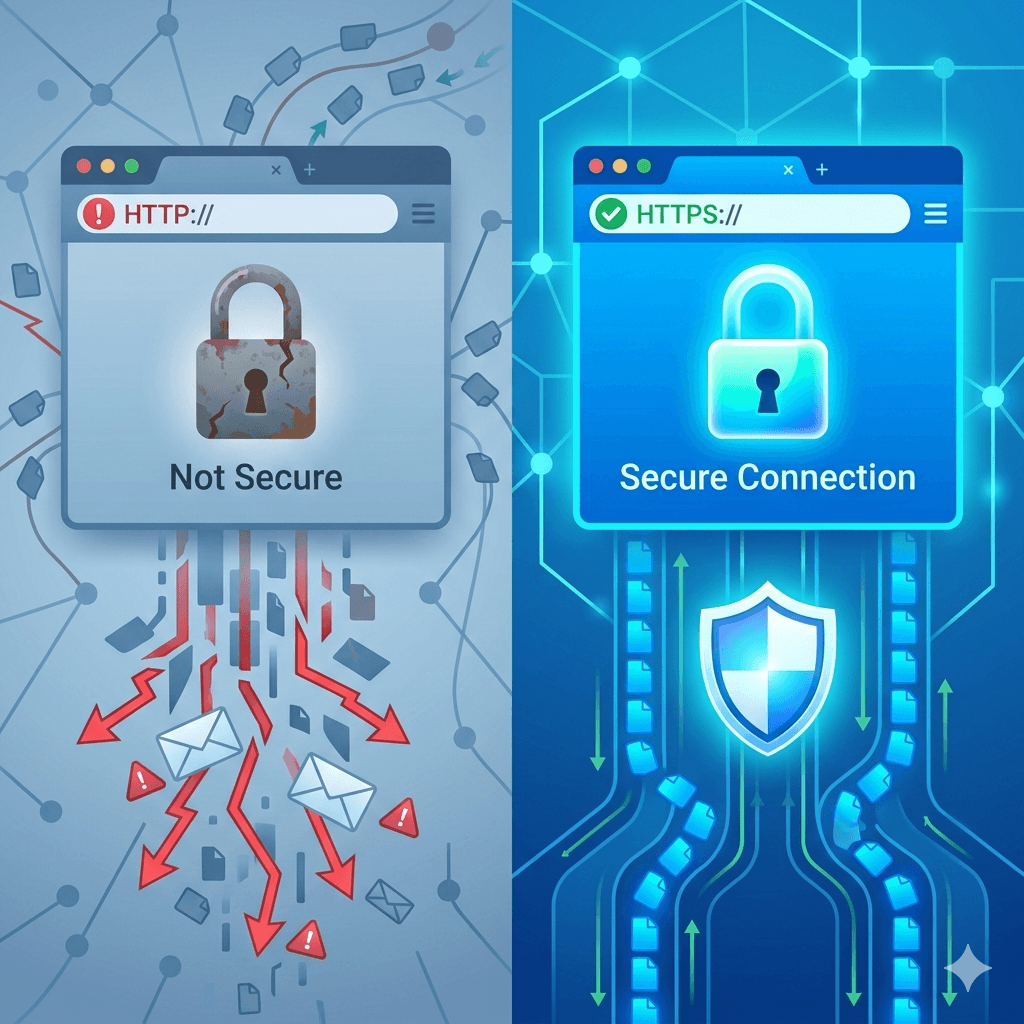
    Think of it this way: sending information over HTTP is like mailing a postcard. Anyone who handles it along the way can read what’s written on it. HTTPS, on the other hand, is like sealing that message in a tamper-proof envelope that only the intended recipient can open.

    Whether you run a blog, an online shop, or a corporate website, understanding the difference between HTTP and HTTPS   and the role of SSL certificates in making your site secure   is no longer optional. It is a basic requirement for anyone serious about their online presence.

    This guide will walk you through everything you need to know, in plain, simple language.

    What Is HTTP?

    HTTP stands for HyperText Transfer Protocol. It is the set of rules that govern how data is transferred between your browser and a web server. When you type a web address and press Enter, HTTP is the system that fetches the page and sends it back to your screen.

    HTTP has been around since the early days of the internet, and for a long time, it was the standard for all websites. It works well for delivering information quickly   but there is one big problem: it has no built-in security. All the data that moves between the browser and the server travels as plain text, meaning anyone with the right tools and access to the network could potentially read it.

    For basic informational websites with no user logins or payment forms, this used to be considered acceptable. Today, that standard has changed entirely   and websites that still rely on plain HTTP are flagged as “Not Secure” by most modern browsers.

    What Is HTTPS?

    A frustrated lawyer waiting in an empty office while competitors attract clients online

    HTTPS stands for HyperText Transfer Protocol Secure. The https meaning is simple: it is the secure version of HTTP. It does everything HTTP does, but with a critical addition   it encrypts the data being transferred between the browser and the server.

    This encryption is made possible by an SSL certificate (or its modern successor, TLS   Transport Layer Security). When a website has a valid SSL certificate installed, the connection becomes encrypted, and your browser displays a padlock icon in the address bar. That padlock is a signal to visitors that the site they are on is safe.

    A secure website with HTTPS protects sensitive information like passwords, credit card numbers, and personal data from being intercepted. If you are wondering what HTTPS means in practical terms   it means your users can trust you. Learn more about how to register a domain name in Uganda as a starting point for setting up a secure online presence.

    Key Differences Between HTTP and HTTPS

    Understanding the http vs https difference comes down to a few key areas:

    Security: HTTP transfers data in plain text. HTTPS encrypts it using SSL/TLS technology, making it unreadable to third parties.

    Trust Signals: HTTPS websites display a padlock icon in the browser address bar. HTTP sites show a “Not Secure” warning in browsers like Google Chrome.

    SEO Performance: Google treats HTTPS as a ranking factor. HTTP websites are at a disadvantage in search engine results.

    Data Integrity: With HTTP, data can be altered while in transit without either party knowing. HTTPS prevents this kind of tampering.

    User Confidence: When visitors see the padlock, they are more likely to stay on your site, fill in forms, and make purchases.

    In the https vs http security debate, HTTPS wins on every count. For any website that collects information, processes payments, or wants to rank on Google   HTTPS is not optional.

    What Is an SSL Certificate?

    An SSL certificate (Secure Sockets Layer) is a small digital file installed on a web server that activates HTTPS and encrypts the connection between the server and a visitor’s browser. The ssl certificate meaning is essentially this: it is a digital ID card for your website.

    When someone visits your site, the SSL certificate proves two things: that you are who you say you are, and that the connection is safe. It contains information about your domain, your organization (if applicable), and the certificate’s expiration date.

    The term SSL is still widely used, even though the technology has evolved and modern certificates actually use TLS (Transport Layer Security). But whether people call it an SSL certificate or a TLS certificate, the function is the same   to create a secure, encrypted link between a website and its visitors.

    Without an ssl certificate for website security, your site is vulnerable to attacks, and modern browsers will actively warn users away from it.

    How SSL Certificates Work

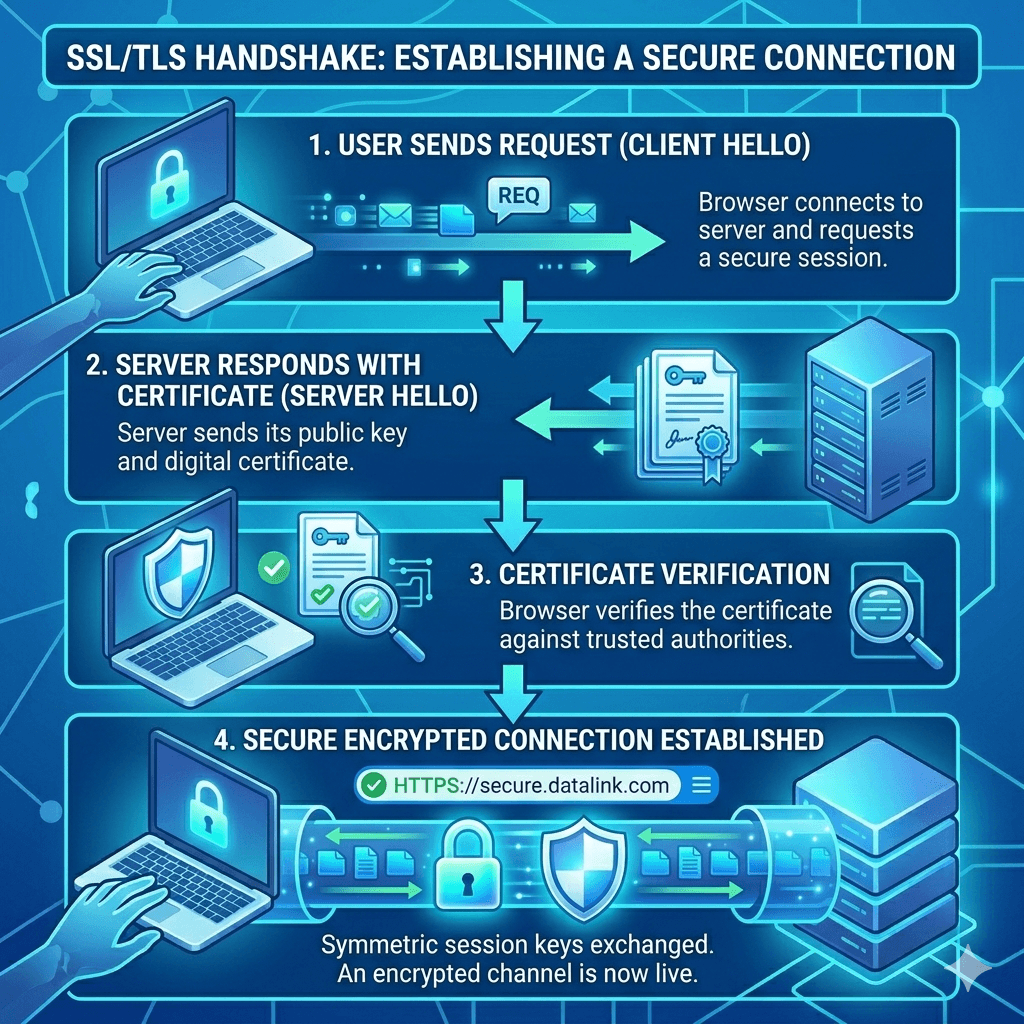
    A step-by-step visual flow showing a user sending a request, the server responding with a certificate

    SSL certificates use a process called a “handshake” to establish a secure connection. Here is a simple breakdown of how it all works:

    6.1 Data Encryption Process

    When a visitor lands on your HTTPS website, their browser and your server exchange a series of messages to agree on an encryption method. This happens in milliseconds and is invisible to the user. Once agreed, all data sent between the browser and server is scrambled into an unreadable format using a unique encryption key. Even if someone intercepts the data, they see nothing but gibberish.

    6.2 Authentication of Website Identity

    SSL certificates are issued by trusted organizations called Certificate Authorities (CAs). When your server presents the SSL certificate to a visitor’s browser, the browser checks whether the certificate was issued by a trusted CA, whether it matches your domain name, and whether it has expired. This authentication process confirms that the visitor is actually on your legitimate website and not a fake impersonation.

    6.3 Secure Data Transmission

    Once the handshake is complete, secure data transmission begins. All information   from login credentials to payment details to contact form submissions   travels between the browser and the server in encrypted form. This is the foundation of data encryption website security and why it matters for both your business and your users.

    Why HTTPS Matters for Uganda Websites

    Uganda’s digital economy is growing fast. More businesses are moving online, and Ugandan consumers are increasingly comfortable shopping, banking, and communicating via the internet. In that context, website security is not just a technical issue   it is a business issue.

    If you run an e-commerce site and want to accept mobile money payments on your Uganda website, HTTPS is non-negotiable. Payment processors, banks, and mobile money platforms require secure connections before they will integrate with your site.

    Beyond payments, Ugandan internet users are becoming more security-aware. They check the address bar. They notice the “Not Secure” warning. A website without HTTPS sends a signal that you have not invested in your visitors’ safety   and that can directly hurt your conversion rates.

    There is also the issue of cart abandonment. A lack of HTTPS is one of the leading reasons online shoppers abandon purchases. Addressing this is part of a broader strategy to reduce cart abandonment on your Ugandan online store.

    For https for Uganda websites to become the norm, every website owner needs to take this seriously   whether you run a small NGO website or a large corporate portal.

    Benefits of Using HTTPS

    Switching to HTTPS is one of the best investments you can make for your website. Here is why:

    8.1 Improved Website Security

    HTTPS protects your website from man-in-the-middle attacks, where hackers intercept communication between your visitor and your server. It also prevents data tampering   ensuring the content your visitor sees is exactly what you sent. These website security tips alone make HTTPS worth it.

    8.2 Better SEO Rankings

    Google confirmed that HTTPS is a google https ranking factor as far back as 2014, and its importance has only grown since. A secure website ranks better than an equivalent HTTP site, all else being equal. If you want to know how to get your Ugandan business on the first page of Google, switching to HTTPS is one of the first steps. In fact, if your Uganda business website is not showing on Google, the lack of HTTPS could be a contributing factor.

    8.3 Increased User Trust

    The padlock icon in the address bar builds immediate confidence. According to multiple studies, users are significantly more likely to complete a purchase or fill in a form on a secure site. This ties directly into how to design a website that builds trust with Ugandan customers   HTTPS is a foundational element of that trust.

    8.4 Protection of User Data

    Any time a visitor submits their name, phone number, email, or payment information on your website, that data needs protection. HTTPS encrypts all of it. This is especially critical for websites that serve clients in regulated industries like healthcare, finance, or education.

    Risks of Using HTTP

    An insecure website under attack, with hackers intercepting exposed data streams between a user and server

    Still running your website on plain HTTP? Here is what you are risking:

    • Browser warnings: Chrome, Firefox, and Safari all display a “Not Secure” warning for HTTP sites. Many visitors leave immediately when they see this.

    • Data interception: Without encryption, any data entered by users   passwords, emails, payment info   can be captured by attackers on the same network.

    • Lower search rankings: Google actively penalizes HTTP sites in rankings. This hurts your visibility and traffic.

    • Lost credibility: Businesses that fail to secure their websites lose the trust of modern users who know what to look for.

    • Legal and compliance risks: Collecting personal data over an unsecured connection can put you on the wrong side of data protection regulations.

    The risks of staying on HTTP far outweigh any perceived convenience or cost savings.

    How to Switch from HTTP to HTTPS

    Making the switch from HTTP to HTTPS is not as complicated as it sounds. Here is a step-by-step guide for how to migrate from http to https step by step:

    10.1 Choose the Right SSL Certificate

    Start by selecting the type of SSL certificate that fits your needs. A basic Domain Validation (DV) certificate is fine for most small websites and blogs. Larger businesses or e-commerce sites may want Organization Validation (OV) or Extended Validation (EV). More on the types below.

    10.2 Install the SSL Certificate

    Most of the best web hosting providers in Uganda offer one-click SSL installation through their control panel. If you are on cPanel, look for the “SSL/TLS” section. Many hosts also offer free SSL through Let’s Encrypt, which installs automatically.

    10.3 Update Website URLs

    Once SSL is installed, update all internal links, image paths, and embedded resources on your website from http:// to https://. In WordPress, you can do this through your site settings or with a plugin like Better Search Replace.

    10.4 Set Up Redirects (301 Redirects)

    Configure 301 redirects to automatically send visitors and search engines from your old HTTP URLs to the new HTTPS versions. This preserves your SEO rankings and ensures no one lands on an insecure page by mistake. You can do this through your .htaccess file or your hosting control panel.

    10.5 Test and Verify HTTPS

    After the switch, use tools like SSL Labs (ssllabs.com/ssltest) to verify that your certificate is installed correctly and your entire site loads over HTTPS. Check for any remaining HTTP resources that might trigger mixed content warnings.

    Types of SSL Certificates

    Three SSL certificate types displayed side by side with increasing levels of security

    Not all SSL certificates are the same. Choosing the right one depends on your website’s purpose and the level of trust you need to establish:

    11.1 Domain Validation (DV)

    Domain Validation SSL is the most basic and most common type. It verifies that you own the domain but does not check any organizational details. DV certificates are issued quickly   sometimes within minutes   and are ideal for blogs, small business websites, and personal portfolios. Most free SSL certificates are DV certificates.

    11.2 Organization Validation (OV)

    Organization Validation SSL requires the Certificate Authority to verify your organization’s identity, including its legal existence and location. This adds a layer of credibility and is suitable for businesses that want to reassure users they are dealing with a legitimate company. OV certificates typically take a few days to issue.

    11.3 Extended Validation (EV)

    Extended Validation SSL is the highest level of verification available. CA checks your legal, physical, and operational existence thoroughly before issuing the certificate. EV certificates are most commonly used by banks, large e-commerce platforms, and organizations that handle highly sensitive data. They provide the highest level of user trust.

    Common HTTPS Mistakes to Avoid

    Switching to HTTPS is great   but only if you do it properly. Here are the most common pitfalls:

    12.1 Mixed Content Issues

    This happens when your page loads over HTTPS, but some elements   like images, scripts, or videos   still load over HTTP. Browsers flag this as a security issue, and it can break your padlock icon. Always audit your pages after switching to ensure every resource loads securely.

    12.2 Expired Certificates

    SSL certificates have expiry dates, usually one year. An expired certificate causes browsers to display a scary security warning, driving visitors away instantly. Set calendar reminders or enable automatic renewal through your hosting provider.

    12.3 Incorrect Redirects

    Poorly configured redirects can create redirect loops, send users to the wrong pages, or result in duplicate content issues that hurt your SEO. Always test your redirects thoroughly after setup.

    12.4 Ignoring Security Warnings

    If your browser or security tools flag an issue with your SSL setup, do not ignore it. Investigate and fix it promptly. A broken or misconfigured HTTPS is sometimes worse than none at all, because it creates false confidence.

    Cost of SSL Certificates in Uganda

    One of the biggest barriers people cite for not switching to HTTPS is cost   but the truth is, SSL certificates are more affordable than most people think.

    Free SSL certificates: Let’s Encrypt offers free SSL certificates that are valid for 90 days and automatically renewable. Most reputable hosting providers offer these at no extra charge. This is the best free ssl certificate option for beginners and small websites.

    Paid SSL certificates: For businesses that need OV or EV certificates, ssl certificate cost in Uganda typically ranges from a few hundred thousand to a few million Uganda shillings per year, depending on the type and provider. Check website pricing in Uganda for guidance on what to budget.

    For most Ugandan websites, especially small businesses, NGOs, and bloggers   a free DV certificate is perfectly adequate.

    Best Practices for Maintaining HTTPS

    Getting HTTPS installed is the beginning, not the end. Here is how to keep it working properly:

    14.1 Regular Certificate Renewal

    Whether you use a free or paid certificate, make sure it renews before expiry. Most hosting providers offer automatic renewal to enable it. If you manage your own server, set up automated renewal using tools like Certbot.

    14.2 Use Strong Encryption

    Ensure your server is configured to use modern, strong TLS versions (TLS 1.2 or 1.3). Disable outdated protocols like SSL 3.0 and TLS 1.0, which have known vulnerabilities.

    14.3 Monitor Website Security

    Use security monitoring tools to check your website for vulnerabilities regularly. Google Search Console will also alert you if it detects security issues. Pair this with knowing how to back up your WordPress website   backups are your last line of defence if something goes wrong.

    14.4 Keep Software Updated

    Outdated plugins, themes, and CMS versions are a common entry point for attackers. Regular updates, combined with HTTPS, significantly reduce your website’s attack surface. Consider a professional service if you need help with this   our team offers dedicated

    website maintenance services to keep your site secure and running smoothly.

    Frequently Asked Questions

    15.1 Is HTTPS necessary for small websites in Uganda?

    Yes. Even if your website only has a contact form or collects email addresses, HTTPS protects that data. Beyond security, Google flags all HTTP sites as “Not Secure” regardless of size. It also affects your SEO rankings. There is no good reason to avoid HTTPS in 2024, especially when free options are widely available.

    15.2 Does HTTPS improve Google rankings?

    Yes. HTTPS is a confirmed ranking signal for Google. While it is not the most powerful factor, it does give HTTPS sites a measurable edge over equivalent HTTP sites. Combined with good content and local SEO, it contributes to better visibility. Read our guide on local SEO for Kampala businesses to understand how all the pieces fit together.

    15.3 Can I get a free SSL certificate?

    Absolutely. Let’s Encrypt provides free SSL certificates that are trusted by all major browsers. Many web hosting providers in Uganda include free SSL as part of their hosting packages. If yours does not, consider switching to a host that does   or install it manually using Certbot.

    15.4 What happens if my SSL certificate expires?

    When an SSL certificate expires, browsers display a full-page security warning that effectively blocks visitors from accessing your site. This can cause a sudden and severe drop in traffic and damage your credibility. Always ensure your certificate is renewed before it expires.

    15.5 How do I know if my website is secure?

    Look at your website’s address bar. If it shows a padlock icon and the URL starts with https://, your site is secure. You can also use free tools like SSL Labs (ssllabs.com/ssltest) to get a detailed report on your certificate’s configuration and security rating.

    15.6 Will HTTPS slow down my website?

    Not meaningfully. In the early days of SSL, there was a slight performance cost. Modern TLS and HTTP/2 technology have eliminated that concern. In fact, HTTP/2   which requires HTTPS   often makes websites load faster than they would over plain HTTP.

    15.7 Do I need technical skills to install SSL?

    Not necessarily. Most hosting providers in Uganda offer one-click SSL installation through their control panel. If you are on WordPress, installing SSL can be as simple as clicking a button and installing a redirect plugin. If you run into trouble, our team provides professional website development services to handle it for you.

    15.8 How long does it take to switch to HTTPS?

    For a simple website, the technical process can take anywhere from 30 minutes to a few hours. The bulk of the time goes into updating internal links, testing for mixed content, and setting up redirects. For larger, more complex websites, allow a full day and test thoroughly before going live.

    Ready to Secure Your Website?

    Switching from HTTP to HTTPS is one of the smartest moves you can make for your website   and it is more accessible than ever. Whether you are just starting out or looking to upgrade an existing site, the benefits are clear: better security, better rankings, and more trust from your visitors.

    If you need expert help setting up your website with HTTPS, or if you are starting from scratch, explore our web design services in Uganda or contact us for web design help today. You can also visit our blog for more guides on growing your online presence in Uganda.

    Your website is your digital front door. Make sure it is safe, secure, and ready to welcome visitors   with the lock firmly in place.

  • Best Web Hosting Providers for Ugandan Websites Compared

    Best Web Hosting Providers for Ugandan Websites Compared

    Introduction

    Building a website is one of the smartest moves you can make for your business or brand in Uganda today. But before anyone can find you online, you need a reliable home for your website   and that is exactly what web hosting provides. Think of it like renting space in a building. The quality of that space determines how smoothly your business runs.

    The challenge is that there are hundreds of web hosting providers out there. Some are fast. Some are cheap. Some are both   and some are neither. Picking the wrong one can slow your site, cost you more than expected, or leave you stranded when things break down.

    This guide breaks it all down for you. We will compare the best web hosting in Uganda options, explain what to look for, and help you find a plan that fits your needs and budget. Whether you are building your first website or improving an existing one, this article has you covered.

    1. What Is Web Hosting?

    Web hosting is a service that lets you store your website’s files   like pages, images, and videos   on a special computer called a server. When someone types your website address into their browser, the server delivers those files so the visitor can see your site.

    Without hosting, your website simply cannot exist online. It is the foundation everything else is built on. Even if you have a great domain name and beautiful design, no hosting means no website.

    There are many types of hosting services, and they vary in price, performance, and features. Some plans are designed for beginners with small websites, while others are built to handle thousands of visitors a day. Understanding the basics helps you make a smarter choice from the start.

    If you are working with a team to build your site professionally, pairing good hosting with professional website development services makes a huge difference.

    2. Why Web Hosting Matters for Ugandan Websites

    Vector scene of a website growing traffic, with charts, graphs

    Choosing the right web hosting is not just a technical decision   it is a business decision. In Uganda, where internet usage is growing fast and more people are shopping, reading, and doing business online, your website’s performance can directly affect how much money you make.

    A slow website frustrates visitors. Research shows that most users leave a site that takes more than three seconds to load. If your site loads slowly because of poor hosting, you are losing potential customers before they even see what you offer.

    Uganda web hosting services also affect your Google ranking. Search engines like Google factor in site speed and uptime when deciding which websites to show first. That means bad hosting can hurt your SEO, which is why hosting reliability connects directly to your SEO services strategy.

    Good hosting also means your site stays up and running even during traffic spikes. Whether you run a blog, an online store, or a service business, downtime means lost opportunities. Pair your hosting with solid web maintenance services to keep everything running smoothly.

    In short, your hosting choice shapes your entire online presence. It affects speed, reliability, security, and growth potential   all things that matter deeply in a competitive market like Uganda.

    3. Types of Web Hosting Explained

    Not all hosting plans are created equal. Here are the four main types you will come across, explained in simple terms.

    3.1 Shared Hosting

    Shared hosting is the most popular and affordable option, especially for beginners. Your website shares a server with hundreds of other websites. Think of it like living in an apartment building where you share resources like electricity and water with other tenants.

    It is cheap, easy to set up, and works well for small websites with moderate traffic. The downside? If another site on the same server gets a flood of visitors, it can slow yours down too. Still, for most beginners, shared hosting is the best starting point for website hosting for beginners.

    3.2 VPS Hosting

    VPS stands for Virtual Private Server. It gives you a dedicated portion of a server’s resources, even though you still technically share the physical machine with others. It is like having your own apartment instead of just a room.

    VPS hosting offers more power, flexibility, and control than shared hosting. It is a great middle-ground option for growing websites that need more performance but are not ready for a dedicated server.

    3.3 Dedicated Hosting

    With dedicated hosting, you rent an entire server for your website alone. This means maximum performance, full control, and no sharing. It is ideal for large businesses or high-traffic websites.

    The trade-off is cost. Dedicated hosting is significantly more expensive and usually requires some technical knowledge to manage properly.

    3.4 Cloud Hosting

    Cloud hosting uses a network of multiple servers to host your website. If one server has issues, another takes over instantly. This makes it extremely reliable and scalable.

    Cloud hosting Uganda options are growing in popularity because they offer great uptime and flexible pricing. You typically pay for what you use, making it a smart choice for growing businesses.

    4. Key Features to Look for in a Hosting Provider

    Illustration showing a server in a digital dashboard with clock

    Before you compare prices, you need to know what features actually matter. Here is what to look for when evaluating any hosting provider.

    4.1 Uptime and Reliability

    Uptime is the percentage of time your website is live and accessible. A good hosting provider should guarantee at least 99.9% uptime. That small 0.1% still translates to about 9 hours of downtime per year, anything worse than that is a problem.

    Always check if the host offers an uptime guarantee in their terms. Providers that back their promises with compensation or refunds take reliability seriously.

    4.2 Website Speed and Performance

    Speed is everything online. Look for hosts that use SSD (Solid State Drive) storage, because SSDs load websites much faster than traditional hard drives. Also check if they offer built-in caching, a Content Delivery Network (CDN), and server locations close to Africa for faster load times.

    Website speed optimization hosting should be a priority, especially if you want to rank well on Google and keep your visitors happy.

    4.3 Pricing and Renewal Costs

    Many hosts offer very low introductory prices but charge much more when you renew. Always check the renewal rates before signing up. Affordable web hosting Uganda options exist, but you need to read the fine print.

    Compare what each plan includes at the renewal price, not just the first-year discount.

    4.4 Customer Support Availability

    Good support can save you hours of frustration. Look for providers that offer 24/7 support via live chat, email, or phone. Hosting with good customer support means you are never stuck alone when something goes wrong.

    Test their response time before committing. Many providers offer pre-sales chat, which is a great way to see how responsive their team actually is.

    4.5 Ease of Use and Control Panel

    If you are not a developer, you need a hosting control panel that is easy to navigate. cPanel is the most popular and beginner-friendly option. Web hosting with cPanel Uganda options are widely available and let you manage your files, databases, and email accounts with ease.

    4.6 Security Features

    Your hosting provider should offer basic security features including a free SSL certificate (the padlock icon in your browser), regular backups, malware scanning, and a firewall. Secure web hosting services protect both your website and your visitors’ data.

    This is especially important for e-commerce sites where customers enter payment or personal information.

    5. Top Web Hosting Providers for Ugandan Websites Compared

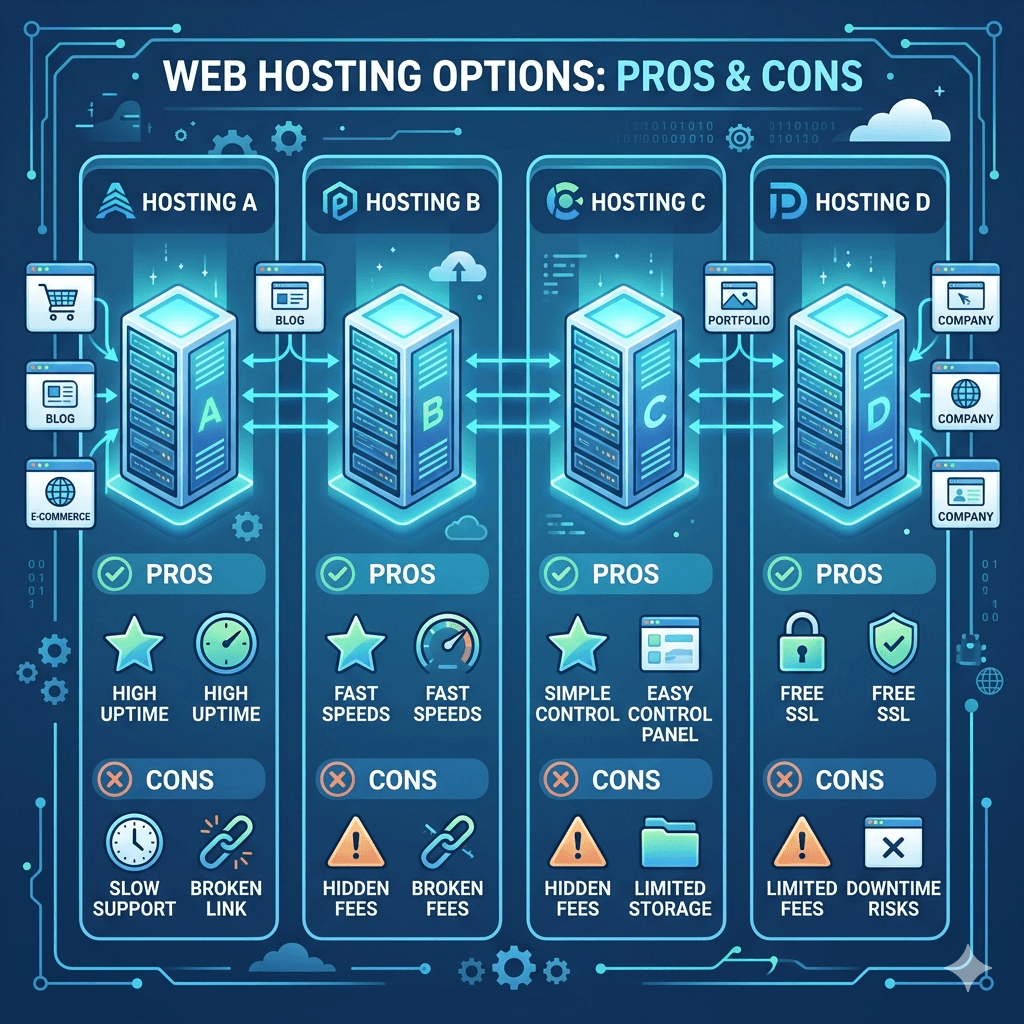
    Vector illustration showing multiple web hosting providers represented as glowing servers

    Here is a look at some of the most popular and reliable hosting providers used by Ugandan websites, along with what makes each one stand out.

    5.1 Overview of Each Provider

    Bluehost   One of the most recommended hosts worldwide, particularly for WordPress users. It offers beginner-friendly tools, a free domain for the first year, and solid performance.

    Hostinger   Known for some of the lowest prices available while still delivering good speed and uptime. It has strong servers across Europe that serve African users reasonably well.

    SiteGround   A premium option with excellent customer support, advanced caching, and strong security. It is more expensive but worth it for serious businesses.

    Namecheap   Offers affordable domain and hosting Uganda packages. Great for beginners who want a simple, no-fuss experience.

    Afrihost / African providers   Some regional providers are emerging with server infrastructure closer to East Africa, which can improve speed for local visitors.

    5.2 Pricing Comparison

    Pricing varies significantly across providers. Here is a rough guide to web hosting prices in Uganda (converted to USD as most plans are priced globally):

    • Hostinger: Starts from around $1.99–$2.99/month (introductory). Renewal is around $6–8/month.

    • Namecheap: Starts from around $2.88/month. Renewal rates are relatively stable.

    • Bluehost: Starts from $2.95/month introductory. Renewal rates can jump to $8–10/month.

    • SiteGround: Starts from $3.99/month introductory. Renewal is around $14–18/month.

    For cheap web hosting in Uganda on a tight budget, Hostinger and Namecheap offer the most value for money, especially for new websites.

    5.3 Performance and Speed Comparison

    When it comes to the fastest web hosting Africa options, server location matters a lot. Most global hosts have servers in Europe or the US, which adds some latency for Ugandan visitors. However, providers that offer CDN integration can significantly reduce this gap.

    SiteGround consistently ranks among the fastest in independent tests. Hostinger has improved its speeds dramatically in recent years and offers great performance relative to its price point. Bluehost is reliable but can feel slower on shared plans during peak hours.

    5.4 Pros and Cons of Each

    Bluehost:

    • Pros: Beginner-friendly, free domain, great WordPress integration, strong uptime

    • Cons: Renewal prices increase significantly, US-based servers

    Hostinger:

    • Pros: Very affordable, fast load times, easy to use, good beginner tools

    • Cons: Support can be slower on lower-tier plans, no phone support

    SiteGround:

    • Pros: Excellent customer support, fast servers, strong security, great for WordPress

    • Cons: Higher price point, storage limits on entry plans

    Namecheap:

    • Pros: Affordable, transparent pricing, good for domain and hosting bundles

    • Cons: Fewer advanced features on basic plans, support can vary

    6. Best Hosting for Different Needs

    Different websites have different hosting needs. Here is a quick guide to help match you with the right choice.

    6.1 Best for Beginners

    If you are just starting out and this is your first website, Hostinger or Bluehost are excellent choices. Both offer one-click WordPress installs, drag-and-drop tools, and easy-to-understand dashboards. They take care of the technical side so you can focus on building your site.

    Website hosting for beginners should feel simple from day one; these two deliver exactly that.

    6.2 Best for Small Businesses

    For the best web hosting for small business Uganda, you want a balance of reliability, speed, and support. SiteGround ticks all those boxes with its managed hosting and daily backups. If budget is a concern, Namecheap’s business plans are also solid.

    Small business websites need to stay online and load quickly. Combining your hosting with good web design services ensures everything works together seamlessly.

    6.3 Best for Bloggers and Content Creators

    The best hosting for bloggers in Uganda is one that supports WordPress well, loads fast, and does not break the bank. Hostinger and Bluehost are both excellent for this. Hostinger especially gives you strong value   you get speed, storage, and simplicity at a low monthly cost.

    For content-heavy sites, CDN integration is a bonus that helps your images and videos load quickly for readers across Uganda.

    6.4 Best for E-commerce Websites

    The best web hosting for ecommerce Uganda needs to be secure, fast, and always online. SiteGround is the top pick here, with its advanced security tools and excellent uptime. WooCommerce-optimized plans from Bluehost are also a strong option.

    E-commerce sites handle customer data and payments, so you cannot afford downtime or slow load speeds. Check out how others have built successful stores through ecommerce website design Uganda for inspiration and reference.

    7. How to Choose the Right Hosting Provider

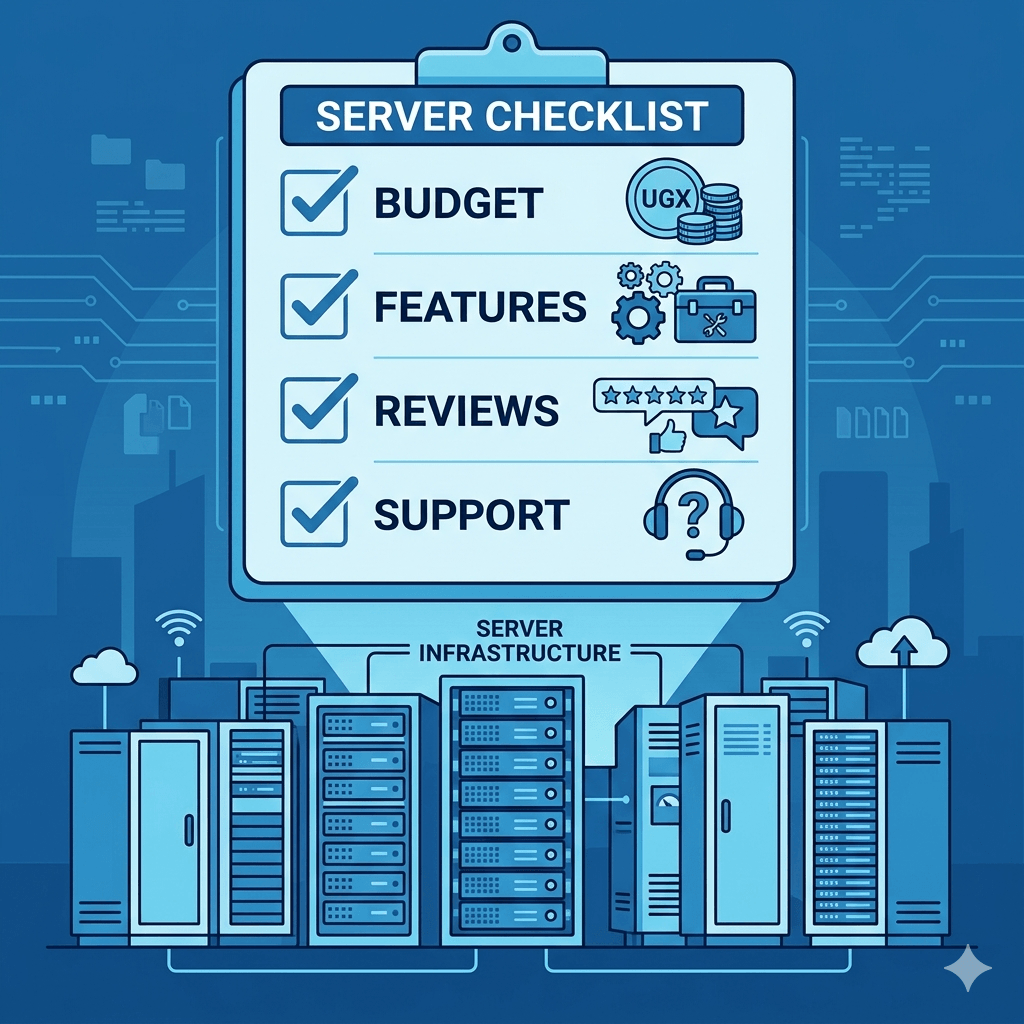
    Vector illustration showing a checklist floating above servers, including budget, features

    Choosing hosting can feel overwhelming, but breaking it down into clear steps makes it manageable. Here is a simple process to follow.

    7.1 Define Your Website Needs

    Start by asking yourself: What kind of website am I building? A personal blog has very different needs from an online shop. How many pages will you have? Do you expect a lot of traffic right away, or are you starting small?

    Knowing your needs upfront saves you from overpaying for features you will not use   or underpaying and regretting it later.

    7.2 Set Your Budget

    Be honest about what you can afford monthly and annually. Remember to factor in renewal costs, not just the first-year price. Affordable hosting for startups in Uganda is available, but make sure the price stays manageable as your site grows.

    You can always check a pricing page to see what services and hosting packages cost in your local context.

    7.3 Compare Features and Plans

    Do a side-by-side web hosting comparison Uganda style   look at storage, bandwidth, number of websites allowed, SSL certificates, and email accounts. Do not just look at the headline price. Dig into what each plan actually includes.

    7.4 Check Reviews and Reputation

    Read real user reviews on platforms like Trustpilot, G2, or Reddit. Look for patterns   if many people complain about the same issues, that is a red flag. Reliable hosting providers Uganda users trust tend to have consistently positive feedback over time.

    7.5 Test Customer Support

    Before you commit, chat with the support team. Ask a technical question and see how quickly and clearly they respond. This gives you a preview of what to expect when you actually need help.

    If you are unsure about what to ask, you can always reach out to local experts through a contact page for personalized hosting guidance.

    8. Common Mistakes to Avoid When Choosing Hosting

    Even smart people make these mistakes. Knowing them in advance puts you ahead of the game.

    8.1 Choosing Based on Price Alone

    Cheap web hosting in Uganda can be tempting, but the lowest price is not always the best deal. Some ultra-cheap hosts cut corners on server quality, support, and security. If your website goes down or loads slowly, you lose visitors and revenue   that costs more than a few extra dollars per month.

    8.2 Ignoring Renewal Costs

    This catches many people off guard. You sign up for hosting at $2/month, then after a year, the renewal bill arrives at $12/month. Always read the renewal pricing before you commit. Look at web hosting prices in Uganda across providers at the renewal rate, not just the promotional one.

    8.3 Overlooking Support Quality

    Poor support is one of the biggest complaints about hosting providers. If something breaks on your website and you cannot reach anyone for hours   or get a helpful response   it is a nightmare. Prioritize hosting with good customer support from day one.

    8.4 Not Considering Scalability

    Your website will grow over time. If your hosting plan cannot grow with you, you will have to go through the hassle of migrating to a new host later. Choose scalable web hosting solutions that let you easily upgrade when the time comes. It is much easier to start with a provider that has higher tiers available.

    9. Tips to Improve Website Performance with Hosting

    Even with great hosting, there are extra steps you can take to make your website faster and more reliable.

    9.1 Use a Content Delivery Network (CDN)

    A CDN stores copies of your website’s content on servers around the world. When someone in Kampala visits your site hosted on a US server, the CDN delivers the content from the closest possible location, cutting load times dramatically. Many hosts include free CDN access through Cloudflare.

    9.2 Optimize Images and Files

    Large image files are one of the biggest causes of slow websites. Before uploading images, compress them using free tools like TinyPNG or Squoosh. Also minimize your CSS and JavaScript files. This reduces how much data the browser needs to load, improving website speed optimization hosting performance.

    9.3 Enable Caching

    Caching stores a version of your web page so it does not have to be rebuilt every time someone visits. Most good hosts support caching plugins or have it built in. For WordPress sites, plugins like WP Rocket or LiteSpeed Cache are excellent options.

    9.4 Choose Server Locations Wisely

    The closer your server is to your visitors, the faster your site loads. While Uganda does not yet have major hosting data centers, choosing a server in Europe (especially the UK or Netherlands) is generally faster for East African users than one in the US. Server location Africa hosting options are emerging, but Europe-based servers remain the practical choice for now.

    Pairing smart hosting with professional web maintenance services ensures your site stays fast and secure over time.

    10. Frequently Asked Questions

    10.1 What is the best web hosting for beginners in Uganda?

    For beginners, Hostinger and Bluehost are the top recommendations. Both offer simple dashboards, one-click installs for WordPress, and helpful support. They are beginner-friendly hosting options that make getting started easy without needing any technical background.

    10.2 How much does web hosting cost in Uganda?

    Web hosting prices in Uganda generally range from about $2 to $15 per month depending on the provider and plan. Entry-level shared hosting starts as low as $1.99/month with some providers like Hostinger. More premium options like SiteGround start around $4/month. Always check the renewal rate, as promotional pricing often increases after the first term.

    10.3 Can I host a website locally in Uganda?

    Yes, it is technically possible to host a website on a local server in Uganda, but it comes with challenges   including power reliability, bandwidth costs, and maintenance. For most businesses, using an established international hosting provider is more practical, reliable, and affordable.

    10.4 Which hosting provider is fastest for African users?

    For the fastest web hosting Africa option, look for providers with CDN integration and servers in Europe (UK, Netherlands, or Germany). SiteGround and Cloudways consistently perform well for African users. Providers that support Cloudflare CDN help bridge the gap regardless of where the server is located.

    10.5 Do I need technical skills to use web hosting?

    Not at all. Most modern hosting providers offer beginner-friendly control panels like cPanel and one-click installers. You can set up WordPress and launch a website without writing a single line of code. If you need help, your provider’s support team or a local web design team can assist you.

    10.6 What is the difference between domain and hosting?

    A domain is your website’s address   like yourname.com. Hosting is the service that stores your website’s files. Think of the domain as your street address and hosting as the actual house. You need both to have a working website. Many providers offer domain and hosting Uganda packages together at a discount.

    10.7 Is free web hosting a good option?

    Free hosting might seem attractive, but it comes with serious limitations. Most free hosts display ads on your site, offer very little storage, and have poor uptime. They also often lack SSL certificates, which makes your site insecure. For anything professional, investing in affordable web hosting Uganda is worth every shilling.

    10.8 How do I migrate my website to a new host?

    Migrating a website involves moving your files and database from one host to another. Many premium hosts like SiteGround offer free migration services. If you are on WordPress, there are plugins that make migration straightforward. Alternatively, a professional web maintenance service can handle the entire process for you with zero downtime.

    Final Thoughts

    Choosing the right web hosting is one of the most important decisions you will make for your online presence. It affects how fast your site loads, how often it stays online, and how secure your visitors’ data is. The good news is that you do not need to be a tech expert to make a smart choice.

    Start by understanding your needs, set a realistic budget, compare providers on the features that matter most, and do not let a low introductory price fool you into ignoring renewal costs. Whether you go with Hostinger for affordability, SiteGround for performance, or Bluehost for beginner-friendliness, the right answer depends on your specific goals.

    And remember   great hosting is just the foundation. Pair it with a well-designed website and solid digital marketing to get the best results. If you need help putting it all together, explore our digital marketing services or reach out through our contact page to get started today.

  • How to Register a Domain Name in Uganda: Step-by-Step Guide 

    How to Register a Domain Name in Uganda: Step-by-Step Guide 

    1. Introduction

    Starting a business or building a personal brand in Uganda today means one thing is non-negotiable: you need an online presence. And every solid online presence starts with a domain name. Think of it as your home address on the internet. Without it, people simply cannot find you.

    Whether you’re launching a new business, a blog, a nonprofit, or a side hustle, registering a domain name in Uganda is one of the first steps you need to take. The good news is that the process is simpler than most people think   and you don’t need any technical background to get it done.

    In this guide, we’ll walk you through everything you need to know about domain registration in Uganda, from understanding what a domain name is, to choosing the right one, to completing the registration process step by step. If you’re ready to claim your space online, let’s get started.

    If you’re also wondering how to get your business online from scratch, check out this helpful guide on how to start an online business in Uganda.

    2. What Is a Domain Name?

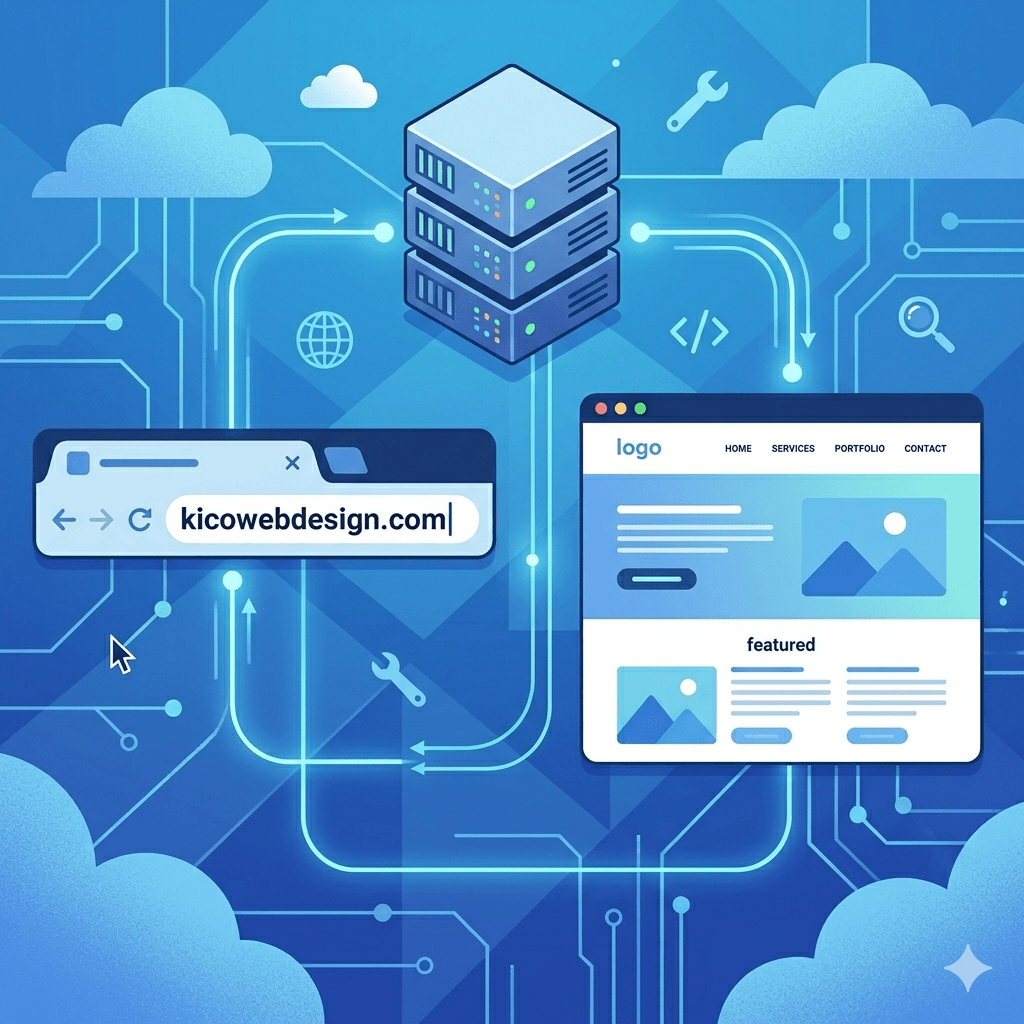
    A simplified browser address bar showing a domain name being typed

    A domain name is the unique web address people type into their browser to visit your website. For example, in the URL www.kicowebdesign.com, the domain name is kicowebdesign.com. It’s the digital identity of your business or brand online.

    You can think of a domain name like a phone number for your website. Just like people dial your number to reach you on the phone, they type your domain name to reach you on the internet. The only difference is that a domain name is easier to remember and much more professional.

    Every domain name has two key parts: the name itself (like “kicowebdesign”) and the extension (like “.com” or “.ug”). Together, they form a complete web address. Once you register a domain name, no one else can use that exact name for as long as you keep it active.

    3. Why You Need a Domain Name in Uganda

    Uganda’s digital economy is growing fast. More consumers are searching for products and services online every day. If your business doesn’t have a website with a proper domain name, you’re essentially invisible to a large part of your potential market.

    Here’s why registering a domain name matters for your business or personal brand:

    • Professionalism: A custom domain name like www.yourbusiness.com or www.yourbusiness.co.ug looks far more credible than a free subdomain from a website builder.

    • Brand identity: Your domain name is part of your brand. It tells people who you are and what you do at a glance.

    Better SEO: A good domain name that includes relevant keywords can help your website rank higher on Google.

    • Control: Owning your domain means no one can take it away from you or shut it down arbitrarily.

    • Customer trust: People are more likely to trust a business with its own domain name and professional email address.

    If you’re serious about growing your digital presence Uganda, securing a domain name is the logical first step.

    4. Types of Domain Extensions in Uganda

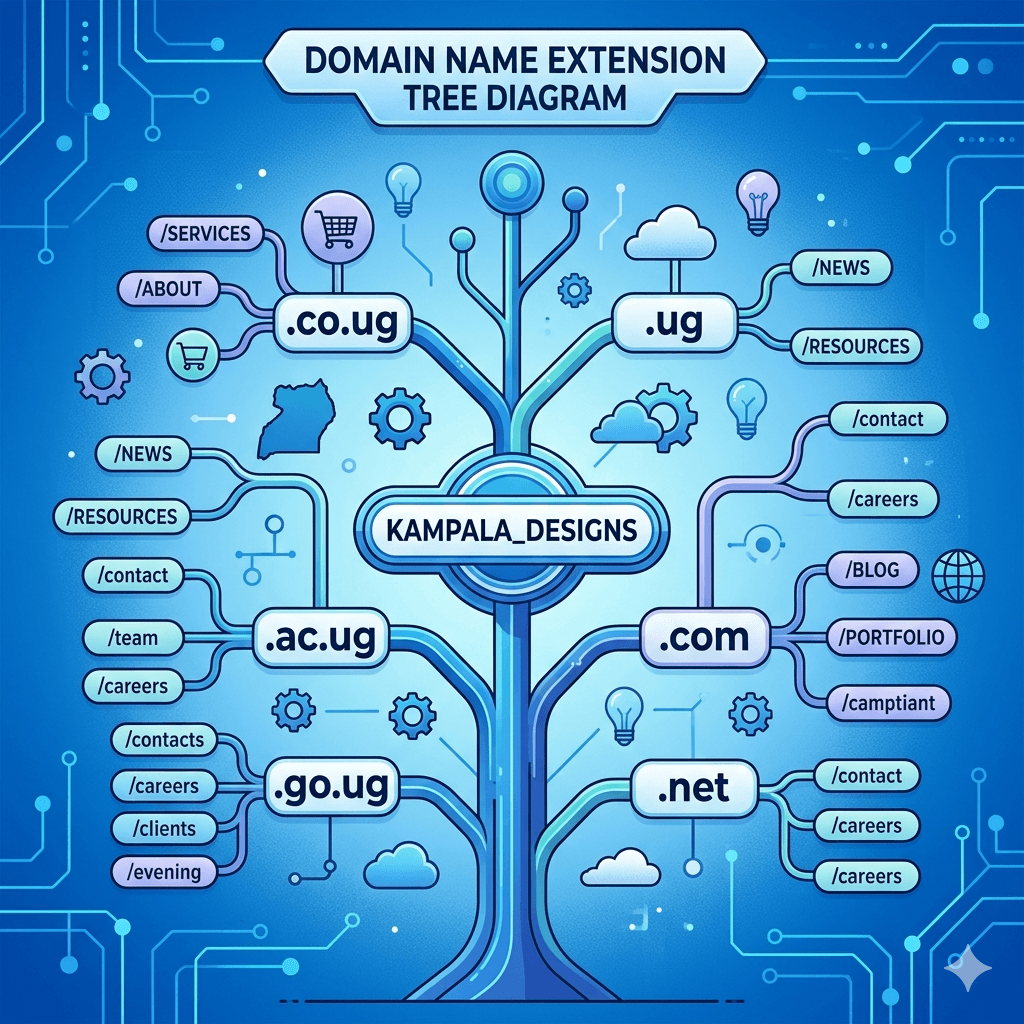
    A branching tree diagram growing from a central domain name

    When you buy a domain name in Uganda, you’ll come across several types of domain extensions. Each serves a slightly different purpose, and choosing the right one matters for your brand and SEO strategy.

    4.1 Country Code Domains (.ug)

    The .ug domain is Uganda’s official country code top-level domain (ccTLD). It signals to visitors and search engines that your website is specifically associated with Uganda. If your target audience is primarily in Uganda, a .ug domain extension is a strong choice. It also tends to rank well in local search results.

    4.2 Second-Level Domains (.co.ug, .ac.ug, .go.ug, etc.)

    Under the .ug umbrella, there are several second-level domain extensions that are used for different purposes:

    • .co.ug   Designed for commercial businesses operating in Uganda. This is the most popular choice for local companies.

    • .ac.ug   Reserved for academic institutions like universities and colleges.

    • .go.ug   Used exclusively by government entities.

    • .or.ug   Intended for organizations and NGOs.

    • .sc.ug   For schools and educational institutions at the secondary level.

    Understanding the difference between .ug and .co.ug will help you pick the one that best fits your purpose.

    4.3 International Domains (.com, .org, .net)

    These are global domain extensions not tied to any country. A .com domain is the most widely recognized and trusted worldwide. If your audience extends beyond Uganda or you have international ambitions, a .com domain makes sense. The .org extension is commonly used by nonprofits and NGOs, while .net is often associated with tech and network-focused companies.

    5. Benefits of Registering a .ug Domain

    Choosing a .ug domain registration comes with some real advantages, especially if your business operates primarily within Uganda.

    • Local SEO advantage: Google uses the domain extension as one of the signals to determine which region a website is most relevant to. A .ug domain helps your website appear in Ugandan search results.

    • Brand relevance: It immediately tells your audience that you are a Uganda-based business, which builds trust with local customers.

    • Availability: Because .ug domains are newer and less saturated than .com domains, you’re more likely to find your preferred name still available.

    • Credibility: A .ug domain can make your brand appear more established and locally committed.

    • Supports the local internet ecosystem: Registering a .ug domain contributes to the growth of Uganda’s digital infrastructure.

    If you’re building a business that serves Ugandan customers primarily, a .ug domain is definitely worth considering.

    6. Requirements for Registering a Domain in Uganda

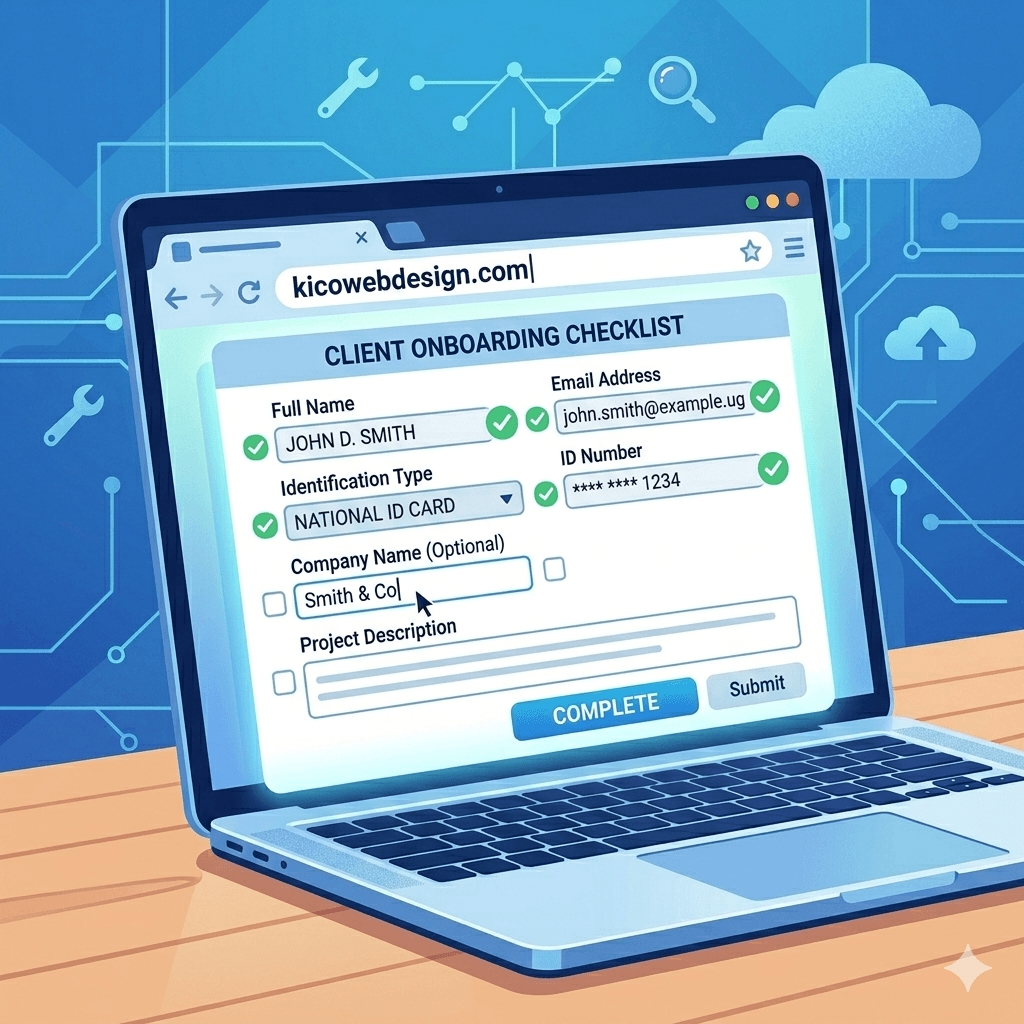
    A checklist interface being completed on a laptop with fields like name, email, and identification

    Before you proceed to register a domain name in Uganda, it’s important to know what you need. The requirements vary slightly depending on whether you’re registering as an individual or a business.

    6.1 Personal vs Business Registration

    Individuals can register domain names just as easily as businesses can. You don’t need to be a registered company to own a domain. However, if you’re registering a business domain, having your business registration documents ready is good practice, especially for extensions like .co.ug which are meant for commercial entities.

    6.2 Required Information and Documents

    For most domain registrations, you’ll need:

    • Your full name or business name

    • A valid email address

    • A phone number

    • A physical address (for billing and contact purposes)

    • Payment method (mobile money, credit/debit card, or bank transfer depending on the registrar)

    For second-level domains, some registrars may require additional verification. It’s always a good idea to check with your chosen registrar for their specific requirements before starting the process.

    7. How to Choose the Right Domain Name

    Choosing the right domain name is almost like naming your business. Get it right, and it becomes one of your most powerful branding assets. Get it wrong, and it can create confusion and cost you visitors. Here are some practical tips for choosing a domain name for business.

    7.1 Keep It Short and Simple

    A domain name that’s easy to type and remember is worth its weight in gold. Aim for something between 6 and 15 characters if possible. Shorter names are less prone to typos and easier to share verbally. Would you prefer to direct someone to “yourbrand.com” or “youramazingbrand2024.co.ug”? Exactly.

    7.2 Use Keywords for SEO

    Including a relevant keyword in your domain name can give your website a small SEO boost. For example, if you run a bakery in Kampala, something like “kampalachoicebakery.com” signals to both users and search engines what your site is about. For more on this, read our guide on

    7.3 Avoid Numbers and Hyphens

    Numbers and hyphens create confusion. If you tell someone your website is “best-deals-4-you.com”, they may not be sure whether to type the number 4 or the word “for”, or whether to include hyphens. Keep it clean and straightforward.

    7.4 Make It Brandable and Memorable

    The best domain names are unique, catchy, and aligned with your brand personality. Think about big names like Google, Amazon, or Jumia. None of these are dictionary words, yet they’re unforgettable. Try to create something distinct that sticks in people’s minds long after they’ve visited your site once.

    8. How to Register a Domain Name in Uganda (Step-by-Step)

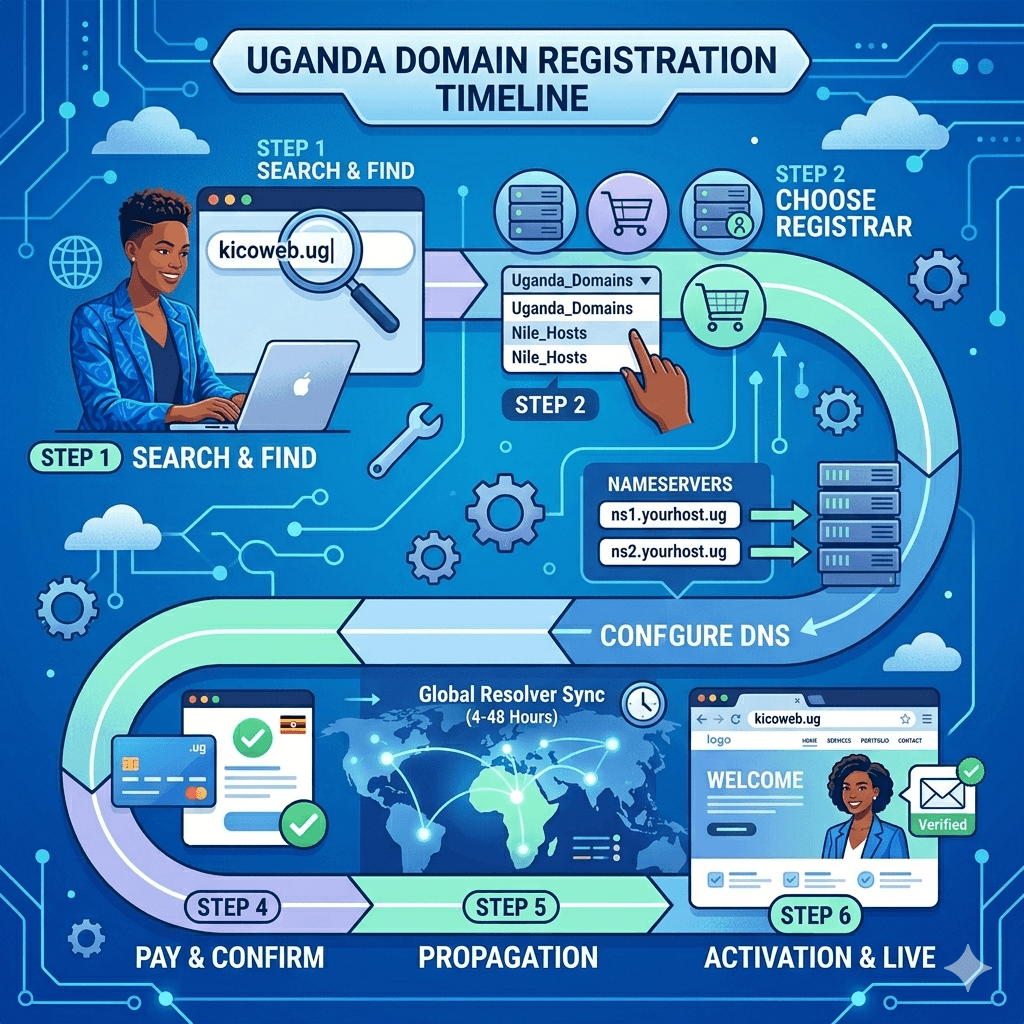
    A clean step-by-step timeline showing the full domain registration process from search to activation

    Here’s the part you’ve been waiting for   the actual domain name registration process. Follow these steps and you’ll have your domain secured within minutes.

    8.1 Choose a Domain Registrar

    A domain registrar is a company authorized to sell domain names. When looking for the best domain registrar Uganda has to offer, consider factors like pricing, customer support, ease of use, and renewal costs. Some popular registrars you can use in Uganda include:

    • REGISTRY.CO.UG   the official registrar for .ug domains

    • Namecheap   great for international domains like .com

    • GoDaddy   globally known with competitive pricing

    • Afriregister   focuses on African domain extensions

    For .ug domains specifically, registering through REGISTRY.CO.UG or an accredited local registrar is the most reliable route.

    8.2 Search for Domain Availability

    Once you’ve chosen a registrar, use their domain search tool to check if your desired name is available. This is how you check domain availability. Simply type in your preferred name and the tool will tell you instantly whether it’s taken or free. If your first choice is unavailable, the registrar will usually suggest alternatives.

    8.3 Select Your Domain Extension

    Decide whether you want a .ug, .co.ug, .com, or another extension. As discussed earlier, your choice should depend on your target audience and the nature of your website.

    8.4 Add to Cart and Proceed to Checkout

    Once you’ve found an available domain, add it to your cart. At this stage, you may also be offered optional add-ons like web hosting, SSL certificates, or privacy protection. We’ll talk more about what to do after registration shortly.

    8.5 Provide Registration Details

    Fill in your personal or business information accurately. This information goes into a database called WHOIS, which records who owns every registered domain. Make sure your email address is correct; you’ll need it to verify ownership.

    8.6 Make Payment

    Choose your preferred payment method. Many registrars in Uganda accept mobile money (MTN MoMo or Airtel Money), Visa or Mastercard, and sometimes bank transfers. Cheap domain names Uganda can start as low as UGX 60,000 per year for a .co.ug domain.

    8.7 Verify Ownership and Activate

    After payment, check your email for a verification link. Click it to confirm your email address and activate your domain. Once confirmed, your domain is live and officially yours. The whole process typically takes less than 30 minutes.

    9. Cost of Registering a Domain in Uganda

    The domain name cost in Uganda varies depending on the extension and registrar you choose. Here’s a rough estimate to guide your budget:

    • .co.ug domain: Approximately UGX 60,000 – 120,000 per year

    • .ug domain: Approximately UGX 100,000 – 200,000 per year

    • .com domain: Approximately UGX 45,000 – 90,000 per year (around USD 10–20)

    • .org or .net domain: Similar range to .com

    Keep in mind that some registrars offer discounted first-year pricing, then charge the full renewal rate from year two. Always check the renewal price before committing. If you want to understand the cost of building a full website, visit our

    10. Common Mistakes to Avoid When Registering a Domain

    Many first-time domain owners make avoidable mistakes that cause headaches later. Here’s what to watch out for:

    10.1 Choosing Complicated Names

    A domain name with unusual spelling, multiple hyphens, or a string of random words is hard to type and even harder to remember. Stick to something clean and intuitive. If you have to explain how to spell your domain name every time you share it verbally, it’s probably too complicated.

    10.2 Ignoring Renewal Dates

    Your domain is only yours for as long as you keep renewing it. Missing your renewal deadline can result in losing your domain   sometimes permanently. Set a reminder at least 30 days before your renewal date, or enable auto-renewal with your registrar.

    10.3 Not Checking Availability on Social Media

    Before finalizing your domain name, check if the same username is available on major social media platforms like Facebook, Instagram, and X (Twitter). Brand consistency across platforms matters for building a recognizable online identity.

    10.4 Registering the Wrong Extension

    Choosing the wrong domain extension can confuse your audience. If you’re a government agency registering a .co.ug instead of a .go.ug domain, or a school using .com instead of .sc.ug, it sends mixed signals. Pick the extension that best represents what your organization does.

    11. What to Do After Registering Your Domain

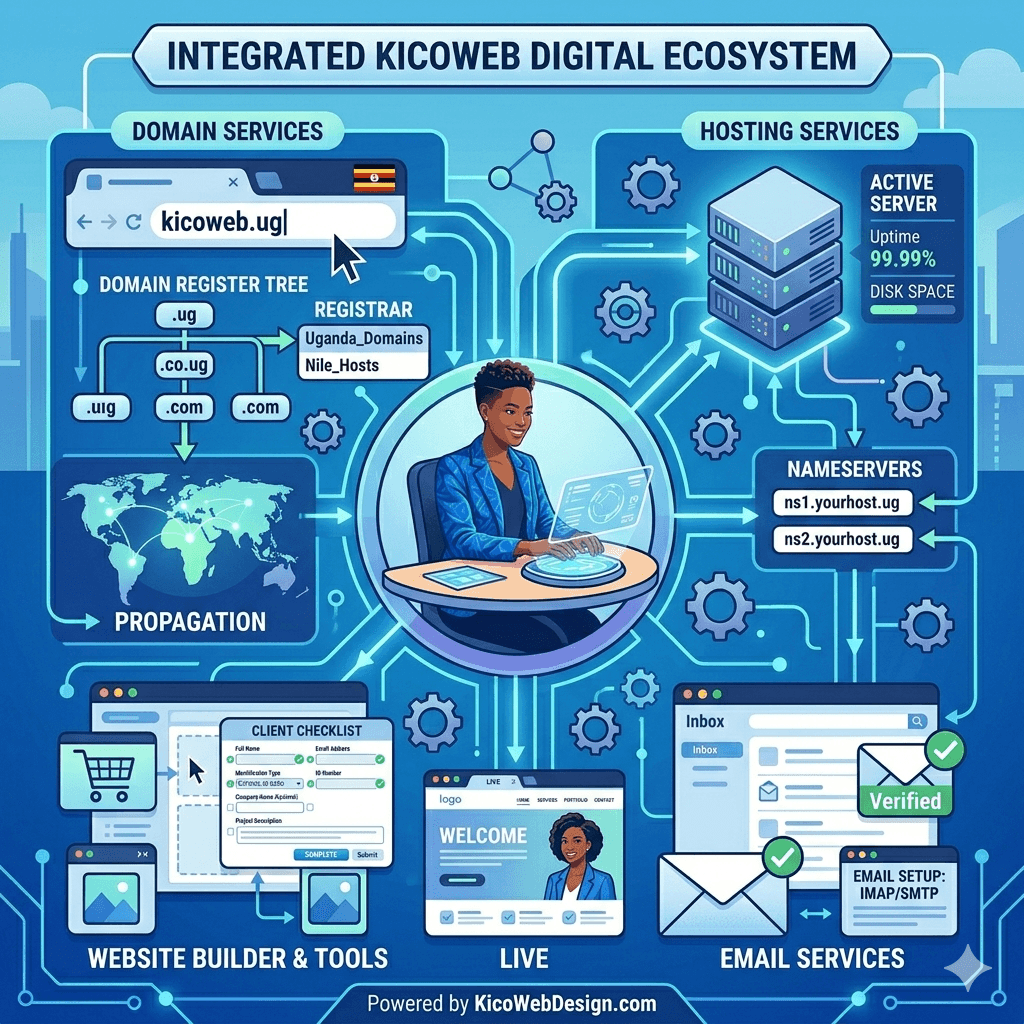
    A connected ecosystem showing domain, hosting, email, and website tools working together

    Congratulations! You’ve secured your domain name. But your work isn’t quite done yet. Here’s what to do next to make the most of your new domain.

    11.1 Connect to Web Hosting

    Your domain name is just an address   you still need hosting to store your website’s files. Web hosting is like the actual building that sits at your address. Read our guide on

    11.2 Create a Professional Email Address

    One of the best things about having your own domain is the ability to create a professional email address like info@yourbusiness.co.ug. This looks far more credible than a generic Gmail or Yahoo address and strengthens your brand every time you send an email.

    11.3 Build Your Website

    With your domain and hosting in place, it’s time to build your website. If you need expert help, our

    11.4 Secure Your Domain

    Enable domain privacy protection if your registrar offers it. This hides your personal contact details from the public WHOIS database, reducing spam and protecting your privacy. Also make sure your domain registrar account is protected with a strong password and two-factor authentication.

    12. Tips for Managing and Renewing Your Domain

    Once your domain is live, here are a few tips to keep it in good shape:

    • Enable auto-renewal so you never accidentally let your domain expire.

    • Keep your contact details up to date with your registrar, especially your email address.

    • Log in to your registrar account at least once every few months to check for any alerts or notifications.

    • Consider registering your domain for multiple years upfront   many registrars offer discounts for multi-year registrations.

    • Lock your domain against unauthorized transfers through your registrar’s control panel.

    • If you have a popular brand name, consider registering multiple extensions (.com, .ug, .co.ug) to protect your brand from competitors or domain squatters.

    Managing your domain doesn’t have to be complicated. With auto-renewal on and your details current, your domain will keep running smoothly in the background while you focus on growing your business.

    13. Frequently Asked Questions

    13.1 How long does it take to register a domain in Uganda?

    The process is usually very fast. Once you complete payment and verify your email, your domain can be active within minutes to a few hours. In some cases, especially for .ug domains with additional verification steps, it can take up to 24–48 hours.

    13.2 Can I register a domain without a business?

    Yes, absolutely. You don’t need to own a registered business to buy a domain name in Uganda. Individuals can register domain names for personal websites, blogs, portfolios, and more. The only exception is for specific second-level domains like .go.ug (reserved for government) or .ac.ug (reserved for academic institutions).

    13.3 What is the difference between .ug and .co.ug?

    A .ug domain is the country-level extension for Uganda and is very broad in its use. A .co.ug domain is a second-level domain specifically designed for commercial businesses. Both signal that you are Uganda-based, but .co.ug is more appropriate for business websites, while .ug can be used for a wider range of purposes.

    13.4 How much does a .ug domain cost?

    A .ug domain typically costs between UGX 100,000 and UGX 200,000 per year, while a .co.ug domain can start from around UGX 60,000 per year. Prices vary between registrars, so it pays to shop around for cheap domain names Uganda has to offer.

    13.5 Can I transfer my domain to another registrar?

    Yes. If you’re unhappy with your current registrar or find a better deal elsewhere, you can transfer your domain. Most registrars require that the domain has been registered for at least 60 days before a transfer is allowed. You’ll need an authorization code (also called an EPP code) from your current registrar to initiate the transfer.

    13.6 What happens if my domain expires?

    If you miss your renewal date, your domain will enter a grace period (usually 30–90 days) during which you can still renew it   often at a higher fee. After the grace period, it may be released back to the public or placed in an auction. In the worst case, someone else could register it and your website address becomes lost to you permanently.

    13.7 Can I own multiple domain names?

    Yes, there’s no limit to how many domain names you can own. Many businesses register multiple versions of their name, different extensions, common misspellings, and related keywords   to protect their brand and redirect all traffic to their main website.

    13.8 Do I need technical skills to register a domain?

    Not at all. Registering a domain name is a straightforward process that anyone can complete online, even without any technical knowledge. The step-by-step guide above covers everything you need. If you still feel unsure, you can always

    Ready to Build Your Online Presence?

    Registering your domain name is just the first step. The real journey begins when you pair it with great web design and solid SEO. At Kico Web Design, we help Ugandan businesses build professional websites that don’t just look good   they rank on Google and convert visitors into customers. See examples of websites we’ve built or explore our SEO services in Uganda to take your digital presence to the next level. Have questions? We’re always happy to help.

  • Why Law Firms in Uganda Need a Professional Website in 2026

    Why Law Firms in Uganda Need a Professional Website in 2026

    Why Law Firms in Uganda Need a Professional Website in 2026

    1. Introduction

    Imagine a potential client in Kampala searching for a lawyer to handle a land dispute. They pull out their phone, type a quick search, and start scrolling. If your law firm doesn’t show up, you’ve already lost that client   and you didn’t even know they were looking.

    That’s the reality of doing business in Uganda today. The internet has changed how people find services, including legal help. A professional law firm website is no longer a luxury for big firms with deep pockets. It’s a basic business tool that every legal practice needs, whether you’re a solo advocate or managing a growing firm.

    This article breaks down exactly why your law firm needs a professional website in 2026, what it should include, and how it can bring in more clients without you having to make a single cold call.

    2. What Is a Professional Law Firm Website?

    A clean, structured website interface displayed on a laptop showing sections like services, contact, testimonials

    A professional law firm website is more than just a page on the internet with your firm’s name and phone number. Think of it as your firm’s digital office   one that’s open 24 hours a day, seven days a week, ready to answer questions, showcase your expertise, and connect with clients.

    A well-built legal website clearly explains what areas of law your firm handles, who your lawyers are, and how clients can reach you. It looks polished, loads quickly, and works just as well on a mobile phone as it does on a desktop computer.

    More importantly, a professional website builds trust before a client ever walks through your door. It tells visitors, “We take our work seriously, and we’ll take your case seriously too.” That first impression can be the deciding factor between a client calling you or calling your competitor.

    3. The Digital Landscape in Uganda in 2026

    Uganda’s internet penetration has been growing steadily over the last decade. With mobile internet access spreading across cities and rural areas alike, millions of Ugandans now rely on their smartphones to search for products, services, and professional help. According to recent data, Uganda has over 22 million internet users, and that number keeps climbing.

    In Kampala and other urban centres, online searches have become the first stop for people looking for legal help. Whether someone needs help with a property transaction, a business contract, or a family matter, the first thing many of them do is search online.

    At the same time, social media platforms like WhatsApp, Facebook, and X (formerly Twitter) are widely used. But social media alone isn’t enough. Profiles on these platforms don’t carry the same professional weight as a dedicated, well-designed website. If your firm doesn’t have one, you might be invisible to a large and growing segment of potential clients. Understanding why your website is not showing on Googleis the first step toward fixing that gap.

    The legal market in Uganda is also becoming more competitive. Firms that embrace digital tools now will have a significant head start.

    4. Why Law Firms in Uganda Need a Professional Website

    A lawyer gaining clients through online channels with arrows pointing from search engines to their website and then to consultations

    Uganda’s legal market is becoming more competitive every year. New law firms are opening, and clients are becoming more selective about who they hire. In this environment, your reputation and visibility matter more than ever.

    Here’s the honest truth: most people looking for a lawyer will search online before making a call. If they can’t find you or if what they find looks outdated or unprofessional, they’ll move on to someone else. A law firm without a website in 2026 is like an office with no signboard   people walk right past without knowing you’re there.

    A professional website for lawyers does several things at once. It introduces your firm to new clients, explains your services clearly, and gives people a reason to trust you before they’ve even met you. It also makes it easy for satisfied clients to refer others to you, since they can simply share a link instead of trying to remember your phone number.

    Beyond visibility, a website supports your entire marketing strategy. From search engine optimization to content marketing, your website is the foundation of your law firm online presence. Without it, every other digital effort you make is much harder to sustain.

    5. Key Benefits of Having a Professional Website

    5.1 Increased Visibility on Search Engines

    When someone searches for advocate or lawyer services in Kampala, Google decides which firms to show based on how well their websites are built. A professionally designed website, optimized with the right keywords and structure, gives your firm a real chance to appear in those results. Without a website, you’re simply not in the game. Learning how to get your business on the first page of Google can make a dramatic difference for your firm.

    5.2 Builds Trust and Credibility

    People hire lawyers they trust. A clean, professional website signals that your firm is legitimate, established, and serious. It gives visitors a place to read about your team, learn about your track record, and understand your approach to legal work. Knowing how to design a website that builds trust is especially important for law firms, where clients are often dealing with sensitive and high-stakes matters.

    5.3 Attracts More Qualified Clients

    A well-structured legal website doesn’t just bring in more visitors, it brings in the right ones. When your service pages clearly explain what you do and who you help, people who need exactly what you offer are more likely to reach out. This means fewer wasted consultations and more cases that are a genuine fit for your practice.

    5.4 24/7 Accessibility for Clients

    Your office closes at 5 PM. Your website never does. A potential client going through a stressful situation at 11 PM on a Friday can still visit your site, learn about your services, read client testimonials, and fill out a contact form. By morning, you have a warm lead waiting in your inbox, no effort required on your part.

    5.5 Competitive Advantage in the Legal Market

    Many law firms in Uganda still haven’t built a proper online presence. That’s actually good news for you. Every day you have a professional website and your competitors don’t, you’re ahead. And as more firms eventually catch up, the quality of your website will become the differentiator. Getting started now puts you in a strong position for years to come.

    6. Common Mistakes Law Firms Make Without a Website

    A frustrated lawyer waiting in an empty office while competitors attract clients online

    6.1 Relying Only on Referrals

    Referrals are valuable, but they have limits. If your entire client pipeline depends on word of mouth, you’re vulnerable. What happens during a slow period? What if a key referral source moves away or retires? A website creates a second, always-on channel for new client acquisition that works even when your network goes quiet.

    6.2 Using Outdated or Free Platforms

    Some firms try to solve the website problem by using free website builders or directory listings. While these can help a little, they don’t give you the control, the credibility, or the search engine performance of a proper, custom-designed site. Clients can tell the difference, and Google’s algorithms can too.

    6.3 Poor Online Branding

    A law firm’s brand is built on trust and professionalism. If your online presence is scattered   a Facebook page here, a WhatsApp number there   it sends mixed signals. A unified website gives your firm a consistent, professional face that reinforces your brand every time someone finds you online.

    6.4 Lack of Contact Information

    This one seems obvious, but it’s surprisingly common. Law firms without a website are often hard to reach online. Even when someone hears about your firm and wants to get in touch, they may struggle to find a current address, phone number, or email. A website solves this instantly and makes it easy for any interested client to take the next step.

    7. Essential Features of a High-Performing Law Firm Website

    7.1 Clear Service Pages

    Each area of law your firm handles should have its own dedicated page. Whether it’s conveyancing, family law, commercial litigation, or employment matters   spell it out clearly. Don’t make visitors guess what you do. Use plain, everyday language so that non-lawyers can understand what help you offer and whether it fits their situation.

    7.2 Mobile-Friendly Design

    More than half of web traffic in Uganda comes from mobile phones. If your website doesn’t work well on a small screen   if text is tiny, buttons are hard to tap, or pages load slowly   you’ll lose visitors before they even see what your firm has to offer. A mobile-responsive design is non-negotiable in 2026.

    7.3 Fast Loading Speed

    Website speed isn’t just a technical issue   it’s a user experience issue. Research consistently shows that visitors abandon pages that take more than three seconds to load. For law firms competing for attention online, a slow website is like a slow receptionist: it creates a bad impression before the relationship even starts.

    7.4 Easy Navigation

    Visitors should be able to find what they’re looking for in two or three clicks. A clear menu, logical structure, and well-organized content keep people on your site longer and make them more likely to get in touch. Think of your navigation like a well-organized filing system   everything in its place, easy to find.

    7.5 Contact Forms and Calls-to-Action

    Every page on your website should make it easy for visitors to take the next step. That means visible phone numbers, clickable email addresses, and simple contact forms. A strong call-to-action   something like Book a Free Consultation or Get Legal Advice Today   removes any friction between a visitor’s interest and their decision to reach out.

    7.6 Client Testimonials and Case Results

    Testimonials from satisfied clients are among the most powerful trust-building tools on a law firm website. When a potential client reads that someone in a similar situation was helped by your firm and walked away happy, it reduces their hesitation significantly. Where possible and appropriate within professional guidelines, share case outcomes that demonstrate your firm’s track record.

    8. How a Website Helps Generate More Clients

    A funnel illustration showing visitors entering a website and converting into paying clients

    8.1 Search Engine Optimization (SEO)

    SEO is the process of making your website easier for search engines to find and rank. When done right, it means that someone searching for “land dispute lawyer Kampala” is more likely to find your firm on the first page of results. Investing in SEO services for law firms is one of the most cost-effective long-term strategies for growing your client base.

    8.2 Local Search Visibility (Google Maps)

    Setting up a Google Business Profile and linking it to your website helps your firm appear in local map results. When someone nearby searches for legal help, your firm can show up with your address, phone number, and star rating right there on the map. This is especially powerful for attracting clients in your immediate area. A solid foundation in local SEO for Kampala businesses will help you dominate these local search results.

    8.3 Content Marketing (Blogs and Articles)

    Publishing helpful articles on legal topics is a smart way to attract visitors who are already looking for information related to your services. When someone reads your article on “how to handle a tenancy dispute in Uganda” and finds it useful, they’re far more likely to contact your firm when they need legal help. It builds authority and trust at the same time.

    8.4 Lead Capture Strategies

    Your website can do the work of a receptionist by capturing visitor information even before they call. A well-placed form offering a free case review, a downloadable legal guide, or a newsletter signup can turn an anonymous browser into an identifiable lead. With the right follow-up system in place, these leads can become paying clients.

    9. How to Create a Professional Law Firm Website

    9.1 Define Your Target Audience

    Before designing anything, get clear on who your ideal clients are. Are you focused on individual clients dealing with family or property matters? Or do you serve businesses with commercial and employment needs? Knowing your audience shapes every decision   from the tone of your content to the design of your pages.

    9.2 Choose a Domain Name and Hosting

    Your domain name is your web address. Choose something that includes your firm’s name and is easy to spell and remember. Avoid hyphens and complicated words. For hosting, choose a reliable provider with strong uptime guarantees and local support if possible.

    9.3 Design with User Experience in Mind

    Good design isn’t just about looking nice   it’s about making things easy for visitors. Work with a team that understands professional web design services and can create a layout that guides users naturally from landing on your site to reaching out for help.

    9.4 Add Essential Pages

    At a minimum, your website should include a homepage, an about page, individual service pages, a contact page, and a blog section. Each page should have a clear purpose and guide visitors toward making contact with your firm.

    9.5 Optimize for SEO

    Use relevant keywords on each page, write clear meta descriptions, add your location to your content, and make sure your site loads quickly and works on mobile. These technical steps are what help search engines understand what your site is about and who it should be shown to.

    9.6 Launch and Test

    Before going live, test your website on multiple devices and browsers. Click every link, submit every form, and make sure all phone numbers and email addresses are correct. Ask a colleague to navigate the site and tell you if anything is confusing. A clean, error-free launch builds confidence in your brand from day one.

    10. Cost of Building a Law Firm Website in Uganda

    A pricing comparison chart showing different website packages and features

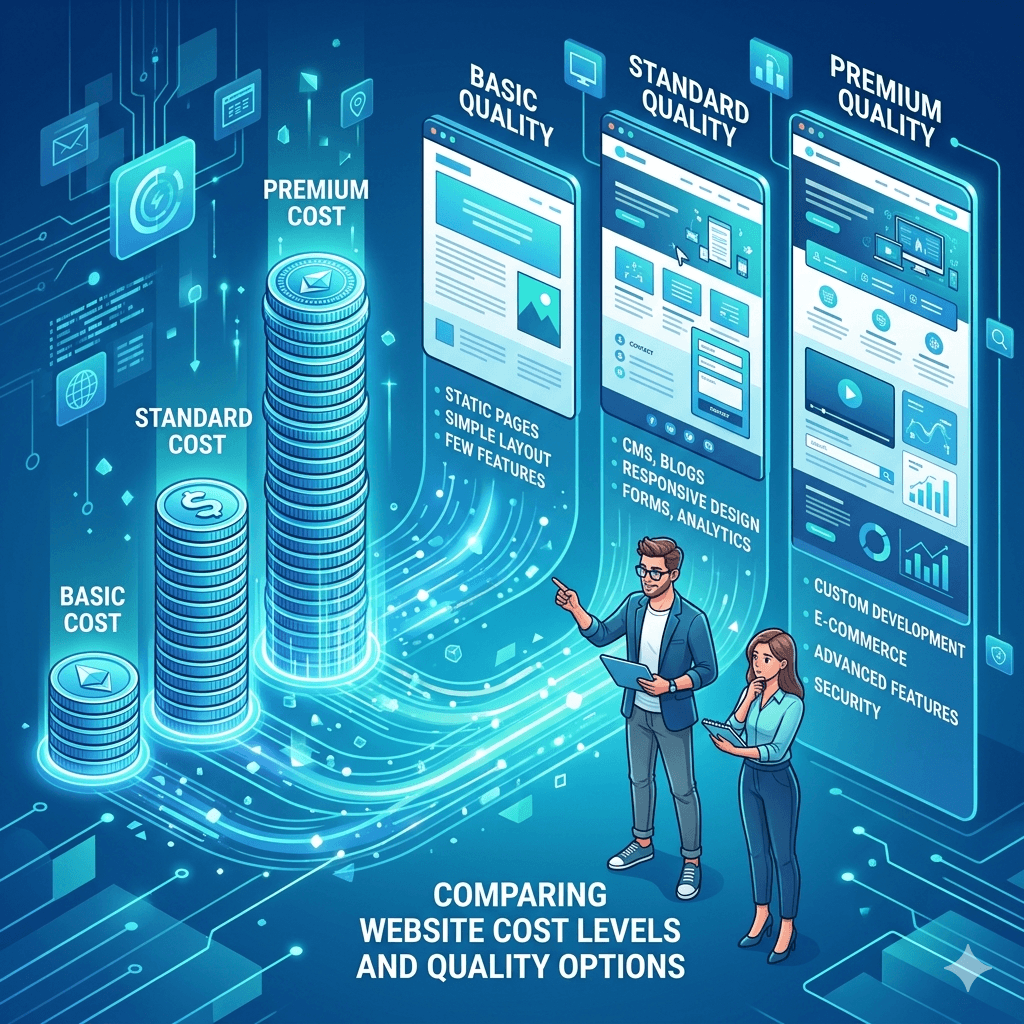
    The cost of building a law firm website in Uganda varies depending on the complexity of the site, the features required, and the team you hire. A basic professional website might start from around UGX 1,500,000 to UGX 4,000,000. More complex sites with custom features, advanced SEO, and content creation can go higher. Check out current website pricing in Uganda to get a clearer picture of what to budget.

    It’s worth comparing the cost of a professional website against alternatives. Before committing to a free builder, read about the real difference between

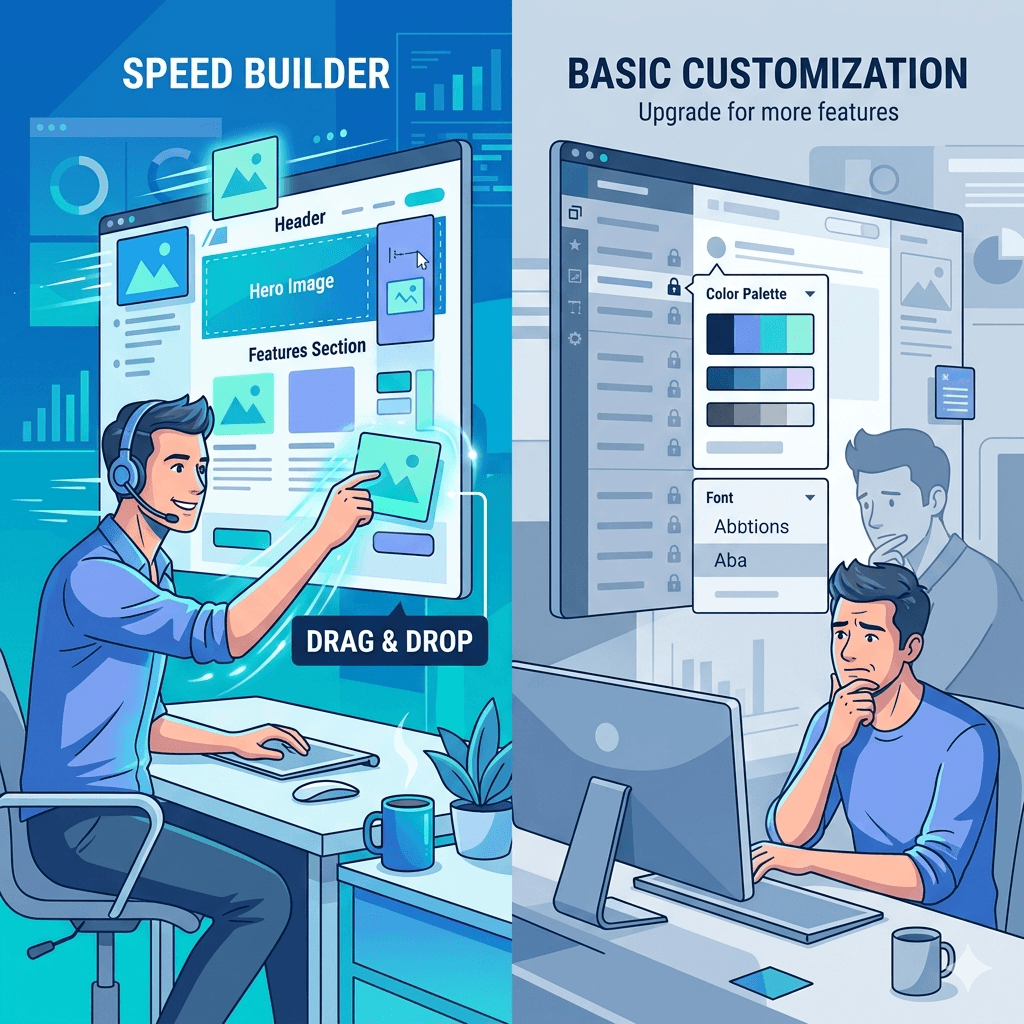
    free website builders vs professional designers   the hidden costs often outweigh the initial savings.

    Think of your website as a long-term investment. A well-built site that consistently brings in one or two new clients per month pays for itself many times over in the first year alone. The real question isn’t whether you can afford a website, it’s whether you can afford not to have one.

    11. Tips for Maintaining and Updating Your Website

    11.1 Regular Content Updates

    A website that hasn’t been updated in a year sends a quiet message to visitors: nobody’s home. Adding new blog posts, updating your service pages, and refreshing your team bios regularly shows that your firm is active, engaged, and keeping up with changes in the law.

    11.2 Security and Backups

    Your website holds sensitive information, contact details, inquiry forms, and client-facing content. Make sure your site is protected with an SSL certificate (the padlock that appears in the browser), that software is kept up to date, and that regular backups are made so nothing is lost if something goes wrong.

    11.3 Performance Monitoring

    Use tools like Google Analytics and Google Search Console to track how people are finding and using your website. These free tools show you which pages are popular, how long people stay, and where they’re dropping off. This information helps you improve your site over time.

    11.4 Updating Legal Information

    Laws change. Regulations are updated. Court procedures evolve. Make it a habit to review your website’s legal content at least twice a year to make sure everything is accurate and current. Outdated information can mislead potential clients and harm your firm’s credibility.

    12. Future Trends in Law Firm Websites (2026 and Beyond)

    12.1 AI Chatbots for Client Support

    More law firm websites are now integrating AI-powered chatbots that can answer basic questions, qualify leads, and book consultations automatically. These tools work around the clock, reducing the burden on your administrative staff while keeping potential clients engaged.

    12.2 Voice Search Optimization

    As voice assistants become more common, more people are searching by speaking rather than typing. Optimizing your website content for natural, conversational queries   the kind someone would speak aloud   will become increasingly important for maintaining search visibility.

    12.3 Video Content Integration

    Short explainer videos, attorney introductions, and client testimonial videos are becoming powerful tools on legal websites. Video content builds a personal connection faster than text alone and can significantly increase the time visitors spend on your site.

    12.4 Enhanced Mobile Experiences

    Mobile design will continue to evolve beyond simple responsiveness. Expect to see more law firm websites designed with a mobile-first philosophy   prioritizing touch-friendly navigation, fast mobile load times, and features like click-to-call buttons that make it effortless for smartphone users to reach out.

    13. Conclusion

    Building a professional website isn’t just a trend, it’s a foundational step for any law firm that wants to grow in Uganda’s increasingly digital marketplace. A well-designed site gives your firm visibility, builds trust, attracts the right clients, and works for you around the clock.

    Whether you’re just starting out or looking to upgrade an outdated online presence, now is the right time to act. Your competitors are waking up to this reality, and the firms that invest in their digital presence today will have the edge tomorrow.

    Ready to take that step? Explore our law firm website design in Uganda services, view our portfolio of past work, or contact a web design expert today to discuss how we can help your firm stand out online.

    14. Frequently Asked Questions

    14.1 How much does a law firm website cost in Uganda?

    The cost typically ranges from UGX 1,500,000 to UGX 6,000,000 or more, depending on the size of the site, features included, and whether you need ongoing SEO and content services. A basic but professional site is affordable for most small and mid-sized firms.

    14.2 How long does it take to build a professional website?

    A professional law firm website usually takes between two to six weeks to design and launch, depending on how quickly content and feedback are provided. More complex sites with custom features may take longer.

    14.3 Can I create a law firm website without technical skills?

    Yes. You don’t need to know how to code. You just need to provide the content   information about your services, team bios, and your contact details. A professional web design team handles all the technical work, from design to launch and beyond.

    14.4 What pages should a law firm website include?

    At a minimum, your site should have a homepage, an about page, individual pages for each service area you offer, a contact page with a form, and a blog section for publishing helpful legal content.

    14.5 How do I get clients through my website?

    Combine SEO to rank higher in search results, compelling content that answers client questions, clear calls-to-action, and lead capture forms. Over time, a consistent content strategy and local SEO work will bring a steady stream of qualified inquiries.

    14.6 Is SEO necessary for law firms in Uganda?

    Absolutely. Without SEO, your website is like a beautiful office in a building with no signs   hard to find. Digital marketing for law firms that includes SEO ensures that people who need your services can actually find you online.

    14.7 How often should I update my website?

    Aim to publish a new blog post or update your content at least once a month. Review your service pages and legal information every three to six months to make sure everything is accurate and current.

    14.8 What makes a law firm website trustworthy?
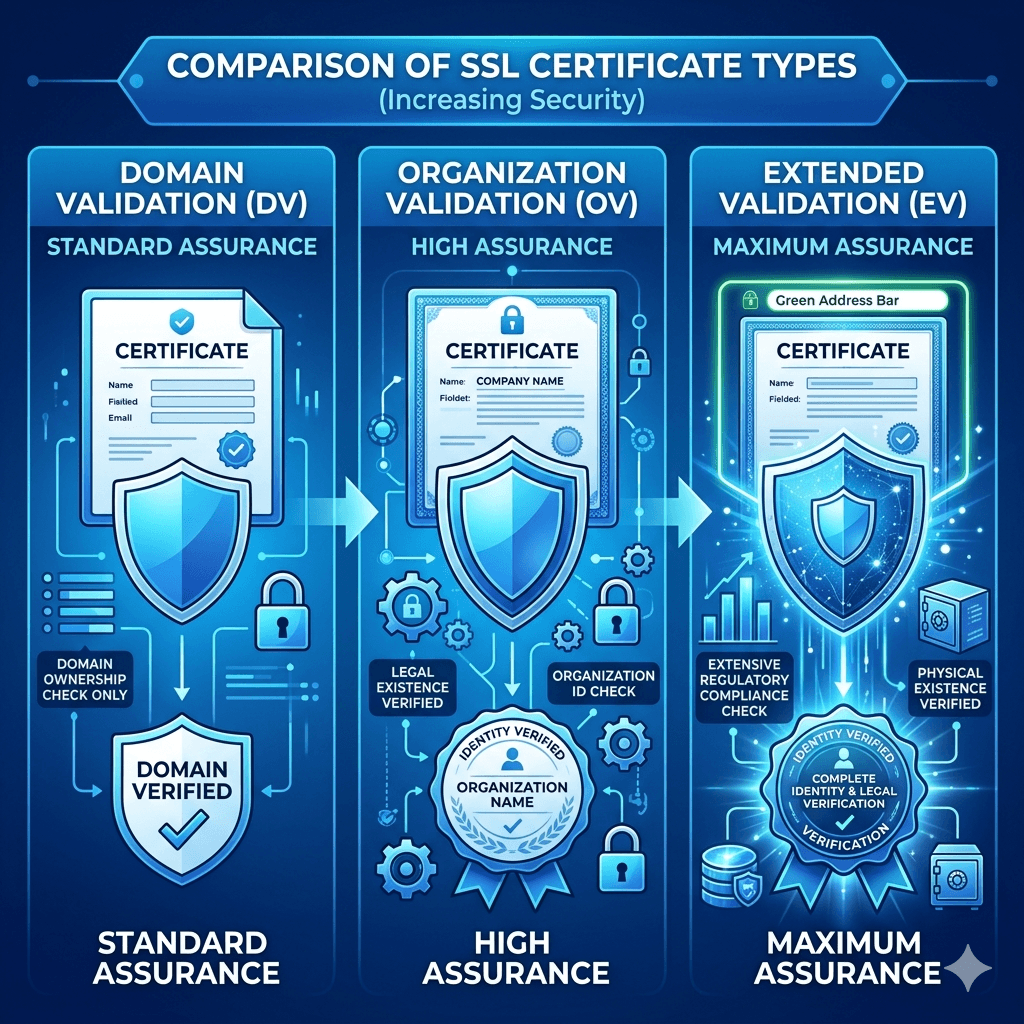
    A trustworthy legal website has a clean professional design, clearly states who the lawyers are and what they specialize in, includes real client testimonials, shows professional credentials, has clear contact information, and uses an SSL certificate (shown as a padlock in the browser). You can also learn more about our team at

    learn more about our team to see how we approach building credible, trust-focused websites for legal professionals in Uganda.

  • How Uganda’s Tourism Industry Can Win More Bookings Through SEO

    How Uganda’s Tourism Industry Can Win More Bookings Through SEO

    1. Introduction

    Uganda is one of Africa’s most remarkable travel destinations. From gorilla trekking in Bwindi to wildlife safaris in Queen Elizabeth National Park, the country offers experiences that travelers around the world are actively searching for. Yet many tour operators are missing out on bookings simply because potential clients cannot find them online.

    This is where Uganda tours SEO comes in. Search engine optimization is one of the most powerful and cost-effective tools available to small and medium-sized tour businesses. When done right, SEO helps your website show up when someone in London, New York, or Nairobi types “best Uganda wildlife tours” or “book safari tours Uganda” into Google.

    This article walks you through practical, proven SEO strategies designed specifically for Uganda tour operators and travel businesses. Whether you run Uganda safari tour packages, cultural tours, or eco-tourism experiences, these insights will help you attract more visitors to your website and turn them into paying customers.

    2. What Is SEO and Why It Matters for Tour Operators

    An illustration of a tour operator surrounded by floating SEO elements like magnifying glasses

    SEO, or search engine optimization, is the process of making your website more visible on search engines like Google. Think of Google as a massive travel directory. When someone searches for “Uganda gorilla trekking tours” or “Uganda cultural tours booking,” Google scans millions of websites and ranks the most relevant ones at the top. SEO is how you earn that top spot.

    For tour operators, online visibility directly drives bookings. Studies consistently show that the majority of travelers research and book trips online. If your business does not appear on the first page of search results, you are essentially invisible to most potential clients. Paid ads can help in the short term, but organic search for travel bookings through SEO delivers long-term, sustainable traffic without paying for every click.

    Uganda’s tourism industry has a genuine competitive advantage here. Many local operators are not yet investing heavily in SEO for tour operators in East Africa, which means there is still a window of opportunity to rank well for high-value searches. Getting in early and doing it right can put your business miles ahead of competitors.

    3. Benefits of SEO for Uganda’s Tourism Industry

    Increase Website Traffic and Leads

    Every day, thousands of people search for phrases like “wildlife safari tours in Uganda,” “family friendly Uganda tours,” and “private Uganda safari packages.” Good SEO puts your website directly in front of these potential clients at the exact moment they are looking to book. More relevant traffic means more inquiries and ultimately more confirmed bookings.

    Build Brand Credibility and Trust

    Websites that rank highly on Google are automatically perceived as more trustworthy. Most travelers associate a top search ranking with legitimacy and expertise. When your site consistently appears for searches related to Uganda adventure travel experiences or eco-tourism experiences in Uganda, it builds brand authority that no paid ad can replicate. People trust organic results more than sponsored links.

    Improve Cost Efficiency Compared to Paid Ads

    Running Google Ads or Facebook campaigns gets expensive fast, especially for small and medium-sized businesses with tight marketing budgets. SEO requires an upfront investment of time and effort, but once your pages rank, they continue attracting visitors without you paying for each click. Over time, the cost per booking through organic search is significantly lower than through paid advertising, making SEO a smart long-term investment for tour operators across East Africa.

    4. Key SEO Strategies for Tour Operators

    A creative dashboard-style illustration showing a tour operator optimizing website elements like mobile layou

    4.1 Optimizing Your Website for Search Engines

    Your website is your most important digital asset, and it needs to be built for both users and search engines. A well-structured, fast-loading website is the foundation of any strong tour operator SEO strategy.

    Mobile-friendly design is non-negotiable. More than half of all travel searches now happen on smartphones. Google prioritizes mobile-optimized websites in its rankings, so if your site is hard to navigate on a phone, you are losing both rankings and bookings. Fast page loading speeds are equally critical. A slow website frustrates visitors and signals poor quality to Google.

    Clear navigation and a great user experience keep visitors on your site longer, which signals to Google that your content is valuable. Make it easy for visitors to find tours, read descriptions, see pricing, and book directly. If you need help building a site that checks all these boxes, a professionally built

     tourism website designed specifically for Uganda’s tourism industry can give you a significant head start. You can also explore options for professional website development that prioritizes speed, responsiveness, and SEO from the ground up.

    4.2 Keyword Research for Tourism Businesses

    Keyword research is the process of finding the exact phrases your ideal customers type into Google. It is one of the most important steps in any travel SEO keyword research strategy.

    Start with high-intent travel keywords that show someone is ready to book, such as “book safari tours Uganda,” “Uganda safari tour packages,” or “Uganda gorilla trekking tours.” These phrases attract visitors who are not just browsing but are actively looking to make a purchase.

    Do not overlook long-tail travel keywords Uganda. These are longer, more specific phrases like “best time to visit Uganda safari,” “Uganda safari itineraries SEO,” or “eco-tourism experiences in Uganda.” They may have lower search volumes individually, but they attract highly targeted visitors who know exactly what they want and convert at higher rates.

    Destination keywords Uganda tourism are also powerful. Phrases like “wildlife safari tours in Uganda” or “Uganda adventure travel experiences” help you capture travelers who are researching specific regions or activities. Use free tools like Google Keyword Planner or Ubersuggest to identify the best opportunities for your specific offerings.

    4.3 Creating Engaging, SEO-Friendly Content

    Content is the engine that drives SEO. Think of each blog post, tour page, and destination guide as a door that opens onto your website. The more high-quality doors you have, the more people can find their way in.

    Travel content marketing SEO works best when you create genuinely useful content. Write blog posts about Uganda tour blog ideas such as “Top 10 Things to Do in Bwindi,” “How to Plan a Uganda Safari Itinerary,” or “Uganda Cultural Tours: What to Expect.” These articles answer real questions travelers have and help you rank for dozens of additional keywords.

    Visual content is equally important. Use high-quality images and videos of your tours and destinations, and always include descriptive alt text for every image. Alt text like “gorilla trekking guide in Bwindi Impenetrable Forest Uganda” helps search engines understand your visuals and improves your chances of appearing in image searches. See examples of how effective visual storytelling looks in action by exploring our

    portfolio of adventure and hiking websites we have built for tourism clients.

    4.4 On-Page and Technical SEO

    On-page SEO involves optimizing the individual elements of each page on your website. Every page should have a unique, keyword-rich meta title and meta description. For example, a page about gorilla trekking might have a meta title like “Uganda Gorilla Trekking Tours | Book Now with [Your Company].” These elements appear in search results and directly influence whether someone clicks on your link.

    Use clear header tags (H1, H2, H3) to structure your pages, and include your target keywords naturally within them. A clean URL structure also matters. A URL like yoursite.com/uganda-gorilla-trekking-tours is far better for SEO than yoursite.com/page?id=47.

    Structured data, also called schema markup, helps Google understand what type of content your page contains, such as a tour product, review, or FAQ. Internal linking connects your pages to each other, spreading SEO authority across your site and helping visitors discover more of what you offer. Professional

    SEO services can handle the more technical aspects of this if you are not confident doing it yourself.

    4.5 Building Quality Backlinks

    A backlink is when another website links to yours. Google treats backlinks like votes of confidence. The more quality websites that link to you, the more authoritative your site appears in Google’s eyes.

    For Uganda tour operators, some of the best backlink opportunities come from partnering with established travel blogs, working with Uganda Tourism Board, and listing your business on reputable travel directories like TripAdvisor, SafariBookings, and Lonely Planet. Getting featured in articles like “Best Uganda Safari Companies” or “Top Tour Operators in East Africa” can earn you powerful links.

    You can also request backlinks from complementary businesses such as hotels, lodges, and airlines that serve your clients. Even listing your

    travel agency website on local business directories and tourism associations provides a steady stream of legitimate backlinks that boost your overall domain authority.

    5. Leveraging Local SEO to Attract Tourists

    Illustration of a Uganda map with pins marking popular tourist destinations

    Local SEO for tour operators is about making sure your business shows up when people search for services in your specific area. This is especially important because many travelers search for tour operators by destination, using phrases like “tour operators in Kampala” or “safari companies near Entebbe.”

    The single most impactful thing you can do is claim and fully optimize your Google Business Profile. Fill in every detail: business name, phone number, address, website, operating hours, photos, and a compelling description that includes relevant keywords. A complete, well-maintained profile dramatically improves your chances of appearing in Google’s local map pack, the section that shows up prominently at the top of local search results.

    Encourage every satisfied client to leave a review on Google. Reviews are a major ranking signal for local SEO and they also build social proof that converts new visitors into bookings. User-generated content such as photos your clients share on their profiles and tag your business in also helps boost local visibility.

    Create location-specific landing pages for major destinations you serve. For example, a dedicated page titled “Bwindi Impenetrable Forest Gorilla Trekking Tours” or “Queen Elizabeth National Park Safari Packages” helps you rank for those specific destination searches. Pair this with a well-designed

    hotel booking website if you also offer accommodation bookings, and you create a seamless online experience that captures travelers at multiple stages of their planning journey.

    6. Measuring SEO Success for Tour Operators

    One of the great things about digital marketing is that everything is measurable. You do not have to guess whether your SEO efforts are working. You just need to know which metrics to track.

    Start with website traffic. Google Analytics shows you how many people are visiting your site, where they come from, which pages they view, and how long they stay. Pay particular attention to organic traffic, visits that come directly from search engines, as this is the clearest indicator of SEO performance.

    Track your keyword rankings using tools like Google Search Console, SEMrush, or Ahrefs. Are you moving up for searches like “Uganda tours SEO” or “Uganda travel packages SEO”? Improving rankings for high-intent keywords directly correlates with more inquiries and bookings.

    Conversions are the most important metric of all. A conversion could be a completed booking, an inquiry form submission, or a call to your business. Google Analytics lets you set up goals to track these actions, so you can see exactly which pages and keywords are driving real revenue.

    Review your data at least once a month. Look for what is working and invest more effort there, and identify what is not working so you can adjust. SEO is not a set-and-forget strategy; it rewards consistent attention. Your

    digital marketing strategy should be built around these insights, continuously refining your approach based on real-world performance data.

    7. Common SEO Mistakes to Avoid

    A visual metaphor of tourists getting “lost” while searching online due to poor mobile optimization or ignored local SEO

    Even well-intentioned SEO efforts can backfire if you fall into common traps. Here are the most frequent mistakes tour operators make and how to avoid them.

    Keyword stuffing is one of the biggest offenders. This means cramming keywords unnaturally into your content in an attempt to rank higher. Google’s algorithms are sophisticated enough to detect this, and it results in penalties that push your site down in rankings rather than up. Always write for humans first and let keywords flow naturally.

    Publishing low-quality content is equally damaging. Thin, generic pages that do not genuinely help travelers will not rank and will not convert visitors. Every piece of content you publish should answer a real question or provide genuine value.

    Ignoring mobile optimization is a critical error in 2025. With the majority of travel searches now happening on mobile devices, a site that is not mobile-responsive will lose both rankings and bookings.

    Overlooking local SEO opportunities is perhaps the most common missed opportunity for Uganda tour operators. What is local SEO for travel? It is the combination of Google Business Profile optimization, local keywords, location-specific landing pages, and review management that helps you appear in searches for tours and operators in specific areas of Uganda. Neglecting this means leaving a steady stream of high-intent, locally-relevant searches unanswered.

    8. Frequently Asked Questions

    8.1 How long does it take to see results from SEO?

    SEO is a long-term strategy, not a quick fix. Most tour businesses start seeing meaningful improvements in traffic and rankings within three to six months of consistent effort. Highly competitive keywords may take longer, while local and long-tail keywords often show results faster. The key is consistency. Businesses that stick with SEO for twelve months or more typically see compounding returns as their domain authority grows.

    8.2 What is the best way to choose keywords for a tour business?

    Start by thinking like your customer. What phrases would they type into Google when looking for what you offer? Then use tools like Google Keyword Planner, Ubersuggest, or Google’s autocomplete suggestions to validate and expand that list. Prioritize a mix of high-intent commercial keywords like “book safari tours Uganda” and specific long-tail phrases like “best time to visit Uganda safari” that have lower competition but highly qualified search intent.

    8.3 Should I focus more on content or technical SEO?

    You need both, but if you are just starting out, content often delivers quicker visible wins. Great content with the right keywords can rank even on a technically imperfect site. That said, technical issues like slow loading speeds or a non-mobile-friendly design can cap how well even excellent content performs. Aim to get the technical foundations solid early, then invest heavily in ongoing content creation.

    8.4 How can I get local tourists to find my tours online?

    Focus on local SEO. Claim your Google Business Profile, optimize it fully, and actively encourage reviews. Create pages on your website targeting specific destinations and activities within Uganda. Use location-specific keywords in your content and meta tags. Being listed on local business directories and local tourism association websites also helps local visitors find you through organic search.

    8.5 Are backlinks really important for small tourism businesses?

    Yes, backlinks remain one of Google’s most important ranking signals. Even a small number of high-quality backlinks from reputable travel blogs, tourism boards, or travel directories can significantly boost your rankings. Focus on earning links naturally by creating genuinely useful content, reaching out to travel writers, and ensuring your business is listed on the major travel platforms. You do not need hundreds of backlinks to make a real difference.

    8.6 Can social media affect SEO for my tours?

    Social media does not directly influence Google rankings, but it plays an important supporting role. Active social profiles help drive traffic to your website, increase brand awareness, and can lead to earned backlinks when people share your content. Platforms like Instagram and Facebook are also where many travelers discover destinations and tour operators, so strong social presence complements your overall travel booking trends in East Africa and SEO strategy.

    8.7 How often should I update my website content?

    Aim to publish new content at least two to four times per month. This could be blog posts, updated tour pages, destination guides, or travel tips. Google favors websites that are regularly updated, as it signals that the site is active and current. Beyond adding new content, revisit and refresh your existing pages at least once or twice a year to ensure information is accurate and to incorporate new keywords you want to target.

    8.8 Do I need to hire an SEO expert or can I do it myself?

    Many of the foundational SEO practices covered in this article can be implemented without hiring an expert, especially if you are comfortable with basic digital tools. However, technical SEO, in-depth keyword research, and building a structured content strategy can be complex. If you want to accelerate results or tackle more competitive keywords, partnering with a professional who understands how to rank a travel business on Google and the specific dynamics of tourism SEO best practices can deliver a strong return on investment. For businesses serious about growing their online bookings, professional SEO support is often worth the investment.

    Uganda’s tourism industry is full of extraordinary experiences just waiting to be discovered by travelers worldwide. SEO is the bridge that connects those travelers to your business. Start with the fundamentals, stay consistent, and keep learning from your data. The tour operators who invest in SEO today are the ones who will be filling their calendars with bookings tomorrow. If you are ready to take your online presence to the next level, explore how

    Kico Web Design’s full suite of digital solutions can help you build, optimize, and grow your tourism business online.

  • Building a School Website in Uganda: What Parents Expect to See

    Building a School Website in Uganda: What Parents Expect to See

    Introduction

    Think about the last time you were looking for a school for your child. What was the first thing you did? Chances are, you typed the school’s name into Google. And if the website you landed on was slow, confusing, or looked like it hadn’t been touched in years, you probably moved on to the next option.

    That’s the reality schools in Uganda face today. Parents are more informed and more selective than ever before. They research before they visit. They judge before they call. And more often than not, a school’s website is where that judgment begins.

    This article walks you through everything you need to know about school website design in Uganda  what parents expect to see, the features that matter most, how to build one the right way, and how to avoid the mistakes that could cost you enrollment.

    1. What Is a School Website?

    A school website is your institution’s digital front door. It’s the first place most parents, students, and even teachers go to learn about your school before they ever step foot on the compound.

    A good school website is more than just a page with your school’s name on it. It’s a complete online resource that tells your school’s story, shares key information, and helps visitors take the next step   whether that’s booking a visit, downloading an admission form, or simply calling your office.

    Think of it like your school’s brochure, notice board, and reception desk all rolled into one   available 24 hours a day, 7 days a week. Unlike a printed flyer, a website can be updated instantly, reach hundreds of people at once, and work for you even when your offices are closed.

    In short, a school website is one of the most powerful tools a modern school can have. It builds credibility, improves communication, and helps you attract the right students.

    2. Why School Websites Matter in Uganda

    Parents in an urban Ugandan environment using smartphones to access school information

    Uganda’s education sector is growing fast, and so is competition between schools. Private schools, government-aided schools, international schools   parents have more choices than ever, and they’re using the internet to help them decide.

    According to data from the Uganda Communications Commission, internet penetration in Uganda has been rising steadily, with more households accessing the internet via smartphones. This means more parents are online   and they’re using that access to research schools, compare programs, and make enrollment decisions.

    A school without a website in this environment is practically invisible to a large segment of potential parents. Even word-of-mouth referrals often lead to an online search. If someone hears about your school from a neighbor and searches for it online but finds nothing   or worse, finds an outdated site   you’ve likely lost that enrollment opportunity.

    Beyond enrollment, a well-maintained website for schools helps with day-to-day communication. Parents can check announcements, review the school calendar, and get contact details without calling the front desk every time. It reduces pressure on your staff and keeps parents informed and engaged.

    A strong online presence also positions your school as professional, organized, and forward-thinking   qualities every parent looks for.

    3. What Parents Expect from a School Website

    Parents come to a school website with specific questions in mind. They want to know: Is this school right for my child? Can I trust this institution? What will my child experience here? Your website needs to answer these questions clearly and quickly.

    Here’s what most parents look for in a school website:

    • Clear and honest information. Parents want to know your school’s name, location, type, and level   primary, secondary, or both. They don’t want to hunt for basic facts.

    • Fees and admission details. This is often the first practical question parents have. If your website doesn’t mention fees or how to apply, many parents will move on.

    • Academic programs. What curriculum do you follow? Uganda National Examinations Board (UNEB)? Cambridge? IB? Parents want to know what their children will be studying.

    • School culture and values. Photos, videos, and stories help parents understand what life at your school looks like   which matters as much as academics.

    • Evidence of results. PLE results, UCE results, or any national rankings build confidence and trust.

    • Easy ways to get in touch. A working phone number, email, and map location are non-negotiable.

    Simply put, parents want a website that respects their time, answers their questions, and makes the school feel trustworthy and approachable.

    4. Key Features Every School Website Should Have

    A dashboard-style website layout showcasing essential features like admissions, programs, gallery

    Not all school websites are created equal. Some look great but have no useful information. Others have great content but are so hard to navigate that visitors give up. The best school websites strike a balance between design and substance. Here are the must-have features:

    4.1 Clear School Information

    Start with the basics. Your website should clearly state your school’s full name, location, type (private, government-aided), levels offered (nursery, primary, secondary), and year of establishment. This sounds obvious, but many schools skip it   leaving parents confused about whether they’ve even landed on the right site.

    4.2 Academic Programs and Curriculum

    Parents want to understand what their children will learn. List the subjects offered, the curriculum followed (UNEB, Cambridge, etc.), any special programs like science clubs, arts, or sports, and details about teaching methods. You can also explore how school management systems in Uganda can complement your website by streamlining admissions and communication.

    4.3 Admissions and Fees Details

    One of the most visited pages on any school website is the admissions page. Include the application process, entry requirements, intake dates, fees structure (even a general range helps), and any scholarships or bursaries available. The more transparent you are, the more trust you build.

    4.4 Contact Information and Location

    Make it effortless for parents to reach you. Include a working phone number, email address, physical address, a Google Maps embed, and office hours. If you have multiple campuses, list them all. Never make a parent search three pages deep to find a phone number.

    4.5 Photo Gallery and School Life

    Humans are visual. A gallery of real photos showing classrooms, students in activities, sports days, and graduation ceremonies helps parents imagine their child at your school. Keep photos recent and authentic, avoid stock images that look nothing like your campus.

    4.6 News and Announcements Section

    A news or updates section shows that your school is active and communicates regularly. Post about upcoming events, exam schedules, school holidays, achievements, and any important notices. Even a short monthly update keeps the website feeling alive and relevant.

    5. Design Elements That Build Trust with Parents

    The way your website looks and feels sends a powerful message. A poorly designed site can make even a great school look unprofessional. When it comes to education website design, trust is everything. Here’s how good design builds it.

    For a deeper look at this topic, read our guide on how to design a website that builds trust with Ugandan customers.

    5.1 Clean and Simple Layout

    A cluttered website is like a messy classroom; it creates anxiety and makes it hard to focus. Use white space generously, keep fonts readable, and organize information into clear sections. Parents shouldn’t need to zoom in or squint to read your content.

    5.2 Mobile-Friendly Design

    In Uganda, most people browse the internet on their phones. A mobile-friendly school website isn’t optional   it’s essential. Your site must look and function properly on smartphones of all sizes. If it doesn’t, you’re losing visitors before they even read your first sentence.

    5.3 Fast Loading Speed

    A website that takes more than three seconds to load will lose most visitors. Compress your images, use a reliable hosting provider, and avoid overloading your pages with unnecessary plugins or scripts. Speed is a silent trust signal   when your site loads quickly, it communicates that your school is efficient and well-managed.

    5.4 Consistent Branding and Colors

    Your school has a brand, its name, logo, colors, and motto. Your website should reflect that consistently. Use your school colors, display your logo prominently, and make sure the overall look matches the image you want to project. Consistency creates familiarity, and familiarity builds trust.

    6. How to Structure a School Website for Easy Navigation

    A user journey path visual where a parent smoothly navigates through pages

    A great school website layout is one where visitors never get lost. Think of navigation like the corridors of your school   clear, well-labeled, and leading people exactly where they need to go.

    6.1 Homepage Essentials

    Your homepage is your first impression. It should instantly communicate who you are, what you offer, and why parents should choose you. School website homepage content should include your school name and tagline, a strong hero image or banner, a brief welcome message, quick links to admissions and contact, and highlights of recent news or achievements.

    6.2 Menu and Page Organization

    Keep your main navigation simple and logical. Recommended pages include: Home, About Us, Academics, Admissions, Gallery, News, and Contact. Avoid cramming too many items into the menu   if a visitor has to think about where to click, they might click away entirely.

    6.3 Clear Call-to-Action Buttons

    Every page should guide visitors toward an action. Common call-to-action (CTA) buttons include “Apply Now,” “Book a School Visit,” “Download Prospectus,” and “Contact Us.” These buttons should be easy to spot   use a contrasting color and place them where the eye naturally lands.

    7. Content That Engages and Informs Parents

    Good design draws people in, but it’s content that keeps them there   and convinces them to take action. Knowing how to write website content that ranks on Google can give your school website a significant advantage in search visibility.

    7.1 School Mission and Values

    Parents want to know what your school stands for. Share your mission statement, core values, and educational philosophy in plain language. Avoid generic statements like “we nurture excellence” without backing them up. Be specific about what makes your school’s approach different and valuable.

    7.2 Teacher Profiles and Qualifications

    One of the most underused school website content ideas is teacher profiles. Parents care deeply about who will be teaching their children. A short bio for each teacher, their qualifications, experience, and what they love about teaching   adds a human face to your institution and builds enormous trust.

    7.3 Student Achievements and Testimonials

    Nothing sells a school better than its own results and happy families. Share exam result highlights, awards won at competitions, student projects, and testimonials from current parents and alumni. Real quotes from real people carry more weight than any marketing copy you could write.

    7.4 Blog or Updates Section

    A blog or news section keeps your website dynamic and supports school website SEO. Write about topics parents care about: study tips, upcoming school events, curriculum changes, or highlights from the school term. Even posting once a month makes a big difference in search visibility and parent engagement.

    8. Common Mistakes to Avoid When Building a School Website

    A split illustration showing a well-designed website versus a poorly designed one

    Many schools build websites with good intentions but make avoidable mistakes that undermine the effort. Here are the most common pitfalls in school website development   and how to sidestep them.

    8.1 Outdated Information

    Nothing damages trust faster than a website that still shows last year’s fees, old staff names, or events that happened three terms ago. Assign someone on your team to review and update the website at least once per term. Treat it like a notice board and keep it current.

    8.2 Poor Mobile Experience

    As mentioned earlier, most Ugandan parents will visit your site from a phone. If buttons are too small to tap, text runs off the screen, or images don’t load   they’ll leave. Always test your website on a smartphone before launching it.

    8.3 Lack of Clear Contact Details

    It’s surprisingly common to visit a school website and struggle to find a phone number. Don’t make parents work for this. Your contact information should be visible on every page   ideally in the header or footer   not buried in a hard-to-find contact page.

    8.4 Overcomplicated Design

    More is not always better. Flashing animations, too many fonts, and cluttered layouts make a website hard to use and harder to trust. Keep it clean, focused, and professional. Your website should be easy to navigate for a first-time visitor with no technical background.

    9. How to Build a School Website in Uganda (Step-by-Step)

    Ready to get started? Here’s a straightforward step-by-step guide to building a school website in Uganda, whether you’re doing it yourself or working with a professional.

    9.1 Define Your Goals

    Before you touch a single design tool, know what you want your website to achieve. Is it primarily for attracting new students? Communicating with parents? Showcasing achievements? Your goals will shape every decision that follows.

    9.2 Choose a Domain Name and Hosting

    Your domain name is your website’s address   for example, www.yourschoolname.ac.ug. Choose something simple, memorable, and close to your school’s actual name. For hosting, look for a reliable provider with servers that load quickly in Uganda. Hosting costs in Uganda typically range from UGX 100,000 to UGX 500,000 per year depending on the package.

    9.3 Select a Website Platform

    The most popular platforms for school websites include WordPress (highly flexible and widely supported), Wix and Squarespace (easier for beginners), and custom-built sites (best for unique needs). WordPress is generally the top recommendation for schools because of its flexibility, large community support, and SEO capabilities.

    9.4 Design and Add Content

    Start with a professional template or theme designed for education. Then populate it with your school’s information, photos, and pages. Our web design services can help you create a custom design that reflects your school’s identity and meets modern standards. If you’d rather use professional website development services, working with an expert saves time and ensures a polished final result.

    9.5 Test and Launch the Website

    Before going live, test everything. Check that all links work, pages load quickly on both desktop and mobile, forms submit correctly, and information is accurate. Ask a few people   staff, parents   to navigate the site and give feedback. Then launch confidently.

    10. Cost of Building a School Website in Uganda

    A cost breakdown infographic with elements like design, hosting, and maintenance

    The cost of school website design in Uganda varies widely depending on what you need.

    A basic school website with four to six pages typically costs between UGX 800,000 and UGX 2,000,000. A more comprehensive site with custom design, a gallery, admissions forms, and a blog can range from UGX 2,000,000 to UGX 5,000,000 or more. Ongoing hosting and maintenance adds an additional UGX 200,000 to UGX 600,000 per year.

    You can also explore free website builders vs paid web designers to understand the real long-term cost of each route. Free tools seem appealing but often come with limitations that hurt your school’s image and SEO performance.

    For a clearer picture of what to budget, visit our website design pricing page. And if you want to see examples of what we’ve built for schools and other organisations, view our portfolio to get inspired.

    Investing in a professionally built site is genuinely worthwhile. A well-designed website that attracts even one or two additional students per term pays for itself many times over.

    11. Tips to Maintain and Update Your School Website

    Building the website is only half the job. Keeping it updated and performing well is what delivers long-term value. Here are the most important school website maintenance tips to follow.

    11.1 Regular Content Updates

    Assign a dedicated person   an administrator or a tech-savvy teacher   to update the website regularly. This includes posting news, updating the events calendar, refreshing photos, and reviewing fees or contact details each term. A stale website sends the wrong message.

    11.2 Monitoring Performance

    Use free tools like Google Analytics to understand how many people visit your site, which pages they spend the most time on, and where they drop off. This data helps you improve the site over time and understand what parents care about most.

    11.3 Ensuring Security and Backups

    A hacked or crashed website is both embarrassing and disruptive. Make sure your hosting provider takes regular backups. Keep your website platform and plugins updated. If you’re using WordPress, consider a basic security plugin to block common threats. A secure site also signals to parents that your school takes data and privacy seriously.

    12. Benefits of a Well-Designed School Website

    Let’s step back and look at the big picture. What do you actually gain from investing in a quality school website?

    • Increased enrollment. Parents who find your school online and like what they see are more likely to book a visit and eventually enroll their children.

    • Better first impressions. A professional website positions your school as credible and well-managed before a parent ever meets you in person.

    • Improved communication. Parents stay informed through news updates, event announcements, and direct contact options   reducing phone call volumes to your office.

    • Stronger brand identity. A consistent, well-designed site reinforces your school’s reputation and sets you apart from competitors.

    • 24/7 visibility. Your website works for you around the clock   even when your offices are closed, parents can access information, download forms, and get in touch.

    • Higher search ranking. A well-structured website with good content improves your visibility on Google, helping more parents discover your school organically.

    Whether you run a nursery school   nursery school website design is a specialty we offer   or a secondary school, these benefits apply across the board. And if you’re part of a larger institution, university website design follows many of the same principles at a larger scale.

    13. Frequently Asked Questions

    13.1 How much does it cost to build a school website in Uganda?

    Costs vary based on the size and complexity of the site. A basic school website typically starts around UGX 800,000, while a fully featured site with custom design, forms, and a blog can cost UGX 2,000,000 to UGX 5,000,000 or more. Annual hosting and maintenance adds to this. Check our website design pricing for a detailed breakdown.

    13.2 What information should be on a school website?

    At a minimum: school name and location, levels offered, academic programs, admissions details, fees structure, contact information, a photo gallery, and a news or updates section. The goal is to answer the questions parents ask most frequently before they even call.

    13.3 Can a school website help increase enrollment?

    Absolutely. A well-designed school website makes a strong first impression, answers parents’ key questions, and makes it easy to take the next step   whether that’s booking a visit or downloading an application form. Schools with professional websites consistently attract more inquiries than those without.

    13.4 How often should a school website be updated?

    At minimum, review and update your website once per term. More frequent updates   such as posting news monthly or updating the events calendar regularly   improve both parent engagement and Google ranking.

    13.5 Do we need a professional to build a school website?

    Not necessarily, but it helps significantly. Free website builders can get you started, but a professional brings expertise in design, SEO, mobile optimization, and user experience that’s hard to replicate on your own. If you want a site that truly represents your school well and performs in search results, a professional is worth the investment. Our guide on how to choose the best website design company can help you make that decision.

    13.6 Is it necessary for a school website to be mobile-friendly?

    Yes   without exception. Most parents in Uganda access the internet through their smartphones. A website that isn’t mobile-friendly will be hard to read, slow to load, and frustrating to navigate on a phone. It will also rank lower on Google, reducing your visibility in search results.

    13.7 What pages are most important for parents?

    The pages parents visit most are: Home (first impressions), Admissions (how to apply and fees), About Us (school values and history), Contact (how to reach you), and Gallery (to see the school environment). These should be your highest priority when building or improving your site.

    13.8 How long does it take to build a school website?

    A basic school website can be ready in two to four weeks. A more complex site with custom design, multiple pages, and integrated features may take six to eight weeks. The timeline also depends on how quickly you can provide content   photos, text, and information   to your designer.

    Conclusion

    Building a school website in Uganda isn’t just a technical project   it’s an investment in your school’s reputation, reach, and future. When parents can find you easily online, trust what they see, and take action without friction, you’re one step closer to filling your classrooms with the right students.

    The good news is, getting there doesn’t have to be complicated. Start with the right features, keep the design clean and mobile-friendly, and commit to keeping your content fresh. Whether you’re building from scratch or improving an existing site, every step in the right direction makes a difference.

    At Kico Web Design, we specialize in creating professional, parent-friendly school websites across Uganda. From primary schools to secondary institutions, we understand what your audience needs and how to deliver it. Contact us today to discuss your school’s website, or explore how to choose the best website design company so you can make the most informed decision for your institution.

  • How Churches in Uganda Can Use Websites to Grow Their Congregation

    How Churches in Uganda Can Use Websites to Grow Their Congregation

    How Churches in Uganda Can Use Websites to Grow Their Congregation

    1. Introduction

    If you lead a church in Uganda, you already know that reaching people takes more than Sunday services. The world has changed. People search for answers online before they walk through any door, including a church door.

    A church website is no longer a luxury. It is one of the most powerful tools you can use to grow your congregation, share your message, and connect with people who are searching for a faith community.

    Think of your website as your church’s open door, available 24 hours a day, seven days a week. Whether someone is looking for a place to worship in Kampala or Gulu, your website can be the first thing they see. In this guide, you will learn exactly how to build and use a church website to attract new visitors, engage your existing members, and expand your ministry online. For help getting started, explore our church website design in Uganda services.

    2. What Is a Church Website?

    A simple yet engaging interface of a church website displayed on a large screen with buttons for sermons

    A church website is simply a set of web pages on the internet that represents your church. It tells people who you are, what you believe, when and where you meet, and how they can get involved.

    It is different from a social media page. While Facebook or WhatsApp lets you share updates, a website gives you a permanent, professional home online that you fully control. You can publish sermons, list events, accept donations, and share your church’s story, all in one place.

    A good church website works like a well-organised church notice board, except it never gets rained on and anyone in the world can read it at any time. It is your digital front door, and it deserves the same care and attention you give to your physical building.

    3. Why Churches in Uganda Need a Website

    Uganda has one of the fastest-growing internet user populations in East Africa. Millions of Ugandans access the internet every day, many using mobile phones. That means your potential congregation is already online and searching.

    When someone moves to a new town, experiences a personal crisis, or simply wants to find a church near them, the first thing they do is search on Google. If your church does not have a website, you are invisible to those people.

    A church website Uganda gives you a direct channel to reach those seekers. It also helps you stay connected with members who travel, live far away, or cannot attend services in person. Online ministry Uganda has become a real and growing part of church life, especially since more people now expect digital engagement from the organisations they trust.

    Beyond new visitors, a website builds credibility. It shows your community that your church is organised, active, and serious about its mission. Church outreach Uganda is no longer limited to flyers and word of mouth. Your website multiplies your reach every single day.

    4. Benefits of Using a Website to Grow Your Church

    Church leaders and members celebrating while digital charts and graphs float above

    A church website does much more than just look good. Here are the key benefits:

    • Reach new people: Anyone searching for a church in your area can find you through Google and other search engines.

    • Stay connected with members: Post updates, sermons, and announcements so your congregation never misses important information.

    • Share your message beyond your walls: Your teachings can reach people who cannot physically attend church.

    • Build trust and credibility: A professional website agency in uganda makes your church website look established and dependable.

    • Accept donations online: Make it easy for members and supporters to give, even when they are not physically present.

    • Promote events: Advertise crusades, youth programs, prayer nights, and other activities to a wider audience.

    • Grow your congregation: Church growth strategies that include digital tools consistently outperform those that rely on offline methods alone.

    In short, a website is one of the highest-return investments a church can make in its growth and outreach efforts.

    5. Key Features Every Church Website Should Have

    Not all church websites are created equal. If you want your website to actually work for you, it needs to have the right features. Here are the most important ones:

    5.1 Clear Service Times and Location

    This is the first thing a visitor wants to know. When do you meet? Where are you located? Make these details easy to find on your homepage. Include a map if possible. Nothing frustrates a potential visitor more than having to search through a whole website just to find out your Sunday service time.

    5.2 Sermons and Teachings Online

    Uploading your sermons, whether as audio, video, or written summaries, is one of the most powerful things you can do. It lets people experience your teaching before they visit. It also keeps members engaged during the week and allows those who missed a service to catch up.

    5.3 Contact Information and Forms

    Make it easy for people to reach you. Include a phone number, email address, and a simple contact form. When visitors feel they can easily communicate with your church, they are more likely to take the next step and actually come in person.

    5.4 Mobile-Friendly Design

    Most Ugandans browse the internet on their mobile phones. If your website does not look good and work well on a phone screen, you are losing a huge portion of your potential audience. A mobile-friendly design is not optional, it is essential. This is a core part of good church website design.

    5.5 Online Giving Options

    Allow members to give tithes and offerings through your website using mobile money or other payment options popular in Uganda. This makes it convenient for members and can significantly increase your church’s income.

    6. How to Create a Church Website

    A church leader brainstorming domain name ideas on a laptop

    Creating a church website might sound complicated, but it does not have to be. Here is a simple step-by-step guide. If you would prefer professional help, you can always work with a team that offers professional web design services tailored for churches.

    6.1 Choose a Domain Name

    Your domain name is your web address, for example, www.gracechurchkampala.ug. Choose something short, easy to remember, and clearly connected to your church’s name. Try to get a .ug domain if you can, as it signals that your church is locally based.

    6.2 Select a Website Platform

    A website platform is the tool you use to build and manage your site. WordPress is the most popular and flexible option for churches. Other platforms like Wix or Squarespace are easier for beginners. The best website builder for churches is one that your team can actually learn to use and update regularly.

    6.3 Pick a Simple Design

    You do not need a complicated design. Choose a clean, welcoming template that reflects your church’s identity. Use your church’s colours and include real photos of your congregation. Authentic imagery builds trust far better than stock photos.

    6.4 Add Essential Pages

    At minimum, your website should have these pages: Home, About Us, Services (times and location), Sermons, Events, Contact, and Give. Each page should have a clear purpose and be easy to navigate.

    6.5 Launch Your Website

    Once you have added your content, review every page carefully. Check that all links work, all information is correct, and the website looks good on both a computer and a mobile phone. Then publish it and start sharing the link everywhere.

    7. How to Use Your Website to Attract New Visitors

    Having a website is just the start. You also need to actively use it to bring in new people. Here is how:

    7.1 Share Helpful Content

    Write blog posts or articles that answer questions people in your community are asking. Topics like “How to find peace during hard times” or “What the Bible says about family” attract people who may not yet be churchgoers. Think of it as a content marketing strategy that serves your mission. Learning how to write website content that ranks on search engines will help your articles reach a much wider audience.

    7.2 Optimize for Search Engines (SEO)

    Search Engine Optimisation, or SEO, is the process of making your website more visible on Google. When someone searches “church in Kampala” or “Sunday service near me”, you want your website to appear in the results. Use relevant keywords on your pages, write clear page titles, and make sure your website loads quickly. Our SEO services can help your church appear where people are already searching. You can also learn about local SEO strategies to reach people in your specific area.

    7.3 Use Clear Calls-to-Action

    A call-to-action is simply an invitation for the visitor to do something next. Examples include: “Join us this Sunday”, “Watch our latest sermon”, or “Send us a prayer request”. Every page should have at least one clear next step for the visitor to take.

    7.4 Highlight Community Activities

    Show visitors that your church is a vibrant, active community. Share photos and stories from outreach programs, community events, youth groups, and charity work. People are attracted to churches where they can see real, positive impact in the community.

    8. How to Engage Your Congregation Online

    A church website displaying a regularly updated sermon library

    Your website is not just for attracting new visitors. It is also a powerful tool for keeping your existing members connected, informed, and spiritually nourished during the week.

    8.1 Post Sermons and Updates Regularly

    Make it a habit to upload sermons shortly after each service. Members who missed a service can catch up, and those who attended can revisit key points. Regular updates also signal to Google that your website is active, which helps with search rankings.

    8.2 Create Event Announcements

    Use your website to announce upcoming events: crusades, fasting programs, fellowship meetings, youth camps, and more. Include dates, times, locations, and registration links where relevant. This keeps your congregation informed and excited about what is coming.

    8.3 Add Prayer Request Forms

    A prayer request form is a simple but deeply meaningful feature. It invites members and visitors to share their needs privately and feel the support of their faith community. It also gives your prayer team a structured way to intercede for others.

    8.4 Use Blogs or Devotionals

    A short weekly devotional or blog post keeps members spiritually engaged between services. It also gives them something to share with friends and family, which brings more people to your website organically. Consider building this into your email marketing strategy by sending weekly devotionals directly to subscribers’ inboxes.

    9. How to Promote Your Church Website

    A great website only works if people know it exists. Here is how to get the word out:

    9.1 Share on Social Media

    Every time you post a new sermon, blog post, or event announcement, share the link on your church’s Facebook, Instagram, and Twitter pages. This drives traffic back to your website. You can also consider running targeted Facebook ads to reach people in your local area who are searching for a church community.

    9.2 Announce During Church Services

    Remind your congregation about your website during services. Tell them what they can find there: sermons, events, the offering link. Encourage them to visit and share it with others. A simple weekly mention from the pulpit can dramatically increase traffic.

    9.3 Use WhatsApp Groups and SMS

    WhatsApp is one of the most popular communication tools in Uganda. Share your website link in your church’s WhatsApp groups whenever you post new content. You can also send SMS messages to members with links to important pages. Learn more about WhatsApp marketing strategies that work in the Ugandan context.

    9.4 Add Website to Printed Materials

    Include your website address on all printed materials: flyers, bulletins, banners, business cards, and letterheads. Every physical touchpoint should point people to your digital home.

    9.5 Encourage Members to Share

    Your congregation is your greatest marketing team. Encourage them to share your website link with friends, neighbours, and family members. Word of mouth, now digital, remains one of the most powerful forms of church outreach Uganda has ever known.

    10. Common Mistakes to Avoid

    Even well-intentioned church websites can fall into these common traps. Knowing them in advance will save you time and frustration.

    10.1 Outdated Information

    Nothing drives a visitor away faster than finding that your website still shows events from two years ago or wrong service times. Outdated information signals that your church is disorganised. Commit to keeping your content fresh and accurate.

    10.2 Complicated Navigation

    If visitors cannot find what they are looking for within a few clicks, they will leave. Keep your menus simple and your most important information easy to find. Think about it from the perspective of someone visiting for the first time.

    10.3 Ignoring Mobile Users

    With so many Ugandans browsing on mobile phones, a website that does not work well on small screens is a serious problem. Always test your website on a mobile phone before and after making any changes.

    10.4 Lack of Clear Purpose

    Every page on your website should have a clear goal. What do you want the visitor to do after reading this page? If you cannot answer that question, the page needs more work. Keep your church online presence focused and purposeful.

    11. Simple Tools to Manage Your Church Website

    Illustration showing floating web page elements being arranged by a leader

    You do not need to be a tech expert to manage a church website. Here are some simple tools to help:

    11.1 Website Builders

    Platforms like WordPress, Wix, and Squarespace give you drag-and-drop tools to build and update your site without writing code. WordPress is generally the best choice for churches that want flexibility and long-term control.

    11.2 Content Management Systems

    A Content Management System, or CMS, lets you add new pages, blog posts, and updates without any technical knowledge. WordPress is the most widely used CMS in the world and has many free and affordable templates specifically designed as church website examples.

    11.3 Analytics Tools

    Google Analytics is a free tool that shows you how many people are visiting your website, which pages they read most, and where they come from. This information helps you understand what is working and where to improve. Tracking this data is part of a smart digital marketing strategies approach. If you notice that your sermon page gets many visits but people leave quickly, that is a signal to improve the page.

    12. Tips for Keeping Your Website Updated

    A church website that is not updated regularly quickly becomes useless. Here is how to stay on top of it:

    12.1 Set a Weekly Update Schedule

    Decide on a specific day each week to update your website. This could be every Monday morning after Sunday service. Routine is the key to consistency. Treat it like any other church responsibility.

    12.2 Assign Responsibility to a Team Member

    Do not leave website updates to chance. Identify one person in your church, perhaps a young, tech-savvy member, whose responsibility it is to keep the site updated. Give them clear guidelines and check in with them regularly.

    12.3 Reuse Content from Sermons

    You are already producing valuable content every Sunday. Turn sermon points into short blog posts. Use quotes from your pastor’s message as social media posts that link back to the website. This approach makes content creation much easier and more sustainable for busy ministry teams.

    13. Conclusion

    Growing your church congregation in Uganda today means meeting people where they already are, and they are online. A well-built, regularly updated church website is one of the most effective tools you have for reaching new people, nurturing your current members, and expanding your ministry beyond your local community.

    You do not have to do it all at once. Start simple. Get the basics right: your service times, location, a few sermons, and a contact form. Then build from there. Every small step you take online is a step toward a larger, more connected congregation.

    Whether you are just starting out or looking to improve an existing site, the resources and guidance you need are available. Check out our website design pricing to find an option that fits your church’s budget, view our recent website projects for inspiration, or contact us to discuss how we can help your church grow online.

    14. Frequently Asked Questions

    14.1 How much does it cost to build a church website in Uganda?

    The cost varies depending on the features you need and whether you build it yourself or hire a professional. Basic websites can cost anywhere from a few hundred thousand shillings to several million. Affordable church website design options are available for small churches on tight budgets. Visit our website design pricing page for specific options.

    14.2 Can I create a church website without technical skills?

    Yes, absolutely. Website builders like WordPress and Wix are designed for people with no coding experience. However, if you want a more polished, customised result, working with a professional team will save you time and produce a better outcome.

    14.3 How often should a church website be updated?

    Ideally, at least once a week. At minimum, update your events calendar monthly and upload a new sermon after every service. Regular updates keep visitors coming back and also help with search engine rankings.

    14.4 What content should a church website include?

    Church website content ideas include: service times and location, sermon recordings, event announcements, a church history or about page, a statement of faith, a contact form, a giving page, and a blog or devotional section.

    14.5 How can a website help attract new members?

    When people search for a church online, your website is what they find first. A clear, welcoming, and informative website encourages them to take the next step and visit in person. Good church SEO tips and regular content help you appear in more searches. You can also learn how to get on the first page of Google to maximise your visibility.

    14.6 Is social media better than a website for churches?

    Social media and a website serve different purposes. Social media is great for quick updates and community interaction. A website is your permanent, professional home online that you own and control. Both work best when used together. Think of social media as the invitation and your website as the house people enter.

    14.7 How do I get people to visit our church website?

    Share it on social media, announce it during services, add it to all printed materials, and use WhatsApp groups to distribute links. Investing in church SEO also helps people find you through Google searches. Good keyword research ensures your content appears when people search relevant topics. If your site is not showing up, read about why your website is not showing on Google for practical solutions.

    14.8 Can we collect donations through our website?

    Yes. You can integrate mobile money options such as MTN Mobile Money and Airtel Money, as well as bank payments, directly into your website. This makes it easy for members to give tithes and offerings from anywhere at any time, and for supporters abroad to contribute to your ministry.

  • Free Website Builders vs Paid Web Designers: The Real Cost for Ugandan Businesses

    Free Website Builders vs Paid Web Designers: The Real Cost for Ugandan Businesses

    So, you’ve decided it’s time to take your business online. Congratulations, that’s a smart move. But then comes the question that trips up almost everyone starting out: Do I use a free website builder, or do I hire a paid local web designer in uganda?

    It sounds simple at first. One option is free. The other costs money. Case closed, right?

    Not exactly.

    The truth is, the real cost of website in Uganda   whether free or paid   goes well beyond what you see upfront. There are hidden fees, lost time, missed sales, and long-term consequences that most people don’t think about until they’re already stuck.

    Think of it like buying a car. A brand-new vehicle off the lot costs more upfront, but it comes with reliability, warranty, and everything working as it should. A used car with no history might seem cheaper, but the repair bills and headaches can quickly make it more expensive than the new one.

    This article breaks down both options honestly   the benefits, the drawbacks, and the real numbers   so you can make the best choice for your specific business. Whether you’re launching an online shop, a service business, or a portfolio, you’ll find the answers you need here.

    Let’s get into it.

    1. What is a Free Website Builder?

    A free website builder is an online tool that lets you create a website without writing any code. Think of it as a digital Lego set   you drag and drop pieces (images, text boxes, buttons) onto a page until you have something that looks like a website.

    Some of the most popular free website builders include:

    • Wix   known for its drag-and-drop simplicity and wide template library

    • WordPress.com   offers a free tier with basic blogging and website features

    • Weebly   beginner-friendly with basic e-commerce tools

    • Shopify (free trial)   focused on online stores, with paid plans after the trial

    • Google Sites   very basic, mainly used for internal business pages

    Here’s how they typically work: you sign up for a free account, choose a template that fits your industry, add your content, and hit publish. Your site goes live on a subdomain like yourbusiness.wix.com or yourbusiness.wordpress.com.

    For someone just testing the waters or building a personal project, this is a quick and accessible entry point. But for a business that wants to grow and look professional online, it’s important to understand what you’re actually getting   and what you’re giving up.

    2. What is a Paid Web Designer?

    “A professional web designer at a modern desk, sketching layouts on paper

    A paid web designer (or web design agency) is a professional   or team of professionals   who builds your website for you. Instead of using a template, they create something tailored specifically to your brand, your audience, and your business goals.

    When you hire a web designer, you’re typically getting:

    • A custom design built around your brand colors, logo, and identity

    • A fully functional website optimized for speed and user experience

    • Integration of features like payment gateways (including Mobile Money), product listings, booking systems, or contact forms

    • Search engine optimization (SEO) foundation to help your site rank on Google

    • Ongoing support to fix issues, update content, and keep your site running well

    In Uganda, professional web design services range from small freelancers charging a few hundred thousand shillings to full-service agencies offering complete packages for e-commerce, branding, and ongoing maintenance.

    If you want to explore what professional work actually looks like, the portfolio at KicoWeb Design shows real examples of custom websites built for Ugandan businesses   from retail to services.

    The key difference from a free builder is this: a paid web designer doesn’t just give you a website. They give you a business tool built to convert visitors into customers.

    3. Benefits of Using Free Website Builders

    Free website builders genuinely have their advantages, especially when you’re just starting out. Let’s be fair and look at what they do well.

    3.1 Ease of Setup and No Upfront Cost

    This is the biggest selling point. You don’t need any technical knowledge, and you don’t spend a single shilling to get started. Sign up, pick a template, add your content, and your website is live   sometimes in a single afternoon.

    For a business owner who is still testing a product idea or validating demand, this is genuinely useful. It costs nothing to try, and you can get a basic web presence up quickly.

    3.2 Quick Deployment for Online Presence

    Speed matters. If you need a simple website today   maybe for a market event, a product launch, or to share your contact details   a free DIY website builder in Uganda gets you there fast.

    There’s no waiting for a designer to finish your project. You’re in control of the timeline, and you can publish as soon as you’re ready.

    3.3 Basic Templates and Features Included

    Free builders come with dozens (sometimes hundreds) of templates across different industries. They also include basic features like:

    • A simple product or service listing page

    • A contact form

    • A photo gallery

    • Basic blog functionality

    For very simple informational websites   like a restaurant menu page or a hair salon’s contact page   these templates can work well enough.

    4. Drawbacks of Free Website Builders

    A small website on a laptop trapped inside a cage, color palettes and design elements locked

    Now here’s where things get interesting. Free website builders have some significant limitations that can hurt your business, especially as you grow. Understanding these hidden costs of free website builders is essential before you commit.

    4.1 Limited Customization and Branding Options

    Free plans give you a template   but everyone else using that platform can use the same template. Your website ends up looking like dozens of others. Branding is about standing out, and a cookie-cutter template doesn’t help you do that.

    You’ll also find that many customization options   custom fonts, specific color schemes, removing the builder’s branding   are locked behind paid upgrades.

    4.2 Platform Restrictions and Ads

    One of the biggest frustrations with free tiers is the advertising. Platforms like Wix will display their own ads on your free website. Imagine a customer visiting your online store and seeing a banner at the bottom saying “Made with Wix   Create your own website for free.” It looks unprofessional and undermines trust.

    You also don’t get a custom domain name on the free plan. Instead of www.yourbusiness.com, you get www.yourbusiness.wix.com. That small difference signals to customers that you haven’t invested in your business   and it can hurt your credibility more than you’d expect.

    4.3 Scalability Challenges for Growing Businesses

    This is perhaps the most important limitation. Free builders are designed for simple, small websites. Once your business starts growing   more products, more traffic, more payment options, more integrations   the free platform struggles to keep up.

    You’ll hit limits on storage, bandwidth, and features. The only way to get around those limits is to pay for upgrades, at which point the “free” option isn’t free anymore. And if you eventually outgrow the platform entirely, you’ll have to migrate everything to a new site   losing time, money, and possibly search engine rankings in the process.

    5. Benefits of Hiring a Paid Web Designer

    Now let’s talk about what you actually get when you invest in professional web design services. For many businesses, the return on that investment is well worth it.

    5.1 Custom Designs Tailored to Brand Identity

    A professional web designer doesn’t start from a template   they start from your brand. They learn about your business, your customers, your competitors, and your goals. Then they build something that reflects all of that.

    The result is a website that looks unique, feels professional, and tells your brand’s story in a way that resonates with Ugandan customers. This isn’t just about aesthetics   it’s about trust. People buy from businesses they trust, and a polished, professional website builds that trust from the first click.

    You can see this difference clearly by checking out some professionally designed websites for Ugandan businesses to compare what’s possible.

    5.2 Better Functionality and Scalability

    A custom-built site can handle exactly what your business needs   product catalogues, online payments, booking systems, customer accounts, inventory tracking, and more. And as your business grows, the site can grow with it.

    For businesses planning to sell online, professional e-commerce services include things like Mobile Money integration, secure checkout flows, and product management systems that free builders simply can’t match.

    5.3 Access to Expert Advice and Ongoing Support

    When something breaks on a free website, you’re on your own   scrolling through forums and YouTube tutorials to figure it out. With a paid web designer, you have someone to call.

    Many professional designers offer web maintenance services that include regular updates, security monitoring, backups, and technical support. That peace of mind has real value, especially for business owners who’d rather focus on running their business than troubleshooting website errors.

    6. Drawbacks of Paid Web Designers

    Ugandan business owner looking at a calculator and rising price icons,

    To be fair, hiring a professional isn’t without its challenges. Here’s what to be aware of going in.

    6.1 Higher Upfront Costs

    This is the most obvious drawback. Professional web design costs more upfront   sometimes significantly more. For a small business with tight cash flow, this can be a real barrier.

    Website design pricing in Uganda varies widely, but you can get a clear picture of what professional services cost by checking the KicoWeb Design pricing page to compare packages and find one that fits your budget.

    The key is to think about this as an investment, not an expense. A well-built website that attracts and converts customers can pay for itself many times over.

    6.2 Longer Development Timelines

    A custom website takes time to build properly. Depending on the complexity of your project, it could take anywhere from two weeks to two months. If you need something live immediately, this can be a frustrating wait.

    That said, a good designer will give you a clear timeline upfront, and the extra time usually results in a much better final product.

    6.3 Dependence on Designer for Updates

    Once your site is built, some updates   changing a photo, adding a product, editing your contact details   may require you to go back to your designer unless they set up an easy content management system (CMS) for you.

    This can slow things down and add to your ongoing costs. The solution? Before you sign any contract, make sure to discuss how updates will work. A good designer will either train you to make simple changes yourself or build a CMS that makes it easy.

    7. Cost Comparison: Free vs Paid for Ugandan Businesses

    Let’s talk numbers. Understanding the web design cost comparison for free vs paid options requires looking beyond the sticker price.

    7.1 One-Time vs Recurring Costs

    Free website builders often start free but shift to subscription models for anything useful. Here’s a realistic breakdown:

    Cost ItemFree Builder (Annual)Paid Web Designer (Once-off)
    Setup / DesignFree – UGX 0UGX 800K – 3M+
    Custom Domain (.com)~UGX 100K–150K/year~UGX 100K–150K/year
    HostingIncluded (limited)~UGX 200K–600K/year
    Premium Plan UpgradeUGX 500K – 2M+/yearN/A (one-off)
    E-commerce FeaturesUGX 900K – 3M/yearIncluded in design
    MaintenanceSelf-managed (your time)UGX 200K–500K/year

    Key insight: A “free” builder that you actually need for a real business often costs UGX 1.5M–5M per year once you add a domain, premium plan, and e-commerce tools. A professionally built site may cost more upfront but less over 3–5 years.

    7.2 Hidden Fees and Add-ons

    The hidden costs of free website builders add up fast. Here’s what catches people off guard:

    • Transaction fees: Some free e-commerce builders charge 2–3% on every sale

    • Storage limits: Run out of space and you’re forced to upgrade

    • Email hosting: Free builders rarely include professional email (info@yourbusiness.com)

    • SEO tools: Advanced SEO features are almost always locked behind a paid plan

    • App integrations: Adding payment options, booking systems, or chat support often requires paid plugins

    7.3 ROI Considerations for Small Business Owners

    Here’s the bottom line: the cheapest option isn’t always the most profitable option.

    A professionally designed website can rank higher on Google, convert more visitors into buyers, and build more trust with your audience. If your website generates even a few extra sales per month as a result of professional design and SEO, it pays for itself quickly.

    This is why understanding how to write website content that ranks on Google in Uganda is just as important as the platform you choose   the best website in the world is useless if no one can find it.

    8. How to Decide Which Option is Right for Your Business

    Entrepreneur examining different-sized buildings representing business scale

    There’s no single answer that works for everyone. The right choice depends on your specific situation. Here are three key factors to consider.

    8.1 Assess Your Business Size and Growth Plans

    If you’re testing a business idea, just starting out, or running a very small side project, a free website builder might be enough to get you started. There’s no shame in starting small.

    But if you have a clear business plan, real products or services to sell, and serious growth goals, investing in a professional website from the beginning saves you from having to rebuild everything later. Think about where you want to be in two or three years, and build accordingly.

    8.2 Consider Budget Constraints

    Budget is a real constraint, and that’s okay to acknowledge. If you simply don’t have the funds for a paid designer right now, a free builder can serve as a temporary bridge. Just go in with open eyes about its limitations.

    Many agencies offer flexible website design packages in Uganda that can be staged over time   paying for core setup now and adding features later. Check out the available web design services to see what fits your budget.

    8.3 Evaluate Technical Skills and Support Needs

    Be honest with yourself about your technical comfort level. If you enjoy tinkering, learning, and managing things yourself, a DIY website builder might be fun and manageable. If you’d rather spend your energy on your business and not on website maintenance, a paid designer with ongoing support is worth every shilling.

    Also consider what happens when things go wrong. Free builders offer limited customer support   often just a help center and community forums. A professional designer is a phone call away.

    9. Tips to Maximize Value from Your Website

    Whichever route you choose, here’s how to make the most of your investment.

    9.1 Optimize Website Speed and Usability

    A slow website loses customers fast. Research consistently shows that if a page takes more than three seconds to load, most visitors leave. Make sure your images are compressed, your videos are hosted externally (like on YouTube), and your site isn’t loaded down with unnecessary plugins or scripts.

    Speed matters even more in Uganda, where many users are on mobile data connections that aren’t always blazing fast.

    9.2 Focus on Mobile-Friendly Design

    The majority of internet users in Uganda access the web from a smartphone. If your website doesn’t look good and function properly on a phone screen, you’re losing a huge portion of potential customers before they even see what you sell.

    Make sure your website uses responsive design   meaning it automatically adjusts to fit any screen size. This should be a non-negotiable for any website you build or commission.

    For businesses selling products online, exploring e-commerce website design options tailored for Uganda can help ensure your site is built mobile-first from the start.

    9.3 Plan Content and Product Layout Effectively

    Your website is only as good as the content on it. Before you launch   whether with a free builder or a custom design   take time to plan your pages carefully.

    Think about what your customer wants to find immediately: your products, your prices, your contact details, and how to buy from you. Reading up on how to write website content that ranks on Google in Uganda can give you a solid framework for structuring your pages.

    Also, if you’re planning to accept payments online, make sure you’ve thought through your payment options. Understanding MTN Mobile Money vs Airtel Money for your Uganda website is a crucial step before you go live.

    And once your site is up and running, use Google Analytics to track your visitors and understand how people interact with your site. This data will help you make smarter decisions about content, products, and marketing.

    10. Frequently Asked Questions (FAQs)

    Here are answers to the questions Ugandan entrepreneurs ask most often when weighing up their website options.

    11.1 Can I Start with a Free Builder and Upgrade Later?

    Yes, but with some caveats. Many free builders offer paid tiers you can upgrade to. However, if you eventually outgrow the platform entirely and need to migrate to a custom site, you may lose your URL history, SEO rankings, and have to rebuild content from scratch. It’s possible, but it’s not always smooth.

    11.2 How Much Does a Basic Website Cost in Uganda?

    The cost of a website in Uganda varies widely. A basic informational site with a few pages can start from UGX 600,000–1,500,000. A fully functional e-commerce site with payment integration typically starts from UGX 1.5M and goes up depending on complexity. See the KicoWeb Design pricing page for specific package details.

    11.3 Will a Paid Designer Handle SEO for My Site?

    Most professional designers build basic SEO into your site   things like clean code structure, fast load times, and proper page titles. But ongoing SEO (like writing keyword-rich content and building backlinks) is usually a separate service. Ask your designer specifically what’s included. You can also check the FAQ page for more details on what services include.

    11.4 Are Free Website Builders Secure for Online Payments?

    Free tiers of most builders are NOT suitable for processing payments. You’ll need at minimum their paid e-commerce plan, and even then, the security and local payment integrations (like MTN Mobile Money) may be limited. For a business accepting online payments, a custom-built solution is generally more secure and flexible.

    11.5 How Long Does It Take to Launch a Website with a Designer?

    Typically, a basic website takes 2–4 weeks. A more complex e-commerce website takes 4–8 weeks or longer. The timeline depends on how quickly you provide content, feedback, and approvals. Discuss timelines clearly before signing any contract.

    11.6 Can I Manage Updates Myself After Hiring a Designer?

    Yes   if your designer sets up a CMS (like WordPress) properly, you should be able to update product listings, change photos, add blog posts, and edit basic content yourself without any coding. Make sure to ask for training on how to use it.

    11.7 Which Option is Better for E-Commerce Businesses?

    For a serious e-commerce business, a professionally built website almost always wins. Free builders for e-commerce have limited payment options, transaction fees, and scalability issues. A custom e-commerce website design for Uganda includes proper Mobile Money integration, inventory management, and a checkout flow built around your customers’ needs.

    Also keep in mind that your website setup is just one piece of the puzzle   you’ll also need to think through operational policies like how to handle returns and refunds on your Ugandan online store, which affect customer trust and repeat business.

    11.8 Are There Ugandan-Specific Website Builder Platforms?

    As of now, there are no widely-used DIY website builders built specifically for the Ugandan market. Most businesses use international platforms (Wix, WordPress, Shopify) or work with local web designers who understand the Ugandan business environment, payment systems, and customer behaviour. Local professionals often provide a more tailored fit for businesses operating in Uganda.

    Final Thoughts: Making the Smart Choice

    The website builder vs web designer debate doesn’t have one universal answer. It depends on your budget, your goals, your timeline, and how seriously you want to compete online.

    Free website builders are a useful starting point for some businesses   especially those with very limited budgets who just need a basic online presence quickly. But they come with real limitations that can hold you back as you grow.

    A professionally designed website, on the other hand, is built to work for your business   not against it. It looks better, functions better, ranks better, and converts better. And over time, the investment tends to pay for itself many times over.

    Whichever path you choose, the most important thing is to start. A basic website today is better than a perfect website that never gets built.

    If you’re ready to explore what a professional website could do for your business, explore KicoWeb Design’s web design services or view the pricing page to find a package that works for you.

  • How to Back Up Your WordPress Website and Why It Matters in Uganda

    How to Back Up Your WordPress Website and Why It Matters in Uganda

    How to Back Up Your WordPress Website and Why It Matters in Uganda

    A Complete WordPress Backup Guide for Ugandan Website Owners

    1. Introduction

    Imagine this: You wake up one morning, open your browser, and try to visit your website. Instead of your homepage, you see a blank screen or an error message. Your content is gone. Your product pages have vanished. Weeks or months of hard work   wiped out in an instant.

    This is not a made-up scenario. It happens to website owners in Uganda and around the world every single day. And the painful truth is that most of them had no backup.

    Whether you run a personal blog, a small business website, or an e-commerce store built on WordPress, having a reliable WordPress backup is one of the smartest things you can do. Think of it like car insurance   you hope you never need it, but you will be incredibly glad you have it when something goes wrong.

    In Uganda, many businesses and content creators are growing their online presence fast. From Kampala-based retailers selling on WooCommerce to freelancers showcasing portfolios in Entebbe, WordPress powers thousands of local websites. But very few of these site owners have a solid WordPress backup strategy in place.

    This guide will walk you through everything you need to know. We will cover what a WordPress backup is, why it matters, when to do it, how to do it step by step, and how to restore your site if something goes wrong. You do not need to be a tech expert to follow along.

    If you would rather have professionals handle your site security and maintenance, you can check out ourWeb Maintenance Servicesor explore how we can help you build a solid online presence through our Web Design Services.

    2. What Is a WordPress Backup?

    A WordPress backup is simply a saved copy of your website. It is a snapshot of everything that makes your site work   stored somewhere safe so that if your original site breaks, gets hacked, or disappears, you can bring it back.

    Think of it like saving a copy of an important document on a USB drive before making major edits. If something goes wrong with the edited version, you still have the original.

    A complete WordPress backup has two main parts:

    2.1 Your Website Files

    These are all the actual files that make up your WordPress site. This includes:

    • WordPress core files   the engine that runs WordPress

    • Themes   the design and layout of your website

    • Plugins   the tools and features added to your site

    • Media files   your images, videos, PDFs, and other uploaded content

    These files live in a folder on your web hosting server, usually called public_html or www.

    2.2 Your WordPress Database

    The WordPress database backup is just as important as the files, if not more so. The database stores all your dynamic content, including:

    • All your blog posts and pages

    • Comments and user information

    • Plugin and theme settings

    • Your website configuration

    Without the database, your website files alone are like a shell with no content inside. A proper backup includes both parts   files and database   to give you a truly complete restore point.

    Some people only back up one part and then discover the hard way that they cannot restore their site without the other. Do not make that mistake.

    3. Why Backing Up Your WordPress Site Matters

    Vector illustration of a website under threat from digital hazards like viruses

    Understanding why WordPress backup is important is the first step toward actually doing it consistently. Here are the most common reasons websites go down   and why backups are your best defense.

    3.1 Hacking and Malware Attacks

    Cybersecurity threats are a real problem, even in Uganda. Hackers target WordPress sites all the time because it is the most widely used CMS in the world. If your site gets infected with malware or defaced, a backup lets you restore a clean version quickly instead of rebuilding from scratch.

    3.2 Human Error

    Sometimes things go wrong because of a simple mistake. You might accidentally delete an important page, install a plugin that breaks your design, or update your theme and lose customizations. With a recent backup, you can undo those changes in minutes.

    3.3 Failed Plugin or Theme Updates

    WordPress, themes, and plugins release updates regularly. Most updates are safe, but occasionally an update clashes with another part of your site and causes it to crash. If you have a backup from before the update, recovery is straightforward.

    3.4 Hosting Server Problems

    Even good hosting providers can experience server failures, data loss, or accidental file deletions. Some hosting companies in Uganda do not offer automatic backups on their lower-tier plans. If something goes wrong on the server side and you have no backup, your data could be gone permanently.

    3.5 Website Migration

    If you ever want to move your website to a new hosting provider or switch to a better server, having a full backup makes the migration process much smoother and reduces the risk of data loss during the transfer.

    3.6 Peace of Mind

    Knowing that your site is backed up lets you work more confidently. You can try new plugins, test design changes, or experiment with features without the fear of breaking everything permanently.

    The bottom line is that data loss is not a matter of “if” but “when.” A proper WordPress backup and restore system is your safety net.

    4. When Should You Back Up Your Site?

    The right WordPress backup frequency depends on how often your website content changes. Here is a simple guide:

    4.1 Personal or Hobby Blogs

    If you post once or twice a week and your site does not change much otherwise, a weekly backup is usually enough. You can also set one up right before making any major changes, like installing a new theme or plugin.

    4.2 Small Business Websites

    For a business website with regular updates   new service pages, staff changes, or blog content   a daily or every-other-day backup is a good practice. Your website represents your business, and losing even a few days of updates can hurt your credibility.

    4.3 E-Commerce Stores

    If you run a WooCommerce or online shop, you should back up daily, or even multiple times per day. New orders, customer data, and product changes happen constantly. Losing that information is not just an inconvenience   it could affect your income and customer trust.

    4.4 Before and After Major Changes

    Regardless of your site type, always create a manual backup before:

    • Updating WordPress core, themes, or plugins

    • Changing your theme or redesigning your site

    • Installing new plugins or removing existing ones

    • Moving your site to a new host

    A good rule of thumb: if you are about to do something significant on your site, back it up first.

    5. Methods to Back Up Your WordPress Website

    Vector illustration of a hosting control panel interface with file export buttons

    There are three main ways to back up a WordPress site. Each has its own pros and cons, and many website owners use a combination of methods for extra protection.

    5.1 Manual Backups via cPanel or Hosting Account

    Learning how to back up WordPress manually is a valuable skill. Most hosting providers in Uganda offer access to cPanel   a dashboard where you can manage your hosting account. Here is how to do a full manual backup:

    Step 1: Back Up Your Files via File Manager

    1. Log in to your cPanel account through your hosting provider.

    2. Click on File Manager in the Files section.

    3. Navigate to your public_html folder (or the folder where WordPress is installed).

    4. Select all files and folders inside it.

    5. Right-click and choose Compress. Select .zip format.

    6. Once compressed, right-click the zip file and click Download to save it to your computer.

    Step 2: Back Up Your Database via phpMyAdmin

    1. In cPanel, find and click phpMyAdmin under the Databases section.

    2. On the left panel, select the database that belongs to your WordPress site.

    3. Click the Export tab at the top.

    4. Choose Quick export method and select SQL format.

    5. Click Go and save the .sql file to your computer.

    That is it. You now have a manual backup of your entire WordPress site   files and database. Store them somewhere safe.

    Pro tip: Label your files clearly, like mysite_files_2025-07-15.zip and mysite_db_2025-07-15.sql, so you always know what version you are working with.

    5.2 Using WordPress Backup Plugins

    If you prefer a simpler route, WordPress backup plugins are the way to go. They automate the process and often include scheduling, cloud storage integration, and one-click restoration.

    Here are some of the best WordPress backup plugins available:

    UpdraftPlus (Most Recommended)

    UpdraftPlus is probably the most popular backup plugin for WordPress, and for good reason. It is easy to use, reliable, and has a free version that covers most needs.

    How to set it up:

    1. Go to your WordPress dashboard and click Plugins > Add New.

    2. Search for UpdraftPlus and install it.

    3. Activate the plugin and go to Settings > UpdraftPlus Backups.

    4. Under the Settings tab, choose your backup schedule for files and database.

    5. Select your remote storage option (Google Drive, Dropbox, etc.).

    6. Click Save Changes and then Backup Now to do your first backup.

    BackWPup

    BackWPup is another solid free plugin that lets you schedule backups and save them to cloud services or email. It gives you more control over what gets backed up and supports multiple destinations.

    How to set it up:

    1. Install and activate BackWPup from Plugins > Add New.

    2. Go to BackWPup > Add New Job.

    3. Choose what to back up: database, files, or both.

    4. Set a schedule and pick your storage destination.

    5. Save the job and run it manually the first time to confirm everything works.

    Both plugins support automatic WordPress backup scheduling, so once you set them up, they run in the background without you having to remember to do it manually.

    Our SEO Services team always recommends running a backup before any major SEO or content update to protect your site rankings and data integrity.

    5.3 Automatic Backups via Hosting Providers

    Many hosting providers offer built-in automatic backup features. This is one of the easiest options because you do not have to install anything   the hosting company handles it for you.

    Common hosting providers used in Uganda and the backup features they offer:

    • Bluehost   Daily automated backups on most plans. Accessible via the hosting dashboard.

    • SiteGround   Daily backups included on all plans, with easy restore options from cPanel.

    • Kinsta   Daily automatic backups with the option to create manual backups anytime.

    • Local Ugandan Hosts (e.g., UCC-registered hosts)   Varies by provider. Check your hosting plan or contact support to confirm if automatic backups are included.

    To enable or check automatic backups with your host:

    1. Log in to your hosting dashboard or cPanel.

    2. Look for a section called Backups, JetBackup, or Site Backup.

    3. Enable daily or weekly backups if not already active.

    4. Confirm the retention period   how many backup versions they keep.

    Important note: Never rely solely on your hosting provider’s backups. They can be deleted during server migrations, account cancellations, or plan changes. Always keep your own independent copy.

    Want to learn more about managing your website effectively after setting up backups? Read our guide on How to Write Website Content That Ranks on Google in Uganda to keep your site both secure and visible online.

    6. Where to Store Your Backups Safely

    A Ugandan entrepreneur organizing backup files on a desktop computer

    Creating a backup is only half the job. Where you store it matters just as much. Storing your backup on the same server as your website is like keeping a spare key inside a locked car   it defeats the purpose.

    Here are your best options:

    6.1 Local Storage (Computer or External Drive)

    Saving your backups directly to your computer or an external hard drive is the simplest option. It is free and gives you offline access.

    Best practice tips:

    • Use an external hard drive or USB drive dedicated to backups.

    • Keep the drive in a safe, dry place away from your main computer.

    • Make copies on two separate drives for extra protection.

    The downside: if your computer crashes, gets stolen, or is damaged by fire or flooding, local backups can be lost too. That is why combining local storage with cloud storage is the safest approach.

    6.2 Cloud Storage (Google Drive, Dropbox, etc.)

    WordPress backup cloud storage has become the go-to option for many website owners. Services like Google Drive, Dropbox, and Amazon S3 let you store backups remotely and access them from anywhere.

    Benefits of cloud storage:

    • Accessible from any device with an internet connection

    • Protected against local hardware failure

    • Most services offer free storage up to a certain limit

    • Easy integration with backup plugins like UpdraftPlus

    For Ugandan website owners, Google Drive is a practical and familiar choice. It offers 15GB of free storage, which is more than enough for most small-to-medium WordPress backups.

    To connect your backup plugin to Google Drive, go to your plugin’s settings (e.g., UpdraftPlus > Settings), select Google Drive as your remote storage destination, and follow the authorization steps. It takes about five minutes to set up.

    Want to also track how your site is performing after backups and updates? Our guide on The Beginner’s Guide to Google Analytics for Ugandan Website Owners is a great next step.

    6.3 Offsite or Third-Party Backup Services

    Besides basic cloud storage, there are dedicated backup services designed specifically for websites. These offer features like versioning, encryption, and automated scheduling.

    Examples include:

    • VaultPress (Jetpack Backup)   A premium service that runs real-time backups in the background.

    • BlogVault   A third-party service with staging environments, migration tools, and one-click restore.

    • ManageWP   Lets you manage and back up multiple WordPress sites from one dashboard.

    These services typically cost a small monthly fee but are worth it for business or e-commerce sites where data loss could have serious consequences.

    7. How to Restore Your WordPress Website from a Backup

    Vector illustration of WordPress plugin dashboard restoring files, with progress bars and success checkmark

    Knowing how to restore WordPress from a backup is just as important as knowing how to create one. Here are the two main methods for a WordPress restore backup

    7.1 Restoring via Plugin

    If you used a plugin like UpdraftPlus to create your backup, restoring is straightforward:

    1. Go to your WordPress dashboard and navigate to Settings > UpdraftPlus Backups.

    7. Click on the Existing Backups tab to see your saved backups.

    8. Find the backup you want to restore and click Restore.

    9. Choose what to restore: plugins, themes, uploads, and/or database.

    10. Click Restore again and wait for the process to complete.

    11. Once finished, visit your website to confirm everything is back to normal.

    It is that simple. Most plugins walk you through the process step by step with clear on-screen instructions.

    7.2 Restoring Manually via Hosting Account

    If you created a manual backup, here is how to restore it:

    Restore Your Files

    12. Log in to your cPanel and open File Manager.

    13. Navigate to your public_html folder.

    14. Delete or rename the existing (broken) files.

    15. Upload your backup zip file.

    16. Right-click the zip file and select Extract.

    Restore Your Database

    6. In cPanel, open phpMyAdmin.

    7. Select your WordPress database from the left panel.

    8. Click the Import tab.

    9. Click Choose File and select your .sql backup file.

    10. Click Go to import. Wait for the process to complete.

    After restoring both the files and database, visit your website and test that everything is working correctly. Log in to your WordPress dashboard to verify your content and settings.

    We have helped many business owners in Uganda restore their websites after crashes and hacks. See ourPortfoliofor examples of sites we have managed and recovered. And if you need hands-on help, ourWeb Maintenance Servicesteam is ready to assist.

    If you have ever wondered about adding more functionality to your site after a successful restore, here is our guide on How to Add a Live Chat Feature to Your Uganda Business Website.

    8. Tips for Effective Backup Management

    Creating backups is great. Managing them well is even better. Here are some WordPress backup tips to keep your backup system organized and reliable.

    8.1 Naming and Dating Backups Clearly

    Use a consistent naming format so you can immediately identify what a file contains without opening it. A good format looks like this:

    • sitename_files_YYYY-MM-DD.zip   for file backups

    • sitename_db_YYYY-MM-DD.sql   for database backups

    Clear naming saves time and avoids confusion, especially when you need to restore quickly during a stressful situation.

    8.2 Testing Backups Regularly

    A backup is useless if it does not work when you need it. Every month or so, pick one of your backups and test it by restoring to a staging environment or a test site. This confirms the backup files are complete and the restore process actually works.

    Do not wait until disaster strikes to find out your backups were corrupted or incomplete.

    8.3 Keeping Multiple Backup Versions

    Do not keep just one backup. Store at least three to five versions so you can go back to different points in time if needed. For example, if you discover malware that has been silently running for two weeks, a backup from yesterday would not help   but one from three weeks ago might.

    Most backup plugins and cloud storage systems make this easy by automatically cycling older versions out as new ones are created.

    9. Common Backup Mistakes to Avoid

    Even people who know about backups sometimes make errors that leave them unprotected. Here are the most common mistakes   and how to avoid them:

    Mistake 1: Only Backing Up the Database and Not the Files

    Both parts of your WordPress site   files and database   are essential. If you only back up one, you cannot do a complete restore. Always ensure your backup covers both.

    Mistake 2: Storing Backups on the Same Server

    If your server crashes or gets hacked, on-server backups will likely be affected too. Always store backups in a separate location, whether that is cloud storage or your local computer.

    Mistake 3: Never Testing Restores

    Creating backups feels productive, but if you have never actually tested restoring from one, you have no idea whether it will work. Test your restore process at least once every few months.

    Mistake 4: Setting Up Backups Once and Forgetting

    Backup settings can break   plugins get deactivated, cloud storage authentication expires, or disk space runs out. Check your backup logs regularly to make sure everything is still running as expected.

    Mistake 5: Not Backing Up Before Major Changes

    Always create a manual backup before you update plugins, change themes, or modify core WordPress files. This gives you an immediate restore point if something goes wrong right after the update.

    Mistake 6: Keeping Only One Backup Version

    If your only backup contains the same malware that infected your live site, it is not helpful. Keep multiple backup versions spanning several weeks so you have clean restore points to choose from.

    10. Frequently Asked Questions (FAQs)

    10.1 How Often Should I Back Up My WordPress Site?

    Your WordPress backup frequency should match how often your site changes. For personal blogs, weekly is fine. For business websites, daily is better. For e-commerce stores, daily or multiple times a day is recommended since new orders and data are generated constantly.

    10.2 Can I Back Up My Site for Free?

    Yes. Plugins like UpdraftPlus and BackWPup offer free versions that cover basic backup needs. You can also store backups on Google Drive or Dropbox using their free storage tiers. Manual backups through cPanel are also completely free.

    10.3 Which Backup Plugin Is Best for Small Business Websites?

    UpdraftPlus is widely considered the best WordPress backup plugin for small businesses. It is reliable, has a user-friendly interface, supports cloud storage integration, and offers both free and premium versions. BackWPup is another solid option, especially if you want more control over your backup configuration.

    10.4 Will Backups Slow Down My Website?

    Backup processes do use server resources, which could cause a slight slowdown during the actual backup window. To avoid affecting your visitors, schedule backups during off-peak hours   early morning, for example   when traffic is low.

    10.5 How Do I Know If My Backup Worked Correctly?

    After a backup runs, check the backup log or notification from your plugin. Most plugins like UpdraftPlus show a success message and display the backup file in the existing backups list. For extra assurance, periodically download the backup file and attempt a test restore on a staging site.

    10.6 Can I Restore My Site If It Was Hacked?

    Yes, WordPress backup and restore is one of the most effective ways to recover from a hack. The key is to restore from a backup that was created before the hack occurred. After restoring, change all passwords, update all plugins and themes, and scan for vulnerabilities to prevent a repeat attack.

    10.7 Are Cloud Backups Secure in Uganda?

    Cloud storage for backups is generally very secure, especially with major providers like Google Drive and Dropbox. These services use strong encryption to protect your data. Your WordPress backup cloud storage files are accessible only to you (or anyone you share access with), regardless of where in the world the servers are located. Just make sure to use a strong password and enable two-factor authentication on your cloud account.

    10.8 Can I Automate My Backups Completely?

    Yes. Setting up automatic WordPress backup scheduling is one of the first things you should do after installing a backup plugin. Both UpdraftPlus and BackWPup allow you to schedule daily, weekly, or custom interval backups. Once configured, the plugin runs in the background and saves your backups to your chosen destination   no manual action required.

    Conclusion

    Your WordPress website is an investment   of your time, money, and creative energy. A WordPress backup is the best way to protect that investment.

    Whether you run a growing e-commerce shop in Kampala, a blog sharing ideas with readers across Uganda, or a professional services website   the question is not whether you should back up your site. It is how soon you will start.

    The good news is that getting started does not require technical expertise. You can set up a basic backup system in less than an hour using a free plugin like UpdraftPlus and Google Drive.

    Here is a quick recap of what to do:

    • Choose a backup method: plugin, manual, or hosting provider

    • Set up automated scheduled backups

    • Store backups in at least two places (local and cloud)

    • Test your backups regularly

    • Keep multiple backup versions

    If you want expert help setting up or managing your WordPress backups, our team is here for you.Contact us today to discuss your needs, or view our Pricing page for our backup and maintenance packages.

    Have more questions? Visit ourFAQ pagefor more answers around WordPress maintenance, backups, and website management in Uganda.

    Do not wait for a disaster to remind you why backups matter. Set yours up today.

  • How to Add a Live Chat Feature to Your Uganda Business Website

    How to Add a Live Chat Feature to Your Uganda Business Website

    Introduction

    Imagine walking into a shop and nobody greets you. You look around, have questions, but there’s nobody to help. Chances are, you’ll walk right back out.

    Your website works the same way.

    If visitors land on your site and can’t get quick answers, they leave   and they might never come back. That’s where live chat comes in. It’s like having a helpful assistant standing right at your digital doorfront, ready to answer questions the moment someone shows up.

    Whether you run a salon in Kampala, sell products online, or offer professional services, adding live chat to your website can change how customers experience your brand. In this guide, you’ll learn exactly how to add live chat to your website   step by step, without needing to be a tech wizard.

    1. What Is Live Chat on a Website?

    Live chat is a real-time messaging tool embedded directly on your website. It lets visitors send you a message   and get a response instantly   without having to pick up the phone or send an email and wait for hours.

    Think of it like WhatsApp, but built right into your website. When someone is browsing your services or products and has a question, a small chat widget pops up in the corner of the screen. They type their message, and someone on your team (or an automated bot) responds immediately.

    Live chat is different from email support, which is slow, and from phone calls, which many people find inconvenient. It sits perfectly in the middle, fast, simple, and non-intrusive.

    Today, live chat software comes in many forms. Some are free tools designed for small websites. Others are more advanced platforms with AI features, analytics dashboards, and CRM integrations. Whether your website runs on WordPress, Wix, or custom code, there’s a chat widget for website owners at every level.

    2. Why Uganda Businesses Should Use Live Chat

    Uganda’s digital economy is growing fast. More businesses are building websites, more customers are shopping online, and mobile internet usage continues to rise. But having a website alone isn’t enough anymore.

    Customers in Uganda   like everywhere else   expect quick responses. They want to ask a question and get an answer fast. If they’re comparing two businesses and one has live chat while the other doesn’t, they’re more likely to trust and buy from the one that’s immediately reachable.

    Local businesses also face unique challenges. Many customers may have questions about delivery to specific locations, mobile money payment options, local pricing, or product availability. These are conversations that happen naturally in a physical store but often get lost on a website.

    Live chat bridges that gap. It makes your business feel accessible and responsive, two things that build trust quickly, especially in markets where word-of-mouth and personal relationships still matter.

    And as part of a well-thought-out strategy (see these website development tips for more), live chat is one of the most practical tools you can add to improve your website’s performance and customer experience.

    3. Key Benefits of Adding Live Chat

    Comparison scene showing chatbot (robot icon) vs human agent (person with headset) responding to messages

    Adding a chat widget for your website does more than just let customers talk to you. It actively improves your business in several ways.

    Faster customer support. Instead of waiting 24 hours for an email reply, customers get help in seconds. This alone can dramatically improve how people feel about your business.

    Higher conversions. When someone is on the fence about buying, a quick chat can be the nudge they need. Real-time chat support allows you to answer objections and close sales before visitors leave your site.

    Reduced cart abandonment. For eCommerce websites, live chat can step in right when a customer hesitates at checkout   answering last-minute concerns and completing the sale.

    Better leads. A live chat app for business lets you collect visitor information like names and email addresses during the conversation, turning anonymous browsers into qualified leads.

    Lower support costs. One agent can handle multiple chats at the same time, something that’s impossible over the phone. This makes your support team more efficient.

    Competitive edge. Many businesses in Uganda still don’t use live chat. Adding it makes you stand out and signals that you’re serious about customer service.

    All of these benefits connect directly to your broader digital marketing goals: more engagement, more conversions, and better customer retention.

    4. Types of Live Chat Solutions

    Not all live chat tools are created equal. Before you install anything, it helps to understand the different categories so you can pick the best fit for your business.

    4.1 Free vs Paid Tools

    Free live chat tools like Tawk.to and Tidio’s free plan work well for small businesses just getting started. They include the core features you need: a chat widget, basic notifications, and chat history.

    Paid tools, like Intercom, Zendesk Chat, or LiveChat, go deeper. They offer advanced automation, detailed analytics, team management features, and better integrations. If you’re scaling up, a paid option can be worth it.

    4.2 Chatbots vs Human Agents

    Chatbots are automated programs that respond to common questions using pre-set rules or AI. They’re available 24/7 and never get tired. Human agents, on the other hand, provide genuine, personal responses   ideal for complex questions or sensitive situations.

    Many businesses use a hybrid approach: a chatbot handles simple queries (like “what are your opening hours?”) and routes trickier questions to a real person. This is a smart form of business automation that saves time without sacrificing quality.

    4.3 Plugin-Based vs Custom Integration

    If your website runs on WordPress, Shopify, or another popular CMS, you can install a live chat plugin in a few clicks with no coding needed. This is the easiest route for most small business owners.

    If your site is custom-built, you’ll need to add a small code snippet (JavaScript) to your website’s HTML. Most live chat platforms provide this snippet and walk you through it. Either way, the setup is simpler than most people expect.

    5. Features to Look for in a Live Chat Tool

    Dashboard-style illustration showing features like notifications

    Choosing the right live chat software means knowing which features actually matter for your business. Here’s what to prioritize.

    5.1 Mobile Compatibility

    Most Ugandans browse the internet on their phones. Your live chat tool must work smoothly on mobile devices   both for your customers chatting from their phones and for you responding on the go. Look for tools that offer a dedicated mobile app so you can manage chats from anywhere.

    5.2 Real-Time Notifications

    You can’t respond to a chat you don’t know about. Good live chat tools send you instant alerts   via browser, email, or mobile push notification   the moment a visitor starts a conversation. This keeps response times short.

    5.3 Chat History and Analytics

    Being able to review past conversations helps you understand what customers are asking, identify recurring problems, and improve your responses. Analytics features show you metrics like response time, chat volume, and customer satisfaction scores.

    5.4 Integration with CRM or Email

    The best customer support chat tools connect directly with your CRM software or email marketing tools. This means customer data from chats automatically flows into your existing systems   saving manual work and keeping everything in one place.

    5.5 Customization Options

    Your chat widget should look like it belongs on your website. Look for tools that let you change the widget’s colour, position, greeting message, and logo. A well-branded chat window builds trust and feels more professional.

    6. How to Choose the Right Live Chat Tool

    With so many options available, picking the right one can feel overwhelming. Focus on these four factors to narrow your choice.

    6.1 Budget and Pricing

    If you’re just starting out, begin with a free tool and upgrade as your business grows. Most paid tools charge per agent per month, so calculate how many team members will be using the platform. Affordable live chat software for startups is widely available  you don’t need to spend a lot to get started.

    6.2 Ease of Use

    A tool that takes a week to figure out will slow you down. Look for platforms with clean dashboards, simple setup guides, and easy-to-use mobile apps. The less time you spend learning the tool, the more time you spend talking to customers.

    6.3 Scalability

    Think about where your business will be in a year. Choose a tool that can grow with you, one that offers more advanced features you can unlock later without switching platforms entirely.

    6.4 Customer Support

    Yes, even your live chat provider needs good support. Check if they offer live chat themselves (the irony!), along with tutorials, documentation, and email support. If something breaks, you want to get help fast.

    7. How to Add Live Chat to Your Website (Step-by-Step)

    Step-by-step visual showing a user installing a chat plugin, adding code, and activating the chat widget on a website

    Ready to get started? Here’s how to install live chat on your website, whether you’re a beginner or have some technical experience. And if you need hands-on help building or restructuring your site, professional web design support can make the process much smoother.

    7.1 Sign Up for a Live Chat Tool

    Start by choosing your platform (more recommendations in the next section). Go to their website, create an account, and complete your profile. Most tools offer a free trial, so you can test everything before committing.

    7.2 Install via Plugin (WordPress or CMS)

    If your site runs on WordPress:

    1. Log into your WordPress dashboard.
    2. Go to Plugins → Add New.
    3. Search for your chosen live chat tool (e.g., “Tawk.to” or “Tidio”).
    4. Click Install, then Activate.
    5. Follow the on-screen setup wizard to connect your account.

    The plugin will automatically place the chat widget on your site. No coding required.

    7.3 Add Code Snippet to Website

    If you’re on a custom-built site:

    1. Log into your live chat account and find the Installation or Widget section.
    2. Copy the JavaScript code snippet provided.
    3. Paste it just before the closing </body> tag in your website’s HTML file.
    4. Save and upload your file.

    The chat widget will now appear on every page of your site.

    7.4 Customize Chat Widget

    After installation, head to your chat tool’s settings and personalise the widget:

    • Choose a colour that matches your brand.
    • Write a friendly greeting (e.g., “Hi there! How can we help you today?”).
    • Add your business name and logo.
    • Set the widget’s position (usually bottom-right works best).

    7.5 Test the Chat Feature

    Before going live, open your website in a browser (or on your phone) and test the chat. Send a test message, verify you receive a notification, and check that the reply displays correctly. Also test how it looks on mobile devices to make sure the layout is clean.

    8. Best Live Chat Tools for Uganda Businesses

    Here are some of the best live chat tools available, selected for their ease of use, reliability, and suitability for small businesses in Uganda.

    8.1 Free Options

    Tawk.to   Completely free, forever. It includes unlimited agents, chat history, and a mobile app. It’s one of the most popular free live chat tools in the world and works perfectly for small websites.

    Tidio (Free Plan)   Offers a basic chatbot, live chat, and email integration. The free tier is limited but sufficient for low-volume businesses.

    HubSpot Live Chat   Part of HubSpot’s free CRM suite. Great if you want to connect chat with contact management and email marketing from day one.

    8.2 Paid Options

    LiveChat   A polished, professional platform with excellent analytics, team tools, and integrations. Plans start at around $20/month per agent.

    Intercom   A premium customer communication platform with powerful automation and AI features. Best for growing businesses with a budget.

    Zendesk Chat   Well-suited for businesses that also need ticketing and multi-channel support. Integrates with a wide range of tools.

    8.3 Tools with Mobile Apps

    All of the tools above have mobile apps. For Uganda businesses where the owner or team may be responding from a smartphone, Tawk.to and Tidio offer especially reliable mobile experiences   keeping you connected to customers even when you’re away from the office.

    9. Tips to Use Live Chat Effectively

    Customer support agent quickly responding to messages

    Having live chat on your site is a good start. Using it well is what makes the real difference.

    9.1 Respond Quickly

    The whole point of live chat is speed. Aim to respond within 30 seconds to 2 minutes. If you can’t always monitor the chat, set up a chatbot to handle initial greetings and simple questions while a human takes over for complex ones.

    9.2 Use Friendly Language

    Keep your tone warm and human. Avoid stiff, formal language. Something like “Hey! Thanks for reaching out, let me help you with that 😊” beats “Dear customer, your query is being processed.” People connect with people.

    9.3 Set Clear Availability Hours

    If you can’t be available 24/7 (most small businesses can’t), display your availability hours clearly. Activate an offline message that lets visitors leave their name and contact so you can follow up.

    9.4 Use Predefined Responses

    Most live chat platforms let you save canned replies for frequently asked questions. Set these up for questions like pricing, delivery options, or how to place an order. This saves time and ensures consistent, accurate answers.

    9.5 Track and Improve Performance

    Regularly check your analytics   average response time, number of chats, customer satisfaction ratings. Use this data to spot gaps in your service and improve your team’s performance over time.

    10. Common Mistakes to Avoid

    Even with the best tools, a few common mistakes can undermine your live chat experience.

    10.1 Ignoring Customer Messages

    Nothing frustrates a visitor more than sending a message and getting no response. If you’re not available, set up an auto-reply or offline form so people don’t feel ignored. An unanswered chat is worse than no chat at all.

    10.2 Overusing Automation

    Chatbots are helpful, but overrelying on them makes your business feel cold and robotic. When a customer has a genuinely complex issue, they should be able to reach a real person quickly. Always have an escalation path to a human agent.

    10.3 Poor Chat Design

    A chat widget that clashes with your website’s design, covers important content, or loads slowly will push visitors away. Keep the design clean, minimal, and well-placed   ideally the bottom-right corner of the screen.

    10.4 Lack of Training

    If you have team members managing the chat, make sure they’re trained. They should know your products or services well, communicate clearly, and stay professional even when dealing with difficult customers. A poorly handled chat can damage your reputation quickly.

    11. How Live Chat Improves Sales and Customer Support

    Live chat doesn’t just make your support team more efficient   it actively drives revenue.

    When a potential customer is on your pricing page trying to decide, a well-timed chat message like “Can I help you find the right plan?” can tip the scale. Studies consistently show that customers who engage via live chat are more likely to convert than those who don’t.

    Live chat also reduces the number of support tickets, phone calls, and emails your team has to handle. By resolving issues instantly in chat, you free up time for higher-value work.

    Over time, chat transcripts become a goldmine of data. They show you exactly what customers are confused about, what objections they raise, and what questions come up most often. You can use that information to improve your website content, product descriptions, and sales pages.

    Combined with your broader SEO tips and conversion strategy, live chat becomes a powerful part of a well-rounded digital presence.

    12. Frequently Asked Questions

    13.1 Is live chat suitable for small businesses in Uganda?

    Absolutely. Live chat is actually one of the most cost-effective tools for small businesses. Free options like Tawk.to mean you can start with zero investment, and even basic setups can have a meaningful impact on how customers experience your business.

    13.2 Do I need coding skills to add live chat?

    Not necessarily. If your website is on WordPress, Shopify, or a similar CMS, you can install a live chat plugin without writing a single line of code. For custom websites, you’ll need to paste a short JavaScript snippet into your HTML   something most website owners or developers can do in under 5 minutes.

    13.3 Can I use live chat on my mobile phone?

    Yes. Most live chat platforms have mobile apps for Android and iOS. You can receive chat notifications and respond to customers directly from your smartphone, which is especially useful for small teams or solo operators.

    13.4 How much does live chat cost?

    It varies widely. Tools like Tawk.to are completely free. Mid-range paid tools like LiveChat or Tidio start from around $15–$25 per month. Enterprise tools like Intercom can cost significantly more. For most small businesses in Uganda, a free or low-cost plan is more than enough to get started.

    13.5 What is the difference between chatbots and live agents?

    Chatbots are automated programs that respond to messages based on pre-set rules or AI. They’re available around the clock but are limited to scripted responses. Live agents are real people who can handle complex, nuanced conversations. Many businesses use both   chatbots for common queries, live agents for everything else.

    13.6 Will live chat slow down my website?

    A well-optimised live chat tool should have minimal impact on your website’s load speed. Most reputable platforms load asynchronously, meaning the rest of your site loads first. That said, always test your site speed before and after installation, and choose providers known for lightweight scripts.

    13.7 Can live chat work with social media platforms?

    Some live chat tools can connect to platforms like Facebook Messenger or WhatsApp, allowing you to manage all your customer conversations from one dashboard. This is especially valuable in Uganda, where many customers prefer to communicate via WhatsApp.

    13.8 How do I track live chat performance?

    Most live chat platforms include built-in analytics dashboards. Key metrics to track include average response time, number of chats handled, chat-to-conversion rate, and customer satisfaction scores. These insights help you continuously improve your customer support and sales processes.

    Final Thoughts

    Adding live chat to your business website doesn’t have to be complicated or expensive. Whether you’re a shop owner in Kampala, a freelancer building your client base, or a startup trying to grow, live chat gives you a direct line to your website visitors right when it matters most.

    Start with a free tool, set it up on your site, and get comfortable responding to customers in real time. As your business grows, you can upgrade to more advanced features.

    The goal is simple: make it easy for people to reach you. Because when customers can talk to you instantly, they’re far more likely to trust you   and buy from you.

    Looking to build or improve your website before adding live chat? Explore our web design services or get in touch with our team for personalised support.